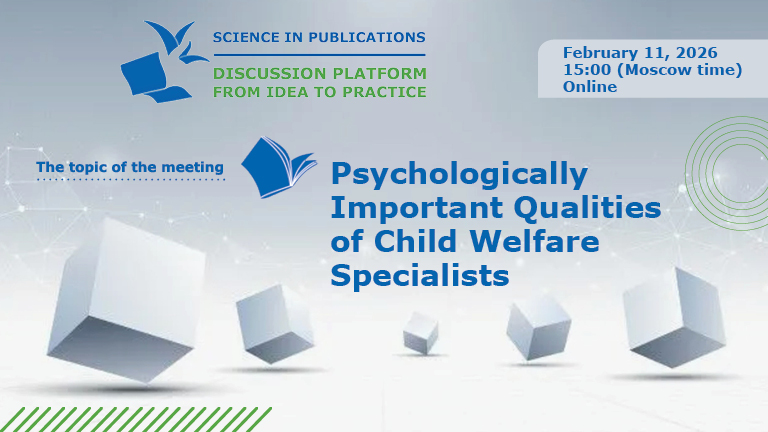
On February 11, 2026, at 15:00 (Moscow time), a webinar titled “Psychologically Important Qualities of Child Welfare Specialists” will be held as part of the discussion platform “Science in Publications: From Idea to Practice”, with the support of the MSUPE Boiling Point venue.
A psychogram is a comprehensive psychodiagnostic description of a specialist’s psychologically important qualities, reflecting the personal, emotional, cognitive, and behavioral characteristics required for the effective performance of professional duties.
During the webinar, participants will become acquainted with the results of a study involving 2036 specialists and managers of child welfare services, as well as with a six-factor model of psychologically important qualities that has demonstrated validity and reliability and represents not a theoretical construct but a practical tool for personnel work. The model includes such qualities as client-centered values and professionalism; analytical abilities; skills in interacting with clients; clear and confident speech facilitating effective communication; psychological resilience; and responsibility and persistence in achieving goals. Predictors of these qualities were also identified, indicators whose development makes it possible to forecast the effectiveness of specialists’ professional performance.
The developed model demonstrates the significant predictive power of overall emotional intelligence, subjective well-being, procedural self-efficacy, cognitive responses to uncertainty, and intrinsic motivation. It makes it possible to design more effective methods for training and supporting child welfare specialists, taking into account the key psychological and emotional aspects of their work.
We invite you to join the discussion and share your views on the following questions:
-
What is the structure of psychologically important qualities that reflects the specifics of child welfare specialists’ work?
-
What are the predictors of these qualities, and how do they influence professional success?
Speaker:
Veronika N. Oslon, Candidate of Sciences (Psychology), Professor at the L.F. Obukhova Department of Developmental Psychology, Faculty of Educational Psychology, Moscow State University of Psychology and Education.
The schedule of webinars and meetings of the “Science in Publications” project for 2025–2026 is available here.
Materials for discussion:
- Oslon, V.N., Odintsova, M.A., Semya, G.V., Kolesnikova, U.V. (2025). The Structure of Professionally Important Qualities of Child Welfare Specialists and an Analysis of Influencing Factors. Psychological Science and Education, 30(6), 21–35. https://doi.org/10.17759/pse.2025300602
- Oslon, V.N., Odintsova, M.A., Semya, G.V., Kolesnikova, U.V., Akkuratova, A.P. The Russian Version of the Social Worker Self-Efficacy Scale for Child Welfare Specialists: Psychometric Testing and Prospects for Use. Organizational Psychology. [In press].