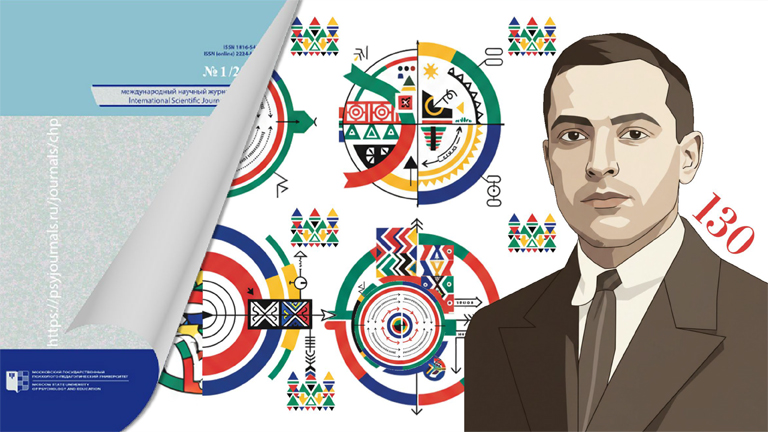
A new issue of the journal Cultural-Historical Psychology (2026, Vol. 22, No. 1) has been published under the guest editorship of Prof. V.V. Rubtsov and Prof. J. Hardman. The issue is dedicated to the 130th anniversary of L.S. Vygotsky and focuses on rethinking contemporary directions in the development of cultural-historical psychology within the framework of international scholarly dialogue, particularly between the research traditions of Russia and the Republic of South Africa.
In their editorial, the guest editors emphasise that the aim of the issue is not only to revisit Vygotsky’s legacy, but also to identify those trajectories in the development of cultural-historical psychology that are acquiring practical relevance and shaping responses to pressing challenges in education and the social sphere. The issue is organised as an integrated scholarly composition comprising four interrelated sections: theoretical and methodological studies, research conducted within the framework of cultural-historical psychology, contributions on professional training, and international perspectives on the development of the cultural-historical approach.
A distinctive feature of the issue is the publication of previously unpublished materials by L.S. Vygotsky—namely, a transcript of his 1931 speech, in which the ideas of “psychological physiology” are articulated for the first time and the concept of extracerebral connections of higher psychological functions is introduced. The theoretical section is further enriched by contemporary contributions that revisit key concepts of cultural-historical psychology, such as reflection and perezhivanie, which are examined as central mechanisms of development and as analytical tools for educational and psychotherapeutic practice.
The studies presented in the issue demonstrate how the conceptual apparatus of cultural-historical psychology functions as both a theoretical foundation and an analytical framework in contemporary empirical research. These contributions examine, in particular, the role of perezhivanie in preschool play activity, as well as the mechanisms underlying the development of thinking in adolescents engaged in joint activity mediated by cultural tools, including the use of video materials. The findings indicate that such forms of interaction activate communicative and reflexive processes that support the development of understanding and problem-solving.
A separate section is devoted to issues of professional training and the implementation of the cultural-historical approach in educational practice. The focus is placed on models of teachers’ professional thinking and on the development of activity-based pedagogical technologies. Particular attention is given to the risks associated with the oversimplified or inaccurate use of key concepts of cultural-historical psychology. It is emphasised that a superficial understanding of such notions as the zone of proximal development, mediation, and scaffolding may not only reduce the effectiveness of educational practices, but also distort the underlying logic of the cultural-historical approach.
The international section reflects the development of cultural-historical psychology as a global research programme. It includes contributions addressing the integration of Vygotsky’s and Bronfenbrenner’s theoretical perspectives in the study of youth resilience, as well as materials synthesising the outcomes of international academic events, including the Beijing Symposium on special education. These studies demonstrate that, while retaining its conceptual core, the cultural-historical approach continues to evolve across diverse cultural and educational contexts.
As noted by the editors, this issue inaugurates a new series of regional thematic issues of the journal, aimed at analysing the development of cultural-historical psychology across different countries and scholarly traditions. The dialogue between Russian and South African research communities presented in this issue highlights both the stability of the theoretical foundations of the approach and the emergence of new directions for its development in the context of contemporary social challenges.