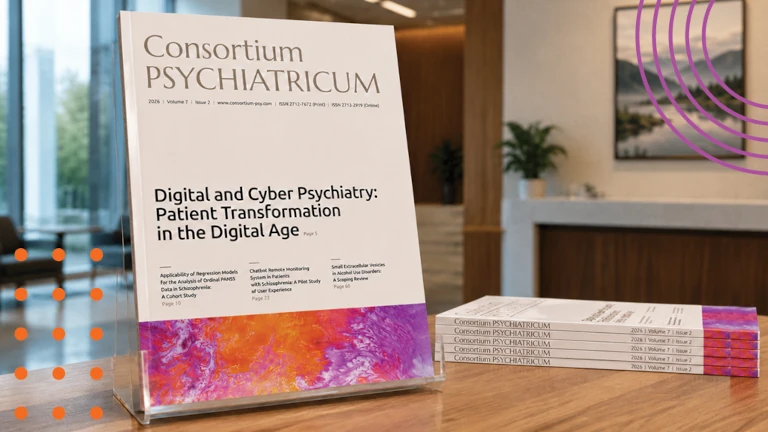
The second issue of Consortium Psychiatricum for 2026 has been published. Read in the new issue:
How to score the PANSS — researchers from St. Petersburg compared methods for analyzing the principal scale used to assess schizophrenia and proposed new approaches to the statistical analysis of data.
A digital assistant — Sechenov University developed and tested Russia’s first chatbot for patients with schizophrenia. Participants gave positive feedback on the remote remission monitoring system but noted that it included too many questions and lacked personalized reminders.
Hidden hunger — Moscow researchers found that food selectivity in children with autism spectrum disorders may serve as a marker of somatic health problems, with most of these children developing vitamin D and B12 deficiencies.
Art therapy for anxiety — Malaysian researchers conducted an experiment with university students: one group colored mandalas, while the other colored blank circles. Anxiety decreased in both groups, but alpha-wave activity (an indicator of deep relaxation) increased only among those who worked with mandalas.
What vesicles reveal — a review by researchers from Sechenov University showed that the composition of extracellular vesicles in patients with addiction differs from that of healthy individuals.
AI in psychiatry: doctor or algorithm? Specialists from the Bekhterev Center analyzed a key paradox of the digital age: the Internet and social media can both contribute to mental health disorders and offer digital “pills” for their treatment.
We wish you an enjoyable and informative read!