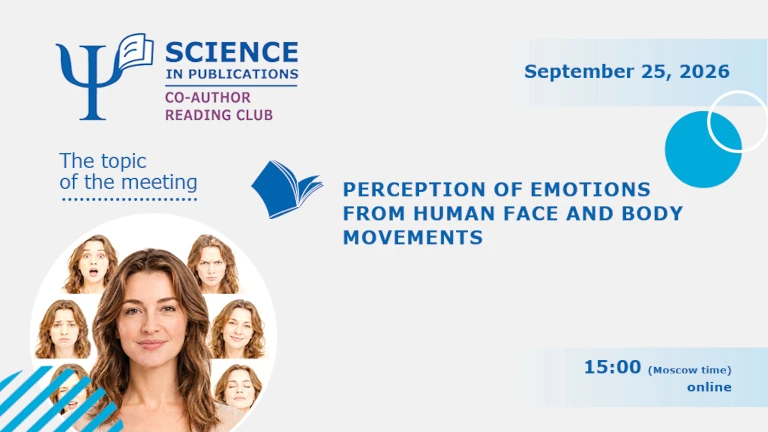
On September 25, 2026, with the support of the MSUPE Boiling Point, a meeting of the “Co-Author Reading” Readers’ Club as part of the “Science in Publications” series will be held on the topic “Perception of Emotions from Human Face and Body Movements.”
When perceiving another person’s emotions, we rely not only on their face but also on body movements — posture, gestures, gait, and the speed and nature of movements. What exactly enables us to recognize a person’s emotional state: body form, movement dynamics, or a combination of the two? Does this work in the same way for different emotions?
At the webinar, we will discuss the results of a series of studies examining the role of form and movement in recognizing emotions from nonverbal behavior.
In particular, the studies showed that the contribution of form and movement depends on the emotion category:
- for joy, form and context play a decisive role;
- for disgust and disappointment, both form and movement are important;
- for fear and boredom, body cues, but not facial cues, are significant;
- for arousal, kinematics plays a key role;
- for calmness, the relationship between facial and bodily information is important.
The webinar will be useful for anyone interested in the psychology of emotions and perception, nonverbal communication, and contemporary methods of behavioral research. You will learn how we recognize emotions from body movements, understand why some emotions are easily recognized from movement while others are not, discuss the practical implications of the findings for psychology, communication, and technology, and become acquainted with a contemporary experimental approach to studying emotions.
Questions for discussion
- Why are some emotions recognized from movement better than others?
- What is more important for emotion recognition — body form, kinematics, or situational context?
- Why does recognition accuracy change when the frame rate is reduced?
- Which emotions are particularly dependent on facial information?
- Can such data be used to develop automatic emotion recognition systems?
- What are the limitations of studies using dynamic point-light displays?
Speaker:
Olga A. Korolkova, Candidate of Science (Psychology), Associate Professor, Leading Researcher at the Institute of Experimental Psychology, Moscow State University of Psychology and Education.
Materials for preliminary reading:
Korolkova, O.A. (2024). Perception of a Communicant’s Emotional State Based on Information about Their Facial and Bodily Expressions. Experimental Psychology, 17(4), 28–43. https://doi.org/10.17759/exppsy.2024170402
Korolkova, O.A. (2025). Perception of a Person’s Emotional State When Transforming Video Images of Their Body. Experimental Psychology, 18(4), 64–79. https://doi.org/10.17759/exppsy.2025180404
For questions about the meeting, please contact Anna V. Shekhorina at shehorinaav@mgppu.ru.
Date and time: September 25, 2026 (Wednesday), 3:00 p.m. (Moscow time). The meeting will be held online via MTS Link.
The Club meeting is held with the support of the MSUPE Boiling Point.
The curator of the “Co-Author Reading” Readers’ Club meetings is Anna A. Shvedovskaya, Candidate of Science (Psychology), Head of the Department of Information and Publishing Projects, Associate Professor, Department of Developmental Psychology named after Professor L.F. Obukhova, Faculty of Psychology of Education, Moscow State University of Psychology and Education.
Calendar of webinars and meetings of the “Science in Publications” project for 2026.