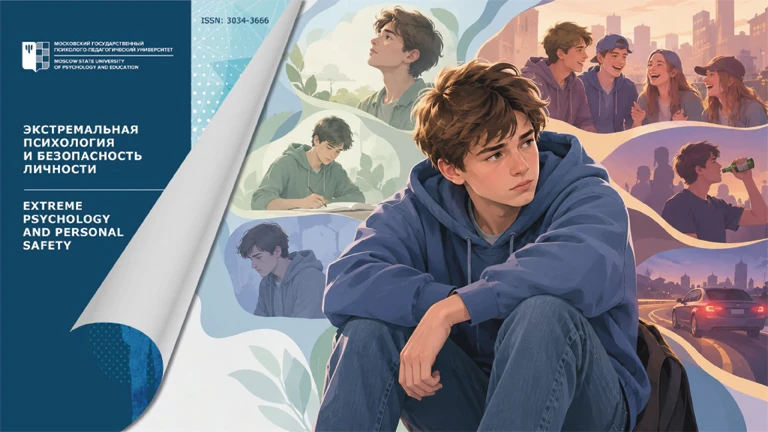
A new thematic issue of the journal "Extreme Psychology and Personal Safety" (No. 3, 2026) has been published. The theme of the issue is "Unsafe Behavior".
Issue Thematic Editor Tatiana N. Berezina, Doctor of Science (Psychology), Professor, Department of Scientific Foundations of Extreme Psychology, Faculty of Extreme Psychology.
The key criterion for classifying behavior as unsafe is the performance of actions that violate safety requirements. In a broad sense, unsafe behavior encompasses any actions that threaten an individual’s psychological safety; in a narrow sense, from the perspective of behavioral psychology, it refers to actions that increase the likelihood of accidents, injuries, and other adverse consequences for life and health.
The thematic issue opens with a foreword by the thematic editor, Tatiana N. Berezina, Doctor of Science (Psychology), Professor, who outlines the main areas of research on unsafe behavior and personal psychological safety and presents the articles in the issue according to these areas.
The first study presented in the "Psychology of Emergency Situations" section is an article by T.N. Berezina and A.S. Tsvetkova examining the relationship between personality characteristics and a predisposition to unsafe behavior. The authors use a naturalistic simulation of a high-risk situation under conditions of a declared terrorist threat. The findings indicate that respondents’ choice of unsafe behavior patterns is primarily influenced by situational emotional factors: anger increases the predisposition to unsafe behavior, whereas a sense of calmness, conversely, reduces it.
Continuing the focus on applied research, the next section turns to technologies supporting performance under extreme conditions. The "Technologies for Supporting Performance under Extreme Conditions" section features articles by both established and early-career researchers. A.V. Kokurin and D.V. Abdrakhmanova show how psychological and educational interventions aimed at developing critical thinking, self-regulation skills, and cyberthreat recognition contribute to increasing cadets’ psychological resilience to destructive informational and psychological influences. Researchers from Belgorod, A.O. Sharapov and O.I. Shekh, present an integrative model of psychological support for military personnel in large-scale combat operations: "Three Contours — Four Principles — Five Protocols". Early-career researchers A.A. Ukolova and K.E. Buzanov present a review of the scientific literature on the use of virtual reality technologies for the psychological prevention of unsafe behavior.
While these studies focus primarily on prevention and psychological support, the next section turns to the experience of providing psychological assistance to those who have already encountered extreme situations. The "Psychological Assistance in Extreme Situations" section features an article by a team of authors from St. Petersburg State University — G.V. Moskalenko, A.A. Fomina, V.D. Dotdaeva, and A.I. Zhaldak — "Hardiness and Psychological Resources of Family Members of Participants in the Special Military Operation". The findings can be used to provide support to the families of participants in the special military operation.
From psychological assistance in extreme situations, the issue moves to the broader social context in which unsafe behavior occurs. The "Social and Political Psychology of Safety" section features articles by Russian and international authors. Laggoune Salah from Abdelhamid Mehri University Constantine 2 (Algeria), in the article "Toxic leadership and counterproductive work behavior: the moderating role of psychological safety and team cohesion", discusses toxic leadership and its influence on the emergence of unsafe behavior in the workplace. Russian researchers V.I. Ekimova and N.D. Drizovskaya examine adolescents’ deviant behavior as a factor of unsafe behavior.
The social context of unsafe behavior naturally leads to the environment in which basic personal attitudes are formed — the educational environment. The "Psychological Safety of the Educational Environment" section includes a study by A.V. Timokhin and G.V. Gnezdilov, "An Integrative Theoretical Model for Studying the Psychological Safety of University Teachers".
Concluding the overview of the thematic sections, we turn to a study that falls outside the main theme of the issue. The "Extreme Psychology" section features an article by E.V. Khramov and E.Yu. Litvinova, "Body Practices in Psychological Rehabilitation for PTSD (A Review of International Research)".
The articles presented in the issue are united by a common theme: unsafe behavior and personal psychological safety in extreme, professional, and everyday settings. The issue demonstrates an interdisciplinary approach to unsafe behavior, examining it at the intersection of behavioral psychology, the psychology of extreme situations, educational psychology, and social psychology. The unifying principle is the understanding that unsafe behavior is not an isolated phenomenon but the result of the interaction of emotional, personality, environmental, and sociocultural factors and therefore requires comprehensive, multilevel measures of prevention and support.
The issue includes studies conducted under Russian Science Foundation grant No. 25-28-02920, "Psychological Prevention of Accidents in Extreme Situations: Development of a Diagnostic VR Model for Assessing Predisposition to Unsafe Behavior", as well as materials from related research.
Listen to episodes of the PsyJournals LIVE podcast in which the authors discuss their research:
Alisa A. Ukolova on virtual reality technologies for the psychological prevention of unsafe behavior
Diana V. Abdrakhmanova on the implementation of psychological and educational interventions that contribute to increasing cadets’ psychological resilience to destructive informational and psychological influences
Natalya D. Drizovskaya on the social identity of adolescents with deviant behavior: theoretical approaches and research directions
The full issue is available on the PsyJournals.ru portal.