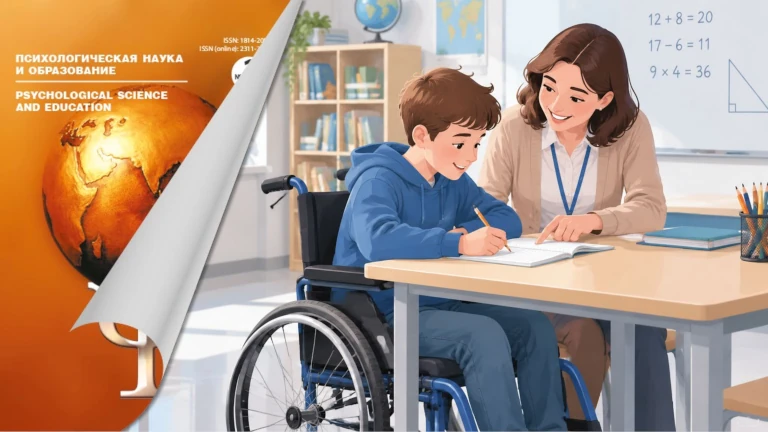
How can inclusive education be ensured at every stage? Which psychological and educational practices have scientifically demonstrated effectiveness, and how can their outcomes be evaluated? These questions are central to the fifth issue of “Psychological Science and Education” (No. 5, 2026), devoted to the theme “Inclusivity in Education at Every Stage: Evidence-Based Practices and Approaches”. The special issue marks the 130th anniversary of the birth of Lev Semyonovich Vygotsky. His ideas concerning the zone of proximal development, the social situation of development, and human compensatory capacities are examined in the context of contemporary approaches to inclusive education. The guest editors of the issue are Vitaly Vladimirovich Rubtsov and Svetlana Vladimirovna Alekhina.
The central focus of the issue is the scientific foundation and evidence-based effectiveness of inclusive practices. The authors address their development, verification, and implementation at different levels of education.
M.G. Sorokova and O.I. Leonova present a procedure for verifying psychological and educational programs, while T.G. Podushkina and S.V. Gani propose a three-stage model for evaluating social practices, from selection to expert assessment. These studies address one of the pressing challenges in contemporary education: establishing a scientific basis for evaluating the approaches and programs used in educational practice.
The theoretical foundations of inclusive education are explored in an article by V.V. Rubtsov, S.V. Alekhina, and A.V. Konokotin, which examines the scientific legacy of L.S. Vygotsky. An international perspective is provided by researchers from Brazil and India, who explore human development in educational settings and the philosophical foundations of inclusion.
A substantial proportion of the articles address practical aspects of psychological and educational support for children with special educational needs. The topics covered include approaches to supporting students with autism spectrum disorder, the organization of inclusive environments in hospital schools (S.V. Sharikov, A.G. Rumyantsev), and the development of communication skills and self-regulation among schoolchildren with developmental delays.
The “Developmental Psychology” section also presents South African experience in ensuring access to education through a cultural-historical analysis of mathematics teaching.
Inclusion in higher and vocational education is another area of research covered in the issue. O.N. Vericheva, Du Yupeng, and Qin Lidong examine the experience of an international inclusive winter school as an educational format that promotes student academic mobility.
A.D. Timoshenko and O.L. Bantserova address the issue of academic resilience among students with visual impairments by analyzing the spatial and environmental conditions of inclusive schools. Their study demonstrates the importance of an interdisciplinary approach to examining educational environments.
The issue concludes with a discussion commentary by T.V. Akhutina, inviting further debate on the theoretical foundations and practical solutions in inclusive education.
Listen to the issue’s authors on the PsyJournals LIVE podcast:
Daniel Novas Gomes Pereira shared the findings of his research on the (trans)formation and psychological uniqueness of L.S. Vygotsky’s legacy in inclusive education in Brazil.
Sandeep Kumar discussed the psychological and philosophical context of Vygotsky’s ideas and their role in inclusive education.
Olga Nikolaevna Vericheva presented her research on the international inclusive school as an innovative educational format for promoting student academic mobility in higher education.
Anna Dmitrievna Timoshenko discussed the findings of a narrative review of the spatial and environmental conditions supporting academic resilience among students with visual impairments in inclusive schools.