Introduction
The Laboratory of Neuropsychology at the Faculty of Psychology, Lomonosov Moscow State University, holds A.R. Luria’s archive, which includes a folder containing case materials dated 1929—1934 and related to a patient referred to as Avt. These materials were partially described in a study by T.V. Akhutina and A.R. Agris, which focused on Luria’s analysis of semantic aphasia (Akhutina & Agris, 2018).
Most records from the 1930s have not survived, making this folder a valuable source for the history of neuropsychology. Among its contents is a record of the Rorschach test administered to patient Avt. on February 14, 1933 — the only known instance of A.R. Luria using this test. In this article, we present and analyze this record and review Luria’s other references to the Rorschach test in his work.
The beginning of the study of aphasia in A.R. Luria’s works
Beginning in the mid-1920s, L.S. Vygotsky and A.R. Luria investigated higher mental functions. In his 1930 report On Psychological Systems (October 9), Vygotsky outlined two major research trajectories — genetic and pathological (Vygotsky, 1982, p. 109).
In 1926, Luria began working at the Clinic of Nervous Diseases at the 1st Moscow State University, where he initially studied behavioral mechanisms in neurosis using the method of conjugated motor reactions. He was later joined by Vygotsky. Both researchers focused on the role of speech in the behavior of patients with organic brain damage, as well as in the development of children with disabilities (Luria, 1982).
Vygotsky believed that language played a central role in the development of higher mental functions. Luria later wrote: “He wanted to show that aphasia affected specific aspects of mediated cognitive activity. Although the hypotheses related to aphasia were somewhat naive, the underlying idea— that a sound psychological theory is needed to explain behavioral disturbances in neurological patients — became foundational for the development of neuropsychology in the USSR” (Luria, 1982, p. 43).
The examination of patient Avt.
The materials concerning patient Avt. focused on speech analysis and the development of methods for its assessment. They included trials conducted in 1929 by clinic physicians, which examined neurological status, impairments in vision, hearing, motor function, and psychological profiling according to G.I. Rossolimo. These assessments followed a research protocol used at the clinic to evaluate mental status (The Course of Nervous Diseases, 1930). In his scientific autobiography, A.R. Luria wrote: “At the Moscow Institute of Neurology named after G.I. Rossolimo, there were a number of tests for clinical diagnosis, similar to the later Wechsler scales. However, this battery of tests failed to explain the psychological mechanisms disrupted by neurological disorders” (Luria, 1982, p. 43).
Between May 27 and July 1, 1929, Luria conducted multiple daily assessments of patient Avt. to study memory, thinking, and speech. Given the patient’s knowledge of several languages, Luria also examined his ability to interpret texts in German and English and to understand grammatical structures.
In late winter of 1933, Luria resumed work with patient Avt., aiming to experimentally validate L.S. Vygotsky’s theoretical approach. A unique document preserved in the archive — a detailed individual examination plan — is presented here for the first time(see Table 1). As in previous studies, this examination focused on the patient’s speech functions (see also Akhutina & Agris, 2018).
Luria began the new series of assessments in February 1933, which included the Rorschach test and analysis of nonsensical words. Until March, he conducted testing sessions several times a week; later, the frequency was reduced to weekly meetings. Due to the patient’s deteriorating condition and increasing fatigue, Luria eventually limited the sessions to no more than two or three in total.
Avt’s anamnesis
Diagnosis: neurosyphilis, amnesic aphasia, unilateral hemianopia.
Complaints: amnestic-type speech impairment, unilateral visual deficit.
Patient Avt. was born in 1885 into a well-off, intact family with no reported history of neurological or psychiatric disorders. He completed secondary education at a real school, enrolled in the university’s law faculty, but was expelled after 1.5 years due to involvement in revolutionary activities. He spent two years in England working at a textile enterprise. Upon returning, he enrolled in the economics department of the Moscow Commercial Institute. After graduation, he worked as an economist in the textile industry. Both his studies and work came easily to him, and he was regarded as a capable, energetic individual. He was sociable, enjoyed travel, and was fluent in English, German, and French.
He married for the first time at the age of 25, and remarried in 1923. His son, born from the second marriage, was three and a half years old and physically weak, likely due to congenital syphilis.
Avt. was diagnosed with neurosyphilis in 1925 and began treatment at the Clinic of Nervous Diseases at the 1st Moscow State University in the winter of 1929.
As the illness progressed, he developed irritability, emotional lability, impatience, suggestibility, shyness, excessive helpfulness, and frequent underestimation of his condition — symptoms commonly associated with neurosyphilis (Gilyarovsky, 1942).
In 1929, Luria described his speech as follows: “Agrammatism, paraphasia, word-finding difficulties, and impaired comprehension despite intact hearing
Table 1. Research Design Avt.
|
1. Description of agrammatism a. Description of the grammatical structure of the spontaneous speech b. Description of an agrammatic voluntary speech c. Field of agrammatism1 d. Law of agrammatism (a phasic and semic agrammatism)2 |
1a. Semic sphere, b. Syntactic sphere 2a. Experiment on shifting the words, and accents b. Experiment on the provocation to a complex (text, syllogism, analogy) |
|
2. Functional effects of agrammatism a. Misunderstanding of the relations3 b. Inability to draw the conclusion from the relations4 |
3a. Absolute assessment – the brother of the father / more and less b. Delivery of the phasic sequence 4a. Syllogism b. Bert’s reasoning (who of them is the most…) |
|
3. Towards the explanation of agrammatism. Hypotheses. 1. There is only an immediate speech directed to an object but there is no possibility of directing speech to speech = another place of speech in consciousness. 2. This is connected to the impairment of an internal speech that gives the possibility for a simultaneous bifurcation = an internal speech. 3. This leads to the involuntary speech and to the impairment of its voluntary construction. a. Involuntary and voluntary constructions of the speech5 |
5a. Experiment with the construction of the phrase b. Experiment with repetition of phrases (the voluntary perseveration) c. Rorschach experiment (the voluntary composition of phrases) d. Composition and writing under a different motivation |
|
b. Awareness of the meaning and awareness of the thought (phrase) [A comparative research of understanding the speech structure (agrammatism)].6 with: 1. Immediate operations (usage)7 2. Conscious operations (realisation) |
6a. Experiment with a fragment (understanding — the analysis of thought — grammatical analysis) 7b. Experiment with a figurative meaning (understanding and analysis) |
|
c. Inner speech: understanding the hidden components of speech8 note: 1. [Understanding the phrases with hidden elements 2. Transferring the correspondence to highlighted and hidden features] [Does the subject treat our task as new?] |
8c. Phrases with a hidden generation d. Number series e. Analogies |
(he could not understand long or complex questions), as well as disturbances in abstract thinking and pronounced deficits in auditory rhythm. Notably, there was a complete inability to comprehend foreign languages (English, German), inaccurate reading in those languages, but with surprisingly good pronunciation of isolated words.”
According to Akhutina and Agris (2018), neuropsychological assessment revealed general inertia, reduced insight into his illness, disorientation in everyday situations, emotional instability, and personality changes more consistent with anterior and/or subcortical brain damage (possibly reflecting diffuse cerebral symptoms) than with localized lesions in the parietal-occipital region (TPO-zone). These impairments may have stemmed not only from local damage to the TPO zone and resulting semantic aphasia but also from other foci or diffuse dysfunctions in brain activity.
The Rorschach test performed by patient Avt.
Between 1923 and 1936, the Rorschach test was primarily used in Soviet psychological research as a tool for studying fantasy and imagination (Nikonova & Rupchev, 2024). A.R. Luria incorporated the test into his diagnostic work to investigate speech functions, particularly the patient’s ability to voluntarily construct phrases.
The original records are presented in Figure 1, and Table 2 provides a transcription of the patient’s responses. This transcription is based on both a handwritten protocol and its typewritten copy, which contain minor discrepancies.
A.R. Luria took cards I, III, and VI from the 10 test cards for the research; perhaps, that choice of the cards was associated with the patient’s fatigue.
Deciphering the record of the Rorschach
test performance
The transcript is based on a handwritten version of the test records, which was later supplemented and verified with a typewritten copy. The numbering of individual responses and the underlining of questions and phrases were added by A.R. Luria, whose remarks are marked with underlining. Footnotes in the text indicate where Luria’s comments are inserted, while the patient’s actions are noted in parentheses. The authors also provide commentary on Avt.’s responses in the notes. The test is interpreted according to the Exner scoring system (Exner, 1997). According to Luria, the spatial localization of responses on the inkblots was only partially recorded; in our analysis, we attempt to reconstruct potential localization based on the available data.
Discussion
The medical history of patient Avt. reflects the impact of the syphilis epidemic that spread in the early 1920s, leading to a rise in cases of aphasia. He was diagnosed with its late-stage form, accompanied by progressive dementia, personality changes, apathy, and reduced social engagement (Zilberberg et al., 2019).
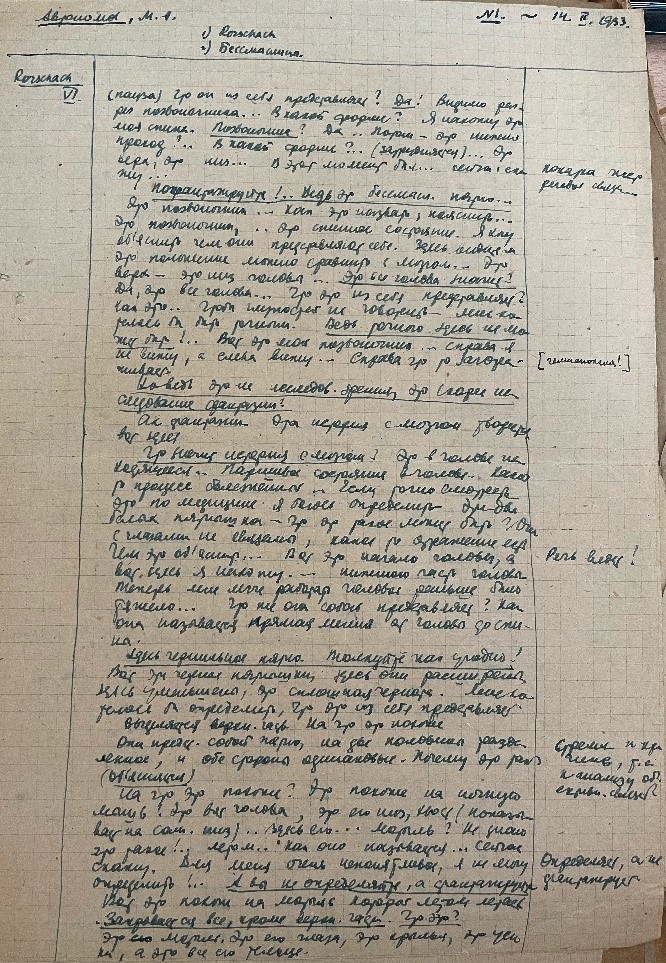
|
Inkblot card |
Patient’s response and clarifying questions by the examiner |
Comment by A.R. Luria |
|||||||
|
1. Some pause. What does it represent? Yes. Seemingly, this is a section of the spine... in what form? I find — this is my back. Spine? Yes... then — this is a line transition... in what form? (Hesitating). This is the top, this is the bottom. At that moment, there was... I’ll tell you now1 |
1 An attempt at a purely verbal communication |
||||||||
|
Note: A.R. Luria noted a significant pause before the patient responded. Although the first verbal response followed shortly thereafter, it was egocentric in nature, reflecting a tendency toward personification (PER) and a fixation on bodily symptoms (An), both according to the Exner system. These features may suggest elements of autistic thinking commonly associated with schizophrenia. The patient then reacted to the symmetry of the inkblots, which, as Luria observed, may reflect heightened anxiety and self-doubt. Repetition of the examiner’s question may indicate mild perseveration or the activation of internal speech processes. The patient had difficulty providing a coherent and concise explanation of what he perceived in the image. |
|||||||||
|
2. Rephrase. Since this is a meaningless spot... this is the spine... what can I call it? Shall I explain? This is the spine. This is the spinal (?) status. I want to explain what they imagine. Here, you see — this position can be compared to the brain. This is the top, this is the bottom of the head. Is it the whole head, then? Yes, this is the head, all... what it represents... How it is... In order not to tell stupid things — I would like to be precise. After all, there cannot be any precise thing here... This is my spine. — I see nothing on the right but I see on the left2. Something obscures on the right |
2 [Hemianopia!] |
||||||||
|
Note: The patient’s response gradually evolves and becomes more elaborate. Frequent questions and fragmented speech suggest a general cognitive decline and reduced performance. His difficulty in producing a complete response reflects overall uncertainty and impaired verbal formulation. A.R. Luria often simplified the task instructions to assist the patient. Although the response developed further, it remained disorganized. At one point, the patient used a neologism — “spinal status” — possibly as a compensatory strategy for anomia or as an indication of autistic-type thinking. Notably, the target word “spine” had already been used earlier. The response then shifted to a second version, identifying the image as “a head with a spine,” indicating the brain. However, the patient lacked confidence and seemed driven to revise his answer. A sense of failure, partial awareness of his deficit, and underlying cognitive impairment appeared to prevent him from completing and finalizing this second version. |
|||||||||
|
3. But this is not the research of vision, this is rather the research of fantasy. Ah, fantasy. This story with the brain is happening right here. What does the story with the brain mean? It is in the head being... a lousy state in the head. There is some process painful. If to look properly, — I am afraid to determine it according to the medicine. They are two white spots, what it might be. They are not associated with the eyes, there is some kind of reflection3. What can I explain this with... this is the beginning of the head, and here I find the lower part of the head. Now it is easy for me to work with my head, it has been hard before. What does it represent? What is it called, a straight line from the head to the back |
3 He is speaking! |
||||||||
|
Note: To reduce the complexity of the task, A.R. Luria guides the patient toward a familiar response involving anatomical content (An), now combined with elements of morbidity (MOR). This combination points to a hypochondriacal projection and a subjective awareness of his impaired condition. The patient’s response reflects a general projection of somatic discomfort (e.g., “a lousy state”) and possibly dysphoria, evidenced by occasional swearing during the session. Avt. attempts to mitigate his sense of failure (e.g., “... I’m afraid to determine it according to the medicine”) by compensating with exaggerated precision — focusing on minor details (DdS), though this effort remains ineffective. The progression of the response is disrupted; perseveration and cognitive viscosity prevent him from completing the thought. He becomes excessively meticulous, producing a deviant response (DR1), which resembles loosening of associations. In response, Luria encourages greater spontaneity and appeals to the patient’s imagination. He observes that Avt. engages with the test rigidly, either trying to guess the “correct” answer or provide an exact one. This rigid approach simplifies his responses in an overly schematic way. The perceptual strategy follows a bottom-up pattern, moving from details to the overall form, which may stem from actual disturbances in the visual system. Avt. continues to discover new features in the inkblot, becomes distracted, and ultimately fails to complete the interpretive hypothesis. |
|||||||||
|
4. Here is an inkblot here. Interpret it as you wish. Those black spots, here they are widened, here they are reduced, it is a solid blackness. I would like to determine what this represent. (The upper part is separated). What is it like? They represent a stain4 divided into two halves and both sides are the same. Why is it so? It can be explained |
4 He strives for an analysis of the causes, i.e. an analysis of the objective connection |
||||||||
|
Note: A.R. Luria further simplifies the instruction, which the patient accepts by repeating the suggested term (“inkblots”), possibly displaying echolalia. The patient then reacts to the achromatic color of the blot (C’F), which may represent a “shock” response, reflecting subdepressive affect, emotional blunting, or melancholic states. The form quality remains poor and ill-defined; the image (“spot”) lacks any clear structural interpretation (Wv), suggesting a diminished capacity for perceptual organization and analytic—synthetic processing. These features point to cognitive dysfunction and signs of intellectual immaturity. |
|||||||||
|
5. What does it look like? It looks like a night mouse. This is its head, this is its bottom, its tail (he points to the very bottom) here is its... bloodworm, I don’t know what it is... in the summer... what is it called. I’ll tell now. It’s very unclear to me, I can’t define it. You don’t define it but fantasize5 |
5 He define, does not fantasize |
||||||||
|
Note: For the first time, the patient provides a brief and singular response — “a night mouse” — which resembles a verbal paraphasia (substituting “bat” with a semantically related but incorrect term) or possibly a mnemonic, substitutive confabulation (replacing “bat” with “night”). However, his naming of the image lacks stability, as he later shifts the interpretation to “bloodworm” or hesitates with the phrase “what is it called?”. At this point, A.R. Luria adopts a more directive approach, instructing the patient: “You don’t define it but fantasize,” thereby deliberately encouraging figurative and imaginative thinking. |
|||||||||
|
6. This one looks like a bloodworm that flies in the summer (he covers everything except the upper part). What is this? This is a bloodworm. These are its eyes, these are its wings, these are its antennae, and this is its entire body |
|||||||||
|
Note: Avt. provides a complete response. However, perceiving the full stimulus field (the entire blot) appears challenging, likely due to underlying visual deficits, which hinder object-based interpretation. When the visual field is narrowed or when attention is directed to a smaller portion of the blot, the patient begins to produce clearer and more coherent responses. |
|||||||||
|
Table VI 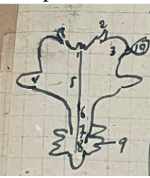
|
7. (the table AR is inverted again) This is my throat (1), these are collars (2), these are my shoulders (3), this is similar to my arms (4). This is a chest divided in half, two chests... this is already the spine going through such a state. This is my lower back (6). This is the lower hole, apparently (7). These are my legs (8) (points to the bottom of the table), this is what my legs are made up of together (9). And this I don’t know, at all, why they are here, what they coincide with |
6 Then he continues speaking and completely stops distinguishing corrections. He speaks into the table. 7 leeres sprach—phantasieren (an empty language of fantasy, Ger.) |
|||||||
|
Note: The patient shows signs of fatigue. He sequentially identifies fragments of a larger object (e.g., parts of a human figure), but fails to integrate them into a coherent whole. This fragmentation, combined with impaired cognitive control, may account for crude anatomical interpretations that would typically be suppressed or censored in socially normative responses. His replies also exhibit recurring self-referential themes, a pattern commonly observed in thought disturbances associated with both syphilitic dementia and schizophrenia. |
|||||||||
|
8. And what is this (10)? This are identical spots — this is the position of the eyes. 9. And what is this (there is a white spot next to 10)? And it is below, I will tell you now. To my mind, this is the upper part... 10. How do you do this? I do it on myself, I start from the head and to the end. I start with the brain, here it should be on top, it is not depicted here, and then there should be the neck, the back. And these spots — you ask... so they well... so that they look like something? How is that possible? |
|||||||||
|
Note: Avt. attempts to provide an explanation, once again reverting to self-referential content and earlier imagery from Table I (e.g., “the brain,” “a head”). However, he fails to follow the instruction, then appears to recall it by echoing the experimenter’s guidance — only to confuse himself again in the process. |
|||||||||
|
Illegibly Clowns 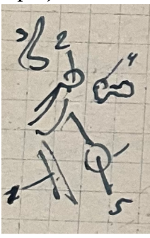
|
11. At first impression? At first impression? There is some kind of caricature here — it represents two animals — though no8, not animals but two people who want to create — they want to seek something hidden, this is a nest and this is a nest — they are looking for something… a bloodworm… Why are they red (in the middle)? Why is it made? This is a caricature to clarify some9 — a caricature for… this is unclear. I feel and cannot explain. There was a similar story in Germany. These are newly released caricatures creates for persons, I will tell you now… |
8 NB leeres sprachphantasieren 9 NB leeres sprachphantasieren (an empty language of fantasy, Ger.) |
|||||||
|
Note: When the examiner repeats the question, the patient’s response once again raises the hypothesis of echolalia, rather than suggesting a simple deficit in auditory-verbal memory. Nevertheless, Avt. promptly provides a well-formed response featuring human figures (H), describing it as “a caricature.” The interpretation is based on specific details (D9) and evolves — moving from animals to people — while also projecting movement (M), which indicates active ideation. The response briefly takes on a combinatorial character (e.g., “people and a nest”), but is interrupted by the re-emergence of a previous association (“a bloodworm”), indicating a perseverative substitution of a past impression for the current stimulus. Although formally adequate, the response is not sustained. As Zeigarnik observed in patients with organic brain damage, such individuals may demonstrate brief episodes of intact cognitive function (“flashes”) within an overall dementing state. Avt. attempts to justify his interpretation using personal memory rather than through direct perceptual analysis of the blot (area D), suggesting a shift from stimulus-bound reasoning to autobiographical association. |
|||||||||
|
12. And what is that? (1) — Legs. And that? (2) — A head And this? (3)10 — A monkey that is inverted. And that? (4) What is the name of the one that flies, or it is rather — a tie 11 |
10 At the direction! 11 Illegibly |
||||||||
|
Note: A.R. Luria offers analysing and substantiating the image in parts. A new response is given (“a monkey”) to the side details (D2). The inverted objects may be the consequence of neurosyphilis. Avt. suffers difficulties with naming (“a butterfly”), replacing the unnamed object with a similar one according to its shape (“a tie”). |
|||||||||
|
13. Now identify it by yourself. They wanted to create some kind of a game here. It’s good here (5). In this nest, they want to take out some things, or they hide them... and at the same time... they want to take it out from there, maybe chicks and pool them out from here... they are two monkeys that want to create a game. |
|||||||||
|
Note: the concept (combination) of the response develops (“create a game”) but the images interact unrealistically, the answer is realised into a nun-crude fabulised combination (FABCOM1) — an absurd combination of incompatible objects (monkeys—a caricature—game—a toy—a nest) — indicating the decrease in clarity, logic and the consistency of thinking. |
|||||||||
|
14. Now explain some more details. In general, this is a game of circus12. They want to create a toy somehow, they are spinning, maybe, they have fun, play, dance and, perhaps, jump. In general, this is a caricature. And in what condition? A caricature for... these are simply Japanese. Because these are very small people and the most active, they want to create some kind of game. |
|||||||||
|
Note: Avt. structures different objects into the whole (“the game of circus”), the answer improves. Detachedly — a depersonalised image (“caricature”) (H) is humanised (“Japanese”) with the elements of devaluation (small)). The substantiation of the answer is based on the autistic logic (ALOG — because they are small and the most mobile). |
|
||||||||
|
(Rotates) Fig. 4. Enlarged fragment of the inverted drawing of the III Card |
This represnts (inaudible)… in Tashkent or Tiflis… an animal that stabs… cattle… This is its head (1), these are its arms (2), these are all its parts, but for some reason. it was cut in half… these are its two arms, and these are its eyes (1), you can only imagine them, this is its middle part (3), this is its end. And these were some small parts flying with it during… this is what they look like… it’s the same as where the red and the black are, the same? I’ll tell you now! This is an impression! … It’s like that insect (4). They look very similar to each other. Why did you think it was an insect? They are very small, and they move13 |
13 Speech |
|
||||||
|
Note: Avt. gives the response through his memories but derails (they do not help). There arise difficulties in nomination (he cannot name a mosquito, a midge) and the base on the insignificant feature (he is a cattle, or he stabs a cattle — the speech disintegrates here). The image is again destructed (cut, apparently, due to the symmetry). In view of the feelings of failure and guilt before A.R. Luria, Avt. promises to “solve everything” (“I’ll tell you now!”) but remembers only the word “insect”, using again in a perseverative way the previous autistic logic as a support (“they are very small. and they move”). There is an inability to construct a holistic image, fragmentation of perception and thinking, fixation on one’s grave condition, dysphoria, an unstable perceptual work and accompanied by periods of a relative success, when he can simultaneously organize the image into the object response. |
|
||||||||
The influence of the disease was also apparent in the Rorschach test records. A.R. Luria focused on speech dynamics, particularly the patient’s ability to name and verbally describe the images. During the assessment, the examiner guided the patient, often requesting clarification of his responses. Patient Avt. exhibited fragmented perception, drawing on autobiographical memories and emotionally charged imagery, which may suggest derealization. Some responses reflected his physical condition; for example, anatomical references might relate to his frequent complaints of headaches and dizziness. In one instance, he described “a night mouse” instead of “a bat,” which may be interpreted as a verbal paraphasia, though the overall image recognition remained intact. Later responses included references to circuses, cities, and ethnic themes, reflecting vivid autobiographical experiences.
The analysis of his responses confirmed cognitive impairments characteristic of late-stage neurosyphilis, including simplified thinking, unstable attention, perseveration, and reduced naming ability. Although Luria’s guiding questions helped the patient better identify image components, assembling them into a coherent whole proved challenging. His speech was marked by long pauses, neologisms, aspontaneity, and episodes of derailment and confabulation — all indicative of internal speech dysfunction, as described by Luria.
More recent studies on the effects of aphasia on Rorschach test performance (Reitan, 1954; Collin Dilmore, 2016) suggest that while speech impairments do not alter image interpretation per se, they do affect the form of verbal responses. Patient Avt.’s emotional state was marked by anxiety, uncertainty, and episodes of dysphoria. Aware of his difficulties, he often relied on trial and error and egocentric associations as coping strategies, relating the images to his own experiences (e.g., personification; Exner, 1991).
Luria’s efforts to facilitate the task and stimulate speech production did not yield substantial improvement. The patient continued to experience marked cognitive difficulties in integrating perceptual information into coherent images — a process further hindered by hemianopia and dementia.
Conclusion
The surviving records contain no further detailed descriptions or references to A.R. Luria’s use of the Rorschach test. The textbook The Scheme of Neuropsychological Research, published under Luria’s editorship in 1973 (Luria, 1973), briefly mentions the use of projective tests — including the Rorschach — in the final section titled “The Assessment of Emotional Reactions.” The test is noted for its ability to assess emotional and personality-related disorders, though no specific methodology is provided. The final mention of the Rorschach test in Luria’s work appears in a 1975 article on the use of psychological assessments in the USSR (Zeigarnik, Luria, Polyakov, 1977).
Luria’s use of the Rorschach test in the study of patient Avt. provides insight into how he gradually developed a comprehensive methodological framework for neuropsychological research. His aim was to use the “Rorschach experience” (i.e., voluntary verbal formulation) to explain agrammatism and to support the hypothesis that “voluntary speech construction,” linked to “internal speech impairment,” was disrupted in this patient.
Although this hypothesis remained unconfirmed, Luria never returned to the topic of internal speech impairment in semantic aphasia in his later work. Nevertheless, this failed hypothesis offers valuable insight into the creative thinking of A.R. Luria — one of the founding figures of global neuropsychology.