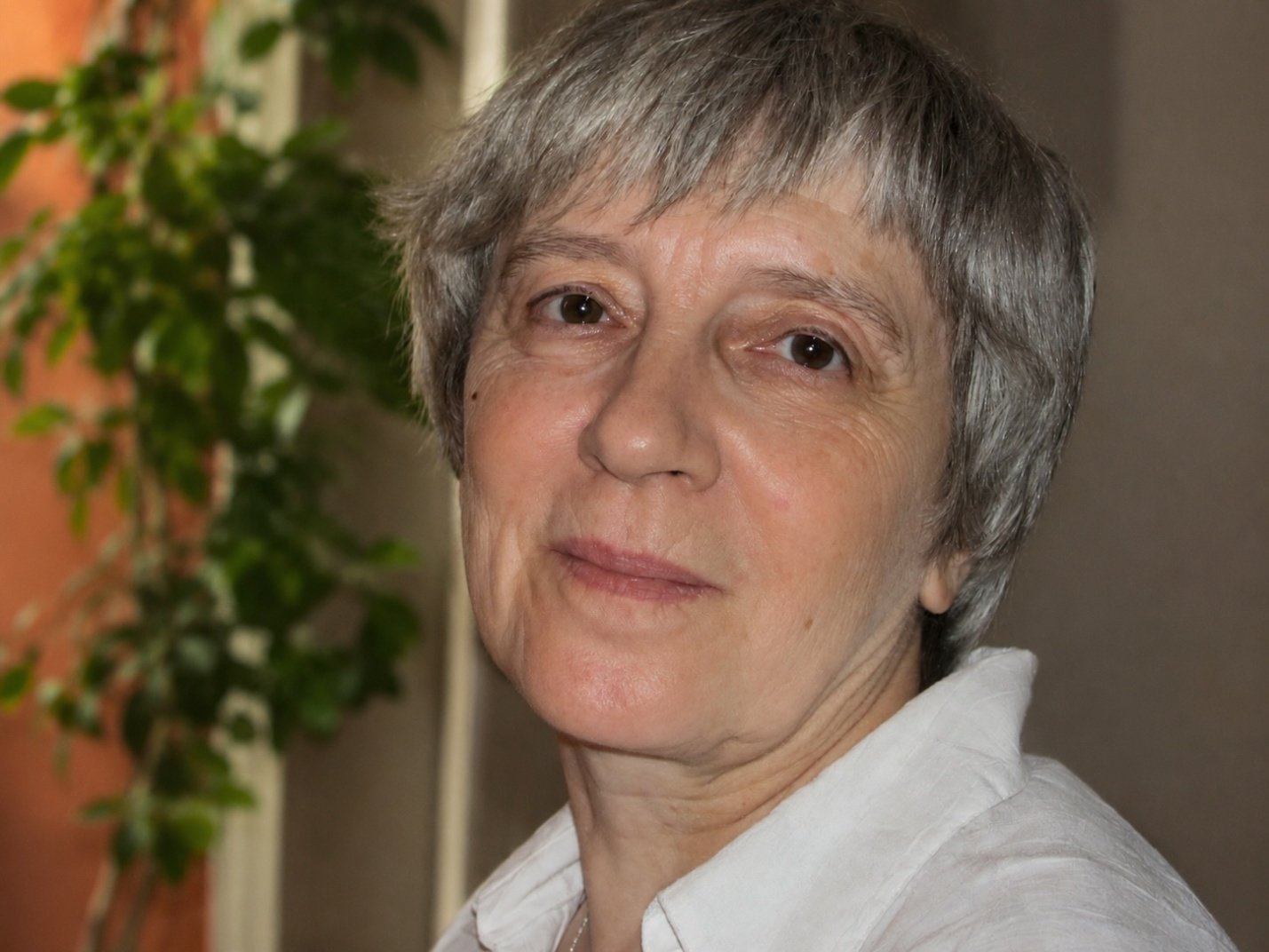
On August 15, 2026, Tatyana Vasilyevna Akhutina celebrated her anniversary — Doctor of Sciences (Psychology), Professor, Chief Researcher at the Laboratory of Neuropsychology of Lomonosov Moscow State University. For many years, Tatyana Vasilyevna has been a member of the editorial board of the journal Cultural-Historical Psychology. For us, this is a great honor and joy.
A student and continuer of A.R. Luria's ideas and legacy, a most brilliant representative of “peak” (L.S. Vygotsky) — cultural-historical — psychology, Tatyana Vasilyevna explores, from the heights of those “peaks”, the processes of the “deep-lying” of higher mental functions — at the neuropsychological level, by psycholinguistic methods. Thus, a new, non-classical “depth” psychology is born, one that coincides with “peak” psychology. And not only psychology — what is at issue is the entire system of supporting speech development in ontogenesis as the key “line of life” of Homo Loquens, as defined by Noam Chomsky and Robert Berwick. And speaking, for any human being — whether in normality or in pathology — is always a problem, one whose solution requires not merely the mobilization of all mental “forces” but also the generation of new ones, ones not directly related to speech. Every person, not only a poet, seeks the living, meaningful word within the range of socially significant words, in order to be understood by others and intelligible to oneself (A.A. Potebnya wrote about this as well).
It is no accident that Tatyana Vasilyevna has left her mark in the most diverse scholarly and practical fields — from aphasiology to addressing the problems children encounter in schooling, including in the course of language acquisition. It is pointless to seek the sources of these “forces” in the neurodynamics of the brain — they are rooted in human culture — in the grand sphere of people's active “exchange of meanings”, which lives by the laws of its own historical life, lending human specificity even to neurodynamics itself. Even brain impairments merely block access to these sources, which is why one must seek roundabout paths to them, and as a result brain functions themselves are transformed. But this applies to the norm as well. Such is the general conclusion to be drawn from Alexander Romanovich Luria's teaching, confirmed in various forms and fields of work with people by his outstanding followers — L.S. Tsvetkova (who was Tatyana Vasilyevna's academic supervisor for her candidate's dissertation), E.D. Khomskaya, V.M. Shklovsky, and Zh.M. Glozman. T.V. Akhutina also belongs to this galaxy of scholar-devotees.
The consolidation of neuropsychology and psycholinguistics — at first glance, a quite logical step and one that has long since become a global research trend, primarily thanks to the efforts of A.R. Luria's scientific school, its worldwide authority, and its contacts with representatives of other approaches — presupposes a special vision of the object of analysis and practical facilitation. This vision was expressed by T.V. Akhutina in her work. At its foundation lies L.S. Vygotsky's genetic approach, in which corrective effects are conceived and achieved as results of development. This means that neuropsychology can only be a genetic science, and that psycholinguistics must create the basis for developmental facilitation for Homo Loquens at different age stages and in different social situations of development. For neither in the organization of the brain nor in the construction of culture, including language, are there ready-made mechanisms or recipes for speech production (the source of strength is not yet strength itself, if one has culture in mind). It is the person himself who must become the subject of speech production and “build” these mechanisms in communication with others and with their help.
This is an extremely complex, most subtle search-and-transformative process, described and conceptualized in the model of speech production developed by T.V. Akhutina together with A.A. Leontiev. This classical model has long been at work in psycholinguistics, but Tatyana Vasilyevna initially found her way toward it within the framework of the neuropsychological clinic and defectological practice. This model makes it possible to lift the veil on the mystery of the genesis of the human word as a whole — the word filled with the life of meaning. And of its understanding as well — since without understanding a word can only be “stillborn”, not filled with the life of meaning. “Speech production”, according to Akhutina, is, to put it mildly, a very far from simple, multi-step search process, which she describes in terms of “motive”, “thought”, “meaning syntaxing”, “choice of inner words”, “semantic syntaxing”, “choice of words by meaning”, “surface syntaxing”, “kinetic programming”, “choice of words by form”, and “choice of articulemes”. But this is movement along the steps of a single function-genetic ladder.
A special gift of Tatyana Vasilyevna is her insightful ability to see Homo Loquens and the social situation of their development, behind which — to use L.S. Vygotsky's words from a letter to R.E. Levina — lies a human Destiny. Such vision is formed from different professional positions: that of a speech therapist, philology teacher, a neuropsychologist, a psycholinguist, a developmental psychologist, and an educational psychologist. Tatyana Vasilyevna graduated from the Defectology Faculty of the Moscow State Pedagogical Institute named after V.I. Lenin (now Moscow Pedagogical State University). A happy chance (not only for her — for all of us!) brought her, then a fourth-year student, to a practicum at the clinic of the N.N. Burdenko Institute of Neurosurgery. It was there that A.R. Luria worked with his group of colleagues. Tatyana Vasilyevna was spellbound by the procedure of examining patients conducted by Alexander Romanovich, revealing himself in his attitude toward each one not only as a great professional but also as a Personality who, in the words of A.F. Losev, is a miracle. And patients with severe speech impairments responded to him clearly and meaningfully. The zone of proximal — or perhaps some more distant — development? Destiny? A.R. Luria combined within himself a thinker and a dreamer. The student Tatyana Ryabova, the future Akhutina, came home and declared to her mother: “I want to work like Luria, with patients who have lost speech”. In this declaration every word is a “key” word, but the main one is “like Luria!”. Like a man who returned to people their lost worlds (see his book The Lost and Returned World). Tatyana Vasilyevna took up the teacher's baton, having accepted the message of his Personality.
This is especially important because all of us, who speak actively, much, and in varied ways, are somewhat lost in the modern world and are searching for ourselves. But Tatyana Vasilyevna is with us — she knows where, whom, and what to look for in it. The wonderful power of Tatyana Vasilyevna's delicate, cultured, motivating, and inspiring help has been experienced by hundreds and thousands of children and adults, including those who are not personally acquainted with her but have read her books. Among them, of course, are her students, undergraduate and graduate students, and colleagues, who are inexpressibly fortunate to be near her, to come into contact with her professional and personal gift, and to receive it as a gift. The power lies in development.
On behalf of the editorial board of the journal Cultural-Historical Psychology, I am happy to congratulate our dear Tatyana Vasilyevna on her wonderful anniversary and to wish her, in the years ahead, to uphold and multiply the glory of A.R. Luria's school, continuing her developmental facilitation for people in search of the Word, and in it — of themselves, thereby contributing to the development of 21st-century psychology.
V.T. Kudryavtsev,
Doctor of Sciences (Psychology),
Professor at the Moscow Institute of Psychoanalysis
and Moscow State University of Psychology and Education,
Deputy Editor-in-Chief of the journal Cultural-Historical Psychology
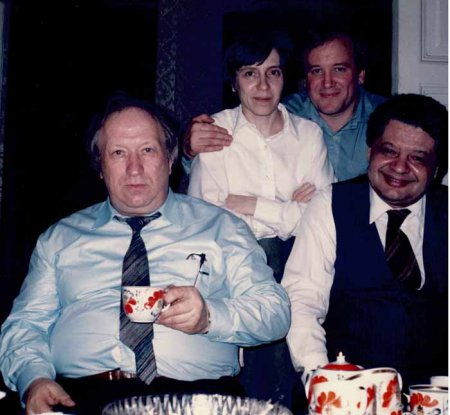
Photo from the archive of Prof. Michael Cole, taken in April 1986 during a break in the session of the Soviet-American seminar on developmental problems at the Institute of Psychology of the USSR Academy of Sciences.
“I have never regretted the choice I made”: An interview with T.V. Akhutina on the occasion of her anniversary.
Interviewed by V.T. Kudryavtsev
Tatyana Vasilyevna, on your birthday — especially on such a special one, which we once again wholeheartedly congratulate you on — it is customary to remember your parents. Please tell us about your parental family. Did it influence your professional choice? What confirmed you in it?
My father, Ryabov Vasily Ivanovich, was a military man; he took part in the Finnish War and the Great Patriotic War. My mother, Gruzintseva Elena Nikolaevna, was a defectologist, an associate professor at the Moscow State Pedagogical Institute named after V.I. Lenin, and the author of Russian language textbooks for auxiliary schools, published from 1934 to 1961. In 1927 she entered the Defectology Faculty of the 2nd Moscow State University (later renamed the Moscow State Pedagogical Institute) and attended L.S. Vygotsky's lectures there. My mother carefully preserved Vygotsky's books and the transcript of his report delivered on December 23, 1933, at a meeting of the Department of Defectology of the Bubnov Pedagogical Institute (another name of the Moscow State Pedagogical Institute). But all of this came into play later.
I was led to the Defectology Faculty of the Pedagogical Institute by an inner crisis. At school I dreamed of going into mathematics or physics at Moscow State University, but then, together with several classmates, we conceived the idea of going to Siberia to the “construction sites of communism” — for the sake of “self-improvement”. The rose-colored glasses quickly came off. My self-esteem dropped, and I made the decision to enter a universal faculty, or a faculty “for housewives”, where there would be a bit of philology, a bit of medicine, a bit of pedagogy — that is, the Defectology Faculty. Only later did I appreciate the opportunities it opened up, and this was connected with the appearance of Alexander Romanovich Luria in my life.
What were your impressions from your first meeting with A.R. Luria? What was especially attractive about his personality?
In the spring of 1962, fourth-year speech therapy students at the Defectology Faculty were invited to help conduct sessions with patients with aphasia. Two of us responded, and we went to learn to work at the N.N. Burdenko Institute of Neurosurgery, in A.R. Luria's laboratory. We were met by a laboratory staff member, Candidate of Medical Sciences E.N. Vinarskaya, and the speech therapist G.B. Rudaya. I first saw A.R. Luria in September 1962 at a patient case discussion. The patient had been preliminarily examined by E.G. Simernitskaya, who had just been hired at the laboratory after graduating from the Psychology Faculty of Moscow State University; this was her first case discussion. She reported the results of the patient's testing and raised the question of their interpretation. In response, Luria conducted several tests with comments for the staff on why he was choosing them. What I saw — the analytical search for the mechanism of the impairment — interested me so much that when I came home I said to my mother: "This is so interesting! This is exactly what I want to do all my life. Alexander Romanovich is such an extraordinarily remarkable scientist!!!" My mother replied: "A.R. is a good scientist, yes. But Lev Semyonovich Vygotsky — he is exactly like that!!!"
I have never regretted the choice I made. During my internship, I mastered not only speech therapy methods for overcoming aphasia but also methods of neuropsychological examination of patients. E.P. Kok, a brilliant neuropsychologist, helped me in this.
What was especially appealing about A.R. Luria's personality? To answer this question, I will give an example. As a student intern from the Defectology Faculty, I approach the world-famous scientist with a request: “A.R.! Please! Could you write a note — share your opinion on what a speech therapist should know?”. A.R. asked again: “For which newspaper? Why are you asking?”. I answered: “For the faculty wall newspaper Defectologist; I am a member of its editorial board”. And unexpectedly, in response: “I'll bring it tomorrow”. At the same time, he immediately switched to other matters. The next day he brought the handwritten text of the note. That was 1963. The note is now in press in my new book, Studies in Neuropsychology and Neurolinguistics. This example clearly shows A.R.'s democratic style of communication with colleagues and students, his enormous capacity for work, and his organization. A.R. loved his work; once, at the first lecture in September, he said to the students: “I had a good rest this summer — I wrote a book” (he meant the book The Man with a Shattered World: The History of a Brain Wound).
Why was it cultural-historical psychology in particular that became the “driver” of the development of neuropsychology?
In my view, cultural-historical psychology developed together with neuropsychology, rather than one following after the other. Take, for example, the 1930 report “On Psychological Systems”. This report was a landmark in the development of cultural-historical psychology, but what is it about? It addresses the systemic nature of higher mental functions, and this is a fundamental principle of neuropsychology. L.S. Vygotsky speaks there about the social genesis of higher mental functions, and in unfolding the stages of interiorization, he explains the third — intrapsychological — stage with a neuropsychological proposition: “Two points of the brain that are stimulated from without tend to act within a single system and turn into an intracortical point” (Collected Works, vol. 1, p. 130). Vygotsky links sociogenesis with systemogenesis. A.R. Luria always emphasized L.S. Vygotsky's role in the creation of neuropsychology. One of the articles by the well-known Estonian neuropsychologist Aaro Toomela is titled “There can be no cultural-historical psychology without neuropsychology. And vice versa”. I agree with this.
(Text on the photograph: “To dear Tanechka Akhutina, with love and deep respect. Gita Vygodskaya”.
Signatures of G.L. Vygodskaya and T.M. Lifanova.)
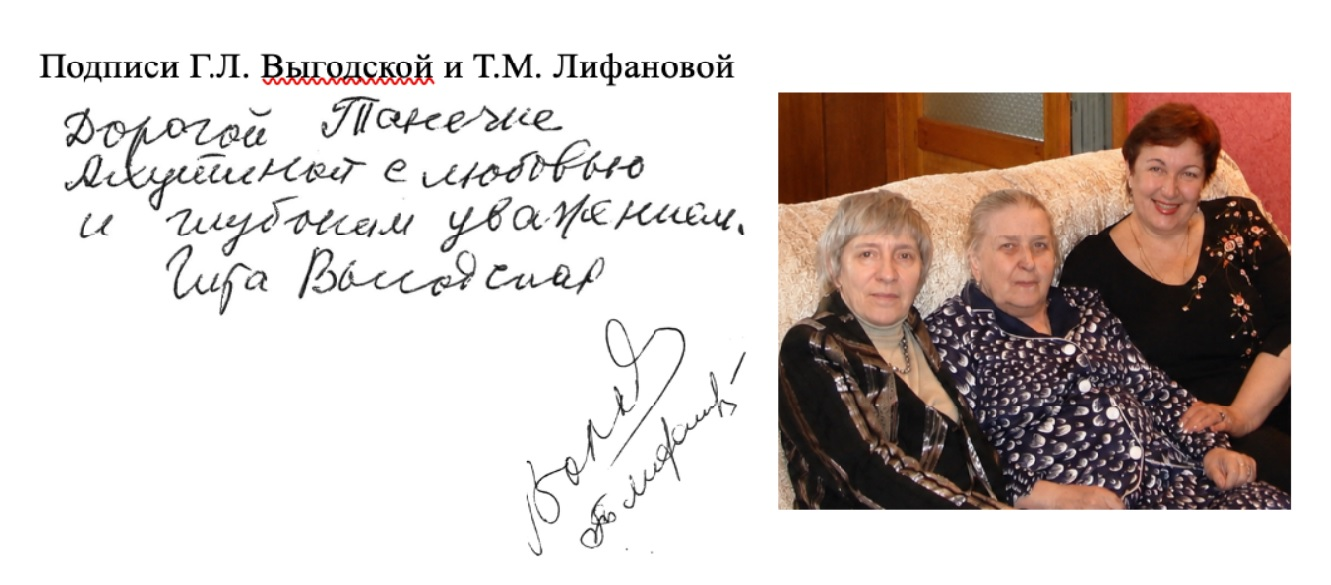
Lev Semyonovich Vygotsky (Moscow, 1997) — G.L. Vygodskaya and T.M. Lifanova
(from the archive of T.V. Akhutina)
Do you characterize L.S. Vygotsky as a psycholinguist of the 21st century? Why?
L.S. Vygotsky is a forerunner of Russian psycholinguistics and our contemporary. Three features of his creative legacy serve as proof of this:
1) interdisciplinarity and methodological rigor;
2) an approach to the human being as part of nature, society, and culture;
3) a transition from the functional and structural linguistics of the early 20th century to generative psycholinguistics.
Unfortunately, within the framework of an interview I cannot speak about this in detail; I will only say that Vygotsky's discovery of “changes in word meanings and their development”, which he considered “his main discovery” in the teaching on thought and speech, allowed him to approach the study of the inner side of speech. Vygotsky's book Thought and Speech and the Notebooks of L.S. Vygotsky (2017), recently published by E.Yu. Zavershneva and Rene van der Veer, give every ground for considering Vygotsky a forerunner of generative psycholinguistics.
Please tell us about your collaboration with A.A. Leontiev, whose anniversary is also being marked this year.
I would have told with great pleasure about my teacher and friend Alexei Alekseevich Leontiev, about the happiness of working under his guidance and protection, but the framework of the interview allows me only to refer to my text written for the 90th anniversary of A.A. Leontiev's birth, published in the first issue of Journal of Psycholinguistics in 2026.
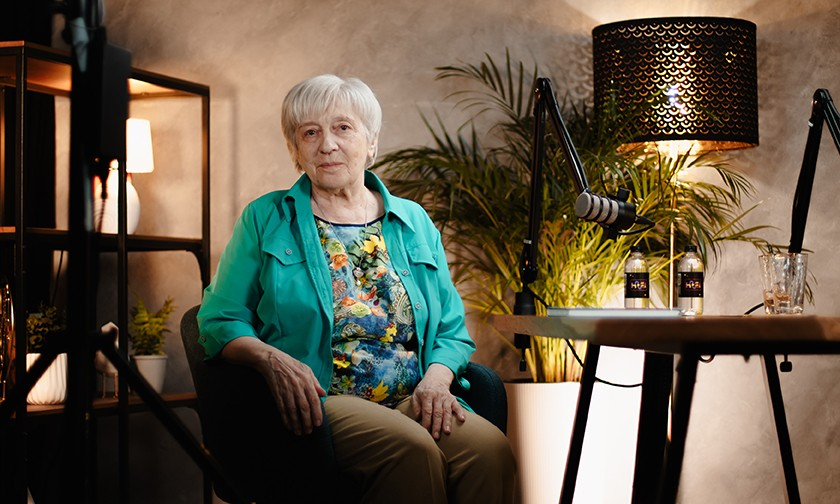
What would you like to wish to the readers of the journal Cultural-Historical Psychology, especially the young ones?
Dear readers! I hope I may say “Dear friends!”, I wish you all a life full of anxieties and joys, falls and rises, much sunshine and a little rain. Success in your creative work! Good friends! Love and happiness! May good books and bright people be your teachers! May you be accompanied by a sense of being needed! Strength to you and warmth of heart!