INTRODUCTION
In recent years, a significant increase in the incidence of substance-induced psychotic disorders (SIPDs) [1], mortality due to illegal psychoactive substances (PAS)-induced toxicity, and the number of individuals with drug addiction dependence referred for forensic psychiatric evaluation in connection with criminal offenses [2] have been reported in the Russian Federation.
Psychotic disorders are among the most serious consequences of illegal PAS use [2], and are most often induced by psychostimulants and cannabinoids [3]. According to a systematic review, approximately 25% of patients are diagnosed with schizophrenia within 3–5 years following an SIPD [4]. An increased risk of schizophrenia after SIPD has also been demonstrated in a prospective Russian study [5]. Specifically, it was found that schizophrenia onset occurs within 12 months of a synthetic cathinone-induced psychotic episode in 12% of cases. In addition, SIPDs increase the risk of self-harm, offending, trauma, or acute poisoning [4].
Trends in the incidence of PAS-induced psychotic disorders at the population level have been studied in Denmark, Norway and Sweden [6]. From 2000 to 2016, the incidence was stable at 10–11 cases per 100,000 population in these countries. At the same time, the incidence of alcohol-induced psychotic disorders during this period decreased by almost half, whereas the incidence of SIPDs increased significantly. In Denmark, since 2009, an almost 2-fold increase in the prevalence of cannabinoid-induced psychotic disorders has been reported, and in Sweden, since 2012, a 2-fold increase in psychotic disorders associated with use of multiple PASs has been seen [6]. However, in our opinion, these data cannot be extrapolated to other countries due to significant differences in regulatory policy regarding illegal PASs, statistical data collection methods, and the use patterns of different illegal PAS classes.
In recent years, several regional studies on the prevalence of synthetic SIPDs have been published in Russia [7-9], along with statistical reports on the activities of drug treatment services [10-26]. However, the available epidemiological data are insufficient to assess long-term trends at the national level. Furthermore, when analyzing the prevalence of psychotic disorders, it is advisable to rely on hospitalization rates, as the vast majority of cases require inpatient treatment1. Analysis of the predictors of trends in the event under study in the Russian Federation also remains important.
Study aims to analyze the trends and factors associated with hospitalizations for SIPDs in the Russian Federation between 2000 and 2024.
Study objectives:
- To evaluate trends in hospitalization rates for patients with illegal and legal PAS-induced psychotic disorders.
- To determine the relationship between trends in hospitalization rates for SIPDs and the distribution of hospitalizations according to the type of illegal PAS used.
- To analyze the relationship between hospitalization rates for patients with SIPDs and data from the Russian Ministry of Internal Affairs on the seizure of illegal and psychotropic substances during criminal case initiations.
- To identify and compare temporal clusters in drug addiction use in Russia.
- To examine the factors associated with the hospitalization rates for patients with SIPDs.
METHODS
Study design
A retrospective epidemiological study was conducted using federal statistical surveillance data (aggregated annual population data).
Measurements
Evaluated parameters
Hospitalizations of patients with illegal and legal PAS-induced psychotic disorders (International Classification of Diseases, 10th Revision (ICD-10) code F1x.5) were evaluated. Data on legal PAS-induced psychotic disorders were evaluated separately, because disorders associated with many new PASs were recorded as part of this parameter before 2014 [27].
Data were extracted manually from a series of published analytical reviews covering the Russian addiction treatment service activities between 2000 and 2024 [10-26]. Furthermore, the study used electronic databases containing statistical information about the patients with addictive disorders who were treated in federal and regional addiction treatment centers and psychiatric hospitals. The period was chosen due to the availability of comparable indicators in the reports. The analytical reviews were prepared using electronic databases compiled from information submitted by state center on addictions and psychiatric inpatient clinics as part of federal statistical monitoring Form No. 11 "Information on SIPDs".
At the end of each calendar year, data from individual hospital reports were analyzed by the National Research Center on Addictions, a branch of the V. Serbsky National Medical Research Centre of Psychiatry and Narcology of the Ministry of Health of the Russian Federation (Moscow, Russia), and published as an analytical review, along with consolidated federal and regional statistics. For the purposes of this study, data on the absolute (number of cases during the respective year) and relative (number of cases during the respective year per 100,000 population) numbers of hospitalizations were extracted from the reviews. The analytical reviews used the average total population of the Russian Federation for the respective year (The Federal State Statistics Service's (Rosstat) data) to calculate extensive parameters.
Over the study period (2000–2024), the statistical reporting protocols and diagnostic criteria for illegal and legal PAS-induced psychotic disorders remained unchanged.
Independent variables
The independent variables included parameters presented in the above analytical reviews and identified as potential predictors of the dependent variable based on previous studies [6, 28]:
- hospitalization rates for illegal PAS dependence syndrome by diagnostic subcategory: dependence on opioids (ICD-10 code F11.2), cannabinoids (F12.2), cocaine (F14.2), other psychostimulants (F15.2), multiple drug use and use of other PASs (F19.2) (cases per year per 100,000 population);
- hospitalizations for illegal PASs harmful use and acute intoxication (cases per 100,000 population per year);
- hospitalizations for legal PASs harmful use and acute intoxication (cases per 100,000 population per year).
Data on the weight of illegal PASs (by class: opioids, cannabinoids, synthetic illegal PASs) seized by the Ministry of Internal Affairs during criminal case initiations from 2017 to 2024 (grams per year per 100,000 population) were also considered as potential predictors of the dependent variable. These data were obtained from an open source, the Unified Interdepartmental Information and Statistical System of Rosstat2.
Additionally, the following parameters were evaluated:
- rehospitalization rates for patients with SIPDs (percentage of the total number of inpatients in a given year);
- length of stay for patients hospitalized with SIPDs (bed-days).
No pre-processing was performed on the data extracted from the above sources; the original data were used. No missing data were identified.
Statistical analysis
Data were analyzed using the R software environment, version 4.5 (R Foundation for Statistical Computing, Austria). Since the study examined aggregated data (federal statistical survey data), within-year variance was not available. For the same reason, the normality of the study data distribution was not tested.
Aggregated data are presented as medians (Q1; Q3). The Mann–Whitney test (for comparing independent samples) and Spearman correlation analysis with the calculation of the rs correlation coefficient were used for data analysis. Bonferroni correction was applied for multiple comparisons. Differences were considered statistically significant at p < 0.05.
To categorize drug addiction trends in the Russian Federation from 2000 to 2024, k-means clustering was performed, with the optimal number of clusters determined using the elbow method. Clustering quality was assessed using the silhouette method, which measures the degree of similarity between objects within a cluster and their differences from objects in other clusters. A mean score greater than 0.5 for all points, as well as balanced cluster sizes, determined visually based on the histogram (see Appendix S1 in the Supplementary), were the criteria for good clustering quality. The "kmeans()" function was used for clustering.
The association between hospitalization rates for patients with substance dependence syndrome and hospitalization rates for patients with SIPDs was assessed using linear regression. The primary regression model analyzed the association between the dependent variable (hospitalization rates for SIPDs) and four independent variables: hospitalization rates for patients with opioid, cannabinoid, psychostimulant, and other PAS or multiple drug addiction syndrome (see Appendix S2 in the Supplementary). A single multiple linear regression model was initially planned.
The model's standardized coefficients indicate how many standard deviations the dependent variable (hospitalization rate for patients with SIPDs) changes for each one-standard-deviation change in the respective independent variable, reflecting the contribution of each independent variable to the dependent variable. The "lm()" function (multiple linear regression model generation) was used to generate predictive models. Assumptions regarding the normality of regression residuals, homoscedasticity, and independence of errors were tested using a Q–Q plot, a plot of residuals vs. predicted values, and a plot of residuals vs. order of observations. Multicollinearity was tested using the variance inflation factor (VIF). Multicollinearity was considered excessive at VIF > 5.
The resulting models were compared using adjusted R2, Akaike's information criterion (AIC), and the Bayesian information criterion (BIC). The AIC to BIC ratio was calculated to assess the accuracy of the models. The relative contributions of input variables were determined using R2 decomposition based on the Lindeman, Merenda, and Gold (LMG) index, calculated using the "calc.relimp()" function. Since exploratory regression analysis was used, the requirements for predictive parameters (R2) for the models were set at the minimum level (> 0.5).
Ethical considerations
The study was approved by the local Ethics Committee of the Ryazan State Medical University (Protocol No. 1 dated September 5, 2022).
RESULTS
Trends in hospitalization rates
From 2000 to 2011, annual hospitalization rates for patients with SIPDs generally ranged from 0.5 to 1.0 per 100,000 population (see Figure 1, Appendix S3 in the Supplementary). From 2012 to 2015, there was a significant increase in this rate, followed by fluctuations between 3.0 and 4.0 per 100,000 population.
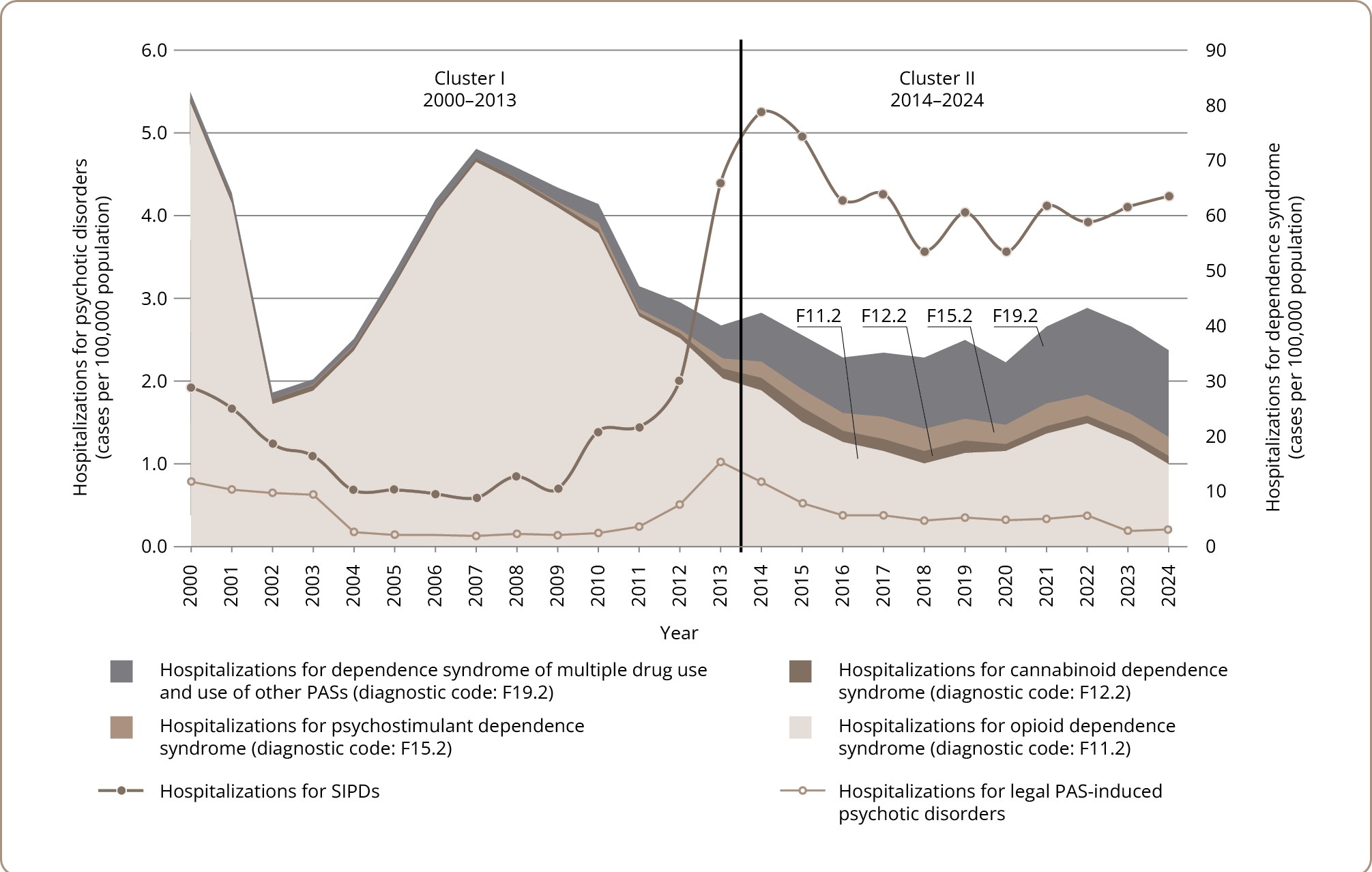
Figure 1. Hospitalization rates for patients with illegal and legal psychoactive substance-induced psychotic disorders and drug addiction syndromes from 2000 to 2024 (per 100,000 population).
Note: PAS — psychoactive substance; SIPD — substance-induced psychotic disorders.
Source: Fedotov et al., 2026.
A different trend was observed in the hospitalization rates of patients with legal PAS-induced psychotic disorders. From 2004 to 2011, the rates were consistently low at fewer than 0.3 cases per 100,000 population. From 2012 to 2015, a short-term increase was observed (peaking at no more than 1.0 case per 100,000 population), followed by a decrease and stabilization at 0.2–0.3 cases per 100,000 population (see Figure 1, Appendix S3 in the Supplementary).
The hospitalization rate for dependence syndrome across all types of PASs fluctuated over the study period, exhibiting two distinct peaks (in 2000 and 2007) (see Figure 1). From 2014 to 2024, it remained relatively stable, fluctuating primarily between 30 and 40 cases per 100,000 population.
Typification of the substance abuse in Russia
Based on the clustering using the elbow method, two time clusters were identified: from 2000 to 2013 year and from 2014 to 2024 (see Appendix S1 in the Supplementary). The median hospitalization rate of patients with SIPDs was sixfold higher in Cluster II compared with Cluster I. Hospitalization rates increased 3.1-fold for cannabinoid dependence syndrome, 16.4-fold for psychostimulant dependence syndrome, and 7.4-fold for dependence syndrome on other illegal PASs and their combinations. At the same time, the rate for opioid dependence syndrome decreased 2.9-fold (Table 1). Moreover, the overall hospitalization rate for substance dependence syndrome decreased by only 1.5-fold, and the hospitalization rate for substance dependence harmful use and acute intoxication increased 3-fold in Cluster II compared with Cluster I. The mean duration of hospitalization for patients with SIPDs decreased by 24%, while the proportion of readmissions for psychotic disorders remained unchanged. The defined clusters were comparable regarding the rates of psychotic disorders, as well as for legal PAS harmful use and acute intoxication. However, the hospitalization rates for patients with legal PAS dependence syndrome were 1.6 times lower in Cluster II.
Table 1. Comparative characteristics of clusters describing the substance abuse in the Russian Federation in 2000–2024
|
Parameter (cases unless otherwise specified) |
Cluster I (2000–2013) |
Cluster II (2014–2024) |
р* |
|
Hospitalizations for patients with psychotic disorders induced by**: |
|||
|
0.64 (0.50; 1.20) |
3.81 (3.57; 4.01) |
< 0.001 |
|
0.21 (0.14; 0.65) |
0.35 (0.32; 0.38) |
0.440 |
|
Hospitalizations for patients with substance dependence syndrome induced by**: |
|||
|
51.39 (34.59; 61.4) |
18.07 (16.41; 21.03) |
< 0.001 |
|
0.57 (0.51; 0.63) |
1.78 (1.18; 1.96) |
< 0.001 |
|
0.01 (0.01; 0.02) |
0.01 (0.01; 0.01) |
0.039 |
|
0.22 (0.19; 0.76) |
3.60 (3.19; 4.01) |
< 0.001 |
|
1.76 (1.16; 3.28) |
13.03 (10.41; 15.46) |
< 0.001 |
|
Hospitalizations of patients**: |
|||
|
54.82 (39.29; 63.89) |
36.43 (33.50; 39.24) |
0.002 |
|
1.48 (1.13; 1.94) |
0.91 (0.69; 1.02) |
< 0.001 |
|
1.27 (1.16; 1.59) |
3.82 (3.65; 4.32) |
< 0.001 |
|
0.78 (0.69; 0.92) |
0.69 (0.55; 0.79) |
0.217 |
|
Rehospitalization rate for patients with SIPDs (%) |
17.28 (15.66; 18.71) |
17.04 (15.82; 17.64) |
0.547 |
|
Length of stay for patients with SIPDs (bed-days) |
17.0 (15.6; 19.22) |
12.93 (12.23; 13.12) |
< 0.001 |
Note: *Differences are statistically significant at p < 0.004 (Bonferroni-corrected). **Per 100,000 population. The rates are described as median (Q1; Q3). SIPD — substance-induced psychotic disorders. See Appendix S1 in the Supplementary for cluster analysis data. PAS — psychoactive substance.
Independent predictors of hospitalization rates for substance-induced psychotic disorders
The hospitalization rate of patients with SIPDs did not correlate with the hospitalization rates for patients with illegal PAS addiction syndrome (rs = −0.366; p = 0.07), or with the amounts of seized opioid substances (rs = 0.238; p = 0.57), cannabinoids (rs = −0.262; p = 0.53), or synthetic illegal PASs (rₛ = 0.524; p = 0.18) (see Appendix S4 in the Supplementary for illegal PASs seizure data). At the same time, the hospitalization rate for patients with SIPDs correlated positively with the hospitalization rates for dependence syndromes on psychostimulants, cannabinoids, other illegal PASs, and polysubstance use, but correlated negatively with the hospitalization rate for opioid dependence syndrome (Table 2).
Table 2. Data of correlation analysis of hospitalization rates
|
Substance-induced psychotic disorder |
Psychostimulant dependence syndrome (F15.2) |
Dependence syndrome of multiple drug use and use of other psychoactive substances (F19.2) |
Cannabinoid dependence syndrome (F12.2) |
Opioid dependence syndrome (F11.2) |
|
|
Substance-induced psychotic disorder |
1 |
||||
|
Psychostimulant dependence syndrome (F15.2) |
0.848 р < 0.001 |
1 |
|||
|
Dependence syndrome of multiple drug use and use of other psychoactive substances (F19.2) |
0.806 р < 0.001 |
0.876 p < 0.001 |
1 |
||
|
Cannabinoid dependence syndrome (F12.2) |
0.793 р < 0.001 |
0.702 р = 0.001 |
0.599 р = 0.001 |
1 |
|
|
Opioid dependence syndrome (F11.2) |
−0.663 р < 0.001 |
−0.754 р < 0.001 |
−0.759 р < 0.001 |
−0.778 р < 0.001 |
1 |
Note: The table shows Spearman's rank correlation coefficients (rs).
In the primary regression model, the hospitalization rate for opioid dependence syndrome (F11.2) was not associated with the hospitalization rate for SIPDs. Furthermore, excessive multicollinearity was found between the hospitalization rate for opioid dependence (F11.2) and those for psychostimulant dependence syndrome (F15.2) and dependence syndrome of multiple drug use and use of other PASs (F19.2) (VIF = 54.34 and 37.81, respectively) (see Appendix S2 in the Supplementary). Therefore, the hospitalization rate for patients with opioid dependence syndrome (F11.2) was excluded from the primary model.
Instead, two models were generated, including only the significant variables from the primary model. To address the issue of multicollinearity, the variables psychostimulant dependence syndrome (F15.2) and dependence syndrome of multiple drug use and use of other PASs (F19.2) were included in separate models. Therefore, Model 1 used hospitalization rates for diagnostic codes F12.2 and F15.2 (see Appendix S5 in the Supplementary), while Model 2 used rates for diagnostic codes F12.2 and F19.2 (see Appendix S6 in the Supplementary). The models were comparable in terms of R2 and the AIC/BIC ratio; for VIF (< 3 for both models), the independent variables included in the models were characterized by moderate multicollinearity (Table 3).
Table 3. Independent predictors for hospitalization among patients with substance-induced psychotic disorders: linear regression analysis data
|
Model 1 |
Model 2 |
||||
|
Independent variable |
Standardized ratio |
LMG (%) |
Independent variable |
Standardized ratio |
LMG (%) |
|
Diagnostic code F12.2 |
0.33 |
40.1 |
Diagnostic code F12.2 |
0.49 |
44.7 |
|
Diagnostic code F15.2 |
0.67 |
52.6 |
Diagnostic code F19.2 |
0.57 |
49.4 |
|
Corrected R2 = 0.92; AIC/BIC = 0.88; VIF = 2.73 |
Corrected R2 = 0.93; AIC/BIC = 0.86; VIF = 1.82 |
||||
Note: AIC/BIC — Akaike Information Criterion / Bayesian Information Criterion ratio; F12.2 — cannabinoid dependence syndrome; F15.2 — psychostimulant dependence syndrome; F19.2 — dependence syndrome on other illegal PASs and their combinations; LMG — Lindeman, Merenda and Gold index; VIF — variance inflation factor.
DISCUSSION
Until 2013, hospitalization rates for patients with SIPDs remained consistently low. Beginning in 2014, a sharp increase in the rate was observed, followed by stabilization at a high level. During the same period, hospitalization rates for patients with legal PAS-induced psychotic disorders remained low, except for a slight increase in 2013–2014.
The increase in hospitalization rates for SIPDs was associated with a change in the structure of hospitalizations for dependence syndromes: an increase in the proportion of dependence syndromes on psychostimulants, cannabinoids, and synthetic drug mixtures, alongside a decrease in the proportion of opioid dependence. However, no correlation was found between hospitalization rates for patients with SIPDs and the quantities of illegal PASs seized by the Ministry of Internal Affairs during criminal cases.
Significant independent factors that are associated with the trends in the hospitalization rates for patients with SIPDs included the hospitalization rates for dependence syndrome on cannabinoids and psychostimulants (or, in an alternative model, for cannabinoids and other illegal illegal PASs, as well as multiple drugs). The hospitalization rate for opioid dependence syndrome was not a significant predictor.
The significant increase in hospitalization rates for patients with SIPDs led to a marked change in their ratio to those of patients with legal PAS-induced psychotic disorders. Whereas before 2014, on average, there was one patient with a SIPD among every 80 patients with alcohol-induced psychosis, after 2014, this ratio decreased to approximately 12:1 [29, 30]. Notably, these trends are consistent with those observed in Scandinavian countries during the same period [6].
The local peak in the hospitalization rates for patients with legal PAS-induced psychotic disorders reported in 2013 was apparently associated with the use of then-novel synthetic new PASs. Since many of these substances were not included in the lists of illegal PASs, conditions induced by their use could be classified as legal substance abuse. Furthermore, cases of dependence on these substances could be reported as mental and behavioral disorders due to the multiple drug use and use of other PASs (ICD-10 code F19.2). A marked increase in this diagnostic category was observed after 2011.
It is noteworthy that the increase in the hospitalization rates for patients with SIPDs occurred alongside a decrease in the hospitalization rate for patients with illegal PASs addiction syndrome, which more than halved between 2008 and 2024. In all likelihood, the observed increase in the hospitalization rates for SIPDs reflects a transformation in the population substances use patterns and may be related to the increased use of synthetic psychostimulants, high-potency cannabinoids, and illegal PASs mixtures containing these substances.
The modeling shows that hospitalizations for SIPDs are equally associated with the hospitalization rates for psychostimulant dependence syndrome (code F15.2), dependence syndrome of multiple drug use and use of other PASs (code F19.2), and cannabinoids (code F12.2). New synthetic stimulants and cannabinoid PASs can cause dopaminergic sensitization of the mesolimbic system, thereby provoking psychotic disorders and increasing the risk of schizophrenia [31]. By contrast, opioids, due to their neuromodulatory action, may have an antipsychotic effect [32], which may explain the significantly lower rates of psychotic disorders during the period of their dominance in hospitalizations before 2013. If the trend towards a decrease in the proportion of opioids and a simultaneous increase in the proportion of synthetic psychostimulants, cannabinoids, other illegal or multiple substances persists, we can expect a further increase in the number of hospitalizations for SIPDs.
The study used aggregated federal statistical surveillance data, which precludes the determination of the variance and distribution features of the original data, i.e., the variables required to refine the regression analysis data. The epidemiological design of the study only allows for the formulation of hypotheses that require testing via patient registry databases.
Due to the lack of data on several parameters in federal statistics, the analysis did not include information on the mean age of patients, their sex, and the degree of social maladjustment — factors that have been associated with differences in outcome rates in studies conducted in other countries [33].
The introduction of a new reporting form (Form No. 11, Information on Substance-Induced Disorders, approved by the Rosstat Order No. 116 dated March 10, 2025) in 2025 will enable the collection of more detailed regional data on all substance abuse disorders and will refine the results of this study.
Furthermore, calculating hospitalization rates for the entire population (including children and older adults) may understate the values, thereby limiting data extrapolation when assessing the burden on the healthcare system.
CONCLUSION
The hospitalization rates for SIPDs increased sixfold in the Russian Federation over the past 25 years and have remained at a consistently high level since 2014. In terms of trends in the substance use patterns during 2000–2024, two time clusters are distinguished: (I) 2000–2013 and (II) 2014–2024. Cluster II showed a significant increase in the hospitalization rates for SIPDs, as well as those for dependence syndromes under diagnostic headings F12.2, F15.2, and F19.2. Furthermore, a reduction in the mean duration of inpatient treatment for patients with SIPDs was reported for this cluster. The marked increase in the hospitalization rates for SIPDs observed in the Russian Federation from 2014 to 2024 can be associated with a transformation in the structure of substances use, manifested as an increase in the hospitalization rates for psychostimulant, cannabinoid, and mixtures of illegal PASs dependence syndromes.
1 Mental and behavioral disorders due to use of psychoactive substances [alcohol, cannabinoids, sedatives and hypnotics, cocaine, other stimulants (except caffeine), hallucinogens and multiple psychoactive substances]. Psychotic disorder: Clinical Guidelines / Ministry of Health of the Russian Federation. Available from: https://cr.minzdrav.gov.ru/preview-cr/817_1
2 The amount of illegal substances, psychotropic substances and their precursors, potent substances, new potentially dangerous psychoactive substances seized at the time of initiation of criminal proceedings / Unified Interdepartmental Information and Statistical System (EMISS) of the Federal State Statistical Service (Rosstat). Available from: https://www.fedstat.ru/indicator/58159