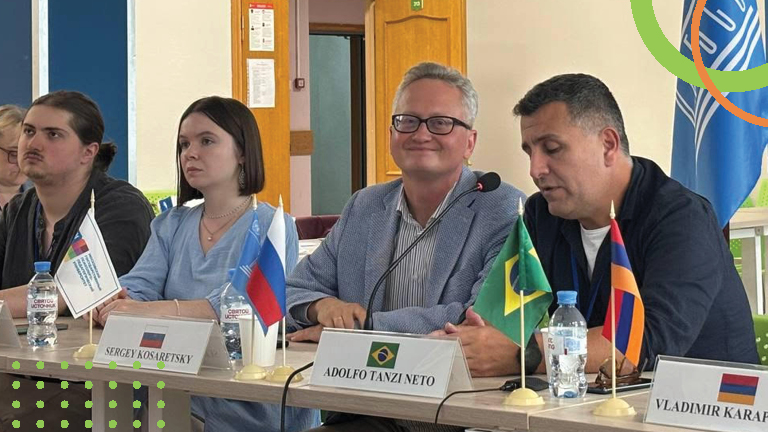
On 14 August 2025, the Moscow State University of Psychology and Education (MSUPE) hosted a hybrid-format Strategic Session on the Development of the Regional Section of the International Society for Cultural-Historical Activity Research (ISCAR). The event was held within the framework of the IX International ISCAR Summer University. The main objective of the session was to outline development plans for the ISCAR Regional Section, which brings together scholars from Russia, Belarus, Armenia, Kazakhstan, Kyrgyzstan and Uzbekistan, for the period 2025–2027.
The session gathered 28 participants representing five countries: heads of departments, research unit leaders, university lecturers, doctoral students and master’s students from institutions whose research and educational programmes are grounded in the principles of cultural-historical psychology and activity theory.
Key programme highlights included:
Presentations by leading international and Russian experts:
- Adolfo Tanzi Neto (Brazil), ISCAR Vice-President and Head of the Department of Anglo-Germanic Languages at the Federal University of Rio de Janeiro, outlined global perspectives and opportunities for ISCAR, emphasising the importance of cooperation between regional sections.
- Sergei Gennadievich Kosaretsky, Vice-Rector for Research at MSUPE and Chair of the ISCAR Regional Section “Russia and Neighbouring Countries”, reported on the current state, strategic objectives and concrete plans of the Section (presentation).
- Viktor Kirillovich Zaretsky, Professor at MSUPE, highlighted key milestones in the history of ISCAR and the role of the Regional Section “Russia and Neighbouring Countries” as a driver in advancing the ideas of cultural-historical psychology and activity theory worldwide.
A series of short contributions from country representatives:
-
Aleksei Mikhailovich Polyakov (Belarusian State University, Minsk) presented perspectives on the implementation of cultural-historical psychology in Belarus, identifying major trends and challenges (presentation).
-
Nina Aronovna Bagdasarova (American University of Central Asia, Bishkek) discussed the specific conditions and challenges of advancing cultural-historical psychology and activity theory in Kyrgyzstan.
-
Kenes Aitzhanovich Nurgaliev (M. Utemisov West Kazakhstan University, Uralsk) provided an assessment of developments in Kazakhstan, underscoring the importance of regional cooperation within ISCAR.
-
Vaan Sargsyan (Khachatur Abovian Armenian State Pedagogical University) emphasised the significance of promoting cultural-historical psychology and activity theory in educational practice, particularly in the context of organising chess lessons within the school curriculum.
Concrete plans for the coming years were discussed, including:
-
Preparation for the ISCAR Regional Conference in Moscow in 2026.
-
Participation of regional representatives in the ISCAR World Congress in Cape Town, South Africa, in 2027.
-
Prospects for joint international research and practice-oriented projects.
-
Coordination of efforts in preparing publications (articles, collected volumes, methodological resources) that further develop cultural-historical psychology and activity theory.
-
Expanding awareness of ISCAR’s activities and attracting new members from the “Russia and Neighbouring Countries” region.
The Strategic Session became an important milestone for consolidating the scientific community of the participating countries and for defining concrete plans for cooperation. Participants reached a shared understanding of the main directions of development of the ISCAR Regional Section for the next three years, in line with contemporary trends in cultural-historical psychology and activity theory and the overall strategy of ISCAR.
“The session clearly demonstrated the value of uniting participating countries within the Regional Section, the importance of ISCAR membership, and the mutual benefits of interaction between the Section and the wider ISCAR community for advancing cultural-historical psychology. At the same time, realising these potential advantages requires greater activity in planning and holding regular events, as well as in information exchange. Involving young researchers and establishing mechanisms of mentorship play a crucial role. I hope that the agreements reached will bring tangible scientific and practical outcomes and strengthen our presence in the global ISCAR academic community,” noted Sergei Gennadievich Kosaretsky, Vice-Rector for Research at MSUPE, Chair of the ISCAR Regional Section, and Member of the ISCAR Executive Committee.
The Strategic Session reaffirmed the central role of the ISCAR Regional Section in preserving the legacy of the founders of cultural-historical psychology and activity theory, and in applying core concepts to both fundamental and applied research. At the same time, it was recognised that the development of cultural-historical psychology and activity theory in other countries has led to new promising research directions and revealed opportunities for applying theoretical constructs to pressing issues in education and social practice. Partnership within ISCAR ensures the exchange of knowledge and serves as a foundation for the further dissemination and strengthening of cultural-historical psychology and activity theory across countries.
Aimed at reinforcing partnerships between research schools and individual scholars in the “Russia and Neighbouring Countries” region, the event laid a strong foundation for ambitious joint scientific and educational initiatives in the years ahead.