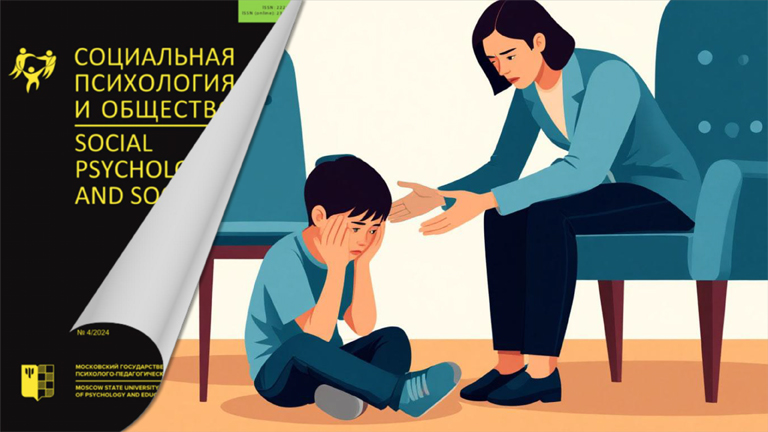
The new issue (No. 4, 2025) of the journal “Social Psychology and Society” is devoted to the topic of difficult life situations, which is becoming increasingly relevant in contemporary psychology as the complexity and uncertainty of the surrounding world continue to grow.
In the foreword by the thematic editor N. V. Grishina, Doctor of Psychology and Professor in the Department of Personality Psychology, Faculty of Psychology, Saint Petersburg State University, a brief overview of research on difficult life situations and an analysis of the current state of development of this problem is presented.
The section “Theoretical Research” includes the article by E. P. Belinskaya “Coping with difficulties as a problem in social psychology” which focuses on defining the specificity of the socio-psychological perspective within the interdisciplinary field of research on how individuals cope with difficult life situations, as well as the article by N. V. Grishina “The individual in interaction with the surrounding world: from situation to context” which continues the discussion of the conceptual issues involved in the development of the topic of difficult life situations.
The empirical research section opens with the publication of the results of a collaborative study by A. A. Rean and colleagues “Value structure and material status as indicators and resources of resilience in a difficult life situation” in which a difficult life situation is conceptualized as part of a young person’s life context and reflects the family’s financial disadvantage.
The influence of cultural context on ways of experiencing difficult life situations is demonstrated in the studies by L. V. Stoilova and O. Yu. Strizhitskaya “The experience of loneliness and coping with it in a situation of forced isolation (evidence from Russia and Bulgaria)” as well as by M. A. Odintsova, N. P. Radchikova, and N. V. Kozyreva “The role of contextual factors in changes in family relationships under high intensity of adverse events”.
The theme of different life contexts within which difficult life situations arise is continued in the article by E. N. Khodakovskaya and S. K. Nartova-Bochaver “Difficult life situations of students in various social and life contexts”. In the article by O. A. Ulyanina, O. L. Yurchuk, L. A. Alexandrova, K. A. Faizullina and E. A. Nikiforova “The family as a resource for coping with difficult life situations in children affected by armed conflict” it is shown that family resources and parents’ psychological resilience are the most important factors protecting children from the negative consequences of traumatic experiences.
Two publications in this issue are devoted to retirement and pre-retirement age: the article by T. P. Emelyanova and E. N. Vikentyeva “The retirement transition in the perception of pre-retirees: the possible self-retiree in a future life situation” and the article by T. V. Drobysheva, “Predictors of financial anxiety in the situation of retirement”.
In the “Methodological Tools” section readers can become acquainted with the new work by M. A. Bultseva, E. D. Vasilieva, and A. V. Trifonova “Adaptation and validation of the identity gaps in communication scale by M. L. Hecht and I. Jung”.
The conclusion of the issue presents the publication by M. M. Reshetnikov “Can the state cure people from fakes? On the boundaries of care and control in the context of digital anxiety” – a review of the monograph by O. S. Deyneka and A. A. Maksimenko, “Vaccine against the infodemic, or the psychological state of society amid the COVID-19 pandemic”. The author draws the reader’s attention not only to phenomena and emerging concepts that are new to domestic science, but also to ethical issues, the need for collective responsibility for the state of the information environment, and the possibility of countering its negative effects.
Enjoy your reading!