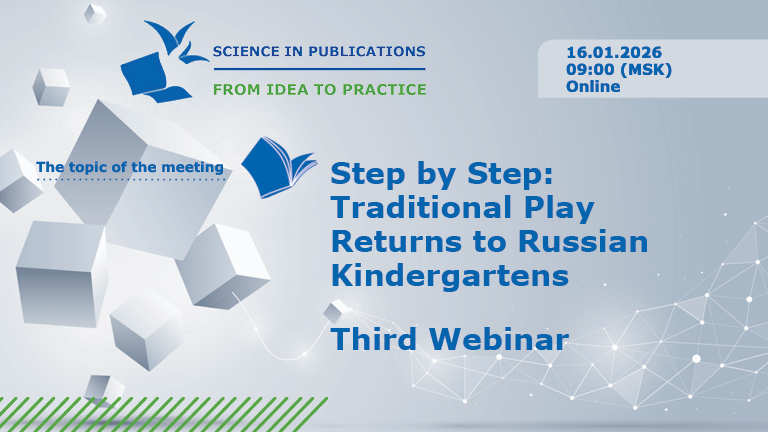
On January 16, 2026, at 09:00 (MSK), the third webinar “Step by Step: Traditional Play Returns to Russian Kindergartens” will take place at the discussion platform “Science in Publications: From Idea to Practice” with the support of Boiling Point MSUPE.
The authors continue the webinar series dedicated to psychological practice using traditional play.
This is the third webinar in a series of meetings aimed at supporting preschool education professionals in mastering the Folk Games Program, developed by the Faculty of Legal Psychology at MSUPE and recommended by the Ministry of Education of the Russian Federation as a way to prepare children for actions in situations of terrorist threat.
Currently, 48 regions of Russia, from Kamchatka to Kaliningrad, are involved in implementing the program (940 participants, including preschool teachers, music instructors, and physical education instructors).
The first webinar examined the features and significance of the stages of entry into the game space: call-and-response chants (zaklichki), names, and the game Karavai. Members of the working group analyze participants’ first experiences using video materials, noting achievements and areas that require special attention in recreating folkloric play practice with strong potential for developing children’s independence, responsibility, and initiative. These qualities help prevent panic and disorganization in situations of terrorist threat.
The second webinar addressed key challenges of play practice, primarily related to theatricalization and staged performances during holiday events. While not opposing these approaches, the discussion emphasized that live, free rule-based play represents a different phenomenon. Participants also discussed difficulties in preparing video materials for analysis, consequences of arbitrary changes to game rules, the role of counting-out rhymes, and challenges teachers face when identifying themselves as participants in play.
The main goal of Webinar No. 3 is to highlight participants’ progress in mastering the games “Goat” and “Tetera”, identify successful practices, explore resources for improving and freeing the play process, and examine the interaction between rules and individual interpretation in real play situations. All fundamental principles of traditional play will be discussed using video materials provided by participants. Participants will jointly discuss challenging situations faced by facilitators during play and possible ways to address them.
Links to recordings of the webinar series “Step by Step: Traditional Play Returns to Russian Kindergartens”:
Webinar No. 1 (01.11.2025)
Webinar No. 2 (19.12.2025)
Webinar No. 3 (16.01.2026)
Speakers:
Vladimir A. Chernushevich, Associate Professor, Department of Legal Psychology and Law, Faculty of Legal Psychology, MSUPE
Anna B. Teplova, Candidate of Pedagogical Sciences, Associate Professor, Department of Legal Psychology and Law, Faculty of Legal Psychology, MSUPE
Ekaterina A. Kupriyanova, Senior Lecturer, psychologist, Training and Production Laboratory, Faculty of Legal Psychology, MSUPE
Marina G. Mogilevchik — educational psychologist, head of the “Forest Playroom” club
The theoretical foundations of analyzing play practice are presented in the following publications:
- Teplova, A.B., Chernushevich, V.A. (2021). Axiological and methodological analysis of folk games. Psychological-Educational Studies, 13(4), 22–38. https://doi.org/10.17759/psyedu.2021130402
- Teplova, A.B., Chernushevich, V.A., Chuprakova, N.N. (2020). Problems of implementing folkloric play practice as a corrective and preventive resource (results and prospects of experimental work). Psychology and Law, 10(2), 64–77. https://doi.org/10.17759/psylaw.2020100206
- Chernushevich, V.A. (2023). Folk play as a phenomenon of enculturation of the modern child. Psychology and Law, 13(3), 119—134. https://doi.org/10.17759/psylaw.2023130309
Webinars and Meetings Calendar of the “Science in Publications” Project (2025–2026)