Three webinars from the series “Step by Step: Traditional Play Returns to Russian Kindergartens” were held at the discussion platform “Science in Publications: From Idea to Practice” with the support of Boiling Point MSUPE.
The Folk Games Program for preschool educational institutions, developed by the Faculty of Legal Psychology at MSUPE and recommended by the Ministry of Education of the Russian Federation as a way to prepare children for actions in situations of terrorist threat, has already been adopted in 48 regions of Russia.
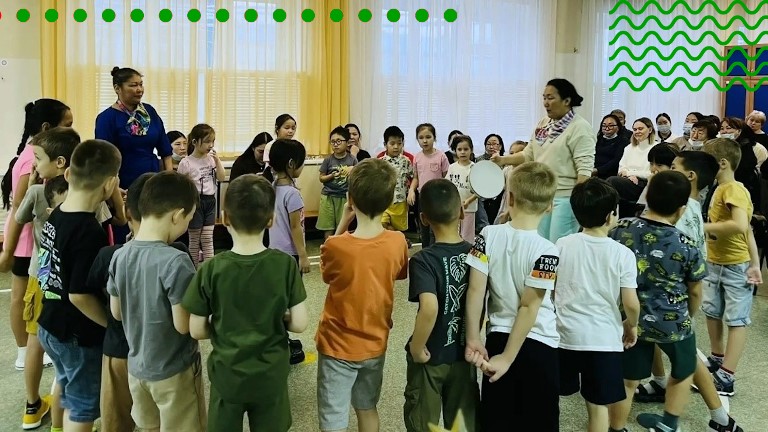
Speakers and participants carefully analyzed video recordings submitted by representatives of kindergartens from different regions of the country. Particular attention was given to the behavior of children and educators in such games as “Zaklichka”, “Counting-out rhyme”, “Goat”, “Tetera”, and others. Vladimir A. Chernushevich emphasized that special attention should be paid to the “Zaklichka”, the introductory part of the game: “A child cannot be moved from a strictly regulated framework directly into free play — gradual involvement is necessary.”
The importance of the circle dance in traditional play was also discussed. In school settings, direct “eye-to-eye” interaction is limited, and a learning-oriented position usually prevails. In traditional play, however, equal relationships between participants are transmitted; children quickly organize themselves and see one another face to face. The game then unfolds, allowing each participant to express themselves.
Speakers also noted some problematic tendencies: play is often transformed into something resembling a children’s performance or holiday event, which should be avoided. Various artificial props, masks, and loud music interfere with the nature of the game, which is “by definition free and can emerge anywhere.” However, for children to fully realize their potential in play, strong emotional contact between the educator and the children is essential. It is important to enter the play mode not “above the children” but together with them. The issue of praise was also discussed. Unlike learning activities, play does not imply evaluative judgments; when working with young children, such judgments are recommended to be avoided.
Experts noted the progress of educators who enthusiastically joined the program and recalled its main objectives — the development of children’s personalities, their independence, and their ability to act in emergency situations. “It is necessary to move from the obligatory to the sincere, from the external to the internal — and this path is always challenging,” commented Anna B. Teplova. Project participants emphasized the importance of the webinars, where real play situations are analyzed in a unique and detailed way. Games are examined in terms of their correspondence to the principles of traditional folkloric play described by E.A. Pokrovsky.
Participants’ feedback:
“Many thanks for this work and for the detailed, meaningful analysis of the games, as well as for the recommendations for us — this is very helpful in our work.”
Elizaveta V. Filimonova (Kindergarten No. 11, Vyborgsky District, Saint Petersburg)
“Very interesting and useful materials! I am simply delighted with the professional work of the specialists involved in this project! The presentation of the material is very clear and accessible! The program is simple and understandable! Our children are lucky — and so are we!”
Lyudmila A. Kalashnikova (Kindergarten No. 267, Barnaul, Altai Krai)
“The seminar left very positive impressions and a desire to continue participating in the program. The rules of the games seem simple… but there are so many nuances and methodological features in how they are conducted. Thank you for the clarity and the meticulous analysis of each game. We will continue learning and playing.” Oksana V. Didenko (Moscow, School No. 1576)
Links to recordings of the webinar series “Step by Step: Traditional Play Returns to Russian Kindergartens”:
Webinar No. 1 (01.11.2025)
Webinar No. 2 (19.12.2025)
Webinar No. 3 (16.01.2026)
Speakers:
Vladimir A. Chernushevich, Associate Professor, Department of Legal Psychology and Law, Faculty of Legal Psychology, Moscow State University of Psychology and Education (MSUPE)
Anna B. Teplova, Candidate of Pedagogical Sciences, Associate Professor, Department of Legal Psychology and Law, Faculty of Legal Psychology, MSUPE
Ekaterina A. Kupriyanova, Senior Lecturer, psychologist, Training and Production Laboratory, Faculty of Legal Psychology, MSUPE
Marina G. Mogilevchik — educational psychologist, head of the “Forest Playroom” club
Nina N. Chuprakova, Lecturer, Department of Legal Psychology and Law, Faculty of Legal Psychology, MSUPE
The theoretical foundations of play practice analysis are presented in the following publications:
- Teplova, A.B., Chernushevich, V.A. (2021). Axiological and methodological analysis of folk games. Psychological-Educational Studies, 13(4), 22–38. https://doi.org/10.17759/psyedu.2021130402
- Teplova, A.B., Chernushevich, V.A., Chuprakova, N.N. (2020). Problems of implementing folkloric play practice as a corrective and preventive resource (results and prospects of experimental work). Psychology and Law, 10(2), 64–77. https://doi.org/10.17759/psylaw.2020100206
- Chernushevich, V.A. (2023). Folk play as a phenomenon of enculturation of the modern child. Psychology and Law, 13(3), 119–134. https://doi.org/10.17759/psylaw.2023130309
Webinars and Meetings Calendar of the “Science in Publications” Project (2025–2026)