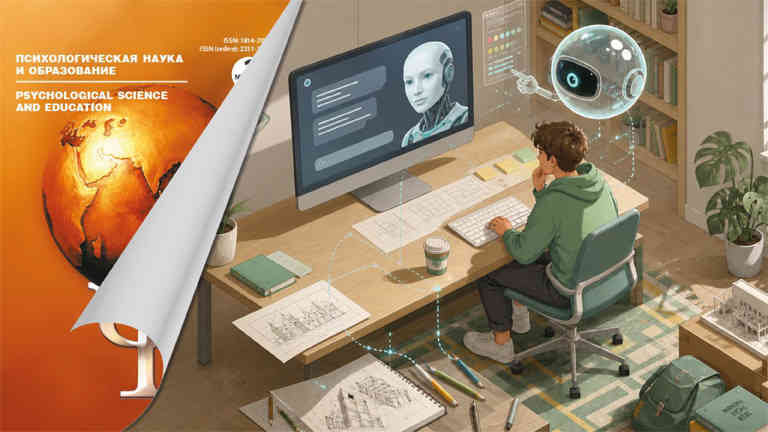
A new issue of the journal “Psychological Science and Education” (2026 # 2) has been published, devoted to the psychological effects and risks of using artificial intelligence (AI) and digital technologies in education.
The issue features interdisciplinary studies that reveal key aspects of the digital transformation of education. Readers will become familiar with new diagnostic instruments, including the “Students' Attitudes toward the Use of Artificial Intelligence Technologies in Educational Activities” questionnaire, the Russian-language adaptation of the MEC Spatial Presence Questionnaire (MEC SPQ) for VR environments, and a questionnaire on the factors of AI use by university instructors.
A considerable part of the issue focuses on the influence of digital technologies on the educational process, including studies on the impact of an interactive AI assistant on student engagement, an analysis of online learning barriers and their effects on academic achievement, and the role of AI in students' creative expression. The issue also pays special attention to the ethical risks of digital solutions, specifically examining the opportunities and limitations of ChatGPT in special education.
The issue closes with cross‑cultural research, including an analysis of the relationship between internet addiction and academic procrastination in students, an investigation of academic engagement among schoolchildren in China, and a study on the association between academic aspirations and cognitive flexibility among female research students in India.
Listen to the issue's authors on PsyJournals LIVE:
Evgeny Andreevich Arlakov shared the results of the development and psychometric characteristics of the questionnaire “Students' Attitudes toward the Use of Artificial Intelligence Technologies in Educational Activities”.
Olga Vladimirovna Morozova discussed the characteristics of experimentation in second‑grade students using a virtual laboratory.
Nikita Vladimirovich Kochetkov presented the findings on the adaptation of diagnostic instruments for motivation to use artificial intelligence.
Malikat Shamilievna Mikhitaeva discussed the association between anxiety and the type of digital content consumed by older preschoolers.
Yulia Vasilievna Sibiryakova presented the results of the adaptation of a questionnaire based on the UTAUT/TAM models for studying the factors of AI use among university teachers in Russia.
Dian Farah Syarifah presented a systematic literature review on cognitive adaptation and student engagement in an AI‑based generative professional learning environment.
Nadezhda Valerievna Sivrikova presented on students' happiness in relation to academic cyberloafing and phubbing.
Vladimir Andreevich Karpuk shared the results of the adaptation, validation, and normative data for the Russian‑language version of the MEC Spatial Presence Questionnaire (MEC‑SPQ) in a VR environment.
Sergey Viktorovich Moiseev presented a psycho‑pedagogical analysis on the perception and evaluation of an interactive AI assistant in a digital learning environment.
Duong Hoai Lan discussed how students in media-related fields are learning to use AI for creative self‑expression as part of their preparation as future authors.
Z. Li about self-esteem and academic engagement of middle school students in China: A moderator mediation model
M. Rizal presented the findings of a case study on the development of creative thinking among secondary school students when solving numerical estimation tasks.
Rishika Mishra presented on purposefulness, cognitive flexibility, and self‑regulation among female researchers in India.