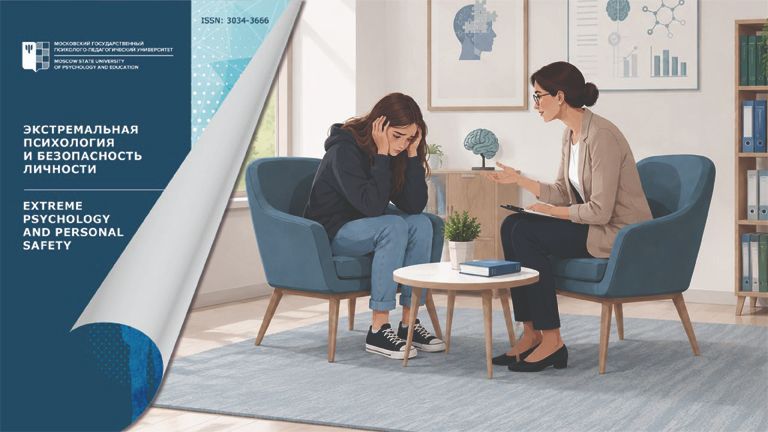
A new thematic issue of the journal "Extreme Psychology and Personal Safety" (No. 2, 2026) devoted to crisis psychology has been published. The thematic editor is - Leonid A. Pergamenshchik, Doctor of Science (Psychology), Professor, Department of Social and Family Psychology, Faculty of Psychology, Maxim Tank Belarusian State Pedagogical University.
The field emerged in the late 1980s in response to the need for psychological assistance for those affected by the Chernobyl disaster and was officially recognized as "crisis psychology" in 1997.
The issue is organized into three major sections, each presenting current theoretical perspectives, empirical research findings, and practical approaches to working with people experiencing crisis situations.
The "Theoretical Research" section introduces the conceptual foundations of crisis psychology and demonstrates how different scientific traditions contribute to understanding the experience of trauma. In particular, L.A. Pergamenshchik examines lived experience as a mechanism for overcoming a crisis event. The author compares phenomenological, hermeneutic, and cultural-historical approaches and shows how their integration helps explain the individual's journey from trauma to personal growth. R.V. Kadyrov addresses one of the central topics of contemporary crisis psychology—crisis intervention as a strategic approach within psychological support systems. The article discusses crisis intervention as a short-term method of psychological assistance with specific requirements regarding timing, setting, and therapeutic techniques. The author identifies the key competencies required of crisis intervention specialists, including accurate assessment of the client's condition, rapid decision-making, a focus on brief interventions, the ability to apply simple yet effective methods of assistance, and an emphasis on restoring safety and a sense of control. The article will be of interest to both researchers and practitioners in crisis psychology, as well as to social workers and volunteers assisting people affected by extreme events.
The "Problems of Psychological Safety in Developmental Psychology" section presents studies examining how crisis situations affect individuals and families at different stages of life and which internal resources help maintain psychological safety. E.Yu. Kozhenevskaya explores sibling relationships as a resource for psychological safety in families raising children with developmental disabilities. The study presents statistical data on the increasing number of such children and demonstrates how typically developing siblings can serve as a stabilizing factor within the family system. E.A. Petrazhitskaya focuses on women who have experienced perinatal loss and proposes considering changes in time perspective as a criterion of post-traumatic growth, thereby expanding current understanding of the mechanisms underlying psychological recovery. This section offers evidence-based support models and criteria for evaluating changes in the psychological well-being of clients across different age groups.
The "Psychological Assistance in Extreme Situations" section focuses on practical approaches and presents crisis intervention tools applicable to real-life support for people affected by traumatic events. L.A. Vertinskaya demonstrates the potential of narrative analysis through a transcribed interview, showing how reconstructing a person's life story helps explore traumatic experiences and overcome the "speechlessness" that often accompanies trauma. Readers will become familiar with methodologically grounded approaches to analyzing lived experience and may use these ideas as a foundation for their own research. S.A. Yangibayev addresses the sensitive issue of shame as a barrier to overcoming the consequences of sexualized violence and demonstrates how narrative interviewing can serve simultaneously as both a research method and a therapeutic tool. This section provides practical support strategies, criteria for evaluating intervention effectiveness, and recommendations for psychologists, social workers, and volunteers working under conditions of extreme stress.
The issue concludes with the "Extreme Psychology" section, which at first glance appears to move beyond the central theme. However, the thematic issue "Crisis Psychology Today" successfully brings together the historical development of the field with some of the most pressing challenges facing contemporary psychological practice. As social tensions continue to intensify, affecting increasingly complex humanitarian and extreme contexts, new psychological approaches become especially important. V.E. Petrov's article, "Personal Predictors of Information and Psychological Security among Extreme Volunteers", addresses one of today's most relevant issues—the protection of extreme volunteers from adverse information and psychological influences. Under conditions of intense information pressure, psychological resilience becomes a critically important personal resource.
V.M. Pozdnyakov's article, "The Wisdom of Life Creativity and the Extension of Professional Longevity among Older Adults", examines the problem of extending the professional careers of older adults in the context of demographic decline and labor shortages in Russia. The central concept is the wisdom of life creativity as a mechanism for preserving personal agency and extending professional longevity. The article presents the author's model of professional longevity and proposes measures to address age-related limitations, including the prevention of age ostracism. Particular emphasis is placed on an individualized approach that takes into account older adults' values, available resources, subjective well-being, and sense of psychological safety.
Listen to episodes of the PsyJournals LIVE podcast, where the authors discuss their research:
Leonid Abramovich Pergamenshchik on the category of experience from a historical perspective
Vladislav Evgenievich Petrov on ensuring the informational and psychological security of extreme volunteers
Sergey Alekseevich Yangibaev on the feeling of shame as a key experience for victims of sexualized violence
Elena Yuryevna Kozhenevskaya on family relationships in which the needs of a child with psychophysical disabilities and their normal sibling are simultaneously met