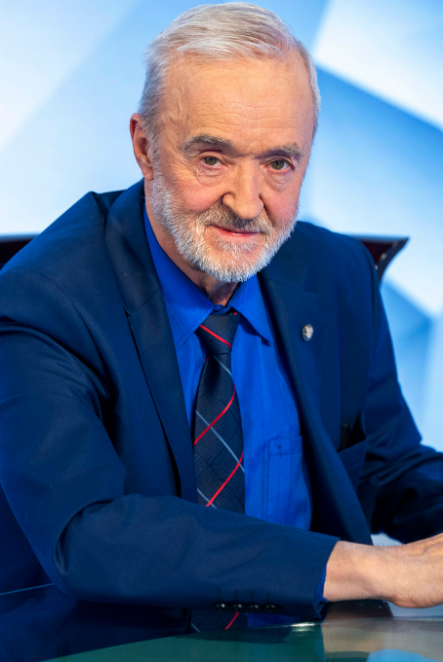
On January 28, Nikolai Nikolaevich Nechaev, Academician of the Russian Academy of Education, Doctor of Psychological Sciences, Professor at the UNESCO Department "Cultural-Historical Psychology of Childhood" at MSUPE, and member of the Editorial Board of the journal "Cultural-Historical Psychology," celebrates his 80th birthday.
Nikolai Nikolaevich belongs to those scholars for whom science is a learning process not only in the sense of doctrine. Although behind him—and within him—lies the great scientific school of his teacher Pyotr Yakovlevich Galperin, a researcher of learning as the development of thought. And throughout his extraordinarily productive life, he has been engaged in continuous learning—as a scientist, as a teacher, and as a student. It is difficult for him to separate these qualities. Moreover, as V.V. Davydov said, "I have many sources," and N.N. Nechaev could repeat this after him. He realizes in his own creative work the entire powerful, productively "explosive" (like the jubilarian himself) potential of cultural-historical and theoretical-activity psychology "in his own unusual manner" (Vladimir Vysotsky).
Undisputed authority, deserved statuses and regalia are not an obstacle to this. Theoretical psychology, its fundamental categories (which students already "memorize"), reside in Nikolai Nechaev's thought in a state of continuous self-justification. Therefore, he draws his students, master's students, and postgraduates into the process of developing science, which he creates before their eyes and with their participation, rather than sharing the "results of what has been accomplished." Professor Nechaev's lessons are always for growth: for the growth of the person in psychology.
According to N.N. Nechaev, the human world is defined in the coordinates of modes of action, ways of activity, rather than ready-made objectivity that is to be mastered through the same activity. In psychology, we study ourselves in action, and through this—the objects of action as well. And the product of creativity captures the potential of the creator's self-transformation. Shakespeare before "Hamlet" and after is different; the creations are different, the world before "Hamlet" and after is different, because Shakespeare concentrated within himself the entire historical force of its transformation during the Renaissance—and became different.
Nikolai Nikolaevich is one of those who, in cultural-historical psychology, made the transition from studying the appropriation of cultural artifacts to studying the mastery of cultural artifacts, in the words of Michael Cole.
In relation to creations so wondrous that they do not fit into the orbit of our experience (even if we call it activity-based, utilitarian), the question "what is this and what to do with it?" is preceded by Kant's: "how is this possible?" Culture accumulates in images of possible transformations — it is written in their language, in the language of readiness for creativity, which becomes the language of human self-consciousness. It has a vocabulary — a vocabulary of models.
It is no coincidence that N.N. Nechaev devoted himself to the problems of architectural creativity, its specific projectivity, and even wrote a remarkable doctoral dissertation on this subject. Architecture is not "bare" artifacts, but artifacts that have become historical "artifacts" [artefacts in the active sense]: frozen search for the space of forms of living creative communication among people involved in their production. Architecture, already at the project level, is the embodied unity of communication and generalization. The 21st century is the century of globalization of artifacts, in which hidden possibilities for human development are sought, including in the global network.
Once Nikolai Nikolaevich was asked how much time he spends preparing a lecture. One of the best lecturers in psychology answered wisely, honestly, and precisely: "I have been preparing for it my entire life." Probably, he would answer the same way if asked how much time he needs to supervise a postgraduate student, a master's student, to prepare a study, an article, a book. He measures by life the readiness for action, thought, word.
May life continue! May readiness for creativity accumulate! After all, there are still so many lectures, meetings with students and followers, articles and books ahead.
Professor Nechaev is today at the peak of his form. There is nothing important in science and education toward which he remains indifferent, in which he is not, as M.M. Bakhtin said, "participative." The Bakhtinian "participativity in being" is his life position.
Happy anniversary, dear Nikolai Nikolaevich! Wishing you joyful creativity!
V.T. Kudryavtsev
Doctor of Psychological Sciences
Professor at the Moscow Institute of Psychoanalysis and Moscow State University of Psychology and Education
Deputy Editor-in-Chief of the journal "Cultural-Historical Psychology"
The editorial noard of the journal "Cultural-Historical Psychology" joins in the anniversary congratulations to Nikolai Nikolaevich Nechaev.