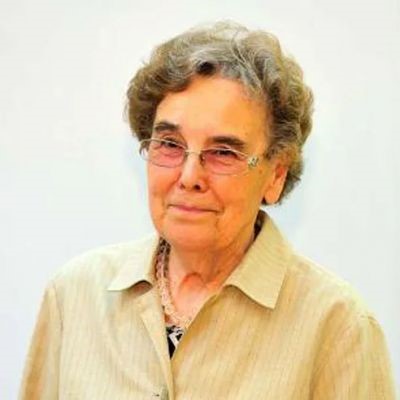
On December 24, 2025, at the age of 91, Corresponding Member of the Russian Academy of Education, Doctor of Psychological Sciences, Professor Antonina Nikolaevna Zhdan, an outstanding historian of Russian and world psychology, passed away.
In 1980, an important event took place. Every Soviet psychology student gained the opportunity to read significant excerpts from the works of Aristotle, Freud, Lewin, and others in the Anthology of General Psychology, edited by P.Y. Galperin and A.N. Zhdan. The very surname "Zhdan" itself became textbook (Pyotr Yakovlevich had become a "textbook name" earlier). And it wasn't just students — the anthology was cited in academic works, as other sources were often inaccessible.
A lot is being published now. Perhaps historians of psychology are no longer needed? A disappearing profession. Everyone can manage on their own. But there is no growth of historicism in professional consciousness. Quotemanship is on the rise—including through "internet quotes". People rarely "dig down" to primary sources. In old universities, science was studied through chapters of classical works. Through exemplars of scientific thinking. And that is exactly how history was studied.
It is worth recalling that history (ἱστορία) translated from Ancient Greek means questioning, inquiring — that is, research. And "textbookization" is merely its outcome. As Marc Bloch wrote, "...causes in history, as in any other field, cannot be postulated. They must be sought". And the search for causes is already theory.
It is often said: "history is fading away". And indeed, history is fading from psychology. The self-awareness of the science is fading away, and with it, the understanding of theory — not the meaning of common words, but the meanings that shape thought.
Antonina Nikolaevna did not merely analyze and preserve the history of psychology. She was not merely its witness. Together with her teachers, she created—she made the history of psychology. And yet, she was remarkably modest.
Her creative work, books, articles, textbooks, and anthologies are a safeguard against falling into historical oblivion in 21st-century science, against a critical halt of thought. Against the feeling of a blank slate—one on which it is difficult to write anything coherent, especially since it has already been inscribed by outstanding thinkers.
The best memory of Antonina Nikolaevna is our thinking. Just as our love for her and our love for historically developing psychology are feelings that cannot be separated.
One small detail. Even in her later years, Antonina Nikolaevna was composed, cheerful, and energetic. She walked quickly. Once we were walking from the Faculty of Psychology at Moscow State University toward the Institute of Asian and African Countries. She had gone far ahead, and I exclaimed: "Antonina Nikolaevna, I can't keep up with you, give me a head start!" That captures the essence. It was formulated by Mandelstam: "The teacher is younger than the student. Because he runs faster".
Our condolences to our friends — Marina Stepanova and Sergey Stepanov, to all who held Antonina Nikolaevna dear, to everyone for whom, since their student days, she lovingly and caringly opened a kind path into our science through its difficult yet beautiful History.
Fortunately, very many are yet to step onto this path by opening the magnificent books of Professor Antonina Nikolaevna Zhdan. And perhaps, they will receive a "head start" from her.
V.T. Kudryavtsev
Doctor of Psychological Sciences
Professor at the Moscow Institute of Psychoanalysis and Moscow State University of Psychology and Education
Deputy Editor-in-Chief of the journal "Cultural-Historical Psychology"