Introduction
The landscape of education is undergoing a profound transformation, driven by the relentless evolution of digital technologies. Among the innovative pedagogical approaches gaining attention, digital gamification emerges as a promising avenue for enriching student engagement and amplifying learning outcomes. Gamification, the integration of game elements into non-game contexts, has been recognized as a crucial tool in advancing educational technology [Simões, 2013]. This approach enhances engagement, motivation, and learning outcomes through various forms like digital platforms, classroom activities, and educational apps [Mohamad, 2018; Saleem, 2022]. Extensive research has explored its application across diverse educational levels and subject areas, demonstrating its versatility and potential in modern pedagogy [Alhammad; Bencsik; Hursen, 2019; Piteira, 2018].
Although gamification in education has been extensively studied, tailored digital gamification, which customizes game elements for specific learners and environments [Klock, 2020; Oliveira, 2023], remains under-researched. This approach rejects a one-size-fits-all model and aligns with the shift towards student-centered learning [Hallifax; Klock, 2020]. Therefore, investigating tailored digital gamification is crucial for creating effective learning environments that cater to diverse student needs and promote positive outcomes [Oliveira, 2023].
Despite the potential of tailored digital gamification in education, its adoption among Vietnamese university lecturers remains slow. This research aims to explore the reasons behind their reluctance, a topic largely overlooked in the existing literature, which primarily focuses on the benefits of gamification [Rojabi, 2022; Topal, Akgun Ö, 2021; Welbers, 2019]. Understanding these underlying factors is crucial for successful implementation. Confucian values, deeply ingrained in Vietnamese culture, emphasize hierarchy and respect for authority [Borton, 2000; Nguyen, 2016a; Truong, 2017], potentially influencing lecturers' openness to novel teaching methods like gamification. Additionally, varying levels of technological literacy among lecturers may contribute to their resistance [Nguyen, 2016a]. Examining these cultural and technological factors provides crucial insights for educational stakeholders to develop effective strategies for incorporating digital gamification into Vietnamese higher education.
This study investigates Vietnamese lecturers' perspectives on digital gamification in teaching. It fills a crucial gap in the literature, which primarily focuses on the benefits and motivations for adoption rather than reasons for hesitancy. Understanding these perspectives and their cultural context is vital for developing effective strategies to promote the successful implementation of innovative teaching methods in Vietnamese higher education.
Literature review
Digital Gamification in education
Gamification, the integration of game elements into learning environments, has emerged as a promising strategy to counter students’ demotivation [15; 30; 37; 60]. By incorporating game design elements like challenges, rewards, and competition, gamification aims to engage students, motivate their actions, and enhance learning outcomes [Deterding, 2011; Vélez Meza]. While computer-based methods are commonly employed in gamified classrooms, it is not mandatory [7; 20]. Digital gamification specifically focuses on incorporating game elements into digital platforms, while normal or traditional gamification is a more inclusive term that encompasses both digital and non-digital contexts [Qiao, 2023; Sanchez-Mena, 2017].
Digital gamification has shown promise in enhancing student motivation, engagement, and academic performance across various educational levels and subjects [1; 3; 12; 21; 54]. Immediate rewards in the form of points and badges, coupled with a narrative base, can effectively engage students with lower motivation levels [Campillo-Ferrer J.-M, 2020; Liu, 2023; Su, 2015; Venkatesh, 2008]. However, its disadvantage lies in the potential for gamified learning environments to distract students from the core educational objectives [Chen, 2015; Christopoulos, 2023; Sailer, 2020]. The potential for over-reliance on extrinsic motivators, such as rewards and competition, raises concerns about the development of intrinsic motivation and a genuine love for learning [13; 22; 56].
Tailored digital gamification in education, which has received insufficient attention from researchers, is imperative due to the profound impact of individual differences, contextual nuances, and task-related aspects on the overall user experience within gamified educational systems [18; 27; 42; 49]. While gamified classes with a one-size-fits-all approach may lead to, or exacerbate, demotivation, particularly when not accounting for students' individual differences [Koivisto, 2019; Kreuter], a tailored approach is considered a means of enhancing students' gamification experiences [Hong, 2024]. Unfortunately, this aspect has received insufficient attention from scholars.
Vietnamese culture
Vietnam culture, deeply rooted in Confucian values [Murray; Nguyen, 2016a] plays a pivotal role in shaping the perceptions of education and gamification. It emphasizes respect for social hierarchy, maintaining harmony, and collective orientation, contributing to a tight cultural framework in Vietnam [Gelfand, 2011; McCauley, 2020]. This collectivist mindset is reflected in the strong emphasis on family ties, interdependence, and a sense of belonging to larger social entities [Truong, 2017]. Vietnam's rapid economic development has led to increased digital engagement, including gaming, while its collectivist culture and Confucian values shape societal norms and educational practices [McCauley, 2020]. However, the impact of these cultural factors on the adoption of digital gamification in Vietnamese education remains under-researched.
Research Gaps
This research aims to address these gaps by delving into Vietnamese lecturers’ challenges, shedding light on their concerns, perceptions, and the contextual factors that influence their adoption of tailored digital gamification. While existing research explores gamification broadly, studies specifically focused on tailored digital gamification remain limited. This is a crucial area for exploration as it delves into the personalizing game elements to enhance individual learning outcomes in the evolving digital education landscape. Furthermore, existing research often focuses on student perspectives or general gamification effectiveness, neglecting the crucial role of lecturers in implementation. Understanding their concerns and perceptions is vital for developing strategies to support successful adoption in Vietnamese universities. Finally, the current literature offers limited insights into the impact of cultural factors on the acceptance of tailored digital gamification. Therefore, this research will address following research questions:
1. How do university lecturers in Vietnam perceive tailored digital gamification in the context of teaching?
2. What are the primary factors influencing lecturers' reluctance to integrate tailored digital gamification in university teaching in the Vietnamese context?
3. How do cultural factors impact lecturers' attitudes and hesitations toward the adoption of tailored digital gamification in teaching?
Methods
Research design
This study employed a qualitative approach, specifically semi-structured interviews, to gain in-depth insights into the factors influencing Vietnamese university lecturers' reluctance to integrate digital gamification. This method allows for capturing the complex cultural, social, and institutional nuances within the Vietnamese higher education context that quantitative methods may not fully reveal [Cassell; Taylor]. By allowing participants to express themselves freely, semi-structured interviews provide a deeper understanding of lecturers' lived experiences, perceptions, and decision-making processes regarding gamification adoption [Taylor].
Sampling
In this research, stratified sampling was employed to ensure a comprehensive representation of the participant population. Participants were divided into distinct groups based on geographic location, teaching experience, education level, discipline, and previous experience with gamification. This method systematically selected participants from each subgroup, allowing for the exploration of nuanced perspectives across diverse backgrounds and regions, thereby enhancing the validity and generalizability of the findings.
Participants
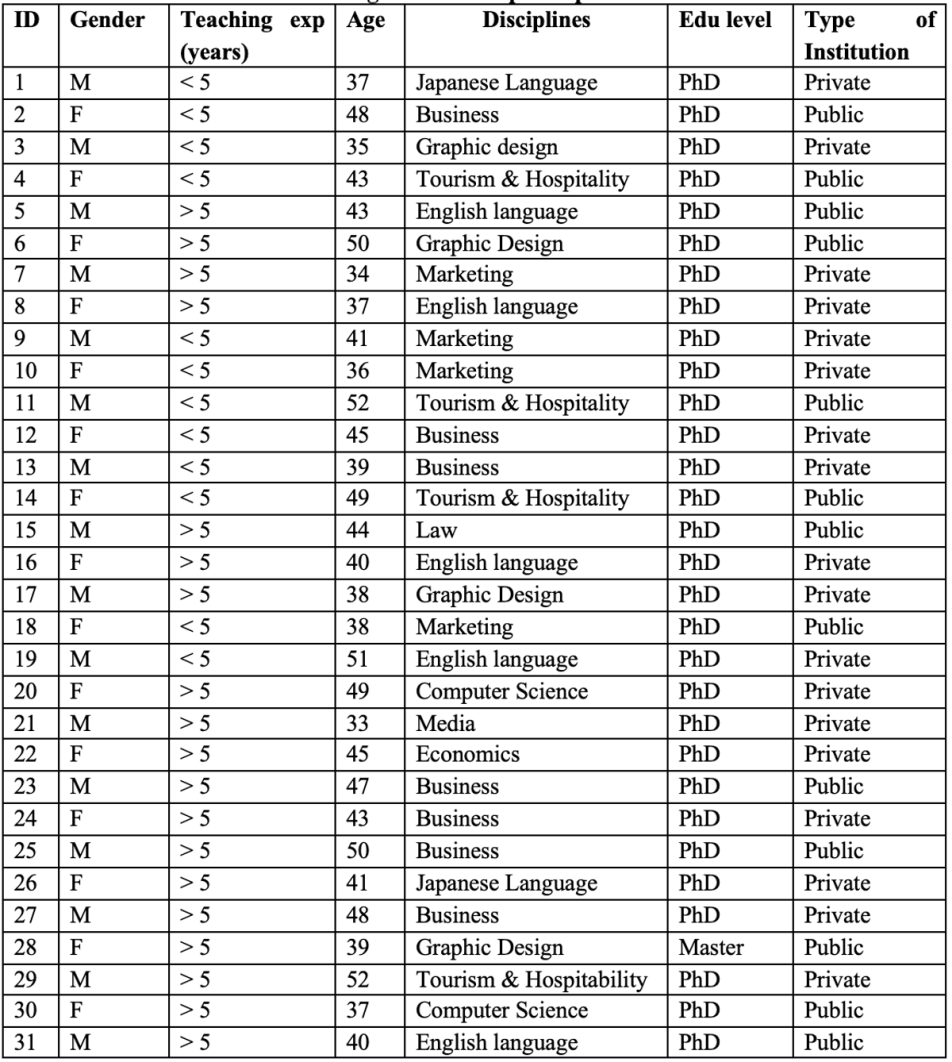
Fig. 1. Profile of participants
The participants in this study represent a diverse cohort drawn from various demographic and professional backgrounds across different regions of Danang, Ho Chi Minh, and Hanoi (as shown in Fig. 1). The 31 participants in this study represented a diverse cohort across gender, teaching experience (under/over 5 years), educational backgrounds (primarily doctoral), disciplines (business, tourism, etc.), and prior gamification exposure. Statistical tests confirmed group homogeneity across key variables, ensuring a robust sample for analysis. To assess the homogeneity of participant groups, statistical tests (including t-test and Chi-square test) were conducted across key variables, including gender, teaching experience, education level, previous experience with gamification, and location. In this research, the homogeneity test holds paramount importance as it ensures the validity and reliability of our findings as well as enhances the generalizability of our results, allowing for broader applicability to the population or context of interest. The results indicated no significant differences among participant groups for teaching experience, age, type of institution, and previous tech integration, ensuring a robust and balanced sample for the study's analyses.
Data collection
Semi-structured interviews, guided by a flexible interview guide, were conducted via Zoom or Google Meet. Each 45-minute session explored participants' understanding of gamification, their experiences, perceived benefits and challenges, and recommendations for implementation (see Appendix).
Data analysis
The data analysis for this research utilized a mixed-methods approach, combining both content analysis and thematic analysis to systematically explore the factors influencing university lecturers' reluctance to integrate digital gamification in teaching [Taylor]. The mixed-methods approach offers a comprehensive exploration of the research topic, combining the strengths of both quantitative and qualitative methodologies [Cassell]. This allowed for a deeper understanding of lecturers' reluctance to integrate digital gamification, while maintaining researcher reflexivity and adhering to ethical guidelines throughout the process.
Content analysis was employed to analyze interview transcripts using a predefined coding framework based on the literature and research questions. Quantitative measures were used to identify and quantify prevalent themes [Cassell]. Thematic analysis was used to explore overarching themes and patterns within the qualitative data (as shown in Tab. 1). Coded segments from the content analysis were further analyzed to identify recurrent themes and relationships. Themes emerged through an iterative process of reviewing and synthesizing coded data segments, capturing the essence of participants' responses and experiences related to digital gamification in teaching. Thematic analysis allowed for a deeper understanding of the underlying meanings and connections within the data [Nowell Lorelli, 2017].
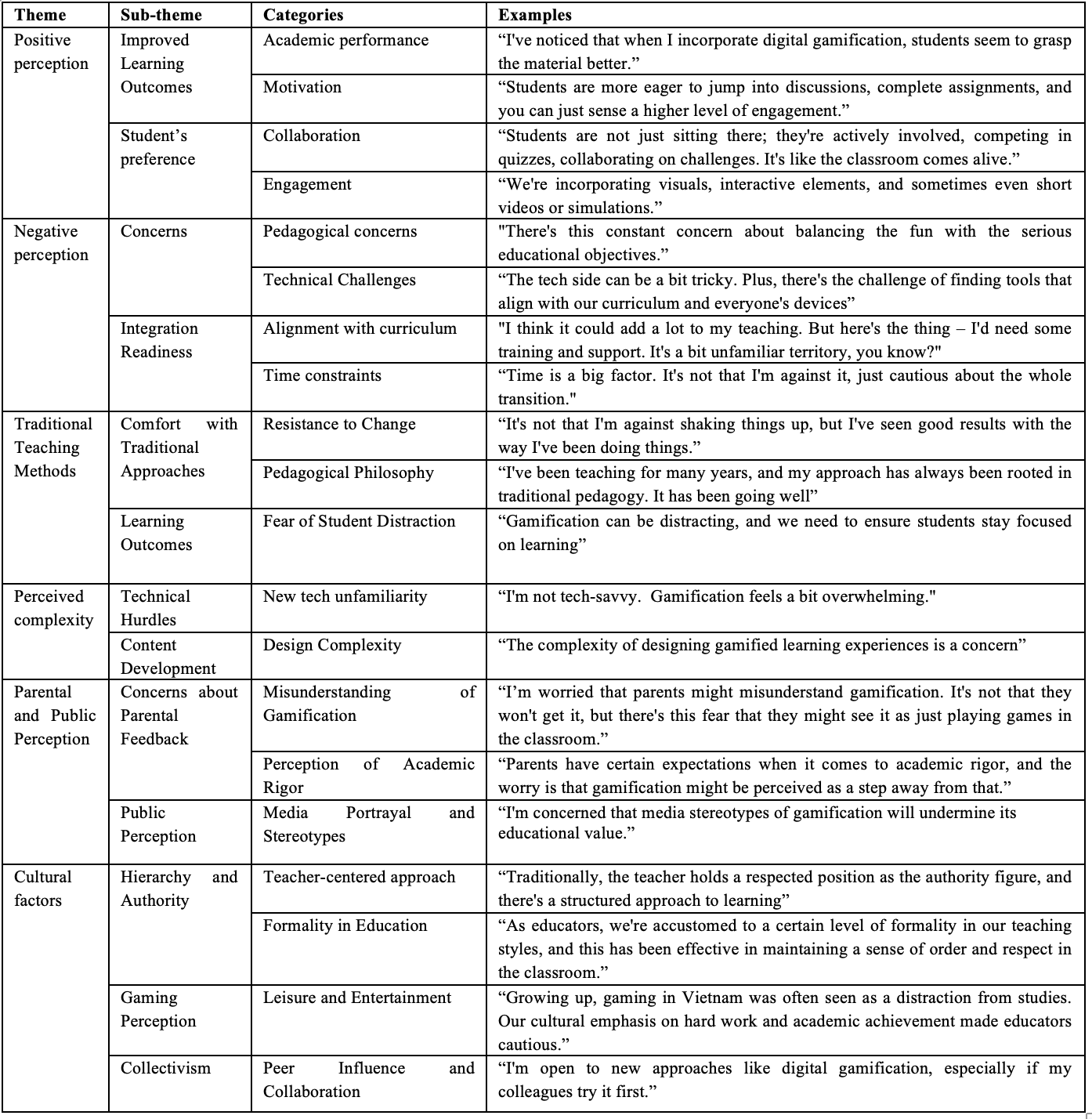
Fig. 2. Themes, sub-themes, categories, examples
Results
Research question 1: How do university lecturers in Vietnam perceive tailored digital gamification in the context of teaching?
Table 1
Lecturer’s perception of tailored digital gamification
|
Perception |
Total (N=31) |
|
Positive |
|
|
Improved Engagement |
21 |
|
Improved Motivation |
18 |
|
Improved academic performance |
7 |
|
Foster collaboration |
19 |
|
Negative |
|
|
Pedagogical concerns |
16 |
|
Technical Challenges |
22 |
|
Time Constraints |
29 |
|
Limited alignment with Curriculum |
20 |
The findings suggest that university lecturers in Vietnam perceive tailored digital gamification in teaching through a predominantly negative lens (as shown in Tab. 1). Overwhelmingly, participants cited time constraints as a significant concern. This finding indicates a widespread belief among lecturers that the design, implementation, and management of tailored digital gamification require substantial time investments. As one participant shared:
“It takes a lot of time for researching and planning, and I’m not really sure about its effectiveness”.
Additionally, most participants highlighted technical challenges as a major barrier. As one participant revealed: “The diverse levels of technological expertise among students introduce an additional layer of complexity. Moreover, locating tools that match our curriculum and accommodate various devices becomes a bit of a balancing act.”
Participants expressed concerns that tailored digital gamification might not align with existing curricula and broader educational goals, raising doubts about its appropriateness in formal education.
Research question 2: What are the primary factors influencing lecturers' reluctance to integrate tailored digital gamification in university teaching in the Vietnamese context?
Table 2
Influencing factors for Vietnamese lecturers' reluctance to adopt digital gamification
|
Factors |
Total (N = 31) |
|
Comfort with Traditional Approaches |
22 |
|
Perceived complexity |
22 |
|
Parental Perception |
14 |
|
Public Perception |
17 |
|
Perceived Student Reaction |
5 |
|
Professional Development Needs |
7 |
|
Institutional Support |
4 |
|
Lack of Evidence-Based Practices |
3 |
|
Lack of incentives |
3 |
1. The majority of participants expressed a strong preference for traditional teaching methods due to familiar instructional approaches (as shown in Tab. 2), creating a resistance to change. While not inherently opposed to innovation, lecturers hesitate to deviate from methods that have consistently yielded positive results over the years. When being asked about reasons for their reluctance, two participants shared:
“The way I learned during my university years was through traditional methods, and I successfully completed my education. I believe in the effectiveness of that approach, and it's been the foundation of my teaching”.
“I feel confident in my ability to measure learning outcomes and identify areas for improvement using these traditional methods.”
Additionally, there is a prevailing concern about potential student distraction, emphasizing the need to ensure that gamified elements align with core educational goals and do not compromise focused learning.
2. Perceived complexity was a major barrier for lecturers, encompassing technical challenges, time constraints, and the intricacies of content development. Many expressed discomforts with new technologies and a lack of training in innovative teaching methods like gamification. When questioned about the reason for not implementing tailored digital gamification, participants expressed:
“Throughout my teaching career, I have yet to encounter any formal training sessions or workshops specifically addressing gamification.”
“As someone who's not tech-savvy, the thought of implementing gamification can be intimidating. Without access to training or workshops, it's challenging to build the confidence to try something new.”
Furthermore, concerns about potential disruptions during gamified lessons without adequate technical support add to the apprehension. The challenges related to content development in gamified settings include concerns about aligning gamified content with the existing curriculum. They often used words like “complex”, time-consuming”, “careful planning”. The time required to learn and adopt new gamification tools, especially when unfamiliar, adds an extra layer of complexity, further contributing to lecturers' reservations.
3. A notable portion of participants identified parental and public perception as influential factors. They expressed worries that parents might misinterpret the concept of gamification, fearing that it may be perceived as mere gameplay in the classroom rather than a strategic educational tool.
“I can't help but think about how parents might react to gamification. There's this concern that they might not fully grasp the educational side of it and simply see it as playtime.”
Additionally, lecturers articulate concerns about how gamification is portrayed in the media, fearing that negative portrayals or stereotypes could influence public opinion: “I've seen articles and reports on gamification that paint it as a distraction or a fad. These stereotypes are hard to shake off."
Research question 3: How do cultural factors impact lecturers' attitudes and hesitations toward the adoption of tailored digital gamification in teaching?
Table 3
Cultural factors affecting lecturers' reluctance to digital gamification adoption
|
Factors |
Total (N = 31) |
|
Hierarchy and Authority |
22 |
|
Gaming Culture |
16 |
|
Collectivism |
18 |
|
Uncertainty Avoidance |
2 |
|
Time orientation |
2 |
1. Findings indicate a strong influence of cultural factors, particularly hierarchy and authority, on Vietnamese lecturers' reluctance to adopt digital gamification (Tab. 3). When questioned about how cultural values influence their teaching style, one participant revealed:
“Our teaching tradition places teachers at the center, and it's something we've grown up with. In our Asian context, the role of a teacher is not just about imparting knowledge; it extends to being a moral guide and a figure of authority.”
Some participants expressed their fear of a potential loss of control or authority when implementing gamified elements. One teacher revealed:
“I worry that embracing digital gamification might introduce an element of chaos. Our students are used to a more controlled setting, and this interactive approach feels like it could disrupt the order we've maintained in the classroom.”
Lecturers emphasized the significance of formality in education: “The community we serve has a strong preference for a formal learning environment. Gamification is a bit outside the norm, and there's this worry about how it might be perceived.”
2. Gaming perception is another significant factor due to its cultural association with leisure rather than education. This historical view of gaming as a distraction from academic pursuits in Vietnam has instilled caution among educators: “Gaming, for me, is a fantastic way to unwind and have fun. However, as agreed by many people, you cannot really focus and retain knowledge if you are having too much fun.”
The traditional values of diligence and prioritizing academic success have contributed to a cautious approach, viewing gaming as “a non-serious pursuit”, potentially diverting Vietnamese students' attention from their studies. This cultural lens has influenced educators to be wary of incorporating digital gamification into teaching methodologies, as it is often perceived as deviating from the serious pursuit of academic excellence.
“Parents and educators often prioritize diligence and hard work. Gaming, unfortunately, is seen as more of a distraction than a tool that can contribute to learning."
3. The collectivist culture in Vietnam significantly influences lecturers' attitudes toward digital gamification, with a preference for adhering to traditional methods used by colleagues. This reluctance stems from a cultural norm of collective decision-making, where deviating from established practices is discouraged. Lecturers emphasize the importance of peer influence and collaboration in their willingness to adopt new approaches: “If a majority of lecturers were already incorporating gamification, I'd definitely follow suit. It's all about staying in sync with the prevailing trends and approaches within the academic community. However, now, not many of my colleagues have ventured into gamification.” They expressed curiosity about learning from the experiences of others, however, they need to balance between established practices and potentially transformative approaches.
Discussion
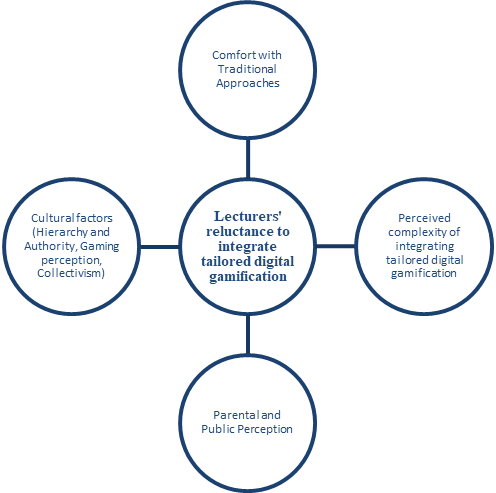
Fig. 3. Factors impacting lecturers' reluctance to integrate tailored digital gamification
Despite the acknowledged benefits of digital gamification, lecturers are reluctant to adopt tailored digital gamification due to the preference for established traditional teaching methods, perceived as effective. This aligns with previous research highlighting resistance to change and a preference for familiarity in educational practices [5; 26; 33]. The desire to maintain the perceived effectiveness of established practices, as highlighted in this study, resonates with Hamlaoui (2021)’s argument that educators often resist changes that challenge the familiar and proven [Hamlaoui, 2021]. Therefore, the familiarity and comfort with the established practices can create a sense of security and confidence among lecturers, making them hesitant to venture into new approaches.
In Vietnamese context, many educators perceive digital gamification as complex and unfamiliar, requiring significant effort to design and implement effectively. This aligns with studies on technology acceptance [Panagiotarou, 2020] revealing that perceived technical difficulty negatively impacts adoption. The time-consuming nature of tailoring gamification to individual student profiles further compounds this reluctance [Hallifax]. Thus, targeted training, support, and resources are necessary to alleviate these concerns and promote wider adoption.
The surprising finding that parental and public perception significantly influences lecturers' reluctance to integrate digital gamification in university teaching within the Vietnamese context indicates a potential lack of awareness or understanding regarding the educational value and purpose of digital gamification [Xie, 2021]. Additionally, parents' views on the educational merits of digital games are notably shaped by the adverse depiction of digital games in mass media [Bourgonjon, 2011]. Media often highlights stories linking game-playing to internet addiction. This influx of negative information could impact individuals' attitudes towards game-based learning, particularly when they possess limited fundamental knowledge of educational games [Xie, 2021].
Culture has strong influence on this gamification hesitation. Confucian values and a “high power distance” culture promote a traditional teacher-centered approach where students are passive learners [Huong, 2016]. This deeply ingrained norm, coupled with the collectivist tendency to conform to established practices [McLeod, 1994], makes lecturers reluctant to deviate from traditional methods. The prevailing norm of collective decision-making contributes to resistance [McLeod, 1994], as lecturers might see adopting gamification as unnecessary when colleagues adhere to traditional methods. This tendency is particularly notable among lecturers from public universities, emphasizing the influence of collective practices within the academic community. Moreover, Vietnam's long-term orientation, characterized by a strong emphasis on hard work and persistence [Borton, 2000; Huong, 2004], contributes to this reluctance. Lecturers may question the effectiveness of gamification in fostering long-term retention of knowledge, as the traditional mindset places a premium on enduring challenges for lasting achievement. Particularly, the reluctance of lecturers influenced by the perception of the public and societal norms, reflects the broader cultural context in Vietnam. In Vietnam, where there is less tolerance for deviant behavior [McCauley, 2020], certain aspects of gaming might be scrutinized or viewed with caution. The emphasis on social cohesion and conformity can lead to a more conservative view of gaming activities [McCauley, 2020; Murray]. Particularly, little experience with digital educational games makes them lack insights into their potential benefits and role in enhancing the learning experience [Bourgonjon, 2011].
Conclusion
This study reveals that Vietnamese lecturers recognize the potential of tailored digital gamification but face barriers to adoption, including pedagogical concerns, technical challenges, and time constraints. Cultural factors and societal perceptions further complicate the integration process. To facilitate successful implementation, comprehensive strategies are needed. These strategies should include providing tailored professional development for lecturers, aligning gamified content with curricula, and fostering a supportive environment through public engagement and policy interventions. By addressing these multi-faceted challenges, stakeholders can ensure the effective and sustainable integration of digital gamification in Vietnamese higher education.
Limitations and Recommendations
While this study offers valuable insights, caution is advised when generalizing findings due to the small sample size. Future research could address this with a larger, more diverse sample and a longitudinal design to capture evolving perceptions over time. Additionally, while content analysis provided useful insights, its structured nature may have limited the exploration of emergent themes. Future studies could expand the scope of analysis and specifically examine the mechanisms through which cultural factors influence perceptions of gamification.