Introduction
Emotional intelligence and existential competence constitute two essential dimensions of human development that support academic achievement, psychological adjustment, and social integration. Emotional intelligence (EI), defined by Goleman (1995) as the capacity to perceive, understand, and regulate emotions in oneself and others, has been shown to contribute to communication effectiveness, stress tolerance, and interpersonal competence (Pankratova, Nikolaeva, 2022). Existential competence (EC), in this study, refers to an individual’s capacity to construct meaning, develop self-reflection, integrate value-oriented reasoning into everyday life, and regulate inner experiences, contributing to ethical discernment and a coherent sense of life purpose (Zohar, 2000; Ozhiganova, 2023).
A growing body of research indicates that both EI and EC are shaped by complex interactions between external and internal factors. External influences include supportive school environments, pedagogical approaches that emphasize reflection and mindfulness, and curricula that integrate value-oriented content (Bordunos et al., 2024; Vorobyeva et al., 2024). Internal factors involve emotion-regulation skills, self-directed learning, and reflective capacities, which are often cultivated through regular reflective routines (Eid, 2024; Poskakalova, 2023). Empirical studies demonstrate that daily practices involving focused attention, contemplation, and structured self-reflection enhance emotional stability, intrinsic motivation, and ethical awareness, thereby strengthening both EI and EC (Poskakalova, 2023; Sujadi, Sulistiyo, 2025).
Although institutional value-oriented exposure and individually enacted reflective practices are conceptually related, they represent distinct psychological constructs. Institutional exposure reflects structured learning environments, formalized content, and organized behavioral expectations, whereas reflective practices refer to lived, experiential engagement with meaning-making, personal evaluation, and value-oriented behavior. This distinction is particularly relevant in educational contexts where students are exposed to structured normative content yet differ substantially in the extent to which such exposure is internalized into personal routines. Daily reflective activities—such as repeated self-evaluation, focused attention exercises, and habitual contemplation—function as mechanisms of emotional regulation and cognitive integration, providing a behavioral pathway through which value-oriented learning may influence EI and EC.
Despite this theoretical connection, empirical studies disentangling institutional educational exposure from individually enacted reflective practices remain limited, particularly in Indonesia’s culturally diverse education system. While different types of senior high schools (SMA, SMK, and MA) are designed with varying emphases on general and value-oriented education (Marhaeni Kurdaningsih, Turmudhi, 2020), it remains unclear whether such institutional differences directly foster EI or EC once students transition into university settings. Moreover, most prior studies on EI, existential development, and reflective processes originate from Western or Russian contexts, leaving a significant gap in understanding how these constructs manifest within Indonesia’s socio-cultural environment (Razak et al., 2024).
To address these gaps, the present study investigates the extent to which high school background (SMA, SMK, and MA) relates to university students’ EI and EC, and whether daily reflective practices serve as a more salient predictor of these competencies than formal schooling. The study also examines reflective routines as behavioral indicators of meaning-making, ethical reflection, and emotional regulation. Through this approach, the study offers an empirically grounded perspective on the development of EI and existential competence in Indonesia and contributes recommendations for holistic character-education initiatives at both secondary and tertiary levels.
Materials and methods
A cross-sectional quantitative design was used to examine the relationships among high school background, daily reflective practices, and students’ emotional intelligence (EI) and existential competence (EC). The sample consisted of 754 undergraduates from Universitas Dharmas Indonesia (UNDHARI), selected through simple random sampling. Data collection took place in September 2024 using structured, self-administered questionnaires distributed during scheduled academic activities.
Daily reflective practices were assessed using a 20-item scale rated on a 4-point Likert format (1 = never to 4 = always), producing total scores between 20 and 80. Following established cut-off criteria, scores of 20–49 indicated low engagement, 50–74 medium engagement, and 75–80 high engagement in daily reflective routines. Emotional intelligence (EI) and existential competence (EC) were measured using validated 30-item instruments with the same 4-point response format, yielding composite scores from 30 to 120. Scores of 30–74, 75–112, and 113–120 were classified as low, medium, and high levels of EI and EC, respectively. The construct of existential competence in this study is operationalized based on dimensions of meaning-making, self-reflection, and value-oriented reasoning, while maintaining the original measurement structure and psychometric properties of the instrument.
Reliability testing demonstrated excellent internal consistency across all scales, indicating strong measurement stability. To analyze group differences, a multivariate analysis of covariance (MANCOVA) was performed using Jamovi 2.3. High school type (general/SMA, MA, and vocational/SMK) served as the independent variable, while EI and EC were the dependent variables. Daily reflective practice scores were entered as a continuous covariate to distinguish individually enacted behavioral routines from formal educational exposure. Age and gender were included as statistical controls.
Before conducting the analysis, core assumptions were examined, including multivariate normality, homogeneity of covariance matrices (Box’s M), and equality of error variances (Levene’s test). Given minor deviations from normality and covariance homogeneity, Pillai’s Trace was used as the primary multivariate test statistic due to its robustness under assumption violations.
Results
- Data description
The study involved 754 undergraduate students aged 20–24 years from Universitas Dharmas Indonesia. The sample consisted of 552 females (73,2%) and 202 males (26,8%), reflecting the typical gender distribution in education and health-related programs in Indonesian universities. Students were distributed across major fields of study, including Education, Health Sciences, Economics and Business, and Computer Studies. In terms of secondary education background, participants were graduates of general senior high schools (SMA), vocational schools (SMK), and MA, representing the diversity of Indonesia’s educational pathways and varying degrees of institutional educational exposure. Fig. 1 illustrates the regional distribution of participants.
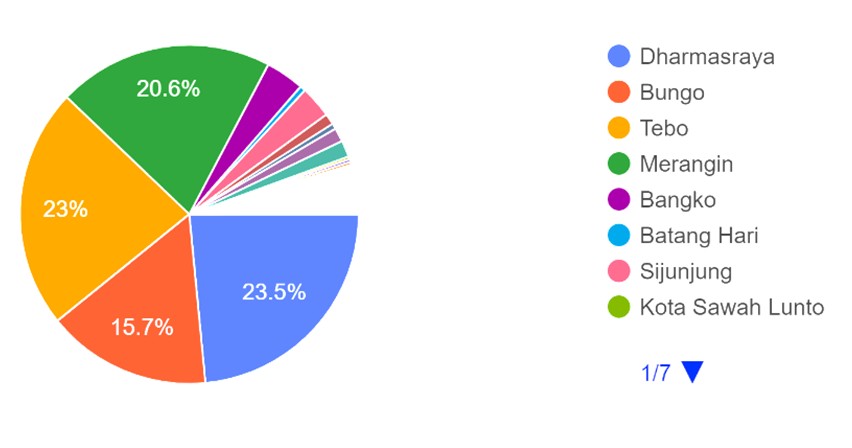
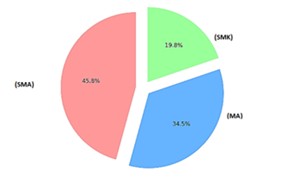
Fig. 2 displays the distribution of students based on the type of senior high school they attended prior to university enrollment. Among the respondents, 45,8% (approximately 345 students) graduated from general senior high schools (SMA), 34,5% (around 260 students) from MA, and 19,8% (approximately 149 students) from vocational senior high schools (SMK). These figures reflect a predominance of students with general and value-oriented educational backgrounds, while graduates from vocational schools were comparatively fewer.
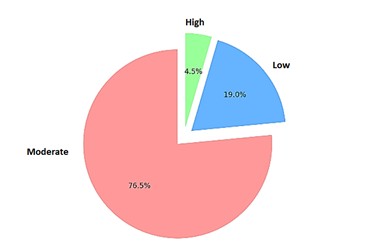
Fig. 3 presents the distribution of students' engagement in daily reflective practices, based on responses to 20 questionnaire items. The majority, 76,5% (approximately 577 students), demonstrated a 'Moderate' level of engagement. Meanwhile, 19,0% (about 143 students) were categorized as having 'Low' engagement, and only 4,5% (approximately 34 students) reported a 'High' level. These findings indicate that most students moderately engage in reflective practices in their daily lives.
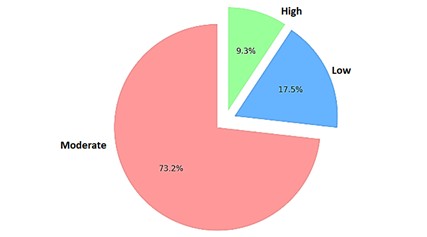
Fig. 4 shows the distribution of emotional intelligence (EI) levels. Based on responses to 30 questionnaire items, 73,2% (approximately 552 students) demonstrated a 'Moderate' level of EI, 17,5% (approximately 132 students) showed 'Low' EI, and 9,3% (approximately 70 students) were classified in the 'High' category. These results suggest that most students possess a moderate capacity for emotional regulation, although a smaller proportion may require further development in emotional self-regulation and self-awareness.
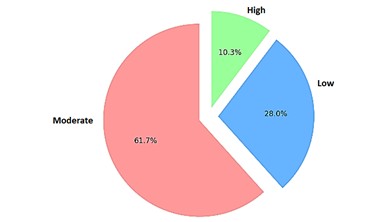
Fig. 5 presents the distribution of existential competence (EC). Among the 754 respondents, 61,7% (approximately 465 students) were classified in the 'Moderate' category, 28,0% (approximately 211 students) in the 'Low' category, and 10,3% (approximately 78 students) in the 'High' category. While the majority exhibit moderate levels of existential competence, a substantial proportion demonstrates lower EC levels, suggesting the need for further development, particularly in areas related to meaning-making, self-reflection, and value-oriented reasoning in daily life.
The correlation analysis demonstrated strong, positive, and statistically significant relationships among daily reflective practices, emotional intelligence, and existential competence. The Pearson correlation coefficient between daily reflective practices and emotional intelligence was 0,716, indicating that students who engage more consistently in reflective routines tend to report higher capacities for recognizing, understanding, and managing their own emotions as well as the emotions of others. The correlation between daily reflective practices and existential competence was also substantial at 0,593, suggesting that regular engagement in reflective activities is meaningfully associated with an individual’s capacity for meaning-making, ethical reasoning, and self-reflection. Furthermore, emotional intelligence and existential competence were strongly related, with a correlation coefficient of 0,696, reflecting considerable conceptual and functional overlap while confirming that these remain distinct constructs.
The consistency of these results was further supported by the Spearman and Kendall coefficients. Spearman’s rho for daily reflective practices and emotional intelligence was 0,660, and Kendall’s tau was 0,509, both of which were highly significant. Similar patterns appeared for the other variable pairs. These results confirm that the associations remain stable even when using rank-based methods that do not assume linear relationships or interval-scaled data. Such agreement across Pearson, Spearman, and Kendall coefficients suggests that the observed relationships are not solely due to measurement effects but instead reflect meaningful patterns in the data.
The narrow confidence intervals for these correlations add further confidence in the reliability of the estimates, considering the large sample size of 754 students. Overall, these correlation results provide solid empirical evidence to justify including daily reflective practices as a central predictor in subsequent multivariate analyses of emotional intelligence and existential competence among university students.
- Data reliability estimation
To ensure the reliability of instruments used to measure high school type, reflective practices, emotional intelligence, and existential competence, internal consistency analyses were conducted based on responses from 754 students. Reliability was assessed using Cronbach’s α and McDonald’s ɷ. The results are presented in Table 1.
Table 1
Scale reliability statistics
|
Variables |
Cronbach's α |
McDonald's ɷ |
|
Reflective Practices |
0,884 |
0,883 |
|
Emotional Intelligence |
0,943 |
0,944 |
|
Existential Competence |
0,948 |
0,948 |
Cronbach’s α coefficients were 0,884 for the Reflective Practices scale, 0,943 for the Emotional Intelligence scale, and 0,948 for the Existential Competence scale; corresponding McDonald’s ɷ coefficients were 0,883, 0,944, and 0,948, respectively. All reliability estimates exceed the commonly accepted threshold of 0,70, demonstrating excellent internal consistency and confirming the robustness of the instruments.
- MANCOVA test
A Multivariate Analysis of Covariance (MANCOVA) was conducted to examine the effects of high school type (SMA, MA, SMK) and continuous reflective practice scores on emotional intelligence (EI) and existential competence (EC), controlling for age and gender. Assumption checks revealed significant heterogeneity of covariance matrices, Box’s M = 16,30, p = 0,012, and departure from multivariate normality, Shapiro–Wilk W = 0,943, p < 0,001. Accordingly, Pillai’s Trace was used for robust inference. The multivariate tests indicated no significant effect of high school type on the combined dependent variables, Pillai’s Trace = 0,005, F(4, 1500) = 0,915, p = 0,454, partial η² = 0,003. In contrast, reflective practices demonstrated a strong multivariate effect, Pillai’s Trace = 0,534, F(2, 749) = 428,69, p < 0,001, partial η² = 0,53.
Follow-up univariate ANCOVAs decomposed the multivariate effect of reflective practices. Reflective practices significantly predicted EI, F(1, 750) = 225,47, p < 0,001, partial η² = 0,23, and EC, F(1, 750) = 310,82, p < 0,001, partial η² = 0,29. Bonferroni-adjusted post hoc contrasts among high school types revealed no significant pairwise differences on either EI or EC (all p > 0,10). The results indicate that daily reflective practices account for 23% of variance in EI and 29% of variance in EC, underscoring their critical role in developing emotional and meaning-oriented competencies among Indonesian university students. Conversely, the type of secondary schooling exhibits negligible influence when reflective practices and demographic covariates are controlled. These findings highlight the primacy of individual engagement in reflective routines over formal educational background in shaping EI and EC. Pillai’s Trace was employed as a robust alternative given its resistance to assumption violations. The results are presented in Table 2.
Table 2
Pillai’s Trace MANCOVA Test
|
Value |
F |
df1 |
df2 |
p |
|
|
Senior high school type |
0,005 |
0,915 |
4 |
1500 |
0,454 |
|
Reflective practices |
0,534 |
428,69 |
2 |
749 |
<0,001 |
The results show no significant effect of senior high school type on emotional intelligence or existential competence (p = 0,454). In contrast, reflective practices had a strong and significant effect (p < 0,001), confirming their critical role in developing both EI and EC. These findings underscore the limited influence of formal educational background and the substantial impact of daily reflective engagement.
Discussion
The present study produced two major findings that provide insight into the development of emotional intelligence and existential competence among Indonesian university students. First, the type of high school attended (general (SMA), vocational (SMK), or MA) did not significantly influence students’ levels of emotional intelligence (EI) or existential competence (EC). Second, daily reflective practices emerged as a strong and consistent predictor of both EI and EC, even after demographic variables were controlled. These findings highlight an important conceptual distinction between institutional educational exposure and the lived behavioral dimension of reflective engagement.
The absence of an effect of high school background suggests that formal schooling, including value-oriented education in MA settings, may not directly shape students’ affective or existential competencies. Emotional intelligence, as defined by Goleman (1995), reflects abilities such as emotional regulation, empathy, and self-awareness competencies that typically develop through interpersonal experiences, family dynamics, and social interactions rather than through formal academic instruction (Bar-On, 2006; Boyatzis et al., 2000; Hoffman, 2009). Similar conclusions have been observed across cultural contexts, including Russian and European studies, which note that emotionally supportive environments and authentic social engagement contribute more strongly to EI than curriculum-based approaches (Anand et al., 2023; Drigas et al., 2023).
A comparable pattern is evident for existential competence. Although MA includes structured value-oriented content, these components often emphasize formal knowledge rather than reflective or experiential engagement. Research indicates that existential competence develops more effectively through continuous self-reflection, ethical engagement, and meaning-oriented participation in daily life rather than through formal content alone (Carr, 2018; Kavar, 2015). The present findings therefore support the idea that institutional exposure does not automatically translate into higher EC unless individuals internalize value frameworks through sustained reflective routines beyond the classroom (Arti et al., 2024; Idris et al., 2023).
In contrast, daily reflective practices were found to be a robust predictor of both emotional intelligence and existential competence. This aligns with theoretical perspectives on reflective engagement, which emphasize that structured practices of attention, contemplation, and self-evaluation create opportunities for individuals to observe emotions, cultivate self-regulation, and frame life experiences within a coherent sense of meaning and purpose (Tirri, 2023; Zohar, 2000). Reflective practices are also associated with emotional resilience, empathy, gratitude, and perspective-taking skills directly related to components of EI (Andrei, 2023; Arti et al., 2024). At the same time, these practices reinforce meaning-making processes, ethical reasoning, and value orientation that underpin EC, as reflected in instruments such as SISRI-24 (Zaini, Hakim, 2023). Studies across diverse cultural contexts similarly show that regular reflective routines promote emotional balance and clarity of purpose, supporting the broader applicability of the present findings (Howard-Snyder, McKaughan, 2022; Aprilianti, 2024).
Importantly, the results also clarify the distinction between institutional exposure and reflective practice. Institutional exposure typically represents structured learning environments, formalized content, and normative expectations, whereas reflective practice refers to the lived behavioral enactment of meaning-making, self-evaluation, and value-oriented action. Although this study did not directly measure institutional adherence as a psychological construct, the strong effect of daily reflective practices demonstrates that behavioral engagement may be a more sensitive indicator of students’ affective and existential development than formal exposure. This also explains why MA graduates did not automatically score higher in EC or EI: while they may have received more structured value-oriented instruction, their ongoing reflective routines appear more decisive in shaping developmental outcomes during university.
The Indonesian socio-cultural context is crucial for interpreting these findings. Daily reflective routines are widely embedded in social and cultural practices, and many students are introduced to structured forms of reflection and value-oriented behavior from an early age. Thus, variation in reflective practice is influenced not only by individual commitment but also by family expectations, peer environments, and community norms. This may help explain why reflective practices remain a strong predictor of EI and EC even after controlling for school type.
Despite relying on self-report instruments, which may introduce common-method bias, cross-checking with multiple correlation coefficients indicated consistent and stable patterns. Future research may employ mixed-method or longitudinal designs to explore how students’ reflective routines evolve across developmental stages and how these routines interact with other psychosocial factors. Structural equation modeling may further clarify the pathways through which reflective practice supports emotional intelligence and existential competence.
Overall, the findings suggest that while formal schooling does not significantly shape students’ emotional intelligence or existential competence, engagement in reflective practices plays a central developmental role. For Indonesian educators and policymakers, these results underscore the importance of complementing curricular content with programs that encourage continuous reflection, ethical engagement, and self-regulation. Such efforts could better support the holistic formation of students, enabling them to develop emotional resilience, moral sensitivity, and a deeper sense of meaning in their academic and personal lives.
Conclusions
This study examined the relative contributions of high school background and daily reflective engagement to the emotional intelligence and existential competence of Indonesian university students. The findings demonstrate that the type of high school (whether SMA, SMK, or MA) did not significantly predict students’ emotional or existential competence, suggesting that institutional differences in curricular orientation do not automatically foster affective or meaning-oriented development. Instead, competencies such as emotional regulation, empathy, and meaning-making appear to be shaped more profoundly by interpersonal interactions, family environments, and community-based socio-cultural experiences than by formal instructional structures.
In contrast, daily reflective engagement emerged as a consistent positive predictor of both emotional intelligence and existential competence. Students who regularly engaged in structured reflective routines exhibited higher levels of emotional balance, ethical awareness, and clarity of purpose. These results highlight an important distinction between formal instruction and lived reflective practice, which functions as an experiential process that supports holistic psychological development.
Implications
The findings underscore the limited impact of formal schooling on the development of emotional and existential competencies and emphasize the central role of reflective engagement in shaping these capacities. For educational institutions in Indonesia, this suggests the need to supplement curricular instruction with programs that promote reflection, ethical engagement, and emotional self-regulation. Initiatives such as mindfulness workshops, structured reflection sessions, service-learning projects, and dialogue-based activities may provide meaningful opportunities for students to cultivate the dimensions of emotional intelligence and existential competence that formal curricula alone are unlikely to develop. Strengthening campus environments that encourage empathy, contemplation, and prosocial behavior can further enhance students’ holistic growth and preparedness for academic and personal challenges.
Limitations and future research
This study has several limitations. Its cross-sectional design restricts causal interpretation, and the use of self-report questionnaires may introduce response bias. The sample was drawn from a single Indonesian region, which may limit generalizability to students from other socio-cultural contexts. Moreover, although daily reflective practices were measured, other relevant factors (such as personality traits, family background, or peer influence) were not included and may account for additional variance in emotional intelligence and existential competence.
Future studies should employ longitudinal or experimental designs to clarify causal pathways between reflective practices and both competencies. Expanding sampling across multiple regions and educational institutions would improve generalizability, while qualitative methods could offer richer insight into how individuals internalize reflective routines. In addition, examining potential mediators such as family environment, peer networks, or personality dimensions could deepen understanding of the mechanisms linking reflective engagement with emotional and existential development.