Introduction
Education serves as a fundamental pillar for national development and societal progress. Higher education, in particular, plays a crucial role in enhancing students’ academic knowledge and skills. Therefore, university students are considered essential contributors to a nation’s advancement (Wijaya, 2022).
Throughout their academic journey, students are continuously confronted with various academic demands. These demands, as noted by Rohinsa (2024) constitute routine stressors in students’ daily lives. Martin and Marsh (2009) refer to these recurring academic stressors as “everyday hassles”. Such hassles are defined as the accumulation of small, routine academic stressors (Martin, Marsh, 2008b). Examples include heavy workloads, challenging coursework, instructor feedback, poor grades, time-management difficulties, tight deadlines, and general boredom during learning activities (Rohinsa et al., 2019).
Although seemingly minor, these everyday hassles require effective management. When left unaddressed, they may diminish students’ motivation and engagement in academic activities. As emphasized by Collie et al. (2017), students need the capacity to cope with these challenges, a quality referred to as academic buoyancy. Academic buoyancy is defined as an individual’s ability to overcome everyday academic setbacks such as disappointing grades, strict deadlines, exam pressure, and demanding tasks (Martin, Marsh, 2008a).
Martin and Marsh (2008b) conceptualize academic buoyancy as a unidimensional construct that reflects a combination of coping strategies and the ability to manage routine difficulties. Students with high academic buoyancy are able to effectively handle academic setbacks by employing problem-focused coping strategies. Rather than avoiding problems or responding emotionally, they actively seek concrete solutions and clear steps to overcome daily academic challenges. Problem-focused coping is essential for achieving optimal learning outcomes (Martin, Marsh, 2008b; Rohinsa, 2024).
Although academic buoyancy is vital for all students, empirical findings suggest that many students still struggle with it. A study by Bahrodin (2024) involving 200 students found that 24% had low academic buoyancy, 67% were in the moderate range, and only 9% reported high levels. These findings highlight the need to identify factors that contribute to students’ academic buoyancy.
One crucial factor identified by Martin and Marsh (2008a) is peer social support, which plays a significant role in strengthening students’ academic buoyancy. Recent studies increasingly emphasize the importance of peer support in helping students deal with academic challenges (Shkembi et al., 2024). Peer social support is considered vital because it fosters a sense of belonging and social stability within the educational environment (Saeed et al., 2023).
Generally, peer support refers to assistance provided by individuals who share similar experiences and life circumstances, enabling them to empathize with each other (Mead, MacNeil, 2004). According to Sarafino (1990), peer social support consists of five dimensions: 1) Emotional support, including affection, empathy, care, and trust that foster inner calm (Pan, Ye, 2025); 2) Esteem support, including positive feedback or acknowledgment that enhances self-worth and motivation; 3) Instrumental support, referring to tangible aid in the form of resources, effort, or time that reduces material obstacles to academic progress (Mishra, 2020); 4) Informational support, including advice, guidance, or useful information to solve problems and improve learning strategies (Fandos-Herrera et al., 2023); and 5) Network support, which provides a sense of belonging to a social group with shared goals or interests.
The importance of peer support in enhancing academic buoyancy has been demonstrated in several studies. Zacher and Rudolph (2022) found that academic resilience decreases when students perceive lower levels of social support. Other research also shows that peer support influences students’ ability to handle academic challenges. However, some studies report that peer social support does not always improve problem-solving skills (He et al., 2023). Furthermore, how peer support contributes to academic outcomes remains underexplored (Putri, 2024).
Several previous studies indicate that students who feel supported and accepted by their peers are likely to have stronger intrinsic motivation to face everyday academic challenges (Vasconcellos et al., 2020). Intrinsic motivation is a psychological mechanism that explains how peer support enhances academic buoyancy. It involves the internal processes that energize, direct, and sustain individuals’ efforts to overcome obstacles (Stone et al., 2009).
Self-Determination Theory (SDT) explains this intrinsic motivational process (Ryan, Deci, 2023). The theory states that individuals act autonomously and are intrinsically motivated when their basic psychological needs, autonomy, competence, and relatedness are satisfied. These needs are fulfilled through support from social environments, including peers (Ryan, Deci, 2000). Peer support helps satisfy these basic psychological needs (Vasconcellos et al., 2020), which in turn enhances students' academic performance (He et al., 2023; Rohinsa et al., 2021).
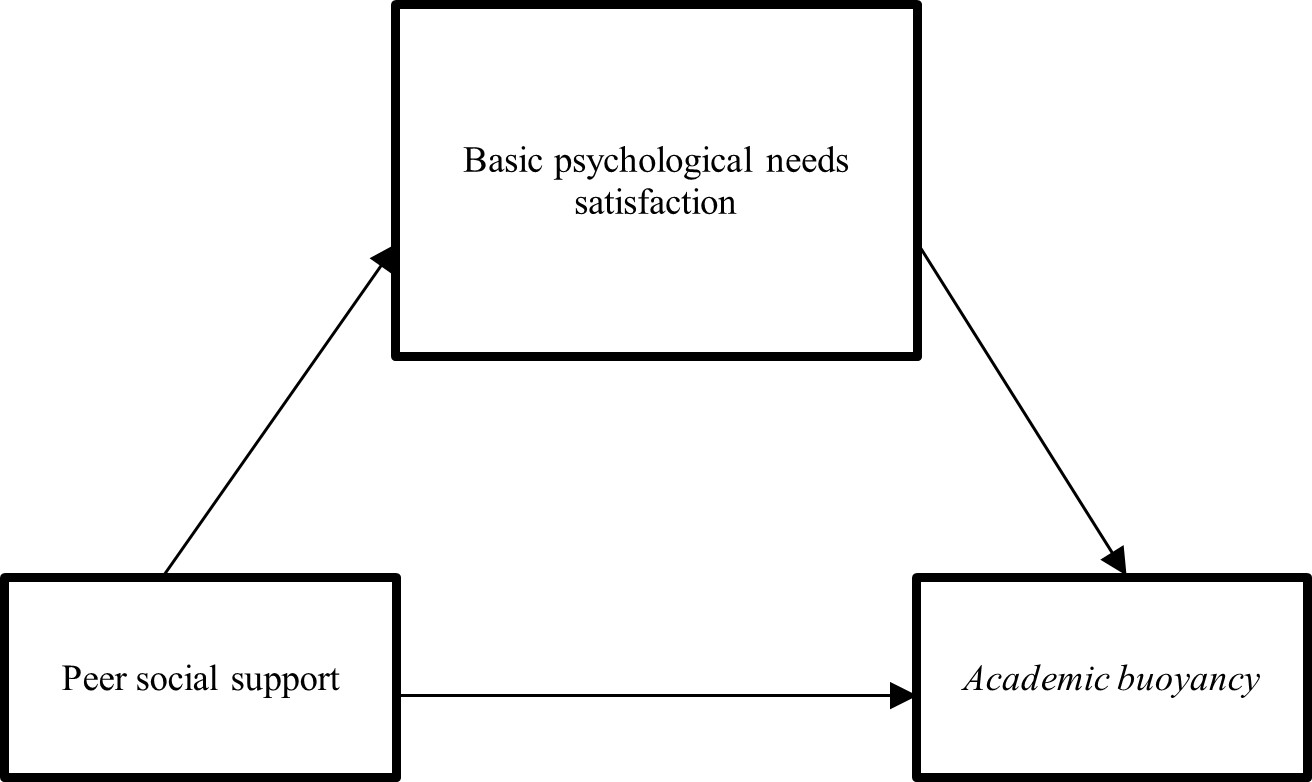
Based on this framework, the present study hypothesizes that peer social support affects academic buoyancy and that basic psychological need satisfaction serves as the psychological mediator explaining this relationship. Specifically, the study examines whether basic psychological need satisfaction mediates the relationship between peer social support and academic buoyancy. The proposed model is illustrated in Figure 1.
Materials and methods
The research employed a cross-sectional design; a choice made for its efficiency in data collection. A total of 372 students participated in this study. This sample size was considered adequate for mediation analysis using Hayes' PROCESS Macro and exceeded the minimum sample size recommended for detecting indirect effects in mediation models (Hayes, 2018). Participants were recruited using quota sampling until the predetermined quota was achieved.
The study utilized three main instruments to measure the variables:
- Academic Buoyancy Scale (ABS): This scale measures students' self-assessment of their ability to cope with academic everyday hassles. It consists of 4 self-assessment items (e.g., “I can overcome learning obstacles”). The ABS uses a four-point Likert scale with options ranging from Disagree to Strongly Agree. The Indonesian version of the ABS has shown good reliability, with a construct reliability (CR) of 0,823 and a variance extracted (VE) of 0,54 (Rohinsa, Sitompul, 2021).
- Basic Need Satisfaction in General Scale (BNSG-S): Developed based on Ryan, R.M., and Deci, E.L. (2023) theory, this scale assesses students' perceptions of their sense of autonomy, relatedness, and competence. The instrument has 17 items across three dimensions (e.g., “In general, I feel I have the freedom to express my ideas and opinions”). It also uses a four-point Likert scale. The original questionnaire was translated into Indonesian by the first author and verified by a language expert to ensure linguistic clarity and conceptual equivalence. Its internal consistency, measured by Cronbach's Alpha, was 0,77, which is considered respectable and reliable.
- Peer Social Support Scale (PSSS): This 39-item scale, developed by Ansari Nahruddin et al. (2024) based on (Sarafino, 1990) theory of peer social support, uses a four-point response scale from Strongly Disagree to Strongly Agree. Its validity was tested using the Content Validity Index (CVI), showing that most items had CVI scores between 0,71 and 0,96. The reliability of the PSSS was high, with a coefficient of 0,956.
To test the study's hypothesis, a mediation statistical analysis was performed using the Hayes Process Macro Model 4 (Hayes, 2018). The model hypothesized that peer social support would influence the fulfillment of basic psychological needs (path a), which would, in turn, influence academic buoyancy (path b). The indirect effect was calculated by multiplying path a and path b. The direct effect (c') represents the influence of peer social support on academic buoyancy while controlling for the fulfillment of basic psychological needs. The combined indirect and direct effects are referred to as the total effect. The fulfillment of basic psychological needs is considered a full mediator if the direct effect is not significant, and a partial mediator if the direct effect is significant (Hayes, 2018).
Results
A total of 372 students from a private university in Bandung participated in the study, comprising 78 males (21,0%) and 294 females (79,0%). Many respondents were between 20 and 21 years old, with the highest proportion (32,8%) being 21 years old. A significant portion of the participants (40,9%) were in their 8th semester. The demographic data of the study's respondents are presented in Table 1.
Table 1. Research participants description table
|
Demographics |
N |
Percentage |
|
Gender |
|
|
|
Male |
78 |
21,0% |
|
Female |
294 |
79% |
|
Age |
|
|
|
20 |
80 |
21,5% |
|
21 |
122 |
32,8% |
|
22 |
64 |
17,2% |
|
Semester |
|
|
|
4 |
78 |
21,0% |
|
6 |
74 |
19,9% |
|
8 |
152 |
40,9% |
|
N = 372 |
||
To categorize the generalized indicators, the mean score (see Table 2) served as the boundary criterion. Scores exceeding the mean were categorized as “high”, while scores falling below the mean were categorized as “low”.
Regarding academic buoyancy, a significant portion of respondents (63,7%) reported having low academic buoyancy, while only 36,3% rated their buoyancy as high. This indicates that most students in the sample struggle to effectively cope with everyday hassles.
Basic Psychological Needs: The majority of respondents (62,3%) perceived that their basic psychological needs were inadequately fulfilled. In contrast, only 37,6% felt these needs were met. This finding suggests a widespread sense of lacking autonomy, competence, and relatedness among the students.
Peer Social Support: The data shows a near-even split in the perception of peer support. A slight majority of respondents (51,9%) felt that their peers provided low support, while 48,1% perceived high support. This highlights that a substantial number of students do not feel adequately supported by their peers. The descriptive analysis of the study's variables is presented in Table 2.
Table 2 . Descriptive statistics
|
Variables |
Mean |
Standard deviation |
n |
Percentage |
|
Academic buoyancy |
12,07 |
2,00 |
|
|
|
High |
|
|
135 |
36,3% |
|
Low |
|
|
237 |
63,7% |
|
Basic psychological needs |
34,02 |
18,01 |
|
|
|
Satisfied |
|
|
140 |
37,6% |
|
Not satisfied |
|
|
232 |
62,3% |
|
Peer social support |
125,77 |
17,44 |
|
|
|
High |
|
|
180 |
48,1% |
|
Low |
|
|
192 |
51,9% |
|
N = 372 |
||||
The study aimed to examine the mediating role of basic psychological need satisfaction in the relationship between peer social support and academic buoyancy. Mediation was tested using Hayes PROCESS Macro Model 4.
1. Effect of peer social support on basic psychological need satisfaction (path a)
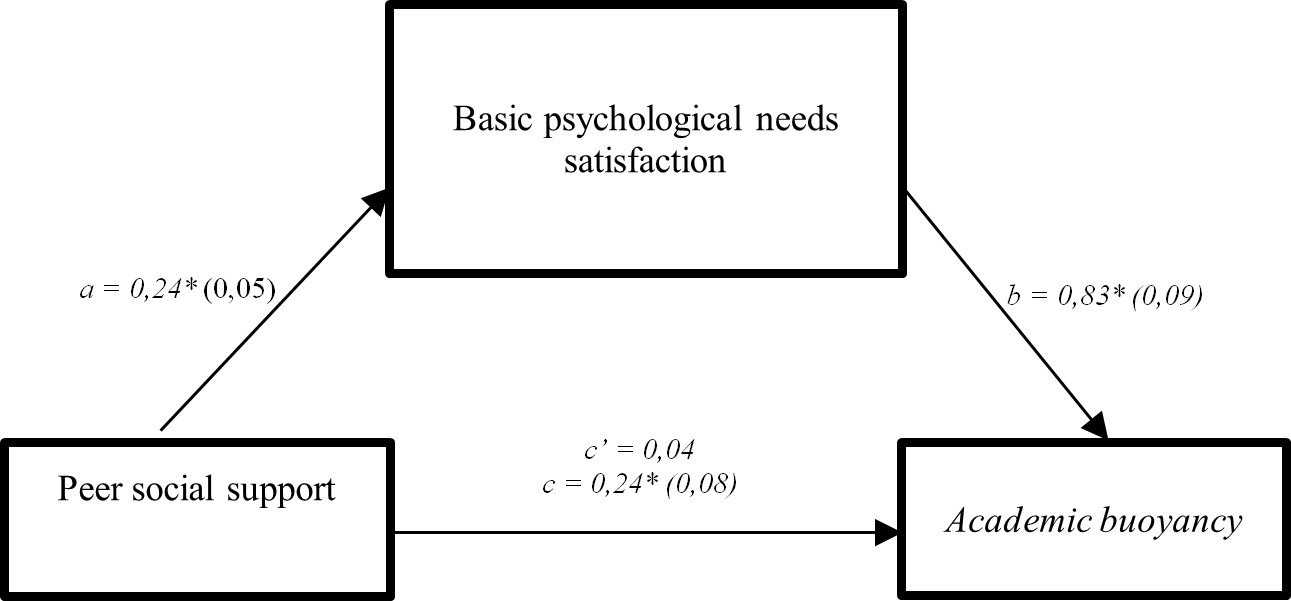
The analysis revealed that peer social support had a significant positive effect on basic psychological need satisfaction (a = 0,24; standard error (SE) = 0,05; p ≤ 0,01).
This indicates that higher perceived peer support is associated with greater satisfaction of basic psychological needs. Conversely, lower peer support is associated with diminished need satisfaction.
2. Effect of basic psychological need satisfaction on academic buoyancy (path b)
Basic psychological need satisfaction demonstrated a significant positive effect on academic buoyancy (b = 0,83; standard error (SE) = 0,09; p ≤ 0,01).
This suggests that students whose basic psychological needs are fulfilled are more capable of managing academic challenges and stressors.
3. Direct effect of peer social support on academic buoyancy (path c')
After controlling for basic psychological need satisfaction, the direct effect of peer social support on academic buoyancy was no longer statistically significant (c’ = 0,043; standard error (SE) = 0,08; p > 0,05).
This indicates that peer social support does not directly influence academic buoyancy once basic psychological need satisfaction is taken into account.
4. Indirect effect (mediation effect)
The mediation analysis using bootstrapping indicated a fully mediated effect. The indirect effect of peer social support on academic buoyancy through basic psychological need satisfaction was significant (indirect effect = 0,24, 95% CI [0,12, 0,36]).
Because the confidence interval excludes zero, the indirect effect is statistically significant.
These findings support the study’s hypothesis that basic psychological need satisfaction mediates the relationship between peer social support and academic buoyancy. In other words, peer support enhances feelings of autonomy, competence, and relatedness, which in turn strengthen students’ academic buoyancy.
The results clarify that peer support does not directly produce academic buoyancy; rather, it exerts its influence through the psychological mechanism of basic psychological need satisfaction.
A visual representation of the mediation model is presented in Figure 2.
Discussion
This study aimed to examine the relationship between peer support and academic buoyancy, with basic psychological need satisfaction serving as a mediating variable. Based on the mediation analysis using Hayes PROCESS Macro Model 4, the findings revealed that basic psychological need satisfaction fully mediates the relationship between peer social support and academic buoyancy. This means that when students perceive themselves as receiving emotional support, instrumental support, informational support, and network support from their peers, these perceptions enhance their satisfaction of basic psychological needs. When these needs for competence, autonomy, and relatedness are fulfilled, students are better able to manage everyday academic hassles, or what is conceptualized as academic buoyancy.
The statistical results demonstrated that a large proportion of students perceived low peer social support. This indicates that many students felt they received limited emotional empathy, affirmation, tangible help, informational guidance, and relational belonging from their peers. The study also found that most students reported low levels of basic psychological needs, suggesting that relatively few students perceived themselves as competent in achieving academic goals (competence), autonomous in regulating their academic actions (autonomy), or connected to individuals in their academic environment (relatedness). As supported by Jang et al. (2016), individuals’ perceptions of environmental support significantly influence the satisfaction of their basic psychological needs. Connell and Wellborn (1991) argued that through ongoing interactions within their social environment, individuals form internal perceptions of themselves, perceiving themselves as competent, autonomous, and connected.
Additionally, the findings revealed that most students experienced low academic buoyancy, meaning many were unable to manage their everyday academic hassles effectively. The mediation model further showed that when students feel unsupported by their peers, their satisfaction with basic psychological needs decreases. As a result, they feel less competent, less autonomous in addressing academic challenges, and less connected to their academic community. These diminished perceptions ultimately lower their capacity to regulate daily stress and reduce their academic buoyancy.
These results align with previous research demonstrating that peers serve as an important source of emotional, informational, and psychological support in educational settings (Wentzel, 1998; Christie et al., 2024). When students lack peer support, they may feel isolated and more susceptible to academic stress, which undermines their confidence and problem-solving abilities (Vasconcellos et al., 2020). Conversely, students who receive adequate peer support are better equipped to navigate academic challenges (Zhang et al., 2024).
The findings also highlight the importance of students feeling competent, autonomous, and connected in order to develop strong academic buoyancy. This is consistent with research by He et al. (2023), which shows that basic psychological need satisfaction enhances problem-solving abilities. As posited by Self-Determination Theory, individuals are driven by three basic psychological needs, autonomy, competence, and relatedness, which are essential for intrinsic motivation, persistence, and adaptive functioning (Ryan, Deci, 2023; Yang et al., 2025). These needs are satisfied only through supportive interactions within one’s environment (Ryan, Deci, 2023). While past research has emphasized the role of teachers and parents in fulfilling these needs (Bin et al., 2023), the present findings underscore that peer social support is equally important in meeting students’ basic psychological needs.
By confirming the study’s hypothesis, the results demonstrate the significant role of peer social support in fulfilling students’ basic psychological needs. Once these needs are satisfied, students are able to develop stronger intrinsic motivation and, consequently, better cope with daily academic challenges, reflecting higher academic buoyancy.
The theoretical implication of this study is that institutions should integrate peer support strategies into educational policies. Given that peer support plays a vital role in satisfying basic psychological needs and subsequently strengthening academic buoyancy, universities should develop programs that foster positive peer interactions, such as mentoring systems and collaborative learning projects. As shown by the findings, peer support is crucial for students’ academic success, and policymakers should embed peer-support dimensions within pedagogical practices to maximize student outcomes.
However, despite evidence supporting the benefits of peer social support for academic development, some studies highlight potential negative effects, particularly in environments with low academic motivation or where negative peer pressure is prevalent (Wu et al., 2022). This suggests that while peer networks can be beneficial, they must be structured carefully to avoid reinforcing counterproductive behaviors such as anti-academic attitudes or unmet psychological needs.
Additionally, previous research indicates that socioeconomic background, cultural expectations, and institutional resources can significantly influence the effectiveness of peer support mechanisms (Vietze et al., 2020). Therefore, future research should explore these contextual factors to identify best practices for fostering peer social support in diverse educational environments.
Conclusions
The findings of this study indicate that basic psychological need satisfaction serves as a mediating factor in the relationship between peer social support and academic buoyancy. Students’ inability to effectively manage everyday academic hassles appears to stem from insufficient peer support, specifically, limited emotional support, esteem-based appreciation, tangible assistance, informational guidance, and relational connection. The absence of these five forms of peer support diminishes students’ satisfaction with their basic psychological needs. When these needs remain unmet, students are less capable of handling daily academic challenges in an adaptive manner, ultimately resulting in lower academic buoyancy.
This study emphasizes the importance for students to recognize that peers constitute a crucial element in their academic journey, particularly in developing their academic buoyancy. The results demonstrate that inadequate peer support undermines basic psychological need satisfaction, which subsequently impairs academic resilience. Therefore, students are encouraged to cultivate interactions that provide emotional support, affirmations, practical help, and informational resources in order to strengthen their sense of competence, relatedness, and autonomy, resources essential for navigating everyday academic stressors.
Future research should further investigate additional contextual factors, such as family and teachers, that may also contribute to academic buoyancy. These three contexts are essential to examine collectively in order to better understand their roles in fulfilling basic psychological needs and supporting students’ academic resilience. Moreover, future studies should explore broader contextual variables, including socioeconomic background, cultural expectations, and institutional resources, to identify the most effective strategies for enhancing peer social support within diverse learning environments.