Introduction
With the rapid penetration of mobile internet technologies, smartphones have become indispensable in daily interactions. While they provide instant communication and convenience, concerns have grown about their unintended social and psychological consequences. One such phenomenon is “phubbing”, a term combining “phone” and “snubbing”, which refers to situations in which individuals prioritize mobile devices over face-to-face interactions (Pera, 2020).
In contemporary digital parenting research, phubbing is increasingly viewed as a specific behavioral manifestation of smartphone-based neglect during dyadic interaction, whereas the broader construct of parental technoference refers to a wider range of technology-driven interruptions in family life, including disruptions caused by various digital devices and media use (Dixon et al., 2023; Nie et al., 2024). Compared with parental technoference, parental phubbing highlights the interpersonal and relational nature of moment-to-moment disengagement during parent-child interactions. In family contexts, parental phubbing, which refers to parents diverting their attention from children to mobile devices, has received increasing scholarly attention because it undermines the quality of parent-child relationships (Selak et al., 2025; Shen, Xie, 2024; Zhang, Wang, 2025).
Adolescents are particularly sensitive to parental behaviors, and prior studies suggest that parental phubbing may impair their psychological well-being and academic adjustment (Wang et al., 2023; Zhang et al., 2023). Academic burnout has emerged as a critical concern among students in upper secondary education (senior high school), particularly within exam-oriented educational systems (Liu et al., 2023; Vazsonyi et al., 2024). Although some studies have documented the negative effects of parental phubbing on academic outcomes among younger students (He et al., 2022), less is known about its role in academic burnout during the high school years.
A growing body of literature suggests that alienation may serve as a key explanatory mechanism. Alienation reflects a psychological state of disconnection from meaningful social relationships, accompanied by feelings of powerlessness, meaninglessness, and loneliness (Mann, 2001). Evidence shows that parental phubbing is associated with disrupted parent-child interactions and heightened adolescents’ sense of alienation (Frackowiak et al., 2024; Liu et al., 2024; Mi et al., 2023). In turn, alienation has been identified as a risk factor for academic maladjustment, including burnout (Atik, Özer, 2020). These findings point to alienation as a potential psychological pathway linking parental phubbing and academic burnout. However, this potential pathway has not been systematically examined among high school students.
The present study is theoretically informed by Self-Determination Theory (SDT), which identifies autonomy, competence, and relatedness as fundamental psychological needs that support motivation and psychological functioning (Deci, Ryan, 1985, 2008). Within the context of parent-child relationships, parental attentiveness and emotional availability are especially relevant for satisfying adolescents’ need for relatedness. When parents are frequently distracted by smartphones, adolescents’ relatedness needs may remain unmet, thereby increasing feelings of alienation. Higher levels of alienation may be associated with poorer academic and emotional functioning, including greater vulnerability to academic burnout (Guo et al., 2024; Shim, Go, 2025). Although the present study primarily focuses on relatedness as the most proximal pathway linking parental phubbing to academic burnout, autonomy and competence may also be indirectly affected by digitally distracted parenting and merit further examination in future research. In this way, SDT serves as an integrative theoretical framework for understanding how digital parenting behaviors may shape adolescents’ academic and emotional functioning.
The present study therefore examines alienation as a potential psychological pathway linking parental phubbing with academic burnout among Chinese high school students. By addressing this question, the study seeks to extend the literature on the psychological effects of parental phubbing and to clarify the potential psychological mechanisms underlying its academic consequences. Theoretically, this work aims to refine the application of SDT to family-school contexts by elucidating how parental interaction patterns are associated with adolescents’ learning-related outcomes. From a practical perspective, the findings may inform future discussions on how parental smartphone use can be guided to promote adolescents’ emotional well-being and academic adjustment.
Materials and methods
Participants
A total of 600 high school students (corresponding to the senior high school level in the Chinese education system) were recruited using a multistage cluster sampling strategy from schools in Shanxi and Heilongjiang provinces, China. These provinces were selected to ensure regional diversity and to capture potential variations in educational environments between central and northeastern regions. Within each province, schools were randomly selected, and classes within these schools were then randomly chosen.
Of the 600 distributed questionnaires, 511 valid responses were obtained, yielding a response rate of 85,2%. The final sample comprised 54,4% female students, with a mean age of 17,01 years (SD = 0,88). In the Chinese education system, high school (senior high school) typically includes Grades 10–12, corresponding approximately to ages 15-18 years. In the present sample, Grade 10 students were mainly aged 15–16 years, Grade 11 students were aged 16–17 years, and Grade 12 students were aged 17–18 years. This age-grade correspondence is provided to facilitate interpretation across different educational systems.
Questionnaires exhibiting patterned responses, extreme outliers, or excessive missing data were excluded (Kang, 2013). Table 1 presents the descriptive statistics of participants’ demographic characteristics.
Table 1
Participant characteristics (N = 511)
|
Variable |
Type |
Frequency |
Percentage |
|
Gender |
Female |
278 |
54,40 |
|
|
Male |
233 |
45,60 |
|
Grade |
10 |
191 |
37,38 |
|
|
11 |
163 |
31,90 |
|
|
12 |
157 |
30,72 |
|
Area |
Rural |
209 |
40,90 |
|
|
Urban |
302 |
59,10 |
|
Only-child status |
Yes |
199 |
38,94 |
|
|
No |
312 |
61,06 |
Measures
Parental phubbing
Parental phubbing was measured using the Parent Phubbing Scale, adapted from the Partner Phubbing Scale developed by Roberts and David (2016) and revised for parent-child contexts by Ding et al. (2020). The instrument includes nine items (e.g., “My parent checks their phone during conversations with me”) rated on a five-point Likert scale (1 = never, 5 = always). Higher scores indicate more frequent parental phubbing. The scale demonstrated satisfactory internal consistency in the present study (Cronbach’s α = 0,839).
Academic burnout
Academic burnout was assessed using the Secondary School Students’ Academic Burnout Scale developed by Hu and Dai (2007). The original scale comprises 21 items across four dimensions: emotional exhaustion, teacher-student relationship disengagement, low learning efficacy, and physical exhaustion. In the present study, one item referring to textbook reviewing behavior was excluded because it was considered less relevant to the learning behaviors of students in senior high school, resulting in a 20-item version. Items were rated on a five-point Likert scale (1 = strongly disagree, 5 = strongly agree), with higher scores reflecting greater academic burnout. The scale demonstrated good internal consistency in the present study (Cronbach’s α = 0,887).
Alienation
Alienation was evaluated using the Interpersonal Alienation Subscale developed by Yang et al. (2002), which was constructed within the Chinese cultural context. The subscale contains 16 items across three dimensions: interpersonal alienation (items 1–7), family alienation (items 8–11), and social isolation (items 12–16). Items were scored on a seven-point Likert scale (1 = strongly disagree, 7 = strongly agree). Higher scores indicate a stronger sense of alienation. The scale demonstrated acceptable internal consistency in the present study (Cronbach’s α = 0,847).
Demographic variables
Demographic information, including gender, grade level, single-child status, and place of residence, was collected. Gender, single-child status, and place of residence were statistically controlled in the structural model to minimize potential confounding effects, whereas grade level was excluded as preliminary analyses revealed no significant association with the primary study variables.
Proposed research model
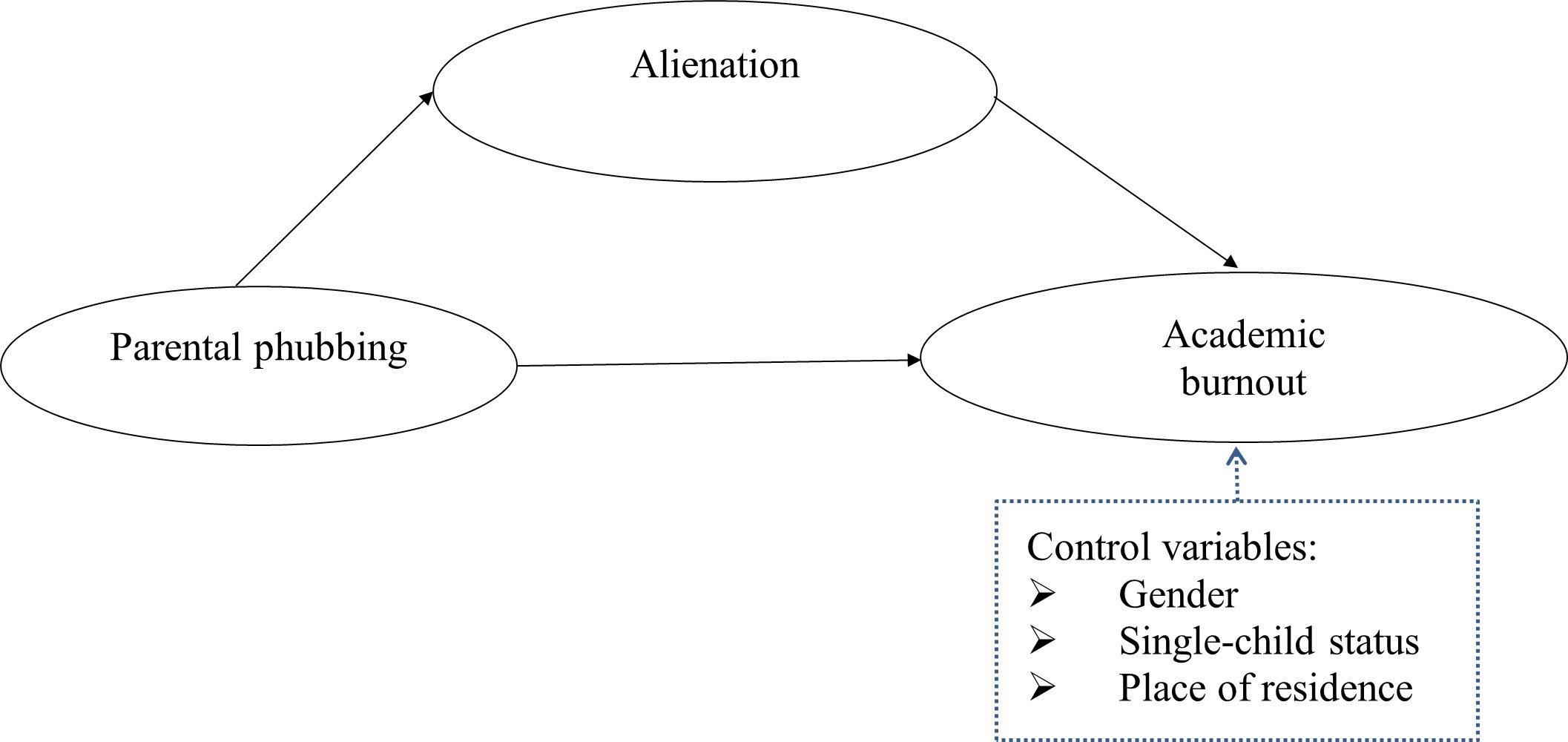
The hypothesized model is depicted in Fig. 1. The model illustrates the hypothesized relationships among parental phubbing behavior (PPB), alienation (AL), and academic burnout (AB). Specifically, PPB is expected to be positively associated with AL, which in turn is positively associated with AB, thereby examining the potential psychological pathway through alienation. Gender, only-child status, and place of residence were included as control variables in the structural model.
Procedure
The study protocol was reviewed and approved by the Research Ethics Committee of the authors’ affiliated university. Informed consent was obtained from school administrators, teachers, parents, and students before participation. Data collection was carried out in classroom settings using a paper-and-pencil survey format. Trained research assistants administered the questionnaires according to a standardized protocol. Students were informed of the anonymity and confidentiality of their responses. Completed questionnaires were collected immediately after administration and securely stored for data analysis.
Statistical analysis
Data analysis was performed using SmartPLS 4, which applies the partial least squares structural equation modeling (PLS-SEM) approach. This method was chosen because it is well-suited for testing complex mediation models and makes fewer assumptions about data distribution. The analysis proceeded in two stages.
First, the measurement model was evaluated by examining indicator reliability, composite reliability (CR), average variance extracted (AVE), and discriminant validity based on the Fornell-Larcker criterion and the heterotrait-monotrait ratio (HTMT). Second, the structural model was assessed to test the hypothesized relationships. Path coefficients were estimated, and their significance was determined using a bootstrapping procedure with 5000 resamples. The mediating effect of alienation was examined by testing the indirect path from parental phubbing to academic burnout through alienation. Mediation was considered significant if the 95% confidence intervals (CIs) of the bootstrapped estimates did not include zero.
Results
Common method bias
To evaluate the potential influence of common method bias (CMB), Harman’s single-factor test was first conducted (Harman, 1976; Podsakoff et al., 2003). The unrotated factor analysis extracted 11 factors with eigenvalues greater than 1, and the first factor accounted for 23,58% of the total variance, which is well below the commonly accepted threshold of 40%. This suggests that common method bias was not a major threat in the present study.
To further assess the potential influence of common method bias, full collinearity variance inflation factors (VIFs) were assessed using SmartPLS 4 (Kock, 2017; Singh et al., 2024). The VIF values ranged from 1,000 to 1,115, all below the recommended cutoff value of 3,3, thereby providing additional evidence that common method variance was unlikely to confound the study’s results.
Measurement model assessment
The reliability and validity of the measurement model were first evaluated. The results are presented in Table 2. Indicator reliability was acceptable, with factor loadings ranging from 0,60 to 0,83. Internal consistency was satisfactory, with composite reliability (CR) values ranging from 0,82 to 0,90, all above the 0,70 cutoff. Convergent validity was supported, as the average variance extracted (AVE) values for each construct exceeded the minimum acceptable value of 0,40. Discriminant validity was confirmed: the Fornell-Larcker criterion was met, with the square root of each construct’s AVE greater than its correlations with other constructs, and the HTMT values were below 0,85. Together, these results demonstrate that the measurement model exhibited satisfactory psychometric properties.
Table 2
Reliability and validity of the measurement model
|
Construct (Variable) |
Indicator reliability (factor loadings) |
Composite reliability (CR) |
Average variance extracted (AVE) |
Fornell-Larcker criterion (√AVE > correlations) |
HTMT (< 0,85) |
|
Parental phubbing behavior (PPB, IV) |
0,72-0,77 |
0,88 |
0,55 |
Satisfied |
Satisfied |
|
Alienation (AL, Mediator) |
0,70-0,83 |
0,82 |
0,60 |
Satisfied |
Satisfied |
|
Academic burnout (AB, DV) |
0,60-0,72 |
0,90 |
0,53 |
Satisfied |
Satisfied |
Descriptive statistics and correlation analysis
Table 3 presents the descriptive statistics and correlation coefficients of all study variables. Parental phubbing was positively correlated with both alienation and academic burnout, and alienation was positively correlated with academic burnout. These findings provide preliminary support for Hypothesis 1.
Table 3
Descriptive statistics and correlation coefficients for variables
|
Variable |
M |
SD |
PPB |
AB |
AL |
IA |
FA |
SI |
|
PPB |
2,55 |
0,68 |
1 |
|
|
|
|
|
|
AB |
2,60 |
0,58 |
0,23** |
1 |
|
|
|
|
|
AL |
3,68 |
0,96 |
0,30** |
0,52** |
1 |
|
|
|
|
IA |
3,78 |
1,03 |
0,20** |
0,34** |
0,83** |
1 |
|
|
|
FA |
3,24 |
1,15 |
0,29** |
0,28** |
0,67** |
0,45** |
1 |
|
|
SI |
3,89 |
1,56 |
0,23** |
0,54** |
0,81** |
0,44** |
0,32** |
1 |
Note: «**» — correlation is significant at the 0,01 level (two-sided). PPB = parental phubbing behavior; AB = academic burnout; AL = alienation; IA = interpersonal alienation; FA = family alienation; SI = social isolation.
Structural model assessment
Figure 2 presents the hypothesized structural model. Parental phubbing behavior (PPB) was modeled as the independent variable, alienation (AL) as the proposed psychological pathway, and academic burnout (AB) as the dependent variable. Gender, only-child status, and place of residence were included as control variables.
The structural model was evaluated in SmartPLS 4 using a bootstrapping procedure with 5000 resamples. Standardized path coefficients (β), standard errors, and significance levels were obtained. Table 4 summarizes the structural model results.
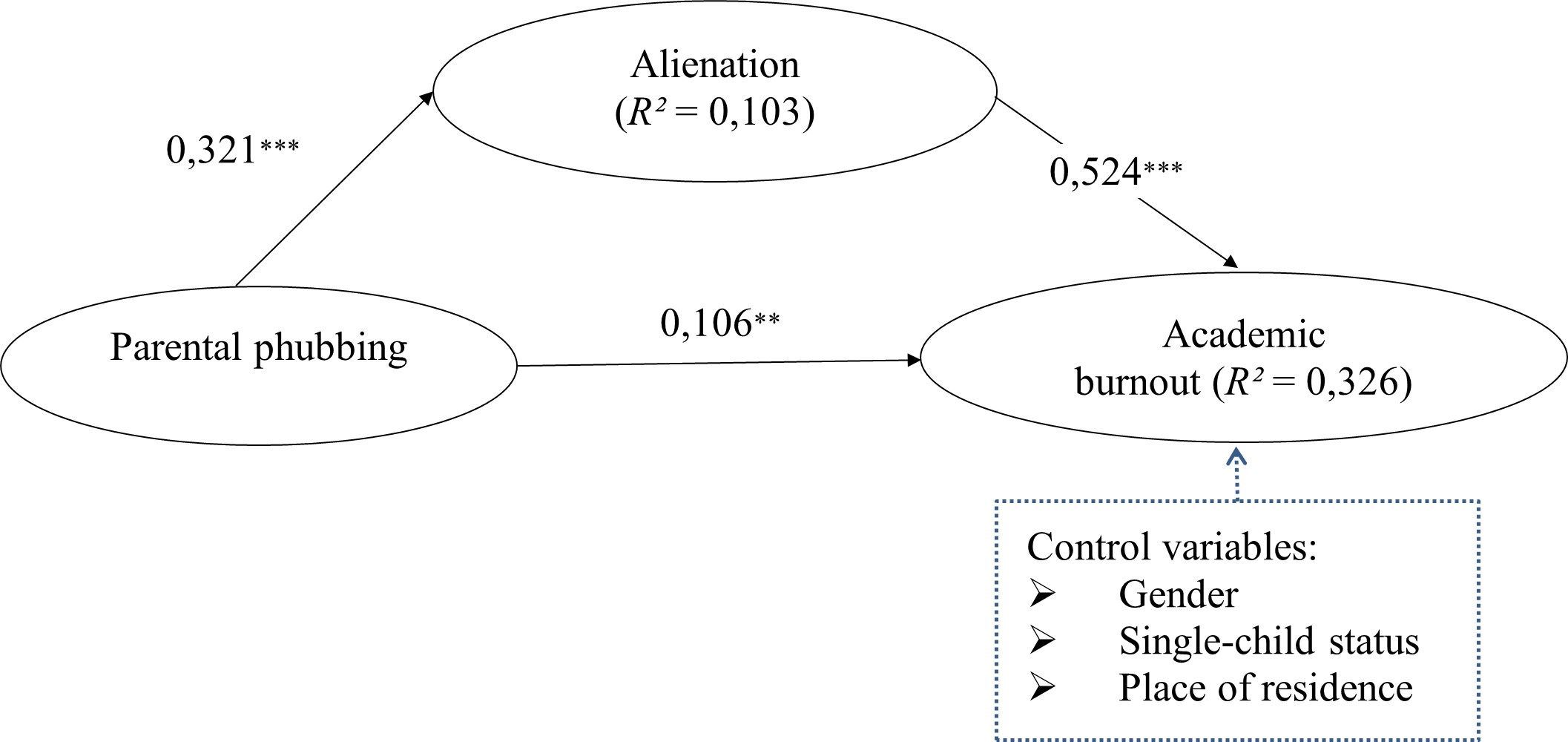
Table 4
Structural model results
|
Path |
β |
SE |
t |
p |
Result |
|
PPB → AL |
0,321 |
0,043 |
7,509 |
< 0,001 |
Supported |
|
AL → AB |
0,524 |
0,034 |
15,31 |
< 0,001 |
Supported |
|
PPB → AB |
0,106 |
0,039 |
2,725 |
0,006 |
Supported |
|
Gender → AB |
−0,249 |
0,076 |
3,253 |
0,001 |
Supported |
|
Only-child status → AB |
0,020 |
0,079 |
0,248 |
0,804 |
Not Supported |
|
Place of residence → AB |
0,045 |
0,163 |
0,277 |
0,782 |
Not Supported |
Note. AB = academic burnout; PPB = parental phubbing behavior; AL = alienation. Gender was coded as 1 = female and 2 = male.
PPB significantly predicted AL (β = 0,321, p < 0,001), and AL significantly predicted AB (β = 0,524, p < 0,001). The direct effect of PPB on AB remained significant (β = 0,106, p = 0,006), indicating that alienation partially mediated the association between parental phubbing and academic burnout, thereby supporting Hypothesis 2. Regarding the control variables, gender was significantly associated with AB (β = –0,249, p = 0,001), indicating that female students reported higher levels of academic burnout than male students. In contrast, only-child status and place of residence were not significant predictors.
Table 5
Structural model results
|
Endogenous variable |
R2 |
Q2 |
|
Alienation (AL) |
0,103 |
0,095 |
|
Academic burnout (AB) |
0,326 |
0,049 |
The structural model demonstrated acceptable explanatory power (see Table 5), with R² = 0,103 for alienation and R² = 0,326 for academic burnout. The model also demonstrated predictive relevance, as Q² values were positive (Q² = 0,095 for alienation; Q² = 0,049 for academic burnout). The global model fit was satisfactory (SRMR = 0,072).
Discussion
The present study examined the relationships among parental phubbing, alienation, and academic burnout in Chinese high school students. The findings supported both primary hypotheses. Specifically, consistent with Hypothesis 1, parental phubbing was positively associated with alienation and academic burnout. Moreover, in line with Hypothesis 2, alienation emerged as an important psychological pathway linking parental phubbing and academic burnout.
The results further indicated that students who frequently experienced parental smartphone distraction during face-to-face interactions reported stronger feelings of detachment and higher levels of academic burnout. These findings are consistent with previous studies indicating that parental distraction during face-to-face communication undermines adolescents’ psychological well-being and academic functioning (He et al., 2022; Marsh et al., 2024). However, most existing studies have focused on primary and middle school students. By contrast, the present study extends this evidence by focusing on Chinese high school students, who face particularly intense academic pressures within an exam-oriented educational context and may therefore be especially vulnerable to the effects of parental phubbing.
Whereas earlier research has primarily emphasized the emotional consequences of parental phubbing, the present findings further highlight its academic implications, suggesting that digitally mediated parental inattention not only disrupts interpersonal dynamics but also undermines students’ engagement and persistence in learning.
The findings further suggest that alienation may represent an important psychological pathway linking parental phubbing behavior with academic burnout. Specifically, when parents prioritize mobile phone use over face-to-face interactions with their children, adolescents are more likely to perceive parental neglect and relational disconnection, which may undermine their sense of relatedness, weaken intrinsic motivation, and increase emotional exhaustion. These findings align with Self-Determination Theory (Deci, Ryan, 1985, 2008), which posits that the satisfaction of relatedness needs is essential for sustaining motivation and psychological resilience.
Although similar mechanisms have been documented among college students (Liu et al., 2023), the present study extends this evidence to high school students who are at a critical developmental stage and exposed to heightened academic demands. Within China’s highly competitive examination system, weakened parent-child bonds may therefore amplify adolescents’ vulnerability to academic burnout and disengagement.
In addition to the hypothesized pathways, the results revealed a noteworthy gender difference: female students reported higher levels of academic burnout compared to their male peers, even after controlling for parental phubbing and alienation. One possible explanation is that adolescent girls tend to be more sensitive to interpersonal dynamics and relational cues, which may heighten their emotional responsiveness to familial interactions. Prior research suggests that girls are more likely to register negative social experiences and exhibit heightened interpersonal sensitivity (Mella-Defranchi, Araya, 2025; Trentini et al., 2022), and that such sensitivity contributes to increased emotional distress during early adolescence (Rudolph, 2002).
This heightened relational sensitivity may make girls particularly vulnerable to the emotional consequences of parental inattention (such as phubbing), thereby increasing their susceptibility to alienation and subsequent academic burnout. The observed gender difference may thus reflect the combined effects of strong academic pressure and elevated emotional sensitivity.
Taken together, beyond demonstrating the detrimental effects of parental phubbing, these findings underscore the importance of fostering healthy family interaction patterns in the digital age. Effective intervention should focus not only on reducing parents’ smartphone distraction but also on actively cultivating emotionally responsive and supportive parent-child communication. Establishing family media-use norms, engaging in shared activities, and promoting attentive communication may strengthen adolescents’ sense of relatedness and help mitigate academic burnout.
At the broader level, schools and policymakers may contribute by implementing parent-oriented digital literacy programs that raise awareness of how everyday smartphone practices influence adolescents’ academic and psychological well-being. In cultural contexts where academic achievement is closely intertwined with family expectations, addressing parental digital behaviors represents an important avenue for supporting adolescents’ healthy adjustment.
Conclusions and limitations
The present study examined the relationships among parental phubbing, alienation, and academic burnout among Chinese high school students. The findings supported both primary hypotheses: parental phubbing behavior was positively associated with alienation and academic burnout, and alienation accounted for part of the association between parental phubbing and academic burnout, highlighting its role as an important psychological pathway. In addition, a significant gender difference emerged, with female students reporting higher levels of academic burnout, which may reflect greater sensitivity to parental inattention during everyday interactions. Together, these findings underscore the importance of family digital behaviors, particularly parents’ moment-to-moment attentiveness, in shaping adolescents’ psychological well-being and academic adjustment. This study further extends prior evidence from younger populations to high school students within an exam-oriented educational context.
At the same time, several limitations should be acknowledged. First, the sample was drawn from only two provinces in China, which may limit the generalizability of the findings to other cultural, regional, and educational contexts. Second, the reliance on self-report measures may have introduced common method bias and social desirability effects. Third, the cross-sectional design precludes strong causal inferences regarding the directionality of the observed relationships. Future research should employ longitudinal, multi-informant, or experimental designs to clarify temporal dynamics and causal mechanisms. In addition, expanding the investigation to more diverse samples, including cross-cultural comparisons, would further enhance the external validity of the findings. Future studies may also examine additional moderators or mediators, such as parental stress, parenting styles, peer support, school climate, or broader forms of digital interference (e.g., technoference), to develop a more comprehensive explanatory model of academic burnout.
Taken together, this study contributes to the growing literature on the psychological and academic consequences of parental phubbing by identifying alienation as an important psychological pathway linking parental phubbing and academic burnout. The findings highlight that digitally distracted parenting not only disrupts immediate parent-child interactions but may also undermine adolescents’ sense of relational connectedness, thereby increasing vulnerability to academic burnout. These findings further support the value of Self-Determination Theory in explaining how digital parenting behaviors influence adolescents’ motivation and emotional functioning in contemporary family contexts.
From a policy and practice perspective, the findings suggest that parent education initiatives should explicitly address digital parenting behaviors, with an emphasis on mindful smartphone use and the cultivation of high-quality parent-child interactions. Schools and community agencies may consider integrating digital literacy, family communication training, and parent-child relationship enhancement programs into existing mental health and academic support services. At a broader level, policymakers may promote public awareness campaigns that encourage balanced technology use within families. Such multi-level interventions may help mitigate the risks associated with parental phubbing and foster healthier psychological and academic development among adolescents.