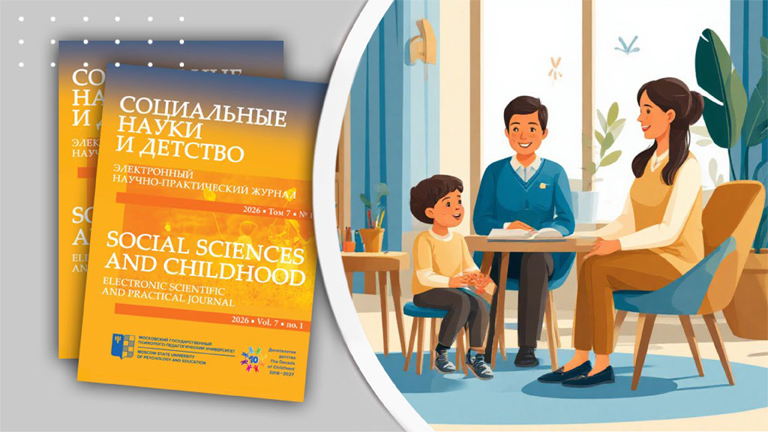
“Social Sciences and Childhood” journal has been published since 2020, appears quarterly, is open access, and is distributed under the Creative Commons Attribution-NonCommercial 4.0 International (CC BY-NC 4.0) license. The journal is included in the second tier of the White List. Publication in the journal is free of charge for authors.
The Editorial Board of “Social Sciences and Childhood” journal announces the call for papers for the 2026 issues, dedicated to the study of childhood phenomena.
Key focus: the psychological portrait of contemporary children and adolescents and the conditions contributing to their subjective well-being.
We invite researchers, practitioners, and specialists in psychology, education, sociology, law, and related disciplines to submit findings from their scientific research, practical developments, and analytical reviews addressing the following thematic areas, aligned with the journal's sections:
- General Psychology. History and fundamental principles of psychological research on childhood; methods, theoretical and analytical reviews; analysis of international studies, statistical data, and monitoring initiatives in the field of childhood.
- Pedagogy and Psychology of Education. Psychological support for learners, including particularly vulnerable groups; analysis of challenges and solutions in education; study of educational needs among specialists working within the child protection system. Preparation of prospective foster parents in foster parent schools for accepting employable categories of orphaned children into their families.
- Social Psychology. Psychological aspects of social adaptation across diverse educational and family contexts (including foster care and institutional settings), living conditions, and upbringing practices; conflict resolution in educational institutions; children's participation in decision-making processes affecting their interests ("the child's voice").
- Developmental Psychology. Psychological portraits of contemporary children and adolescents, accounting for various socio-demographic characteristics. Risk and resilience factors; conditions facilitating or hindering positive development, self-realization, and well-being among children and adolescents; typologies of individual psychological development. Support for foster families who have accepted different categories of orphaned children for upbringing.
- Safety and Law. Child Well-being. Scientific substantiation of measures restricting or terminating parental rights, or removing a child when their life or health is at risk; support technologies for minors who have experienced violence, abuse, or witnessed crimes; resocialization of juvenile offenders; training of child protection specialists; psychological analysis of legal and regulatory frameworks pertaining to childhood.
- Academic Life. Reviews of conferences, webinars, and round tables; book reviews of monographs and educational materials; overviews of dissertation research; anniversary materials and discussions on current issues in childhood studies.
For Young Researchers, including master's students: an opportunity to publish their scientific findings — both theoretical and empirical — provided they align with the journal's scope and submission requirements.
The Editorial Board expresses sincere gratitude to authors and readers for their trust and invites all interested specialists to contribute to shaping the scientific discourse on the child as a full-fledged subject of social life.
We welcome manuscripts that combine theoretical depth with practical relevance and reflect an interdisciplinary approach to the study of childhood.
Submission Guidelines and Formatting Requirements are detailed in the Guide for Preparing Publications for Peer-Reviewed Scientific Journals of the Moscow State University of Psychology and Education (MSUPE):
Publication languages: Russian and English
Length: no more than 30,000 typed characters with spaces (including the reference list)
Submission: exclusively via the Electronic Editorial Office of MSUPE Publications
Submission deadlines:
- April 30 — for Issue No. 2 (June)
- July 30 — for Issue No. 3 (September)
- October 29 — for Issue No. 4 (December)
Manuscripts are reviewed on a rolling basis. We recommend submitting materials in advance to ensure inclusion in the nearest available issue.
Manuscript submissions on the specified topics will continue to be accepted beyond the stated deadlines for consideration in subsequent journal issues.