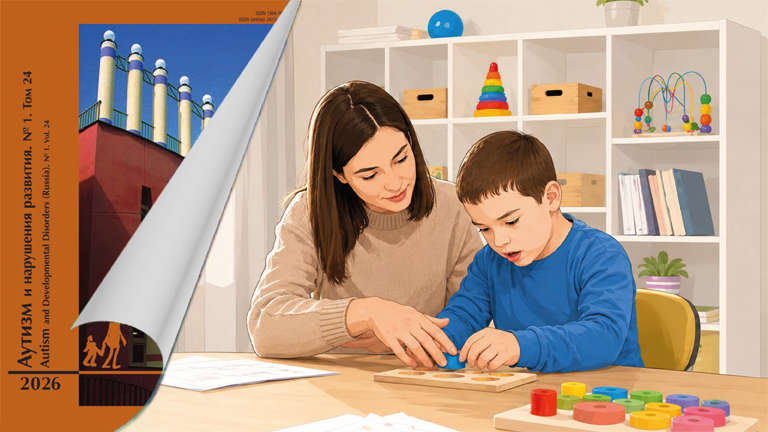
The summer thematic issue of the journal "Autism and Developmental Disorders" (No. 2, 2026) has been published. The theme of the issue is "Supporting Children and Adults with Severe Developmental Disorders Across Different Life Stages". The thematic editor is Irina S. Konstantinova, Candidate of Science (Psychology), expert at the Regional Charitable Public Organization "Center for Curative Pedagogy", Associate Professor, and lecturer at Moscow State University of Psychology and Education.
The issue introduces two new sections: "Conceptual Foundations of Supporting Children and Adults with Developmental Disorders" and "Research on Developmental Disorders".
The first section opens with an article by Academician A.G. Asmolov, who proposes replacing the paradigm of influencing the child with a paradigm aimed at fostering the realization of the child's potential. In relation to children with developmental disorders, this requires a shift in society's values regarding upbringing, education, and support—not only for children with special needs, but also, in the author's view, the creation of an "institution of special parenthood" and the development of predictive diagnostics. "Evolutionary optimism, along with Albert Schweitzer's great value-based principle of reverence for life, should become the moral imperative for educators, parents, and everyone working with the world of children with developmental differences", the author argues.
The second section features studies devoted to supporting children and adults with developmental disorders.
The article by A.A. Sergienko examines the heterogeneity and transience of neuropsychological profiles in autism spectrum disorder based on three clinical cases involving children and adolescents, highlighting their importance for developing personalized intervention strategies.
E.A. Chernyshova presents a new reading instruction technology for primary school children with autism and severe intellectual disabilities, based on an assessment of readiness for learning.
The study by N.A. Karpova, E.S. Zakharova, and Yu.A. Burdukova evaluates the impact of training in a model gastronomic training environment, together with related factors, on the development of vocational skills in people with mental disorders.
I.A. Bobyleva proposes a two-track approach to evaluating the outcomes of inclusive employment, combining the monitoring of work activities performed by people with developmental disorders in supported workshops with an assessment of their subjective well-being.
The article by T.V. Ryakhovskaya and E.E. Artemova presents the results of a qualitative analysis of various aspects of the everyday experiences, challenges, and resources of independently living adults with autism spectrum disorder, providing a basis for developing support programs for adolescents.
The review by M.E. Sisnyova and S.M. Babintseva examines the effectiveness of the supported decision-making model for people with mental disorders, which promotes their right to self-determination.
The issue concludes with a summary of the first decade of the annual All-Russian Inclusive Festival #PeopleLikePeople, as well as a post-event report on the annual "Friendship" Inclusive Walk, organized in Moscow by the Best Buddies Russia charitable foundation and the Perspektiva Regional Public Organization of People with Disabilities.
Listen to new episodes of the PsyJournals LIVE podcast, in which the authors discuss their research:
Maria E. Sisnyova on the article "From Paternalism to Self-Determination: International Experience of Supported Decision-Making for People with Mental Disorders".
Tatyana V. Ryakhovskaya on the article "Key Aspects of Independent Living Among Adults with Autism as a Basis for Developing Support Programs for Adolescents".