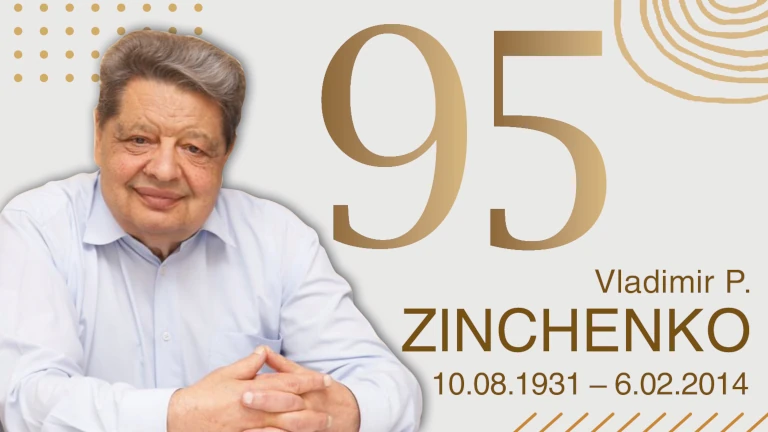
Today, August 10, 2026, marks the 95th anniversary of the birth of Vladimir P. Zinchenko, one of the most prominent and devoted representatives and custodians of the cultural-historical psychology tradition.
Those who studied at the Faculty of Psychology of Lomonosov Moscow State University in the 1960s–1980s, where V.P. headed the Department of Engineering Psychology; those who studied at MIREA in the 1980s–2000s, where he headed the Department of Ergonomics; and those who studied at Moscow State University of Psychology and Education in the 2000s–2010s, where V.P. taught and served as the first Editor-in-Chief of the journal Cultural-Historical Psychology, surely remember his extraordinarily engaging lectures, his unique sense of humor, and his remarkable memory. Thanks to this memory, his stories about the extraordinary people he himself had known and worked with made his listeners feel as though they, too, had known these people personally and closely. V.P. spoke about his teachers, colleagues, and the followers of L.S. Vygotsky. In his memoirs, he recalled how, as a young boy, he served as a “postman,” carrying texts exchanged between his father, Petr I. Zinchenko; his future teacher, Alexander V. Zaporozhets; and the greatly respected Petr Ya. Galperin...
Vladimir Petrovich was born in August 1931, a pivotal year. Just a few months later, another of his teachers, A.N. Leontiev, wrote to L.S. Vygotsky that “we can no longer say what we think,” as he was leaving for Kharkiv. L.S. Vygotsky himself was being subjected to persecution and was forced to “disguise” his scientific work, whose significance for the future of psychology he understood perfectly well—just as he understood that he himself would not live to see that psychology (see L.S. Vygotsky’s Notebooks, edited by E.Yu. Zavershneva and René van der Veer). Yet Vygotsky’s colleagues, students, and followers succeeded in preserving and further developing his scientific legacy. This legacy will be the subject of discussion at the International Forum marking the 130th anniversary of L.S. Vygotsky in November 2026—the year of Vladimir P. Zinchenko’s 95th anniversary...
Vladimir Petrovich was a man of broad learning, with an extraordinary command of many different fields of science. He was a connoisseur of painting—those who visited his home may remember his unique collection of art albums—and of poetry, often drawing on poetic lines to reinforce his scientific ideas. Vladimir Petrovich was also an astute judge of character: his descriptions of people were invariably precise and concise, often tinged with humor... One of V.P.’s special talents—an extraordinarily valuable one in education—was his ability to recognize a student’s potential and help them realize it. Many of his former students remember him with profound gratitude for the support he gave them at precisely the right moment. One such student was F.E. Vasilyuk, who was left without an academic supervisor at a crucial point following the death of A.N. Leontiev. With V.P.’s support, Vasilyuk defended his “revolutionary” dissertation on experiencing as an activity and later became the founder of the Faculty of Counseling Psychology at Moscow State University of Psychology and Education...
Like his teacher Alexander V. Zaporozhets, V.P. remained devoted throughout his life to one central line of inquiry—perhaps one of the “axial” themes of cultural-historical psychology: the problem of action. Action from which the specifically human psyche emerges; joint action as a source of development; action as a unit of the psyche... V.P.’s first publication was devoted to the psychology of action; his last, to the philosophy of action.
...And between those publications lay many decades of inspired work together with his wife, Natalia D. Gordeeva, who was his constant co-author on publications devoted to “action.” After V.P.’s death in 2014, she dedicated the final years of her life to organizing Vladimir Petrovich’s scientific legacy, preparing and publishing five volumes of his collected works. These five volumes bring together V.P.’s remarkable writings, including texts they wrote jointly, Zinchenko’s writings about his teachers, colleagues, and other remarkable people, as well as colleagues’ and students’ recollections of V.P. himself.
Text prepared by Victor K. Zaretsky,
Professor of the Chair of Individual and Group Psychotherapy
at Faculty of Counseling and Clinical Psychology,
Moscow State University of Psychology and Education