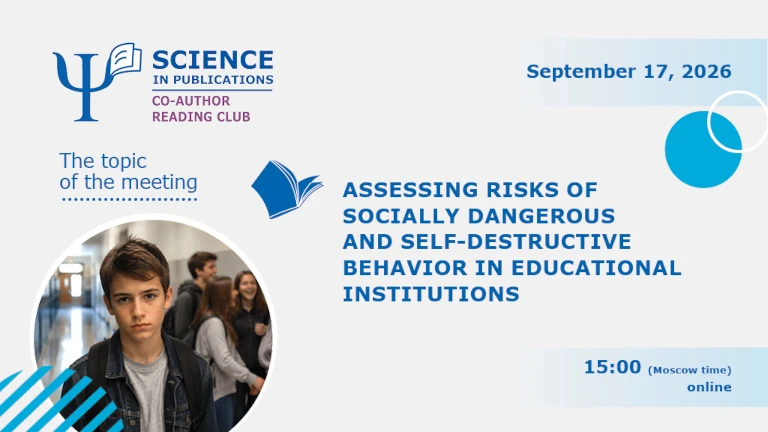
The “Co-Author Reading” Readers’ Club, part of the “Science in Publications” series, is launching its activities for the new academic year!
On September 17, with the support of the Boiling Point, a webinar titled “Assessing Risks of Socially Dangerous and Self-Destructive Behavior in Educational Institutions” will be held.
Destructive behavior among adolescents is one of the most challenging issues faced by education professionals. How can risks be identified in a timely manner? Which psychological markers are truly significant? Is it possible not only to assess risks but also to track changes over the course of preventive work?
At the webinar, we will examine the results of a longitudinal study conducted at 15 special closed-type educational institutions and discuss how a diagnostic model based on the structure of adolescents’ life position can help identify risk groups and assess the effectiveness of a comprehensive prevention program.
The focus will be on the “Ecosystem of Childhood” model, which incorporates skills-based technologies, restorative practices, a solution-focused brief therapy (SFBT) approach, competent guidance, and mentoring. The study showed that systematic, long-term work can contribute to the development of a more prosocial orientation among adolescents.
At the webinar, you will:
- learn about a contemporary evidence-based model for risk assessment;
- learn how to track changes in adolescents during preventive and corrective interventions;
- explore the practical findings of a longitudinal study;
- understand which approaches can help reduce antisocial behavioral tendencies;
- learn how to apply ideas from the webinar in your professional practice;
- gain guidance on developing comprehensive, long-term prevention programs.
Questions for discussion:
- What characteristics indicate that an adolescent belongs to an at-risk group?
- Why is it important for the prevention and correction of risks of socially dangerous and self-destructive behavior in educational institutions to consider not only adolescents’ behavior but also the development of their life position as a whole?
- Which diagnostic methods are most informative when working with adolescents exhibiting deviant and delinquent behavior? Can all the psychological characteristics they assess change at the same rate?
- What factors can affect the effectiveness of corrective and preventive programs?
- Can this model be used in other institutions within the prevention system?
The webinar will be useful for psychologists and educators working in educational institutions; professionals working at special closed-type educational institutions, secondary vocational education institutions, boarding schools, and prevention centers; coordinators, tutors, mentors, and support specialists; members of commissions on juvenile affairs; professionals working in mediation and restorative practices; researchers studying deviant and delinquent behavior among adolescents; and anyone working with at-risk adolescents.
Speakers:
Oksana D. Gurina, Candidate of Science (Psychology), Associate Professor, Department of Legal Psychology and Law, Faculty of Legal Psychology, Moscow State University of Psychology and Education
Ekaterina A. Kupriyanova, Psychologist, Educational and Production Laboratory; Senior Lecturer, Department of Legal Psychology and Law, Faculty of Legal Psychology, Moscow State University of Psychology and Education
Andrey S. Radchikov, Research Assistant, PsyDATA Research and Practice Center for Comprehensive Support of Psychological Research, Moscow State University of Psychology and Education
Publications related to the webinar:
Boikina, E.E., Gurina, O.D., Kupriyanova, E.A., Radchikov, A.S., Shpagina, E.M., Chirkina, R.V. (2024). Psychological predictors of deviant behavior in minors. Part 1. A portrait of a student at a special closed-type educational institution. Psychology and Law, 14(4), 1–14. https://doi.org/10.17759/psylaw.2024140401
Boikina, E.E., Gurina, O.D., Kupriyanova, E.A., Radchikov, A.S., Stratiychuk, E.V., Chirkina, R.V. (2025). Psychological predictors of deviant behavior in minors. Part 2. A portrait of a student at a special closed-type educational institution. Psychology and Law, 15(3), 160–178. https://doi.org/10.17759/psylaw.2025150311
Boikina, E.E., Chirkina, R.V., Stratiychuk, E.V. (2025). Psychological predictors of deviant behavior in minors. Part 3. A portrait of a female student at a special closed-type educational institution. Psychology and Law, 15(4), 44–62. https://doi.org/10.17759/psylaw.2025150403
Chirkina, R.V., Radchikov, A.S., Gurina, O.D., Kupriyanova, E.A., Dvoryanchikov, N.V., Boikina, E.E. (2026). Psychological predictors of deviant behavior in minors. Part 4. Results of a longitudinal study. Psychology and Law, 16(2), 144–176. https://doi.org/10.17759/psylaw.2026160210
For questions about the webinar, please contact Anna V. Shekhorina, shehorinaav@mgppu.ru.
Date and time: September 17, 2026 (Thursday), 3:00 p.m. Moscow time. The webinar will be held online via MTS Link.
The Readers’ Club meeting is supported by the MSUPE Boiling Point.
The curator of the “Co-Author Reading” Readers’ Club meetings is Anna A. Shvedovskaya, Candidate of Science (Psychology), Head of the Department of Information and Publishing Projects, Associate Professor, Department of Developmental Psychology named after Professor L.F. Obukhova, Faculty of Psychology of Education, Moscow State University of Psychology and Education.
See the 2026 calendar of webinars and meetings of the “Science in Publications” project.