Introduction
Higher education is increasingly borrowing practices from other fields in an attempt to overcome the crisis of the classical model of learning. One of the most in-demand is gamification: points, badges, and ratings meant to motivate. At first it was seen as a universal means of awakening student engagement, but today it has itself found itself in a vulnerable position. Short-term growth in engagement turns into deferred costs — anxiety, burnout, impostor syndrome, alienation. A mechanism designed as a stimulus undermines the psychological foundations of learning and shifts it toward a pursuit of metrics at the expense of meaning.
It is precisely this dilemma, and the absence of a coherent theory around it, that makes the topic so acute. Common approaches still operate within the logic of instrumental effectiveness: success is measured by clicks, the number of completed tasks, and other superficial metrics. Such a reductionist view leaves out of account the student's subjective experience, their value orientations, and their existential needs. Meanwhile, a way out of the crisis is possible only at the intersection of sociology, psychology, and pedagogy. What is needed is a theoretical model that would not be limited to stating side effects, but would uncover the very nature of the contradiction and outline ways of resolving it.
The object of the study is gamification as a social technology embedded in the higher education system. The subject is the systemic contradictions that arise between the task of sustaining external learning motivation and the need to preserve the existential well-being of students in a gamified environment.
The aim of the work is to build a theoretical model of the gamification dilemma, which would describe the zones and mechanisms of compromise between external motivation and the existential well—being of students.
To achieve this goal, the following tasks are set.
- To conduct a critical analysis of gamification practices and identify the elements that generate a contradiction between motivation and well-being.
- Operationalize the concepts of extrinsic motivation and existential well-being.
- Develop an empirical research program.
- Based on empirical data, identify specific situations in which this dilemma manifests itself.
- To build and verify a theoretical compromise model with the identification of “incompatibility zones”, “controlled compromise zones” and “critical points”.
The main hypothesis of the study is that the gamification dilemma is not a side effect of particular implementation errors, but a systemic property that arises from a fundamental contradiction between the external nature of gamification stimuli and the intragenic (internal) conditions of existential well-being. We assume that there are “critical points” in the design of a gamified system (for example, the publicity of a rating or the normative nature of badges), the management of which allows us to find the optimal compromise between the goals of motivation and well-being.
Materials and methods
To empirically test the hypothesis of a systemic gamification contradiction, a quantitative cross-sectional correlation study based on self—reports was conducted – observational, without experimental manipulations and interventions. Instead of abstract “game elements”, three specific and socially saturated phenomena that are ubiquitously present in Russian higher education have come into focus: public honor boards, public success comparison practices, and a system of additional points. This made it possible to operationalize the problem in terms understandable to the respondents and to measure the impact of precisely those mechanisms that, according to the theoretical framework, are most likely to generate a dilemma.
Study design: cross-sectional correlational study. Data collection was conducted on the basis of Lipetsk State Technical University (Lipetsk) in October 2025. The survey was implemented through the online platform Yandex.Forms.
The sampling procedure. The link to the survey was distributed through faculty mailing lists, student chats, and social media groups, with the assistance of academic advisors. The survey reached an audience of approximately 1,200 undergraduate students across four fields of study. It remained open for 14 days (October 1–14, 2025). Of the 243 students who started the survey, the final sample consisted of 180 who completed it in full (15% of the audience reached). Sixty-three questionnaires were excluded: 48 because more than 10% of items had been skipped, and 15 because the respondents failed the attention checks. The pilot study was conducted separately in September 2025 (n = 30); its data were not included in the main sample.
Inclusion criteria: enrollment in an undergraduate (bachelor's) program; voluntary consent; full completion of all instruments (no missing responses); successful completion of the attention checks. Exclusion criteria: enrollment in master's, specialist, or doctoral programs; skipping more than 10% of questionnaire items; participation in the pilot version.
Sample size and its rationale. The final sample consisted of 180 participants, which exceeds the minimum recommended threshold for multiple regression analysis with up to 10 predictors (n ≥ 15 × k, where k is the number of predictors; with k = 10, the minimum n = 150).
Socio-demographic and academic characteristics. Age — 18–23 years (M = 20,2; SD = 1,3); gender — 108 women (60%) and 72 men (40%); predominantly ethnic Russians. Distribution by year of study: 1st year — 45 participants (25%), 2nd year — 54 participants (30%), 3rd year — 48 participants (27%), 4th year — 33 participants (18%). Field of study: humanities — 65 participants (36%), natural sciences — 58 participants (32%), technical — 57 participants (32%). The average academic performance score on a 100-point scale was 87,2 (range 72–98), indicating a high level of academic achievement among the respondents.
Sample limitations. The sample is not strictly representative of the general population of undergraduate students, owing to:
- the convenience-based nature of sampling, which limits the possibilities for generalization;
- gender imbalance (60% women) and imbalance across fields of study (a predominance of the humanities);
- geographic limitations (a single university, a single region);
- the self-selection effect (students with higher motivation were more willing to participate).
Accordingly, the results can be validly generalized only to students similar to this sample in demographic and academic characteristics. When interpreting the results, possible confounding factors were taken into account.
Procedure. The survey was conducted via Yandex Forms (15–20 minutes). The instruments were presented in a fixed order: demographics → perception of gamification → OAM → STAI → impostor syndrome → academic cynicism. The order of presentation was not randomized; three attention checks were used, and respondents who failed them were excluded.
Ethical aspects. The study complied with the Ethical Code of the Russian Psychological Society (RPS). Participation was voluntary and began with written informed consent; participants were informed about the purpose, the procedure, and their right to withdraw at any stage without consequences. Anonymity and confidentiality were guaranteed: no personal data were collected, responses were stored in de-identified form, and they are presented only in aggregate form. No compensation was offered, and participation did not affect academic outcomes.
Instruments. The following instruments were used to collect the data.
Perception of gamification elements. For each element, respondents rated: frequency of exposure (a 5-point scale from “never” to “constantly”); degree of perceived pressure (a 7-point Likert scale, single indicator item: “I feel obligated to participate in this race”); and subjective importance (a 7-point Likert scale). Internal consistency of the subscales in this sample: α = 0,78–0,85.
Academic Motivation Questionnaire (OAM), which makes it possible to identify types of academic motivation (intrinsic, extrinsic, amotivation). 28 items, 7-point Likert scale. Internal consistency of the subscales in this sample: α = 0,72–0,84.
Spielberger–Khanin Anxiety Scale (STAI) (Khanin, 1978) for measuring state and trait anxiety (with a focus on the academic context). 40 items, 4-point scale. Internal consistency in this sample: α = 0,83 (state anxiety), α = 0,86 (trait anxiety).
Clance Impostor Phenomenon Scale (Chrisman, Clance, 1995), short 10-item version, 7-point Likert scale. Internal consistency in this sample: α = 0,81.
Academic Cynicism Scale (an adaptation of the “Detachment” subscale of the Oldenburg Burnout Inventory (OLBI) for academic settings (Bolatov et al., 2021)). 8 items, 4-point scale. Internal consistency in this sample: α = 0,75.
Extrinsic motivation was operationalized through responses to specific stimuli — for example, the statement “I try to complete additional assignments in order to earn bonus points”. Responses were recorded on a 7-point Likert scale.
Statistical analysis plan. The data were processed in IBM SPSS Statistics. First, descriptive statistics (M, SD, ranges) were calculated; then, to identify initial associations, correlation analysis (Pearson and Spearman correlation coefficients) was performed between measures of gamification perception, academic motivation, anxiety, impostor syndrome, academic cynicism, and academic performance.
The hypothesis was tested using sequential (hierarchical) multiple regression analysis with three dependent variables: anxiety, impostor syndrome, and academic cynicism. At the first step, the model included control variables (year of study, grade point average); at the second, the objective frequency of exposure to gamification elements; and at the third, the subjective perception of these practices as controlling. This approach made it possible to assess the contribution of perceived normative pressure specifically to the decline in well-being — that is, to directly test the theoretical core of the dilemma.
Results
To conceptualize the contradiction identified above and to demonstrate its systemic character, the phenomenon of gamification should be moved beyond the confines of applied pedagogy and considered within a broader theoretical context. One such context is cultural-historical psychology, which interprets the development of higher mental functions as mediated by cultural tools and social interaction. In its logic, gamification is not a set of techniques but a cultural tool (a sign) that organizes educational activity, which makes it possible to see its profound consequences for the development and well-being of the learner. In this study, gamification is understood as a social technology in the sense of M. Foucault, who analyzed disciplinary practices (Foucault, 2023): a system of purposeful intervention that transforms behavior and interactions in the educational environment through procedures borrowed from games. The classical approach of K. Werbach and D. Hunter (2012) focuses on external design and describes gamification through points, badges, and leaderboards (PBL). Ian Bogost (Bogost, 2016) goes further and reveals its essence as exploitative design, in which mechanics serve predefined actions and often manipulate the user. In operational terms, gamification acts as a behavior-management tool that creates external incentives to compensate for a lack of internal interest.
Relying on external incentives, gamification directly addresses extrinsic motivation, and the theoretical basis for its analysis is provided by Self-Determination Theory (SDT) as developed by E. Deci and R. Ryan (Deci, Ryan, 2017). According to this theory, extrinsic motivation is arranged along a continuum — from fully controlled, where an action is performed for the sake of reward or to avoid punishment, to integrated, in which an external requirement is consciously accepted as a personal value. Traditional gamification, with its emphasis on points and public ranking, most often activates controlled forms in particular. In research practice, these are captured through easily measurable quantitative indicators — measures of academic activity (attendance, timely submission of assignments), “click activity” in learning management systems (LMS), and other superficial engagement metrics. However, such indicators capture only the behavioral surface and say nothing about the qualitative characteristics of the educational process.
The opposite pole of the dilemma is the student's existential well-being. This construct can also be understood through self-determination theory, but in its positive rather than deficit-based dimension. Here, existential well-being is understood as a state that arises when basic psychological needs are satisfied — autonomy (experiencing oneself as the source of one's own actions), competence (a sense of effectiveness in interacting with the environment), and relatedness (a sense of belonging and reciprocity) — enriched by an existential dimension of meaningfulness and authenticity (Deci, Ryan, 2017). Accordingly, its operationalization requires a shift of attention from external actions to internal states.
The key negative indicators that signal a violation of well-being in a gamified environment are: elevated state and trait anxiety, measured, for example, by the Spielberger scale; manifestations of impostor syndrome, a phenomenon described by P. Clance and S. Imes (1978), in which successes are attributed to chance or deception rather than to one's own abilities; a sense of alienation from the learning process, reduced to the accumulation of formal indicators; and symptoms of burnout, according to the model of C. Maslach and S. Jackson (1981) — exhaustion, cynicism, and reduced personal accomplishment.
A comparison of these two conceptual frameworks allows us to formulate the core of the theoretical dilemma. On the one hand, gamification as a social technology works in the logic of extrinsic control: internal interest is replaced by external reinforcement, and the educational trajectory breaks down into a set of atomic, measurable actions. On the other hand, existential well-being and sustained, high-quality engagement rest on an intrageneous logic of self-development, in which autonomy, personal meaning, and the experience of authenticity are the driving force. The fundamental contradiction is that a technology initially aimed at increasing engagement, when applied uncritically, systematically creates conditions that undermine its own psychological prerequisites. The dilemma, therefore, appears not as an accidental malfunction but as an immanent, systemic conflict between two different orders of regulation of human activity.
To better understand the systemic nature of the identified dilemma, it is useful to consider it in the context of cultural-historical psychology and activity theory — in particular, through the concept of jointly distributed learning activity developed by V. V. Rubtsov (Rubtsov, 1996). This approach shifts the focus from individual knowledge acquisition to the organization of collective learning action, in which the task is solved by a group and the functional structure of the activity — goal setting, planning, control, and evaluation — is distributed among its participants. What comes to the fore is not so much personal achievement as the development of ways of cooperation, communication, and reflection that enable the group to become aware of and optimize its shared ways of working.
From this perspective, the traditional model of gamification, built around individualized competition, comes into fundamental conflict with the logic of jointly distributed activity. Such gamification:
- individualizes and ranks where joint work requires cooperation and solidarity;
- spurs external competition for limited places in the ranking, destroying the atmosphere of mutual trust and open exchange of views, without which collective problem-solving is simply impossible;
- shifts the focus from the process — the organization of joint inquiry — to an individual result, thereby blocking the development of reflective abilities aimed at analyzing group methods of action.
Thus, the conflict between gamification and existential well-being acquires yet another — socio-genetic — dimension. The contradiction lies not only in the clash between external control and the individual's internal needs, but also in the confrontation between an individualizing technology and a socially oriented pedagogical model aimed at forming a collective subject of activity. Such an analysis makes it possible to see the dilemma not as a technical failure, but as a consequence of the mismatch between the instruments used and the fundamental psychological patterns governing the development of cognitive and communicative abilities in learning.
As shown in the Materials and Methods section, the sample included 180 undergraduate students (60% women, 40% men; mean age = 20,2; SD = 1,3; average academic performance score = 87,2). This indicates that the study involved predominantly successful and motivated students, for whom educational strategies and the psychological climate of the learning environment are of particular importance.
An analysis of the prevalence of the gamification elements studied confirmed that they have long since become routine pedagogical practice in contemporary Russian higher education. By far the most widespread was the system of additional (bonus) points: 94,4% of respondents encountered it “often” or “constantly”. The practice of publicly comparing achievements — whether by a teacher or as part of group work — was also extremely widespread: 81,1% of students reported its regular presence in the learning process. The honor roll, or public academic ranking, was somewhat less common, yet it remained a significant element for 71,7% of respondents. However, the key indicator for testing the hypothesis proved to be subjective perception of these practices. More than three quarters of respondents (77,8%) agreed to some extent that such practices create a sense of compulsory participation in a competition — a forced “race” for points and status. The strongest sense of normative pressure was associated specifically with bonus points and situations of public comparison, which indicates that, in students' perception, these function not as supportive instruments but as mechanisms of external control.
The results of the correlation analysis presented in Table 1 revealed statistically significant associations that illuminate the structure of the dilemma under study. Consistent positive associations emerged between the frequency of exposure to gamification elements and the level of extrinsic motivation, confirming their instrumental effectiveness as stimulants of activity. An even stronger association was found between the frequency of use of these practices and their perception as controlling, underscoring their leading role in shaping an external locus of regulation of learning behavior.
At the same time, the analysis revealed the negative side of these practices. The perception of gamification as a system of control showed significant positive correlations with all indicators of declining existential well-being. The most pronounced associations were with impostor syndrome and state anxiety, indicating a direct link between experiencing the learning environment as compulsively competitive and growing internal doubts about one's own competence, as well as acute anxiety related to assessment. Moderate but statistically significant correlations were found with trait anxiety and academic detachment, pointing to a long-term risk of chronic emotional distress and a defensive, cynical attitude toward educational activity. It is important to note that extrinsic motivation itself correlated positively with negative indicators, confirming that the motivational gain from gamification is inextricably linked to psychological costs.
Table 1
Results of the correlation analysis (Pearson)
|
Couple of variables |
R |
P |
|
Frequency of gamification elements — External motivation |
0,43 |
< 0,01 |
|
Frequency of gamification elements — Perception as controlling |
0,58 |
< 0,01 |
|
Perception of gamification as control — Impostor syndrome |
0,54 |
< 0,01 |
|
Perception of gamification as control — Situational anxiety |
0,50 |
< 0,01 |
|
Perception of gamification as control — Personal anxiety |
0,39 |
< 0,01 |
|
Perception of gamification as control — Learning disability |
0,46 |
< 0,01 |
|
Extrinsic motivation — Impostor syndrome |
0,42 |
< 0,01 |
Note: all correlation coefficients were calculated using Pearson’s method; a significance level of p < 0,05 is considered statistically significant, all reported values are p < 0,01; N = 180 for all pairs (no missing data).
To identify causal patterns and to determine specific manageable parameters (“critical points”), a multiple regression analysis was performed with stepwise entry of variable blocks. At the first stage, year of study and average academic performance score were included as control variables; the latter, being high in the sample, showed a weak but significant negative association with impostor syndrome and academic detachment, pointing to the protective role of academic self-confidence.
The introduction of variables reflecting the objective frequency of use of gamification elements at the second step yielded a mixed picture. Although public comparison and bonus points predicted an increase in specific negative indicators, the overall explanatory power of the models remained moderate. The sharp increase in the predictive power of all three regression models — for anxiety, impostor syndrome, and academic detachment — came at the final step, when variables capturing the subjective perception of these practices as obligatory and controlling were included in the analysis. The main contribution to explaining the variance of the dependent variables was made by this block of predictors, not by the mere presence of a ranking or bonus points.
The results summarized in Table 2 made it possible to clearly identify the two most destructive critical points in the design of the educational environment.
- The perception of public comparison as normative pressure emerged as the leading predictor of both state anxiety and impostor syndrome. This suggests that teacher-sanctioned public comparison of student results is a significant factor undermining the sense of basic competence and autonomy: the student is constantly in a state of evaluation, and their successes begin to provoke deep internal doubts about whether those successes are deserved.
- The perception of the bonus point system as a mandatory “race” proved to be the strongest predictor of academic detachment — here we see the paradoxical effect of a stimulus turning into an instrument of alienation. When additional activity is experienced not as an opportunity but as a compulsory requirement for maintaining competitiveness, emotional distancing and a cynical attitude toward the very essence of educational activity become a predictable psychological reaction.
Table 2
Results of multiple regression analysis (final step)
|
Dependent variable |
Predictor |
Β |
P |
ΔR² |
|
Situational anxiety |
Perception of public comparison as a regulatory pressure |
0,41 |
< 0,001 |
0,18—0,24 |
|
Impostor syndrome |
Perception of public comparison as a regulatory pressure |
0,44 |
< 0,001 |
0,18—0,24 |
|
Academic detachment |
Perception of bonus points as a mandatory “race” |
0,38 |
< 0,001 |
0,18—0,24 |
Note: ΔR2 is the increase in the explained variance at the final step, when the block of subjective perception was added; p < 0,001 for all models. The control variables (course of study and average score) were introduced in the first step, their coefficients are omitted for the sake of compactness of presentation.
The quantitative data did more than merely confirm the existence of the dilemma among high-achieving students — they pinpointed with high precision the specific, subjectively experienced aspects of gamification. It is precisely the management of these aspects that holds the key to mitigating the systemic contradiction between motivation and well-being.
Discussion of the results
The results obtained are consistent with the proposed theoretical model: gamification practices function as a social technology of management and shift the regulation of activity outward. The main predictor of negative consequences is the subjective experience of this regulation as obligatory and coercive, which confirms the postulate of self-determination theory regarding the frustration of the needs for autonomy and competence.
The associations identified also reveal the mechanisms of the harm itself. The perception of public comparison as pressure undermines autonomy, turning the student into an object of external evaluation, and at the same time undermines the sense of competence through normative comparison with others; against the background of high academic performance, this leads to one's own achievements beginning to seem insufficient or a matter of chance. The perception of bonus points as a “race”, in turn, devalues the inner content of learning, giving rise to cynicism and alienation — which fits well within the concept of burnout.
On the basis of the analysis, a theoretical model of the gamification dilemma is proposed — not a linear scale, but a field of practices built around two axes: “potential for external motivation” and “risk to existential well-being”. Three principal zones can be distinguished within this field.
The “zone of incompatibility” includes practices with the most consistent association with a decline in well-being and a questionable motivational effect — public rankings and teacher-led public comparison of results. These practices institutionalize social comparison, and reforming them within the framework of gamification is extremely difficult, since their essence is the maintenance of hierarchy and public competition. The contradiction with the need for autonomy and stable competence is so great here that the model calls not for adjustment but for abandoning such practices altogether.
Thus, the boundary between the zones is determined by a set of “critical points” — sensitive system parameters, a slight change in which leads to a qualitative shift in their impact. Our data allow us to specify four such points.
- Public visibility vs. privacy. Public availability of results is a key driver of social anxiety; a shift toward privacy removes this stress factor.
- Focus on ranking (comparison with others) vs. focus on personal progress (comparison with oneself). The former feeds impostor syndrome and frustrates the need for competence; the latter satisfies it.
- Obligatoriness vs. voluntariness. Normative pressure is a direct threat to autonomy and the main cause of cynicism; voluntariness restores a sense of personal choice.
- Uniformity vs. diversification of success criteria. A narrow range of rewarded outcomes narrows the field for demonstrating competence; a broader range allows different students to find their own “entry point”.
The proposed model shifts the focus from the question “to use or not to use gamification?” to the question “how should its elements be designed so as to minimize harm to well-being while preserving motivational potential?”. It serves as an analytical framework for auditing existing educational environments and designing new ones in which technological tools are subordinated to humanistic goals of personal development. A visualization of the theoretical model is presented in the figure.
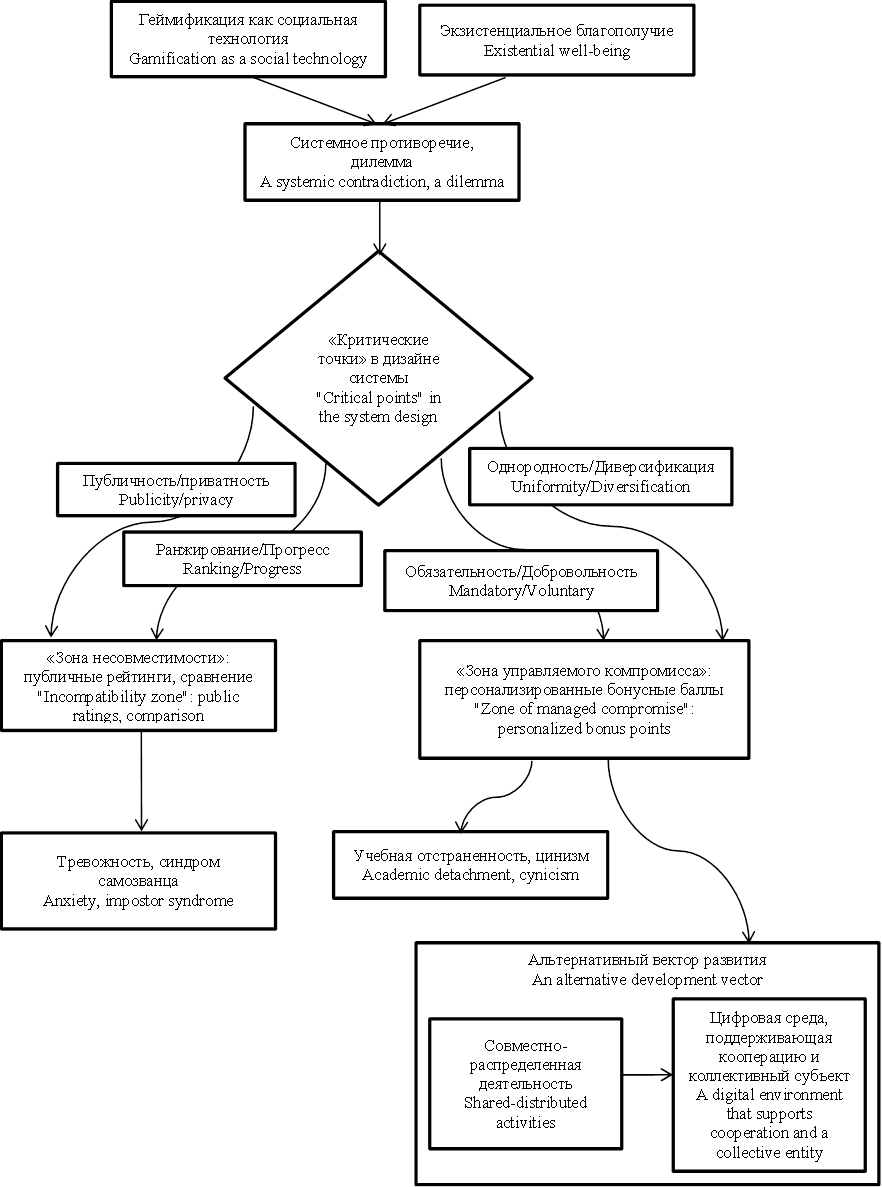
The shift in gamification design toward privacy, personal progress, and voluntariness overcomes the logic of individualized competition and lays the groundwork for designing platforms that support jointly distributed learning activity. The model thus serves not only as a tool for correction but also as the first phase in creating technologies that cultivate cooperation and the formation of a collective subject of knowledge.
The study confirmed the hypothesis that the gamification dilemma is a systemic property rooted in a mismatch between the extrinsic nature of its incentives and the intrageneous conditions of well-being. The findings show that the practices of public comparison and bonus points are associated not only with an increase in extrinsic motivation but also with heightened anxiety, impostor syndrome, and academic detachment; moreover, the decisive role is played by the subjective perception of these practices as a system of compulsory control, rather than by their mere presence.
Conclusion
The theoretical contribution of this study lies in the consistent fulfillment of the objectives set. First, the dilemma was operationalized through concrete social practices, which made it possible to move away from abstract reasoning toward measuring the impact of real tools. Second, a theoretical operationalization of the key constructs was carried out: extrinsic motivation was measured through its controlled forms, and existential well-being through negative indicators. Third, specific situations in which the dilemma manifests itself were identified using quantitative analysis, which showed in which aspects and in connection with which elements it manifests itself most acutely. Finally, on the basis of the data obtained, a theoretical model was constructed that contributes to the sociology of education and to the theory of gamification: it proposes a practice-oriented scheme that distinguishes between “zones of incompatibility” and “zones of managed compromise” and identifies manageable parameters (“critical points”) for redesigning educational environments.
The findings of the study provide a basis for specific recommendations on overcoming the dilemma in higher education practice.
- Abandoning destructive practices. Practices that fall into the “zone of incompatibility” — primarily public rankings that emphasize hierarchy and teacher-sanctioned public comparison of students — should be reconsidered. They are best replaced with alternatives such as individual progress charts or systems that visualize a student's personal development trajectory relative to their own baseline.
- Principles of humanistic redesign. For practices in the “zone of managed compromise” (such as a bonus point system), a consistent shift in design along four axes is necessary:
- From public visibility to privacy: ensuring confidentiality of learning outcomes and feedback.
- From ranking to personal progress: reorienting reward systems from comparing students with one another toward tracking and rewarding personal growth and skill acquisition.
- From obligatoriness to voluntariness and choice: giving students the option to select from a menu of optional activities and to determine for themselves how intensively to participate in gamified elements.
- From uniformity to diversification of criteria: embedding in the reward system diverse forms of demonstrated competence (research, creative, communicative, and volunteering activities), which supports meaning-making and allows for multiple intelligences to be taken into account.
- A checklist for audit and design. The proposed “critical points” together form a practical checklist for instructors and curriculum developers. When creating or evaluating a gamified course, it is useful to ask yourself a series of questions: How public are the results? Is comparison with others encouraged, or comparison with oneself? Is participation perceived as voluntary? Are different forms of success taken into account? The answers help diagnose potential risks to student well-being and adjust the design in a timely manner.
Directions for future research are also outlined. First, longitudinal studies tracing the dynamics of well-being and motivation are needed; such studies would make it possible to establish causality and the long-term effects of gamification. Another promising avenue is the study of the moderating role of personality traits (for example, perfectionism or resilience), which may shape the perception of a gamified environment. Particularly deserving of attention is a comparative analysis of the effectiveness and consequences of gamification across disciplinary contexts (natural sciences vs. humanities) and cultural contexts, where attitudes toward competition and individualism may differ substantially. Finally, qualitative research delving into students' personal experiences and narratives would deepen our understanding of the mechanisms underlying the identified “critical points”.
Limitations. he subjective nature of the data (self-reports) is vulnerable to the influence of social desirability and momentary mood. In addition, the specificity of the sample — high-achieving students — means that the identified effects may be even stronger in groups with lower academic confidence.