Introduction
Interest in the problem of psychological well-being is growing all over the world, and studies have shown that psychological well-being includes components such as self-efficacy, life satisfaction, financial stability, emotional and physical health, and autonomy [Volkova, 2023; Byun; Hall-Kenyon; Haschera, Waberb J, 2021; Nwoko, 2023]. The PERMA model of well-being, developed by M. Seligman, contains components such as positive emotions, involvement (passion for one’s work), relationships, meaning in life, and achievements [Seligman, 2011]. Data from a large-scale Russian online study of the psychological well-being of teachers in preschool educational institutions using the adapted PERMA-Profiler questionnaire, constructed based on M. Seligman’s model of psychological well-being, have been published. It has been shown that the level of psychological well-being of teachers of preschool educational institutions exceeds that for the control group and is higher when teachers have their own children and with increasing work experience [Volkova, 2023].
Psychological well-being is closely related to a person’s mental health, and the latter is understood primarily as the ability to adapt to social changes and self-realization [Folkman, 1986; Otarbayeva, 2023]. Particularly relevant is the issue of the health of teachers of preschool educational institutions, since they experience serious mental stress associated with changing requirements for the performance of work duties, conflict situations with students and their parents, responsibility for the life and health of children, and the need to master new technologies and methods. work, improve skills and solve difficult pedagogical problems [Byun; Chen, 2023; Gomes, 2023; Otarbayeva, 2023; Wang, 2022]. A teacher of a preschool educational institution must strictly observe the implementation of routine tasks in a group of children, conduct classes with students in accordance with the requirements of educational standards, using computer and other modern technologies, know the legislation, legal aspects of the work of a teacher, regulatory documentation in the field of preschool education [ 3]. While psychological well-being is high, as measured by love of work and self-efficacy, a significant number of early childhood educators experience problems both psychologically (e.g., feeling stressed at work, depressive symptoms) and with regard to physical well-being [ 13; 28]. Meta-analysis showed that the morbidity level of teachers is influenced by psychosocial factors such as low social support, heavy professional workload, high noise levels, high demands to the quality of work [Brachtl; Gomes, 2023; Yin, 2018]. Manifestations of anxiety and stress in the educational environment affect both teachers and their pupils of different age categories – from preschool children to students [15; 20; 26; 27; thirty]. In recent years, issues of the psychological well-being of teachers and their students, types of psychological defenses and coping behavior have been studied in the aspect of overcoming the restrictions imposed by the COVID-19 pandemic and climate change [Manina, 2023; Guo, 2020; Heikkinen K.-M, 2023; Keleynikov, 2022; Li; Wang, 2020].
There are contradictions: despite the high demands and workload on teachers of preschool educational institutions, society notes the low status of this profession and low wages. Such contradictions have a negative impact on the physical and psychological health of specialists, which reduces the level of their psychological well-being. To cope with the negative consequences of emerging situations and to perform their job duties efficiently, teachers of preschool educational institutions resort to various psychological defenses and coping strategies. In modern psychology, much attention is paid to the study of psychological defenses and coping strategies of the individual in the context of psychological well-being [Bityutskaya, 2020; Vinokurova, 2018; Dubodelova, 2020; Oslon, 2022; Protsukovich, 2011; Vaillant, 2011]. Modern studies of defense mechanisms and coping behavior are based on the model of R. Lazarus and S. Folkman, within which problem-focused and emotion-focused strategies are distinguished [Folkman, 1986].
In the work of teachers of preschool educational institutions, their emotional intelligence and positive thinking style play an important role [Wang, 2022; Yin, 2018]. Emotional intelligence is considered as a predictor of psychological well-being in various fields of activity, among representatives of various professions, and in stressful situations allows one to choose more effective coping strategies [Sergienko, 2021; Farnia, 2017; Vorobyeva, 2017]. Emotional balance, along with other personal qualities such as empathy and emotional intelligence, on the one hand, can be developed, on the other hand, associated with genetic characteristics [Vorobyeva, 2022]. The emotional balance of preschool teachers is of great importance for the psychological well-being of children and the development of their thinking [Ansari, 2022; Ermakov, 2016].
In our work, the psychological well-being of teachers of preschool educational institutions is the subject of research and is understood as the actual experience of the degree of satisfaction with oneself and one’s own life. We consider coping strategies as behavior that is aimed at adapting a person to the requirements of the situation; psychological defenses are a system of regulatory mechanisms aimed at eliminating or reducing negative experiences associated with states of anxiety and internal conflicts.
Purpose of the study: to establish the characteristics of psychological defenses and coping strategies among teachers of preschool educational institutions with different levels of psychological well-being.
Subject of the study: psychological defenses and coping strategies among teachers of preschool educational institutions with different levels of psychological well-being.
Research hypothesis: teachers working in preschool educational institutions and having different levels of psychological well-being may differ in psychological defenses and choice of coping strategies.
Characteristics of the sample and research methods
The study involved 62 teachers of preschool educational institutions in the city of Rostov-on-Don (kindergarten No. 215), Aksai (kindergarten No. 26 «Rosinka»), Rassvet village of the Rostov region (kindergarten No. 38 «Rainbow», kindergarten No. 12 «Cornflower»). All participants were women, the average age was 32.5 years, and the average work experience was 9.2 years.
To assess psychological well-being, we used the Ryff's Psychological Well-being Scale (adapted by T.D. Shevelenkova, P.P. Fesenko), which allows us to assess the general indicator of psychological well-being and its components such as positive relationships with others, autonomy, control of the environment, personal growth, purpose in life, self-acceptance [Shevelenkova, 2005; Ryff, 1989].
To identify types of psychological defense, the technique of E.R. Pilyugina, R.F. Suleymanov was used, the use of which makes it possible to assess the severity of psychotic (dissociation, regression, hypochondria, isolation, repression), infantile (replacement/transfer, projection, compulsive behavior, passive aggression, denial), neurotic (rationalization, avoidance, reactive formation, compensation, omnipotent control), adaptive (sublimation, altruism, suppression, anticipation, humor) defense mechanisms [Pilyugina, 2020].
To assess coping strategies, the questionnaire «Types of orientations in difficult situations» by E.V. Bityutskaya, A.A. Korneev was used, aimed at identifying types of orientation in difficult situations: orientation to approaching difficulties (striving for difficulties (drive), orientation to high labor intensity (thoroughness), orientation to threat signals, orientation to opportunities, orientation to obstacles) and orientation to care and removal from difficulty (avoiding difficulties, conserving resources and inaction, ignoring difficulties (carelessness)) [Bityutskaya, 2020].
To process the results obtained, methods of mathematical statistics were used: descriptive statistics, Mann-Whitney U test.
Results
The average values of indicators of psychological well-being of teachers of preschool educational institutions, assessed using the Ryff's Psychological Well-being Scale, correspond to the average level: positive relationships with others (58.2±9.7), autonomy (56.8±9.4), environment management (55.8±10.8), personal growth (60.9±9.8), purpose in life (60.2±11.4), self-acceptance (57.2±10.7), general indicator of psychological well-being (359.4±50.8) [Shevelenkova, 2005].
The entire sample of teachers of preschool educational institutions was divided into three subgroups: with a high (group 1, 50%), with an average (group 2, 33%) and with a low (group 3, 17%) level of psychological well-being.
To identify differences in the psychological defenses of teachers of preschool educational institutions with different levels of psychological well-being, we will consider assessing the reliability of statistical differences using the Mann-Whitney U test between teachers with high, average, and low levels of psychological well-being (Table 1).
Table 1. Results of assessing statistical differences using the Mann-Whitney U test in protective mechanisms among teachers of preschool educational institutions with different levels of psychological well-being
|
Protective mechanisms |
Subgroups of teachers who were compared |
|||||
|
Groups 1-2 |
Groups 1-3 |
Groups 2-3 |
||||
|
U |
p |
U |
p |
U |
p |
|
|
Dissociation |
|
|
58,0** |
0,002 |
58,0* |
0,048 |
|
Regression |
|
|
58,5** |
0,002 |
53,0* |
0,028 |
|
Isolation |
|
|
44,0*** |
0,000 |
41,0** |
0,006 |
|
Repression |
|
|
49,5** |
0,001 |
49,5* |
0,017 |
|
Psychotic defense mechanisms |
|
|
35,0*** |
0,000 |
42,0** |
0,007 |
|
Replacement/transfer |
|
|
|
|
48,5* |
0,015 |
|
Projection |
|
|
|
|
58,0* |
0,048 |
|
Passive aggression |
|
|
85,0* |
0,03 |
52,0* |
0,025 |
|
Infantile defense mechanisms |
|
|
|
|
37,0* |
0,003 |
|
Avoidance |
210,5* |
0,03 |
36,0*** |
0,000 |
41,0** |
0,006 |
|
Compensation |
|
|
|
|
59,5* |
0,05 |
|
Neurotic defense mechanisms |
|
|
85,5* |
0,03 |
40,5** |
0,005 |
|
Sublimation |
174,0* |
0,005 |
86,0* |
0,04 |
|
|
|
Altruism |
167,5** |
0,005 |
|
|
|
|
|
Suppression |
215,5* |
0,04 |
|
|
|
|
|
Adaptive defense mechanisms |
173,0** |
0,004 |
|
|
|
|
Note: * – p<0,05, ** – p<0,01, *** – p<0,001.
Table 1 shows that an assessment of the reliability of differences in the severity of types of psychological defenses between subgroups of teachers with a high (group 1) and average (group 2) level of psychological well-being showed the presence of significant differences in the severity of infantile psychological defenses (avoidance (U = 210.5, p = 0.03)) and adaptive (sublimation (U=174.0, p=0.005), altruism (U=167.5, p=0.005), suppression (U=215.5, p=0.04)) types. Teachers with an average level of psychological well-being, compared to teachers with a high level of psychological well-being, are prone to refusal and avoidance of situations and sources of unpleasant influence (protective mechanism of avoidance). Teachers with a high level of psychological well-being in difficult situations more often use adaptive psychological defense.
An assessment of the reliability of differences in the severity of types of psychological defenses between subgroups of teachers with a high (group 1) and low (group 3) level of psychological well-being showed the presence of significant differences in the severity of psychotic psychological defenses (dissociation (U = 58.0, p = 0.002), regression (U=58.5, p=0.002), isolation (U=44.0, p=0.000), repression (U=49.5, p=0.001)), infantile (passive aggression (U=85.0, p=0.03)), neurotic (avoidance (U =36.0, p=0.00)), adaptive (sublimation (U=86.0, p=0.04)) types. Teachers with a low level of psychological well-being, compared to teachers with a high level of psychological well-being, in difficult situations more often use psychological defense of predominantly psychotic, as well as infantile and neurotic types. Teachers with a high level of psychological well-being – psychological defense of the adaptive type.
An assessment of the reliability of differences in the severity of types of psychological defenses between subgroups of teachers with an average (group 2) and low (group 3) level of psychological well-being showed the presence of significant differences in the severity of psychotic psychological defenses (dissociation (U = 58.0, p = 0.048), regression (U=53.0, p=0.028), isolation (U=41.0, p=0.006), repression (U=49.5, p=0.002)), infantile (replacement-transfer (U=48.5, p=0.15), projection (U=58.0, p=0.048), passive aggression (U=52.0, p=0.25)), neurotic (avoidance (U=41.0, p= 0.006), compensation (U=59.5, p=0.005)) types. Teachers with a low level of psychological well-being compared to teachers with an average level of psychological well-being in difficult situations more often use psychological defense of psychotic, infantile and neurotic types.
The results of assessing the coping strategies of teachers of preschool educational institutions with different levels of psychological well-being are presented in the figure.
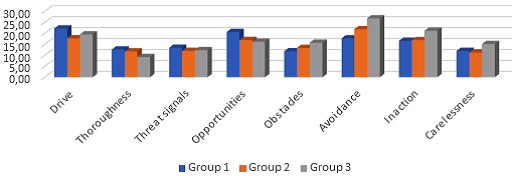
Fig. Results of a study of coping strategies of teachers of preschool educational institutions with different levels of psychological well-being (Group 1 - high level of psychological well-being, Group 2 - average level of psychological well-being, Group 3 - low level of psychological well-being)
To identify differences in the coping strategies of teachers of preschool educational institutions with different levels of psychological well-being, let us consider the results of assessing the reliability of statistical differences using the Mann-Whitney U test between subgroups of teachers with high, average, and low levels of psychological well-being (the table shows only coping strategies with significant differences obtained between subgroups) (Table 2).
Table 2. Results of assessing statistical differences using the Mann-Whitney U test in coping strategies among teachers of preschool educational institutions with different levels of psychological well-being
|
Coping strategies |
Subgroups of teachers who were compared |
|||||
|
Groups 1-2 |
Groups 1-3 |
Groups 2-3 |
||||
|
U |
p |
U |
p |
U |
p |
|
|
Striving for difficulties (drive) |
202,0* |
0,02 |
|
|
|
|
|
Threat signals |
218,5* |
0,04 |
|
|
|
|
|
Opportunities |
152,0** |
0,001 |
70,0* |
0,01 |
|
|
|
Obstacles |
|
|
85,5* |
0,03 |
|
|
|
Avoidance |
211,5* |
0,03 |
48,0** |
0,001 |
|
|
|
Carelessness |
|
|
83,5* |
0,03 |
55,0* |
0,048 |
Note: * – p<0,05, ** – p<0,0.
From the table Figure 2 shows that the subgroup of teachers with a high level of psychological well-being (group 1) differs significantly from the subgroup of teachers with an average level of psychological well-being (group 2) in the severity of coping strategies such as “Orientation towards getting closer to difficulties” (drive (U = 202.0 , p=0.02), threat signals (U=218.5, p=0.04), opportunities (U=152.0, p=0.001)) and “Orientation towards leaving and moving away from difficulty” (avoidance ( U=211.5, p=0.03)). Teachers with a high level of psychological well-being have more pronounced coping strategies such as “Orientation towards getting closer to difficulties”, while teachers with an average level of psychological well-being have more pronounced coping strategies such as “Orientation towards leaving and moving away from difficulties”.
The subgroup of teachers with a high level of psychological well-being (group 1) significantly differs from the subgroup of teachers with a low level of psychological well-being (group 3) in the level of expression of coping strategies such as “Orientation towards getting closer to difficulties” (opportunities (U=70.0, p= 0.01), obstacles (U=85.5, p=0.03)) and “Orientation towards leaving and moving away from difficulties” (avoidance (U=48.0, p=0.001), carelessness (U=83, 5, p=0.03)). At the same time, teachers with a high level of psychological well-being show a greater tendency to coping strategies such as “Orientation towards getting closer to difficulties”, teachers with a low level of psychological well-being tend to use coping strategies such as “Orientation towards leaving and moving away from difficulties” in difficult situations.
Differences were identified between subgroups of teachers with an average (group 2) and low level (group 3) of psychological well-being in the coping strategy of the type “Orientation towards leaving and moving away from difficulties” (carelessness (U = 55.0, p = 0.048)). Teachers with a low level of psychological well-being, compared to teachers with an average level of psychological well-being, are more likely to ignore difficult situations and be unwilling to resolve problems.
The discussion of the results
Our results on the presence of differences in the manifestation of psychological defenses among teachers of preschool educational institutions with different levels of psychological well-being indicate that teachers with a high level of psychological well-being in difficult situations use psychological defenses of an adaptive type (sublimation, altruism, suppression). Teachers with average and low levels of psychological well-being in difficult situations more often use psychological defense of psychotic, infantile and neurotic types. In the work of G.E. Vaillant also obtained similar data that a higher level of psychological well-being corresponds to a higher tendency to use such psychological defense as sublimation [Vaillant, 2011].
Our work revealed differences in coping strategies among teachers of preschool educational institutions with different levels of psychological well-being. Teachers with a high level of psychological well-being are distinguished by a greater preference for coping strategies related to the type “Orientation towards rapprochement, interaction with difficulty.” In difficult and stressful situations, they can assess the complexity of such a situation or anticipate possible difficulties; a difficult situation can evoke in them positive emotions and a surge of strength and help intensify the search for resources to achieve goals. Teachers with a low level of psychological well-being tend to choose coping strategies of the “Orientation towards leaving and moving away from difficulty” type; when they perceive a difficult situation, they tend to evaluate it as more difficult, requiring a lot of effort and resources to resolve it, and tend to avoid it.
Research on the psychological well-being of teachers in preschool educational institutions is being conducted in various countries, as there is a growing understanding that only a teacher who feels his own well-being will be able to have a positive impact on preschool children. These works note the presence of stressful situations in the work of teachers working with preschool children, as well as the resulting emotional burnout and exhaustion among teachers [Wong, 2023]. Teachers of preschool educational institutions use active coping strategies to overcome difficulties that arise in their work. Teachers of preschool educational institutions who use avoidant coping strategies evaluate stressful situations that arise at work negatively and do not consider them as conducive to personal growth [Koçyiğit].
The data obtained in our work is confirmed by the results of other studies, which also indicate that the psychological well-being of teachers working with preschool children depends on the extent to which they themselves perceive the stressful conditions of their work as useful for themselves and encouraging self-development [Narea, 2022]. Studies have found that the higher the level of psychological well-being, the more a person is focused on a strategy for resolving the situation [Vinokurova, 2018; Shevelenkova, 2005]. The use of adaptive coping strategies and a positive attributional style helps to increase the psychological well-being and job satisfaction of teachers [Manina, 2023]. Persons with a low level of psychological well-being are characterized using maladaptive coping strategies and a pessimistic attributional style [Dubodelova, 2020]. Teachers with high levels of psychological well-being and a positive assessment of opportunities for self-development in the professional field show inclinations towards more productive coping behavior aimed at directly resolving emerging problem situations [Kashapov, 2017]. A meta-study of factors influencing the psychological well-being of teachers, including those working in preschool educational institutions, showed that such factors include personal abilities, social-emotional competence, reaction to working conditions and professional relationships, with a high level of self-efficacy [Nwoko, 2023].
Based on the data we obtained and on the work of other authors, it can be noted that the predominance of coping strategies aimed at resolving a difficult situation or avoiding it can act as an important predictor of the psychological well-being of teachers of preschool educational institutions [Avagimyan, Stepanyan A, 2023].
The prospects for our work include assessing the age dynamics of the characteristics of psychological well-being, defense mechanisms and coping strategies of teachers of preschool educational institutions.
Conclusion
The conducted research allowed us to conclude that teachers of preschool educational institutions with different levels of psychological well-being may differ in psychological defenses and coping strategies.
Teachers with a high level of psychological well-being more often use adaptive psychological defenses, such as sublimation, altruism, and suppression. Teachers with an average level of psychological well-being more often use infantile-type psychological defenses, such as avoidance. Teachers with a low level of psychological well-being more often use psychological defense of psychotic (dissociation, regression, isolation, repression), as well as infantile (substitution-transfer, projection, passive aggression) and neurotic (avoidance, compensation) types.
Teachers of preschool educational institutions with a high level of psychological well-being are distinguished by a greater preference for coping strategies related to the type “Orientation towards rapprochement, interaction with difficulty.” Teachers of preschool educational institutions with average and especially low levels of psychological well-being are prone to greater use of coping strategies of the “Orientation towards care and removal from difficulties” type.
The scientific novelty of the study lies in expanding the understanding of the characteristics of coping strategies and psychological defenses among teachers of preschool educational institutions with different levels of psychological well-being.
The results of the study will be useful to teachers, psychologists and specialists interacting with teachers of preschool educational institutions. The results of the study can be used in psychoprophylactic and psychocorrectional working with teachers of preschool educational institutions.