Introduction
Currently, digital environments are widely used in teaching and diagnosing the development of schoolchildren, including specially designed forms of organizing educational material in accordance with educational goals. A special place among such training and diagnostic environments is occupied by digital games. At the same time, a wide range of positions can be found in domestic and foreign literature regarding the use of digital games in working with preschoolers and primary and secondary school students (Rubtsov et al., 1987; Rubtsov, 2024; Salomatova et al., 2024; Fedoseev et al., 2025). When considering digital gaming environments, the high degree of independence of students’ learning actions in the game is of particular interest, which is reflected in the emergence of theories that continue the ideas of J. Piaget, such as the constructionism of S. Papert, which formed the basis for teaching programming to schoolchildren (LaPrade, Lassiter, 2023).
Within the framework of the tradition of cultural-historical psychology, a special role is played by considering learning activity aimed at identifying and mastering generalized methods of action by students. Within the framework of the concept of developmental teaching, V.V. Davydov distinguished the learning task, which, through the implementation of learning actions, restores the initial relation of the studied system of concepts underlying the generalized methods of action (Davydov, 1996). Creating an environment for students to independently set learning tasks and provide pedagogical support for the process of mastering the activity content of education is a key challenge in the context of digitalization of modern life and schools (Loksa et al., 2022; Gromyko, 2023). Therefore, the issue of adequate use of digital gaming environments for diagnosing the psychological development of schoolchildren becomes particularly relevant.
This article discusses approaches to the diagnosis of learning activity based on specially organized digital environments within the tradition of V.V. Davydov, V.V. Rubtsov and Y.V. Gromyko. The proposed diagnostics of educational activities in a digital gaming environment continues the work of L.V. Bertsfai and A.M. Medvedev on the study of the processes of mastering generalized methods of action by schoolchildren.
Research of learning activity in gaming and digital environments
Diagnostics of learning activity in the context of solving learning problems involves the use of a genetic modeling method aimed at studying mental functions in the course of their formation, in specially organized experimental conditions (Medvedev, 2010). This method allows us to study the development of children in unity with the processes of their education and development (Gromyko, Davydov, 1994). Within the framework of a formative experiment implemented in this way, the elements of pedagogical influence are introduced into the very structure of the experiment, so that the researcher actively intervenes in the processes under study. “Its implementation involves designing and modeling the content of new psychical functions, the means and ways of their formation, it allows us to study the conditions and patterns of their origin” (Gromyko, Davydov, 1994, p. 32). Similar work was done by V.V. Davydov when forming the concept of a number in younger schoolchildren, and for secondary school students this method was applied by A.A. Ustilovskaya to form the concept of a geometric object (Ustilovskaya, 2008). This method is also associated with the study of the mechanisms of sign naturalization in solving educational and practical problems (Ustilovskaya, 2008; Medvedev, 2010), that is, operating signs without restoring their original content.
When implementing the genetic modeling method, electronic and digital media were repeatedly used to diagnose new psychical functions in the educational activities of primary and secondary school students (Medvedev, 2010). In this regard, we can single out the experiment of L.V. Bertsfai, aimed at diagnosing the acceptance of a learning task by younger schoolchildren in the framework of solving a practical problem (Bertsfai, 1981). For diagnostics, a special electronic device was designed in which students had to move a figurine using several control buttons (see Fig. 1-a). If the subject had difficulties, the experimenter put him in a situation of self-learning the control logic in a given system to understand how the buttons and the movement of the figurine on a “clean” platform relate. After that, the task became more complicated, and the functionality of the buttons changed imperceptibly for the subject. The authors were able to demonstrate that students of the experimental class, when confronted with a modified problem, solved it in a theoretical way due to the fact that during the execution of mental research work, they identified the general principle of communication between the movement of the figurine and the buttons on the remote control. Actually, the participants reconstructed the connection laid down in the system by the organizers (Davydov, 1996, pp. 189–191).
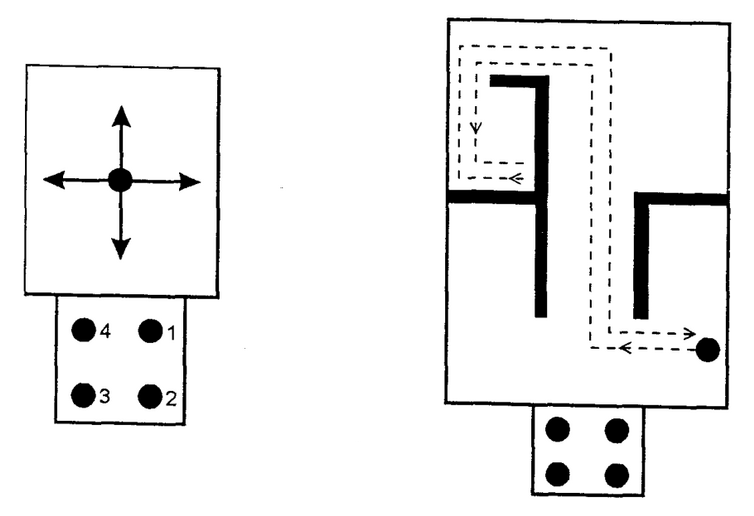
experiment by L.V. Bertsfai: moving a figurine on a plane using control buttons
(a)
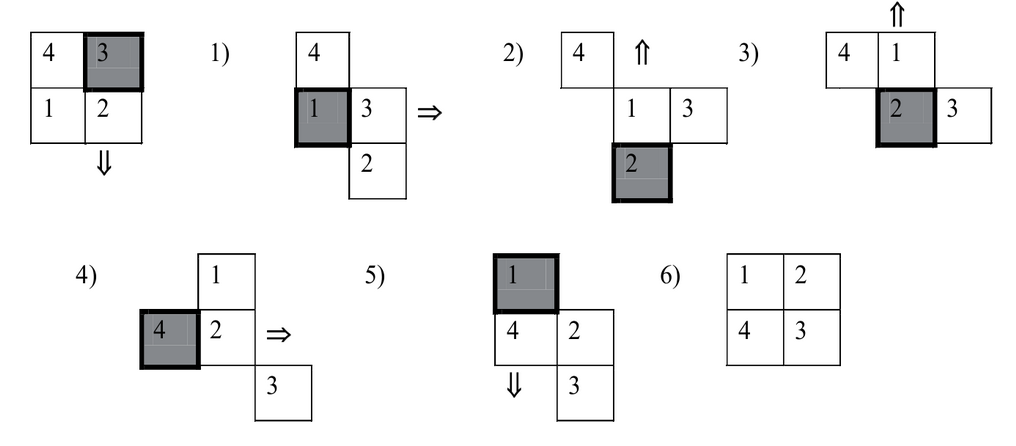
experiment by A.M. Medvedev: transforming a square on a screen using a sequence of shift operations
(b)
A subsequent review of the Bertsfai experiment raised the question of what was the genetically initial attitude of the organization of this movement system that the subjects identified and mastered (Medvedev, 2010). If the original relation is a subject of modeling, then in what abstraction (concept, model) was it recorded by them? Isn’t this experiment just a detection of the construction process of an indicative basis for practical action without identifying the most genetically original relationship in the sign-symbolic plan? Developing the line given by L.V. Bertsfai, A. M. Medvedev proposed an experiment based on the computer technique “Square” (see Fig. 1-b). The subjects were given the practical task of converting a square from its initial state to its final state taking into account the positions of the elements of the square, while performing consecutive “shift” actions. As in the experiment of L.V. Bertsfai, participants had to distract themselves from a particular practical problem and go out to find a general way – to transform the original square into any other, for which it was no longer enough to perform elementary operations and keystrokes, it was necessary to enter their own sign mediation (model). In the course of working with the test students of the 5th grade, A.M. Medvedev managed to identify separate phases of the formation of a generalized method: natural operation (describing what is happening in the language of “clicks”), direct transformations (establishing the boundaries of possible and expedient transformations) and sign mediation (constructing a solution in sign-symbolic means, for example, “a circle movement”).
This paper continues the logic of subjects' orientation to mastering the generalized method set in the experiments of L.V. Bertsfai and A.M. Medvedev. We suggest a step towards constructing an experimental scheme based on controlling the virtual digital environment both by direct operations on objects and by programming using a special sign system. If, summarizing the results of the considered experiments, we imagine a virtual digital environment as a combination of two sign environments: a) objects that are controlled by the subject; b) actions and operations that are available to him and are represented in different signs – one can select a relationship or model that connects these environments. Otherwise, if one does not restore the presence of both sign environments and the relationships between them, the user of the digital environment finds himself in a situation of sign naturalization, when operations do not restore the original relationships.
In accordance with this theoretical approach, the subject while solving a practical problem should first be put in the situation of trying to act using the proposed operations of the game environment. This step is accompanied by a sign naturalization of his work in the system. On the second step the subject should overcome the sign naturalization by restoring the original relationship from the game environment system according to ideal computer (notional machine) of the system (Grover, Pea, 2013; Munasinghe, 2023; Tenenberg, 2024), which defines all possible variants of the game dynamics.
This type of models probably is the most fundamental and important for secondary school students, since it allows them to answer the question of the value of using computer-based systems as a kind of sign-dynamic model for organizing and regulating the processes of the physical world. By mastering the relationship between a dynamic process within a digital environment and the computational model embedded in its device, a computer-based computing system as a model can become a method of organizing student activities. To do this, the student must learn to identify the relationship between the dynamic process of the digital environment and the computational model, describe it in signs that do not coincide with the signs of the digital environment itself. Such an action will mean overcoming the sign naturalization of the programming environment, reaching the relation of the dynamic process of the system and the computational model, its initial abstraction or the “germ cell”.
The diagnostic environment based on the educational video game “Berloga: Apiary Defence” was used to diagnose the development of learning activities as the first stage in the design of this formative experiment.
Digital game environment “Berloga: Apiary Defence”
New opportunities for diagnosing the development of students’ learning activities are offered by the digital game environment – the video game “Berloga: Apiary Defence”1, created within the framework of the National Cyber-physical Platform “Berloga”2. The video game was aimed at introducing students in grades 5-7 to the basics of programming. “Berloga: Apiary Defence” is not just an educational simulator with gamification elements, but a full-fledged strategy video game, which at the same time has a built-in programming capability. A player must protect an apiary from the invasion of hostile drones controlled by artificial intelligence, using protective drones, performing simple operations: placing them for the upcoming battle and directly giving them commands (see Fig. 2). In fact, the game is a virtual control environment, and the described part of the game forms a plan for operational management of objects-drones in the game.
The game contains two co-organized plans – the gameplay of a strategic game and the programming actions to change the automatically performed functions the drones. The second plan is an activity upon the activity of a strategic video game, which determines the processes of setting a learning task and finding a common way to solve it (Konokotin, 2021).
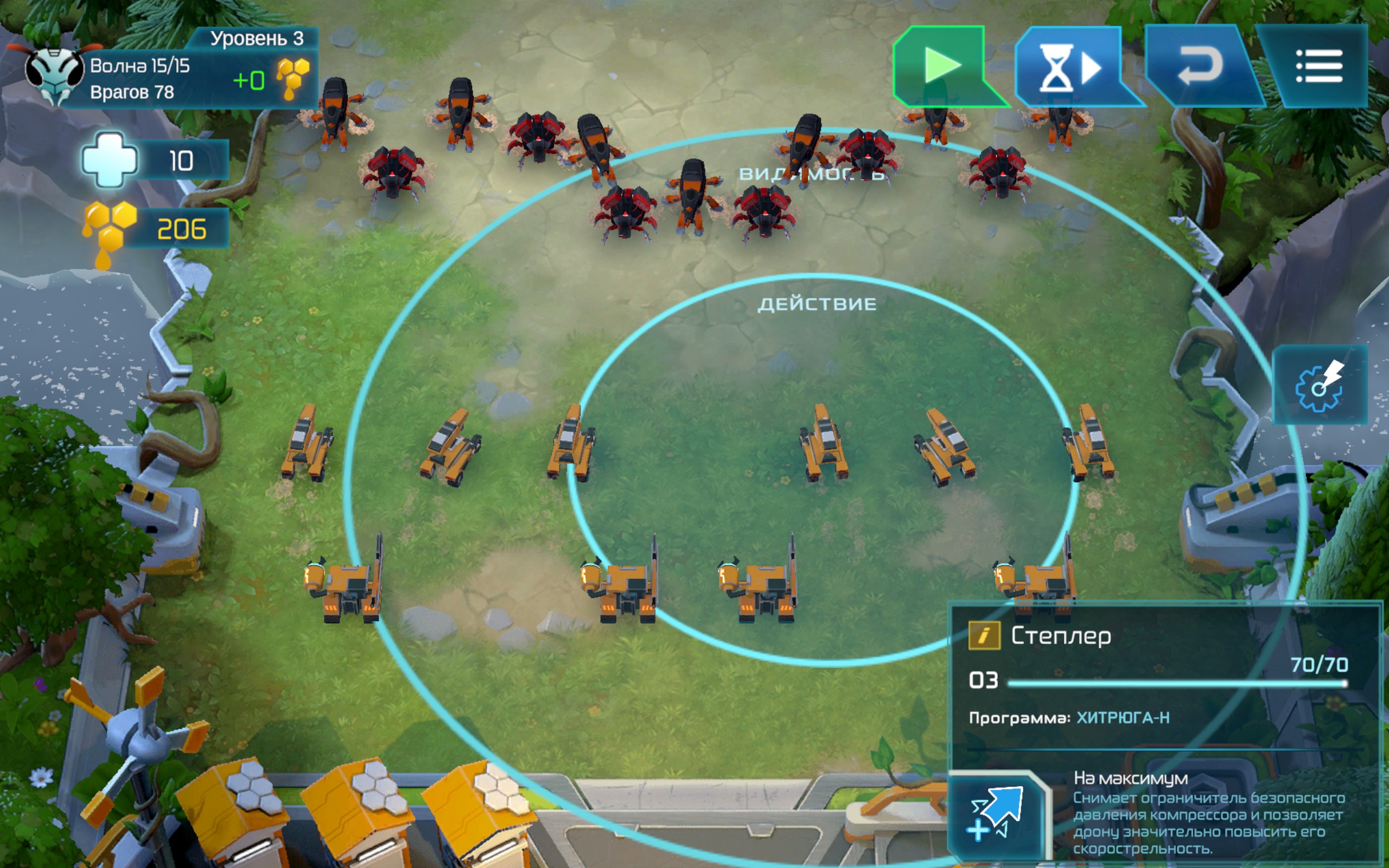
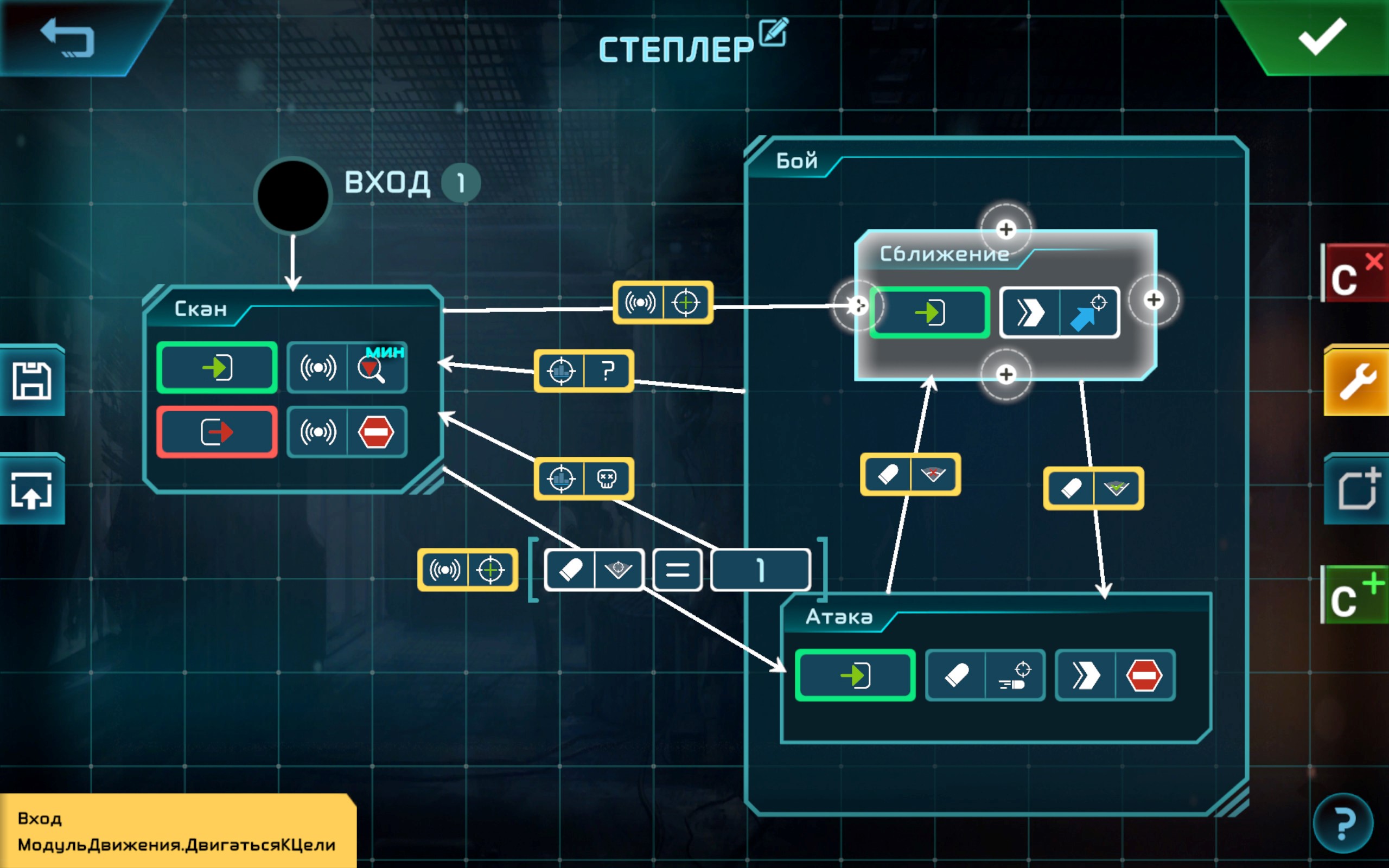
At any given time, a player can “look under the hood” of their drones and see what algorithm determines their operation, as well as modify or construct the logic of the drone’s actions from scratch. The game uses the visual programming language of extended hierarchical state machines, which is unusual for a modern schoolchild, and is the de facto industry standard for programming autonomous systems (Voevodin et al., 2024; The Preliminary National Standard..., 2024). It is specially adapted for beginners3. Drone programs are edited in a separate window, forming an alternative action plan for a player – a sign substitution of the object control actions using the programming language. A player gets the opportunity to operate with signs that turn out to be “collapsed” particular actions of the drone in the game (Fig. 3). This aspect of the game will be discussed in more detail in the next section of this article.
This digital gaming environment has a great potential for conducting psychological and pedagogical research due to its popularity and the ability to analyze data on player actions. So, by the beginning of 2025, the game was downloaded and installed 25 thousand times, and the results of more than 8,5 thousand players became available for analysis. Game statistics are collected anonymously, but players are given the opportunity to connect the game to the digital platform “Talent”4 of the NTI Kruzhok Movement, thereby linking game achievements to personal data of the student (age, grade, etc.) The game is included in the implementation of extended education programs based on organizations in the Republic of Bashkortostan (more than 100 organizations), the Novosibirsk region, St. Petersburg and other regions.
The game allows researchers to conduct comprehensive research, including long-term studies on mastering programming and related abilities, such as modeling, construction, etc. Statistics of game sessions allow one to get a general idea of the nature of the game and the resulting gaming experience. Thus, when considering the typical scenario of a novice player (game time no more than 3 days, etc.) for the years 2022-2024, we can select a subset of 5,5 thousand players. For such players, the following fact is typical: only a quarter of them have ever turned to programming in the game. The graph shows the distribution of such players by the number of their own programs created for drones (Fig. 4).
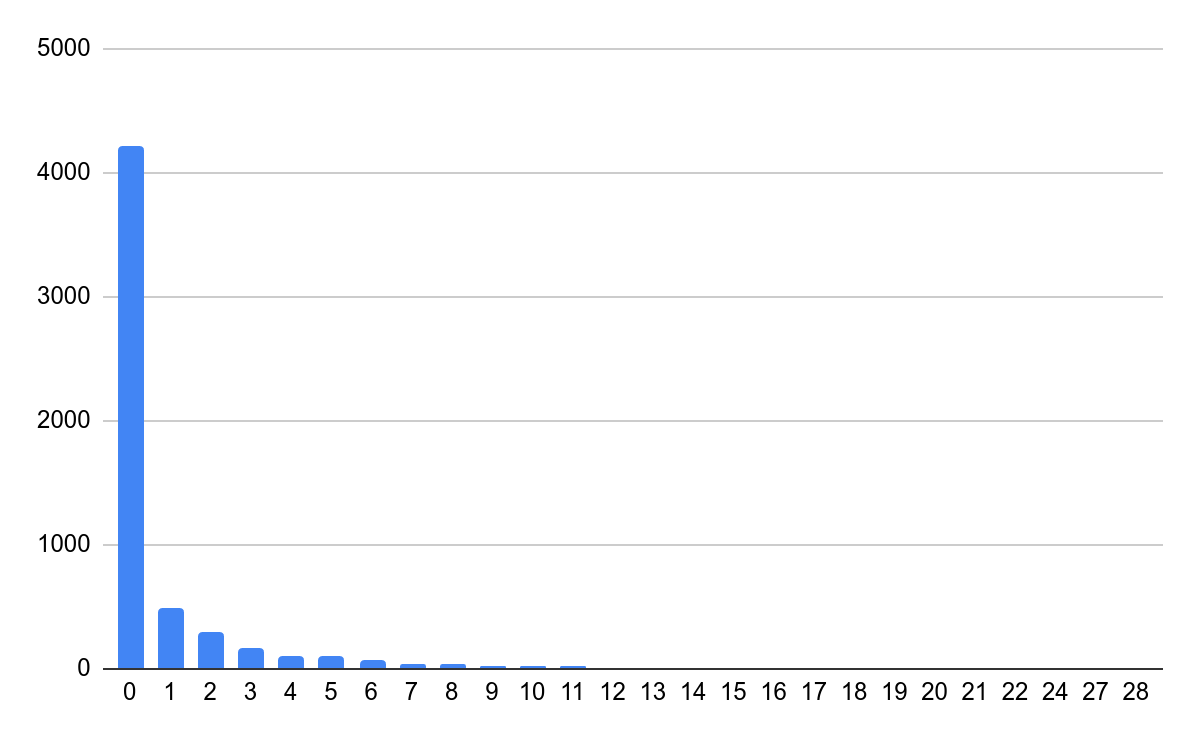
Analysis of game statistics, as well as comparison of quantitative measurements with the results of qualitative research, including observations of game sessions and discussion with subjects of the experience gained in the game, allows us to take the first step towards exploring the psychological mechanisms of setting students’ learning tasks and overcoming their sign naturalization when working in digital gaming environments. In the previous section, the principal theoretical grounds for conducting such a diagnosis were presented. Consider in more detail the proposed hypothesis about the levels of learning activity that can be detected in the framework of diagnostics based on individual experience of playing “Berloga: Apiary Defence”.
Hypothesis about the levels of development of educational activities in the game “Berloga: Apiary Defence”
As part of the educational game "Berloga: Apiary Defence", a player needs to consistently solve a number of practical tasks for managing a group of drones in an increasingly complex virtual environment (more opponents, more complex and dangerous behavior). Solving such a practical problem is impossible without mastering the operational level of the drone control action and is difficult to implement without using a special programming language that includes control commands.
Level 1: mastering individual operations on objects. A player independently learned how to select controlled objects (drones) and operate them, directly issuing commands that complement their basic logic. A player did not learn how to use programming effectively, and did not use sign representations from programs in speech.
Level 1: mastering individual operations on objects. A player independently learned how to select controlled objects (drones) and operate them, directly issuing commands that complement the drones' basic logic. A player did not learn how to use programming effectively and did not use sign representations from programs in their own speech.
Level 2: mastering the system of operations on objects and programming elements within the control system. A player experimented with control techniques that involved tactical planning on the field. A player identified the limitations and capabilities of drones, as well as tactical schemes. The use of programming was not systematic, and progress in the game was not related to programming. A player's speech reflects the context of control activity (tactics, control heuristics).
Level 3: mastering programming as a generalized sign representation of individual control operations. A player achieved success in solving a practical problem, including through the use of programming capabilities in terms of modifying the available default drone programs – he/she carried out software control over the operations of drones at the level of individual automated actions and their combinations. While working with the programming interface, a player discovered a link between individual control operations and their sign representations in the programming language. This allows a player to create simple programs through trial and error aimed at overcoming the identified limitations of manual control of drones. A player did not offer programs based on the underlying models of the controlled system, using signs without identifying the original relationships and models that formed the basis of the system.
Level 4: Overcoming the sign naturalization that occurs when programming in the game by highlighting the limitations of the managed system model that are embedded in the default programs. This level implies that a player overcame the perception of program elements as iconic signs without restoring their content and the link with the programmed system. A player was able to identify the proposed model and discover its limitations. At this level, a player experimented with the link between the program and the objects controlled by it in the game, and used special tools to restore this link (for example, using the drone LED indicator to highlight the current state of the program). A player created original programs. In a player's speech, one can find generalized descriptions of the management process, in an attempt to offer their own sign-symbolic tools, which are not enough in the default programs — a step towards overcoming sign naturalization and identifying the limitations of the management model used.
Level 5: identifying the genesis of the program as a model of the relationship between the management activity (the sign environment of actions on objects) and the activity of a controlled drone system (the sign environment of control objects). A player is ready to draw (schematize) how the computer system works – a model of an ideal computer (notional machine) built into the game as a special operator for changing the actions of drones. A player can determine the purpose of the computing system itself and the conditions for its reconfiguration. In fact, a player has reconstructed the original relation laid down in the game by the developers and can offer their own modification of the game.
Testing this hypothesis allows us to take the first step in organizing the formative experiment, namely, to determine the starting level of mastering the subjects’ educational activities as a type of educational tasks that they independently formulate when they encounter difficulties in solving a practical problem. The following sections present the methodology and results of diagnostics aimed at testing this hypothesis.
Research methodology
The stages of this study were: 1) conducting an introductory study of the work of schoolchildren in the game “Berloga: Apiary Defence”; 2) identifying two groups of subjects different in the context of using the game – specially trained and independently acting in the game; 3) conducting a comparative analysis of the nature of their playing; 4) highlighting the presence of levels of development of educational activities among players in both groups.
In this study, the individual experience of a player was considered to determine the level of development of learning activity. Diagnostics of the player’s learning activity was carried out by analyzing game behavior (stored in the digital artifacts). Following the results of the practical part of the diagnosis, the subject was asked questions aimed at reflecting on the method of solving a practical problem and the proposed solutions during the game, the difficulties that the subject encountered.
The diagnosis was aimed at students in grades 4-7. This range of students was chosen due to the special interest in the situation of transition from primary education to general education, which was already mentioned in the previous sections, as well as the lack of knowledge about programming among students of this period formed within the framework of the “Informatics” lessons.
The first group of subjects (Group A) was composed of students who had experience interacting with the game on a school computer as part of extracurricular activities and extended programming education. Participants of Group A took specially organized individual tests: they completed the same task (pass level 1 of the game) without the help of a teacher, without using hints or previously created programs. Subjects were allowed to start the test from the beginning, without limiting the number of attempts. One hour of working time was allocated for diagnostics.
The second group (Group B) included students who were not in Group A but played the game independently outside of school or clubs, using personal mobile phones and computers.
Based on the results of individual tests of Group A participants, the gameplay data (Fedoseev, 2025) were analyzed to detect the attributes given in the previous section (for level 1 – the absence of programmed drones, the intermittent nature of game sessions; for level 2 – the combination of drones of different types, the use of their tactical capabilities, etc.). These data were compared with the analysis of students' responses in their reflection with teachers. For the participants of Group B, an analysis of their gameplay was conducted to identify the signs indicating the levels of mastering learning activity.
Statistical methods were used to analyze the data obtained, including Pearson's chi-square test.
Results of diagnostics of students’ learning activity development
The first group of subjects (Group A) was formed from 42 students of the Republic of Bashkortostan. The second group (Group B) included 147 students from 26 regions of Russia. A total of 189 subjects participated in the study, including 163 boys (86%) and 26 girls (14%). Subjects are enrolled in grades 4-7, with an average age of 12,2 years (standard deviation – 1,04). Table 1 shows the detailed composition of both groups of subjects.
Table 1
Characteristics of the testing group A (N1 = 42) and B (N2 = 147)
|
Parameters |
Group A |
Group B |
|
1. Number of students |
42 |
147 |
|
2. Students’ sex |
40 males / 2 females |
123 males / 24 females |
|
3. Students’ grade |
4th – 5, 5th – 16, |
4th – 9, 5th – 28, 6th – 34, 7th – 76 |
|
4. Students’ origin |
Republic of Bashkortostan (Bolsheustikinskoe village, Ishimbai, Sterlitamak, Tuimazy, Ufa) |
26 regions of the Russian Federation, including the Novosibirsk region (46), the Republic of Bashkortostan (27), St. Petersburg (18) |
The game statistics obtained in the course of the study were published in the RusPsyDATA database (Fedoseev, 2025). When determining the level of learning activity, the analysis of statistical data was compared with the answers of the subjects to the questions of the diagnostician. Here are some examples of the subjects' characteristic quotes for each of the levels.
At level 1 (mastering individual operations on objects), the subjects noted difficulties during gameplay without trying to identify the system of actions and their relationships with objects ("There are too many units and enemies, I don't have time to follow them", "I don't understand how to make the drone do what I want"), formulated specific tasks and then added a list of them. They did not generalize ideas about how to solve a practical problem ("This time my drone was killed, but last time it survived") and did not connect programming with control operations ("I did not understand how to program; it is very difficult").
At level 2 (mastering the system of operations within the control system), the subjects noted difficulties associated with the tactical features of friendly and enemy drones ("Smoker hits his own, I didn't understand how to avoid it", "Bombardier beetle destroys all my Staplers") or with coordinating the control of many objects ("I got tired of constantly clicking on 'pause' to turn on the special ability of all units in turn"). The difficulties associated with programming were not related to control ("I tried programming, but I didn't understand the arrows", "I tried adding new states, but nothing happened").
At level 3 (mastering programming as a generalized symbolic representation of individual control operations), the subjects operated with signs from a graphical programming language without restoring the distinction between actions in the controlled system and their model representation in a program or an ideal computer ("When I added Overdrive to the Attack, it did not work every time", "I taught the drone to retreat from the enemy, but it did so belatedly").
At level 4 (overcoming sign naturalization), it was possible to identify only three subjects who were able to go beyond the proposed default programs: they programmed original tactics, named states in the program in accordance with their logic of operation ("It was necessary to program the drone so that it retreated at low health. To do this, it was required not to return to the Scan state to avoid searching for a new enemy", "My Autoborders retreated to the base when they reached half health and returned back after repairing, but I was able to do this only when the timer event condition was correct").During the diagnosis, no subjects who reached level 5 were identified.
The distribution of subjects by levels of learning activity development in accordance with the proposed hypothesis is presented in Table 2.
Table 2
The distribution of students by the level of learning activity (N1 = 42, N2 = 147)
|
Parameters |
Group A |
Group B |
|
Level 1 |
14 (33%) |
91 (62%) |
|
Level 2 |
12 (29%) |
32 (22%) |
|
Level 3 |
16 (38%) |
21 (14%) |
|
Level 4 |
0 |
3* (2%) |
|
Level 5 |
0 |
0 |
* – the subjects showed the evidence of going beyond sign naturalization when programming in the game.
We will test the statistical hypothesis about the independence of the revealed level of mastery of learning activities from the subjects' grade. Since the number of subjects from the 4th grade and the number of subjects who have reached the 4th level are small, we exclude these values from the sample under study. To test the hypothesis, we will create contingency tables for two groups of subjects: reduced group B (N=136) and group C, which combines students from both reduced groups A and B (N=173). To evaluate the independence of values, we use the Pearson chi-square test. The results of calculating the statistical criterion at the significance level p < 0,05 are presented in Table 3.
Table 3
The criteria for testing a statistical hypothesis
|
The sample under study |
Chi-squared test |
The critical value from the chi-squared distribution |
|
Reduced group B (N=136) |
1,98 |
9,49 |
|
Group C – reduced groups A & B (N = 173) |
2,64 |
9,49 |
Since the values of the obtained statistics fall within the confidence interval at the significance level p < 0,05, it can be concluded that during the diagnosis it was possible to find the independence of the revealed level of mastering learning activity from the grade of the subject.
Conclusions
Based on the results of the diagnostics of learning activity in the game "Berloga: Apiary Defence", the following conclusions can be drawn:
- The proposed hypothesis about the presence of levels of development of learning activity in the game is confirmed when diagnosing students in grades 4-7.
- In the independent individual game mode, only three participants out of 189 subjects demonstrated high levels of mastering learning activity related to generalized methods of action and working with models.
The identified levels of learning activity do not depend on the grade of subjects.
Limitations. The limitations of this study include the difference in the context of groups of subjects A (organized learning) and B (independent play). The diagnostic format did not allow to take into account the previous experience of students, which makes it difficult to interpret the results.
Discussion
The diagnostic results show that the transition from the level of mastering individual operations on objects in the game to more complex levels of learning activity is difficult within the framework of an individual game. These results can be explained by the fact that the subjects do not have support either in the game itself or in the development environment specially organized by the teacher to reach generalized modes of action, in particular, the subjects do not have the means to overcome the sign naturalization of the visual programming language.
It remains unclear whether students set a detailed learning task while playing or continue spontaneous manipulative actions. The answer to the question of what determines the transition to the formulation of a learning task will require further special research.
The independence of the level of development of learning activity from the grade of the subject may be due to the fact that generalized methods of activity in the field of programming, modeling and management are not the subject of development by students in the course of studying academic disciplines of a general education school. For this purpose, as shown in the works of V.V. Davydov, it is necessary to design a new type of educational subjects, which was later devoted to the fundamental works of V.V. Rubtsov and Y.V. Gromyko on the development of educational subjects that form the basis of the meta-subject content of secondary schools.
The results obtained allow us to speak about the limitations of digital game learning environments that claim to master theoretical content with independent actions of students, including their independent setting of learning tasks. At the same time, it is of particular interest to identify the psychological mechanisms of the transition from mastering individual operations to operating with signs without restoring their internal theoretical content, and then to identifying internal patterns and initial content – genetic relationships that make it possible to reach generalized ways of solving problems through programming. Therefore, the next step in the development of the use of digital gaming environments for diagnosing and ensuring the psychological development of schoolchildren can be the implementation of a formative experiment aimed at overcoming the sign naturalization when programming in a game (moving from level 3 to levels 4 and 5).
Of particular interest is the transition from individual to joint activities of schoolchildren. This aspect is reflected in a number of studies on the development of schoolchildren based on technical and digital game systems (Guzman, 1980; Konokotin, 2021; Margolis et al., 2022). The presence of a situation of discussion of actions performed and their corresponding signs has great potential in terms of building common sign-symbolic methods while solving problems.
The method of diagnostics considered in the article for mastering the learning activity of secondary school students in a digital game environment continues the theoretical works of V.V. Davydov, V.V. Rubtsov, L.V. Bertsfai, A.M. Medvedev, and Y.V. Gromyko. This method shows the potential of developing special pedagogical methods and requirements for building developing digital game environments aimed at secondary school students.
1The educational video game “Berloga: Apiary Defence” – https://platform.kruzhok.org/apiary
2The National Cyber-physical Platform “Berloga” – https://platform.kruzhok.org/mission
3Programming in Berloga: the learning materials – https://platform.kruzhok.org/programming
4The digital portfolio platform “Talent” of the NTI Kruzhok Movement – https://talent.kruzhok.org