Introduction
Burnout among university students has become an increasingly significant concern and a prominent focus of academic research, prompting scholars to investigate its underlying causes and identify effective strategies for mitigation (Liu et al., 2023). Evidence shows that moderate levels of burnout are common among university students worldwide, with its detrimental effects on engagement and academic performance observed across diverse cultural contexts (Rosales-Ricardo et al., 2021; Schaufeli et al., 2002). In Iran, for instance, a scoping review of Iranian studies revealed that burnout is widespread among medical students, a trend attributed to the educational challenges they face and occasional dissatisfaction or misalignment with the academic environment. This highlights the importance of identifying factors that may help reduce burnout among university students (Sayadinia et al., 2023).
Although the precise nature of the relationship between burnout and stress remains debated, a connection between them is widely acknowledged (Parker, Tavella, 2022). Reflecting this connection, the burnout framework — originally developed to address workplace stress — has also been applied to academic settings. Students face a variety of similar stressors, such as coursework demands and deadlines, which contribute to academic stress. When prolonged or unmanageable, this stress can lead to student burnout (Jagodics, Szabó, 2023; Gao, 2023). In academic contexts, burnout typically manifests as emotional exhaustion, depersonalization, academic decline, and a diminished sense of academic efficacy (El Barusi, Kurniawati, 2024; Schaufeli et al., 2002). These symptoms are evident in students’ fatigue, disengagement from coursework, emotional distress, and reduced confidence in their academic abilities (Amelia, 2022).
Burnout is widely recognized as a serious concern among university students, with well-documented effects on academic performance (Madigan, Curran, 2021). Building on this, recent research has begun to clarify the psychological, behavioral, and social factors that may help mitigate its impact. For example, greater social support has been associated with lower levels of student burnout (Ye, Huang, Liu, 2021). A recent systematic review and meta-analysis also identified emotional regulation, positive thinking, and coping strategies as key protective factors (Madigan, Kim, Glandorf, 2023).
Coping refers to the cognitive and behavioral efforts individuals employ to manage internal or external stressors perceived as overwhelming (Dubow et al., 2024). It plays a central role in students’ adjustment to academic challenges (Silva-Lorente et al., 2024). Student burnout has been negatively associated with adaptive coping strategies and positively associated with maladaptive ones (Vizoso et al., 2019). Although findings on the effectiveness of specific student coping strategies remain mixed (Xu, Wang, 2022), research highlights the potential value of certain cognitive-behavioral mechanisms — such as problem-solving, seeking help, positive reframing, acceptance, and creativity — in reducing stress and burnout (Lau et al., 2021; Kashirskaya, Belova, Kharkhurin, 2024). Further research is needed to clarify the role of these strategies across diverse educational and cultural contexts.
Although coping strategies have been linked to academic success (Lisnyj et al., 2023; Tripathi, 2025), their relationship with student burnout has received limited attention (Kulikowski, 2021). Among these strategies, problem-solving and creativity were prioritized in this study due to their growing importance in educational settings. These skills are widely recognized for fostering innovation, academic progress, and professional development, and experts advocate for their integration into curricula to enhance learning outcomes (Martz, Hughes, Braun, 2017). While research directly linking these skills to burnout is still emerging, existing evidence suggests that problem-solving may mitigate burnout by helping students address the underlying sources of stress (Lau et al., 2021), and that creativity may serve as a personal coping resource supporting stress management (Kashirskaya et al., 2024).
Creativity and problem-solving, although related, serve different purposes and involve distinct cognitive processes. Creativity refers to the generation of original and diverse ideas, often drawing on multiple perspectives. However, creative ideas do not automatically translate into effective solutions. Their practical value emerges when they are organized and evaluated through problem-solving processes. In educational contexts, this interaction becomes evident when students face complex or open-ended tasks that require both imaginative thinking and structured reasoning. In this way, problem-solving provides the framework that helps transform creative ideas into feasible, goal-directed outcomes (Zhan, He, Zhong, 2024).
Given these distinctions, the interaction between problem-solving and creativity in the context of student burnout remains underexplored. The potential for conflict between goal-oriented problem-solving and the open-ended nature of creativity raises important questions about how these strategies might combine to affect burnout. While both skills independently contribute to reducing stress, their interaction could have nuanced effects on students’ experiences of burnout. Thus, this study aims to explore the complex relationships among problem-solving, creativity, and burnout, aiming to uncover how their combination may influence students’ well-being. By doing so, we hope to provide insights that can guide the development of more targeted and effective interventions to mitigate burnout and promote student resilience.
Theoretical framework. This study adopts the emerging burnout–cognitive functioning theory as its guiding framework. Traditionally, burnout research has emphasized organizational and situational stressors, often neglecting the role of individual cognitive capacities. According to this theory, however, burnout is not only an emotional and psychological condition but is also closely linked to impairments in cognitive capacities such as attention, working memory, and problem-solving. The theory proposes a bidirectional relationship: cognitive abilities influence burnout levels, and burnout, in turn, affects cognitive functioning. Within this framework, cognitive ability is viewed as a personal resource that supports stress management, emotional regulation, and performance under pressure (Kulikowski, 2021).
Current study. Building on the burnout–cognitive functioning theory, which highlights the dynamic interplay between cognitive abilities and burnout, this study examined the association between creativity, problem-solving skills, and burnout among Iranian undergraduate students in rehabilitation sciences — a field that integrates clinical training with interdisciplinary and patient-centered practices (Beamish et al., 2024). Additionally, it explored the extent to which these cognitive-behavioral traits, along with contextual variables such as gender and living arrangements, predict levels of burnout.
Materials and methods
We employed a cross-sectional design to examine the relationships among the study variables within a defined population at a single point in time. Using statistical software, we determined that a sample size of approximately 180 participants would provide reliable estimates for a correlation coefficient of 0,20, which was chosen as a conservative estimate of correlation strength, in accordance with Cohen’s criteria for small effect sizes (Cohen, 1998). A significance level (α) of 0,05 and a statistical power (1 - β) of 0,80 were specified, ensuring that the study was adequately powered to detect the hypothesized correlation.
This study was conducted at the School of Rehabilitation Sciences, affiliated with Shiraz University of Medical Sciences (SUMS), a prestigious medical university in Shiraz, a prominent city in southern Iran. Established in 1946, SUMS is one of the oldest public medical universities in the country. It plays a central role in medical education, research, and healthcare provision across Fars Province, operating under the supervision of the Ministry of Health, Treatment, and Medical Education. With over 10000 students enrolled across 17 schools and more than 200 academic programs, the university provides an academically rigorous environment that may influence students’ experiences of stress and burnout.
Participants. The study sample comprised 193 participants, including 141 females (73,1%) and 52 males (26,9%). The mean age was 21,2 years (SD = 1,5; range 18–25). Most participants were from low to medium socioeconomic backgrounds. The inclusion criteria encompassed Persian-speaking undergraduate students majoring in occupational therapy, physical therapy, speech therapy, audiology, or orthotics and prosthetics. While this sampling frame may not fully represent the entire Iranian student population, it is important to note that students at SUMS come from a wide range of regions across the country and possess diverse ethnic and socioeconomic backgrounds. All participants had successfully passed the National Entrance Exam (NEE), the primary admissions criterion for public universities in Iran. This exam, administered annually by the National Organization of Educational Testing (NOET), selects candidates from a broad pool of high school graduates aspiring to enter higher education (NOET, 2025), thus enhancing the representativeness of the sample.
Instruments. The participants completed three validated Persian questionnaires: the Maslach Burnout Inventory–Student Survey (MBI-SS), the Abedi–Schumacher Creativity Test (A-S CT), and the Social Problem-Solving Inventory (SPSI), along with a brief demographic checklist covering gender, academic program, and living arrangements.
The MBI-SS is an adaptation of the original Maslach Burnout Inventory (Maslach, Jackson, Leiter, 1996) tailored for students (Schaufeli et al., 2002). It measures student burnout across three dimensions: exhaustion, cynicism, and academic efficacy. The scale includes 15 items rated on a 7-point Likert scale ranging from “never” (1) to “always” (7), with total scores ranging from 15 to 105. Higher scores indicate greater burnout. The Persian version demonstrated strong psychometric properties (Rostami et al., 2014).
The A-S CT is a multiple-choice test developed and validated in Iran to assess creativity (Abedi, 1993). It consists of 60 items across four subscales: Fluency, Flexibility, Originality, and Elaboration. Each item offers three response options scored from 1 (least creative) to 3 (most creative), with total scores ranging from 60 to 180. Higher scores reflect greater creativity. The test showed well-established measurement quality (Daemi, Moghimi Barforoosh, 2004).
The SPSI, developed by D’Zurilla et al. (2002), is a self-report measure of problem-solving abilities across five dimensions: positive and negative problem orientation, rational problem solving, impulsive/careless style, and avoidance style. The short form used in this study consists of 25 items rated on a 5-point Likert scale from “completely incorrect” (1) to “completely correct” (5), yielding total scores between 25 and 125. Higher scores indicate stronger problem-solving skills. The Persian version demonstrated solid psychometric properties (Mokhberi, Dortaj, Dare Kordi, 2011).
Procedure. The research received approval from the Research Ethics Committees of Shiraz School of Rehabilitation Sciences, affiliated with Shiraz University of Medical Sciences, Shiraz, Iran (Approval ID: IR.SUMS.REHAB.REC.1398.036). Data were collected over a three-month period through non-random convenience sampling, during which the research team engaged with students on campus. Researchers recruited participants using a sampling frame obtained from the registrar’s office. This framework includes undergraduate students from programs such as occupational therapy, physical therapy, speech therapy, audiology, and orthotics and prosthetics. At the time the data were gathered, there were a total of 345 students in these departments collectively. From this particular group, 193 students opted to join voluntarily, resulting in a response rate of 55,94%.
Data collection was conducted by three trained undergraduate research assistants. They coordinated with course instructors to obtain permission to administer the questionnaires at the end of class sessions. Before participating, students received a standardized explanation of the study procedures and provided informed consent.
Data analysis. Data analysis was conducted using IBM SPSS Version 27, with a significance level set at p < 0,05. Descriptive statistics (frequencies, means, and standard deviations) were used to summarize the data. Inferential analyses included Pearson correlation, analysis of variance (ANOVA), and independent-sample t-tests. Standard multiple regression analysis was employed to examine the relationship between a continuous dependent variable (student burnout) and multiple independent variables: problem-solving (continuous), creativity (continuous), gender (dummy), and living arrangements (dummy). Gender and living arrangements were included in the analysis due to their potential influence on burnout. All predictors were entered simultaneously to assess their individual contributions and to estimate the proportion of variance (R²) in burnout scores explained by the model. Assumptions of regression — including multicollinearity, outliers, normality, linearity, homoscedasticity, and independence of residuals — were assessed using SPSS REGRESSION and EXPLORE procedures; no violations were detected.
Although mediation analysis was not specified a priori, it was undertaken as an exploratory analysis after the primary analyses revealed an apparent discrepancy. Creativity was significantly associated with burnout in the bivariate correlation analysis but was no longer a significant predictor after adjustment for the other variables in the multiple regression model. This pattern was consistent with the possibility of an indirect association, prompting a formal test of mediation using the Sobel test (Preacher, Hayes, 2004). This technique assesses whether a mediator significantly transmits the effect of an independent variable on a dependent variable. Examining problem-solving and creativity as potential mediators offered a more nuanced understanding of their influence on student burnout, particularly given their distinct yet complementary roles in cognitive adaptation and goal attainment.
Results
The Kolmogorov–Smirnov tests indicated that continuous quantitative data, such as total scores for student burnout, creativity, and problem-solving, were normally distributed. The independent-sample t-test showed no significant gender differences in the mean scores of student burnout [males (48,7 ± 16,3), females (49,3 ± 13,9), p = 0,840]; creativity [males (137,3 ± 13,7), females (135,8 ± 14,3), p = 0,523]; and problem-solving [males (88,5 ± 14,2), females (84,9 ± 9,3), p = 0,089]. Table 1 shows the main demographic characteristics of the participants. ANOVA analysis showed no significant differences in the mean scores of burnout, creativity, and problem-solving among the students in five rehabilitation sciences programs.
Table 1
General characteristics of the participants regarding their levels of creativity, problem-solving, and burnout (N = 193)
|
Variables |
N (%) |
Creativity† |
p-value |
Problem-solving† |
p-value |
Student burnout† |
p-value |
|
Academic program |
|||||||
|
OT |
65 (33,7) |
138,46 |
0,464‡ |
86,78 |
0,651‡ |
50,54 |
0,488‡ |
|
PT |
43 (22,3) |
135,28 |
86,14 |
50,23 |
|||
|
ST |
42 (21,8) |
133,64 |
83,67 |
49,31 |
|||
|
AD |
21 (10,9) |
137,71 |
87,00 |
44,86 |
|||
|
OP |
22 (11,4) |
135,05 |
85,95 |
46,36 |
|||
|
Marital status |
|||||||
|
Married |
22 (11,4) |
132,26 |
0,173ǂ |
86,23 |
0,877ǂ |
47,36 |
0,552ǂ |
|
Single |
171 (88,6) |
136,73 |
85,85 |
49,33 |
|||
|
Living arrangement |
|||||||
|
On-campus |
138 (71,5) |
135,70 |
0,410ǂ |
85,14 |
0,128ǂ |
50,72 |
0,015ǂ |
|
Off-campus |
55 (28,5) |
137,56 |
87,76 |
45,07 |
|||
|
Year of study |
|||||||
|
Year 1 |
41 (21,2) |
134,54 |
0,479‡ |
86,54 |
0,070‡ |
45,85 |
0,179‡ |
|
Year 2 |
55 (28,5) |
138,22 |
88,31 |
49,25 |
|||
|
Year 3 |
41 (21,2) |
134,39 |
85,98 |
47,90 |
|||
|
Year 4 |
56 (29,0) |
136,88 |
82,98 |
52,23 |
|||
Note:.† – Mean; ‡ – ANOVA test; ǂ – Independent Samples T Test; OT – Occupational therapy; PT – Physical therapy; ST – Speech therapy; AD – Audiology; OP – Orthotics and Prosthetics. On-Campus: Refers to students living in dormitories or any residential facilities provided by the university. Off-Campus: Refers to students living outside university-provided housing, whether with parents, in their own apartments, or with peers.
Table 2 presents the means, standard deviations, and bivariate correlations (using Pearson correlation coefficient) for each measure. All the variables were significantly correlated with each other.
Table 2
Means, standard deviations, and bivariate correlations between the measures
|
Measures |
M |
SD |
1 |
2 |
3 |
|
1. Problem-solving |
85,9 |
10,7 |
− |
|
|
|
2. Creativity |
136,2 |
14,1 |
0,414* |
− |
|
|
3. Student burnout |
49,1 |
14,6 |
−0,494* |
−0,273* |
− |
Note: * P < 0,01.
The dependent variable was regressed on the independent variables. Table 3 presents the regression results of independent variables on burnout, including the unstandardized regression coefficients (B), standardized regression coefficients (Beta), 95% confidence intervals for B, and part correlations. The overall regression model was statistically significant, F (4, 188) = 17,3, p < 0,001, explaining 27% of the variance in student burnout (R² = 0,27).
Table 3
Predictors of student burnout when regressed on independent variables
|
Variables |
B |
Beta |
Part correlation |
95% CI for B |
p-value |
|
Problem-solving |
−0,621 |
−0,458 |
−0,411 |
[−0,806; −0,435] |
< 0,001 |
|
Creativity |
−0,082 |
−0,079 |
−0,072 |
[−0,221; 0,058] |
0,250 |
|
Gender |
2,270 |
0,069 |
0,068 |
[−1,820; 6,360] |
0,275 |
|
Living arrangements |
−4,051 |
−0,126 |
−0,125 |
[−8,046; −0,056] |
0,047 |
The Beta column allows us to compare the contributions of each independent variable. As illustrated in Table 3, the largest Beta coefficient is −0,458, which corresponds to problem-solving. This suggests that this variable has the most substantial and distinct impact on explaining the dependent variable. Unexpectedly, creativity did not significantly influence burnout, and gender was also identified as an insignificant predictor. In contrast, living arrangements were found to be a significant predictor. Because the “living arrangements” variable was identified as a predictor of student burnout, an additional analysis was conducted using an independent-samples t-test. The results indicated a significant difference in burnout levels between students living on-campus and those living off-campus, with higher levels of burnout observed among students residing on-campus (M = 50,7, SD = 15,3) compared to those living off-campus (M = 49,1, SD = 11,9), p = 0,007.
When squared, a part correlation indicates the contribution of an independent variable to the total R2. In our study, the problem-solving measure had a part correlation coefficient of −0,411 (see Table 3). If we square this (multiply it by itself), we obtain 0,17, indicating that problem-solving uniquely explains 17% of the variance in total burnout. For the independent variable of living arrangements, the value is −0,125, which when squared gives us 0,015, indicating a unique contribution of 1,5% to the explanation of variance in student burnout.
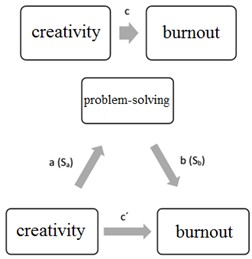
To further investigate the unexpected non-significant effect of creativity on student burnout, we examined whether either problem-solving or living arrangements mediated this relationship. A simple mediation model was applied. Although living arrangements emerged as a significant predictor of burnout in the regression analysis, they did not meet the conditions for mediation. In contrast, problem-solving fulfilled the criteria for mediation between creativity and burnout. According to Preacher and Hayes (2004), establishing mediation involves four steps: (1) the independent variable (creativity) significantly predicts the mediator (problem-solving); (2) the independent variable significantly predicts the dependent variable (burnout) in the absence of the mediator; (3) the mediator significantly predicts the dependent variable while controlling for the independent variable; and (4) the effect of the independent variable on the dependent variable is reduced (partial mediation) or becomes statistically non-significant (complete mediation) when the mediator is included in the model. The data relevant to the simple mediation model described above are presented in Table 4, which provides the necessary statistics for testing mediation. The mediation pathway is also illustrated in Figure for further clarification. The total effect of creativity on burnout (‘c’) is statistically significant, indicating that higher creativity is associated with lower burnout. Creativity also significantly predicts problem-solving ability (‘a’), which in turn negatively affects burnout while controlling for creativity (‘b’). The direct effect of creativity on burnout after accounting for problem-solving (‘c′’) is not significant, indicating that problem-solving fully mediates the relationship between creativity and burnout. In other words, creativity’s effect on burnout operates indirectly through problem-solving ability.
Table 4
The mediating effect of problem-solving on the relationship between creativity and burnout
|
Data needed for mediation analysis |
Unstandardized regression coefficient |
Standard error |
t |
p-value |
|
c |
−0,282 |
0,072 |
−3,927 |
< 0,001 |
|
a |
0,316 |
0,050 |
6,29 |
< 0,001 |
|
b |
−0,669 |
0,085 |
−7,858 |
< 0,001 |
|
c´ |
−0,085 |
0,071 |
−1,199 |
0,232 |
Discussion
This study examined how creativity and problem-solving skills, as forms of cognitive-behavioral coping, relate to burnout among undergraduate students. Both were negatively associated with burnout, indicating that students with stronger coping capacities reported lower burnout levels. These findings align with the burnout–cognitive functioning theory, which highlights the role of cognitive resources in managing burnout. In the regression analysis, only problem-solving emerged as a significant predictor of burnout. Mediation analysis revealed that problem-solving completely mediated the relationship between creativity and burnout, suggesting that creativity may be associated with lower burnout indirectly through its association with stronger problem-solving ability.
The correlational findings are consistent with those of a study conducted among Iranian university students, which also reported a negative association between problem-solving skills and burnout (Khoshgoftar et al., 2023). Similarly, our results support previous research indicating a correlational link between higher creativity and lower burnout, suggesting that creative thinking may contribute to more effective coping in academic settings (Kashirskaya et al., 2024).
Although creativity was negatively correlated with burnout, its lack of significance in the regression model suggests that its influence may be indirect or context-dependent. One possible explanation is that the effect of creativity on burnout may be mediated by stress levels, given the well-established connection between stress and burnout. In support of this possibility, An et al. (2012) identified a significant negative correlation between creativity and stress among students. However, evidence remains inconclusive regarding how stressors affect creativity. Research suggests that the relationship between stress and creative performance depends on both the intensity and nature of the stressor. For example, evaluative stress tends to follow a curvilinear pattern — low levels may enhance creativity, while high levels suppress it. In contrast, uncontrollable stressors typically show a linear negative effect, with creativity declining as stress increases (Byron, Khazanchi, Nazarian, 2010). In some contexts, high stress may even stimulate creative achievement, pointing to a potential non-linear relationship between creativity and stress (Kassymova et al., 2019). These findings underscore the complex and multifaceted relationships among stress, creativity, and burnout, and suggest that individual variation in stress exposure may help explain the inconsistent association between creativity and burnout observed in this study.
The mediation analysis highlights the interconnected nature of creativity and problem-solving as cognitive-behavioral coping strategies, particularly in their contribution to reducing student burnout. This relationship underpins the concept of creative problem-solving, which involves reorganizing existing knowledge to address new, context-specific challenges (Yang et al., 2022). The analysis revealed that the effect of creativity on burnout was fully mediated by problem-solving ability. This finding suggests that while creativity alone may not directly protect against burnout, it can enhance problem-solving skills — which, in turn, play a pivotal role in mitigating burnout. According to our study, students with higher levels of creativity may develop stronger problem-solving abilities. It is this enhanced problem-solving capacity — not creativity itself — that contributes to a reduction in burnout. One possible explanation is that our study participants did not experience burnout at a level that required a high degree of creativity for coping. This interpretation is supported by the relatively low mean burnout score of 49,1 on the MBI-SS, which is significantly below the maximum possible score of 105, indicating moderate rather than severe levels of burnout. Consequently, students in our sample may have relied more on problem-solving strategies — identified as significant in the regression model — rather than on creative approaches. Relevant evidence comes from Forgeard (2025), who reported that creativity is often seen as a pre-existing coping resource, with individuals relying on established creative outlets to navigate challenges, rather than experiencing an immediate surge in creativity in response to stress. This interpretation may also reflect the cross-sectional nature of our study, which captured data at a single point in time and may not fully represent the dynamic or evolving role of creativity during prolonged or acute stress episodes. These findings underscore the importance of considering a broader range of factors that influence student burnout and stress resilience, including personality traits, environmental conditions, and institutional support systems. Future research should aim to disentangle these elements to develop a more comprehensive understanding of the multifaceted nature of student burnout and the role of creativity within this context.
Although problem-solving fully mediated the link between creativity and burnout, our measure assessed only students’ perceived problem-solving ability. This subjective confidence may not necessarily correspond to actual performance on objective or situational decision-making tasks. Self-report instruments tend to capture metacognitive beliefs, whereas real problem-solving involves observable cognitive processes that may respond differently to stress and creativity. Clarifying the alignment between perceived and actual abilities would help determine whether the mediating role identified here reflects genuine cognitive performance or primarily students’ confidence in managing challenges.
Our findings indicated that gender did not emerge as a significant predictor of burnout. Furthermore, no significant gender differences in burnout levels were observed, which contrasts with the results of some studies suggesting that male students experience higher levels of burnout than their female counterparts (Liu et al., 2023). One possible explanation for our results is that both male and female students in our study encounter similar academic pressures, including rigorous coursework, clinical training, and performance expectations, which may equalize their experiences of burnout. Additionally, gender differences in burnout may vary across cultural contexts, as societal expectations and educational structures can influence how students perceive and manage academic stress. Future research should further examine the role of gender in student burnout, particularly within different academic and cultural contexts.
One noteworthy finding is the impact of living arrangements on burnout. The analysis revealed that students residing on campus experienced higher levels of burnout compared to those living off campus. This result aligns with our theoretical framework, which proposed that on-campus living conditions may impose greater social demands on students, including communal living stress, peer expectations, and reduced privacy. These factors may contribute to increased burnout by adding additional emotional and cognitive strain. Furthermore, our findings support previous research indicating that students who live in dormitories face challenges related to homesickness, finances, the academic environment, academic performance, and social interactions, making their experience more stressful than anticipated (Nghiem et al., 2021). These results underscore the importance of considering environmental factors, particularly living arrangements, when exploring burnout in academic settings.
Conclusions
This study investigated the relationships among creativity, problem-solving, and burnout in university students. The findings showed that problem-solving was strongly associated with lower burnout, and creativity appeared to play an indirect role by enhancing problem-solving skills. These results support the hypothesis that cognitive-behavioral coping strategies are linked to burnout and highlight their relevance to student well-being. Given the growing concern around academic stress, the findings offer insights into how specific cognitive strategies may help mitigate burnout. Future research should explore these associations longitudinally and across diverse educational settings to guide more effective student support and mental health initiatives.
Limitations. The sample was drawn from a single university, which may restrict generalizability, and voluntary participation may have introduced self-selection bias. The cross-sectional design precludes causal inferences, and all variables were measured using self-report instruments, which are susceptible to response bias. Furthermore, the study did not assess specific stressors or their intensity, restricting the contextual interpretation of the results. An important additional limitation concerns the measurement of problem-solving. This study relied exclusively on a self-report scale that assesses perceived problem-solving ability, which may not accurately reflect actual performance on behavioral or situational decision-making tasks. Therefore, the mediating effect observed here reflects students’ subjective confidence rather than objectively demonstrated problem-solving skills. Incorporating performance-based or scenario-driven measures in future research would help clarify the relationship between actual problem-solving ability, creativity, and burnout. Additionally, the Abedi–Schumacher Creativity Test assesses self-perceived creative tendencies rather than actual creative performance. Consequently, it remains unclear whether the observed associations would generalize to objective measures of creativity. Future research should incorporate behavioral assessments, such as divergent thinking tasks or evaluations of creative products, to determine whether these relationships are replicated using performance-based measures of creativity.