Introduction
Postgraduate education serves as a cornerstone of global higher education systems, pivotal to cultivating individuals with advanced professional expertise and innovative capabilities — capacities driving societal progress and scientific advancement. Globally, postgraduate enrollment has maintained a steady upward trend over the past decade, reflecting the growing recognition of advanced degrees as a catalyst for addressing complex global challenges, from technological innovation to public health crises. For instance, since 2010, the number of applicants for China's Master's Degree Entrance Examination has increased by an average of 257000 annually, reaching an unprecedented 4,74 million in 2023, while admissions totaled 760000. Amid this expansion, ensuring the quality of postgraduate education has emerged as a critical global concern.
Given such a substantial postgraduate cohort, the quality of this group warrants focused attention. Postgraduate academic achievement serves as a key indicator for evaluating postgraduates' academic performance and development, reflecting their capabilities in learning, research, and innovation. It encompasses students' learning outcomes, behaviors, and attitudes over a specific period, categorized into two dimensions: behavioral performance and objective accomplishments (Wang et al., 2011).
Strong academic achievement not only enhances postgraduates' self-confidence and learning motivation but also facilitates the cultivation of a solid academic foundation and professional competence, with significant implications for their future development and career planning (Harith et al., 2020).
Furthermore, their academic achievements directly influence the quality of postgraduate education and the reputation of institutions. Despite its significance, many postgraduate programs worldwide struggle to consistently produce high-impact research outputs. Studies indicate that a considerable proportion of master's students across diverse contexts fail to generate impactful scholarly work during their studies (Xie, Li, 2017).
Exploring effective mechanisms to elevate postgraduate academic achievement is therefore universally important, with implications for educational policy, curriculum design, and mentorship practices across higher education ecosystems. This research aims to contribute to this global discourse by identifying actionable strategies to strengthen scholarly performance among master's students, offering valuable insights for educators and policymakers worldwide.
The relationship between master's students and their supervisors is a significant factor impacting master's students' academic achievements. For master's students, amidst the diverse social activities of university life, the bond with their supervisors emerges as the most crucial interpersonal relationship. This relationship, known as the supervisor-student relationship (SSR), is a vital element for master's students to succeed in their academic careers (Gill, Burnard, 2008).
Although previous research indicates that the supervisor-student relationship is an important factor influencing master's students' academic achievements (Noy, Ray, 2012) and is significantly negatively correlated with academic procrastination (Wang et al., 2022), little in-depth research has explored how this relationship impacts academic performance or the underlying mechanisms. Consequently, this study investigates the relationship between the supervisor-student relationship and master's students' academic achievements.
Learning engagement is defined as a continuous, positive, and fulfilling state experienced by students during the learning process (Schaufeli et al., 2002). Basic Psychological Needs Theory suggests that within the campus environment, the quality of the supervisor-student relationship can directly or indirectly influence students' motivation and behavior. When students' need for relatedness is met, they exhibit higher levels of learning engagement, which in turn drives them to pursue higher-level goal orientations (Furrer, Skinner, 2003).
Komarraju (2010) found that, in research on the influence of the supervisor-student relationship on learning engagement in postgraduate education, specific aspects of student-teacher interactions — such as approachability, respect, off-campus interactions, and career development support — play a significant role in predicting students' self-confidence, motivation, and achievements. Studies examining how postgraduate learning engagement affects academic achievements consistently find high levels of learning engagement to be closely associated with greater academic accomplishments.
As Mercer (2020) noted, positive interpersonal relationships can enhance an individual's learning enthusiasm. Furthermore, low learning engagement was consistently associated with lower achievement (Saqr et al., 2023).
Drawing on these findings, this study hypothesizes that postgraduate learning engagement may act as a mediating variable in the relationship between the supervisor-student relationship and postgraduates' academic achievements.
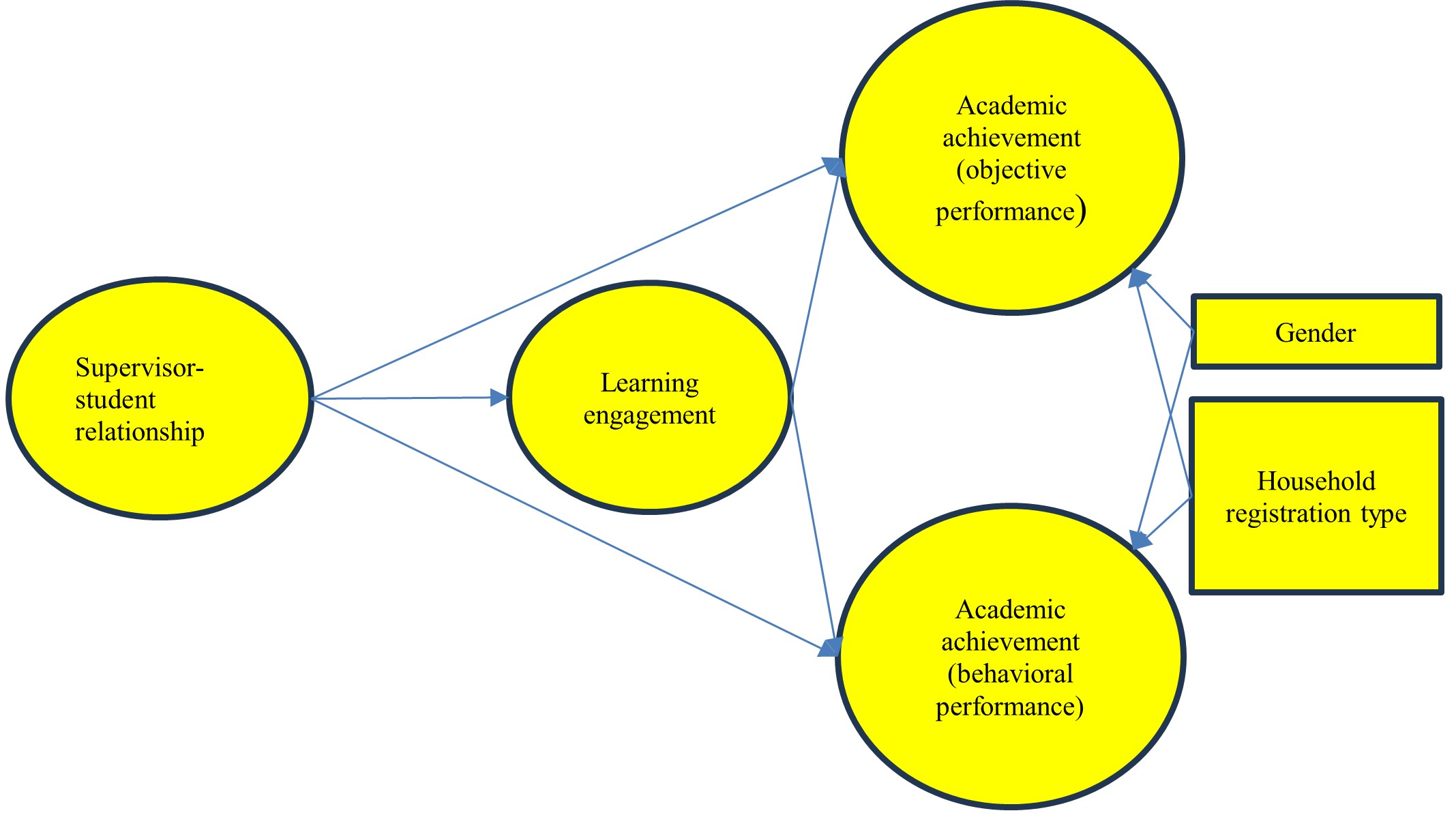
This research proposes the following hypotheses: H1: Master's students' supervisor-student relationship positively predicts their academic achievements. H2: Learning engagement mediates the relationship between master's students' supervisor-student relationship and their academic achievements. The model schematic is presented in Fig. 1, with gender and household registration type included as control variables.
Methods
Research participants
This study employed a convenience sampling method, distributing questionnaires through the online platform Wenjuanxing. For clarity, this study focuses exclusively on master’s students and does not include doctoral candidates. We differentiate between academic masters degrees (research-oriented programs, e.g., MA, MSc) and professional/masters degrees (practice-oriented programs, e.g., MBA, professional MEd).
\Participants were graduate students from various universities. Household registration was coded as 1 = urban and 2 = rural. Gender was coded as 1 = male and 2 = female. Degree type was coded as 1 = academic and 2 = professional. Finally, a total of 213 valid participants were recruited from 65 universities across China, 89 were male (41,78%) and 124 were female (58,22%). Regarding degree type, 101 participants (47,42%) were pursuing academic degrees, while 112 (52,58%) were pursuing professional degrees.
Instruments
Supervisor-Student Relationship Scale
Initially developed by Pianta (1997), the Supervisor-Student Relationship Scale was designed for teachers to assess their relationships with students. Zou Hong et al. (2007) subsequently revised the scale, shortening it to 23 items and restructuring it into four dimensions: intimacy, conflict, support, and satisfaction. Additionally, it was adapted for student self-report, utilizing a 5-point Likert scale ranging from “Strongly Disagree” to “Strongly Agree” (scored 1 to 5). In the present study, the Cronbach's α reliability coefficients were 0,944 for the positive dimensions, 0,851 for the negative dimensions, and 0,942 for the overall scale.
Learning Engagement Scale
Initially designed by Schaufeli et al. (2002), the Learning Engagement Scale was later modified by Fang Laitan et al. (2008). This scale employs a 7-point rating system, with higher scores indicating greater student engagement in learning. In the current study, the Cronbach's α reliability coefficient for this scale was 0,963.
Graduate Academic Achievement Scale
The Graduate Academic Achievement Scale was adapted from the College Student Academic Achievement Scale developed by Wang Yanfei et al. (2011). The original scale consisted of two parts: a 16-item behavioral performance scale (utilizing a 6-point rating system) and a 3-item objective academic achievement scale (utilizing a 5-point rating system). For the present study, the objective achievement scale was replaced with a custom-designed 9-item scale, deemed more suitable for evaluating graduate students' academic performance.
The nine objective indicators were: (1) average course ranking during graduate study; (2) receipt of faculty/university-level scholarships; (3) receipt of city/province-level scholarships; (4) receipt of national-level scholarships; (5) number of research projects led (as principal investigator); (6) number of research projects participated in (excluding leads); (7) number of papers published in SCI/SSCI journals; (8) number of papers published in EI/core journals; and (9) number of national patents obtained. Additionally, the behavioral performance section was restructured by combining its original three dimensions (learning performance, interpersonal promotion, and learning dedication) into two broader categories: learning behavior and interpersonal behavior. In the present study, the Cronbach's α reliability coefficient for the behavioral performance section was 0,941, and for the objective academic achievement section was 0,831.
Statistical methods
Data analysis was conducted using SPSS 26.0, and SPSS AMOS 26 was employed to test the structural equation model.
Ethical statement
This study was reviewed and approved by Guangdong Medical University. All participants were informed of the intended use of the results and provided informed consent before completing the questionnaire. Participation was entirely voluntary, and all participant information was de-identified.
Results
Test for common method bias and validity evaluation
To assess common method bias, Harman's single-factor test was employed through unrotated exploratory factor analysis on items from the three variables. Results revealed 11 factors with eigenvalues greater than 1, and the first common factor explained only 35,133% of the total variance, which is below the 40% threshold indicative of significant common method bias. Thus, common method bias was not a critical concern in this study.
Additionally, to evaluate the validity of the self-developed Graduate Academic Achievement Scale, the Kaiser-Meyer-Olkin (KMO) test and Bartlett’s test of sphericity were conducted. The KMO measure of sampling adequacy was 0,897, and Bartlett’s test of sphericity was significant (p < 0,001). These results indicate that the self-developed scale exhibited good validity.
Descriptive statistics and correlation analysis
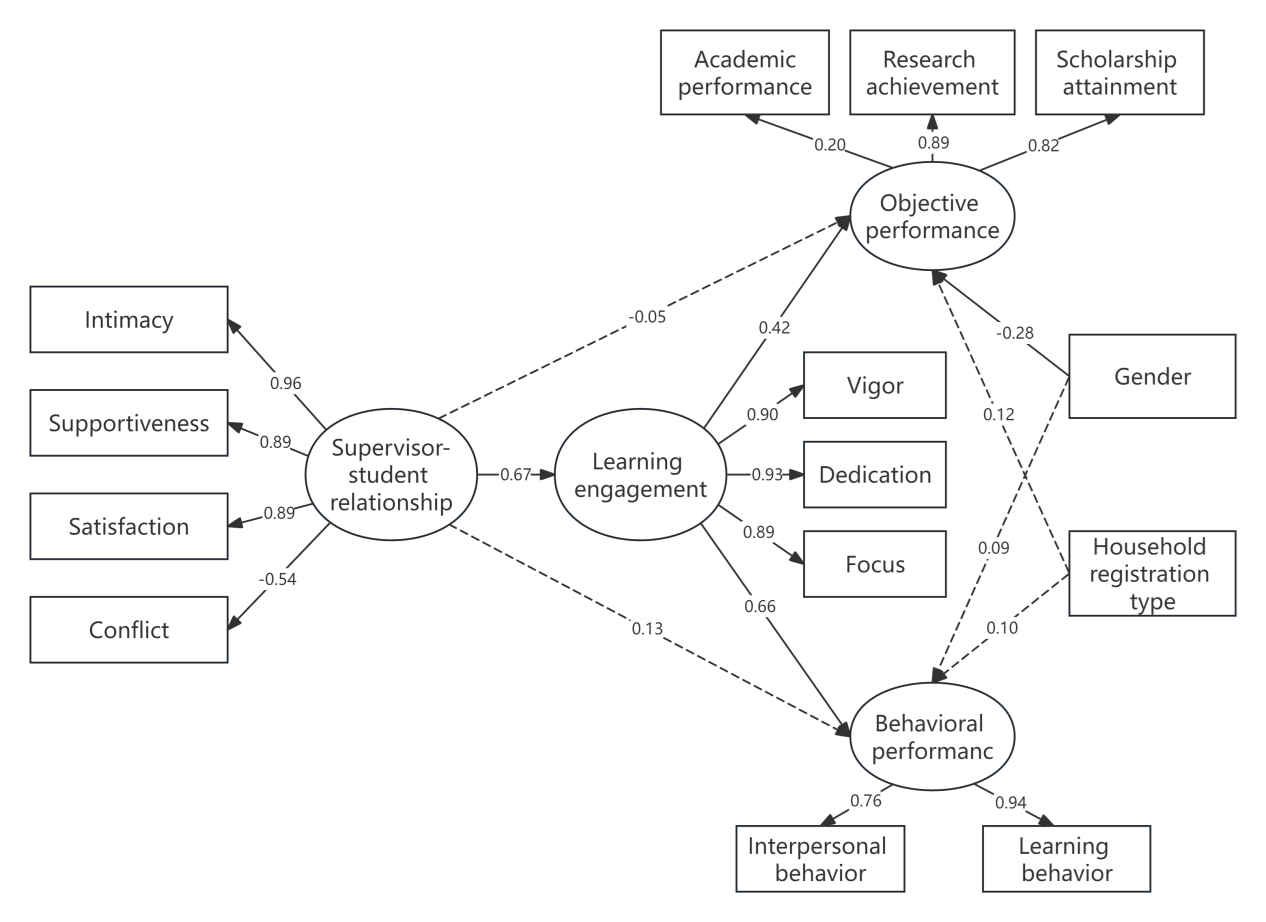
Before conducting model testing and controlling for variables, confirmatory factor analysis (CFA) was performed to validate the measurements. The study included four latent variables: supervisor-student relationship (SSR), learning engagement, and academic achievement (comprising objective performance and behavioral performance). Results showed that the Average Variance Extracted (AVE) for each factor was greater than 0,5, and the Composite Reliability (CR) was greater than 0,7, indicating good convergent validity. Additionally, the square roots of the AVE values were greater than the correlations between each factor and the others, demonstrating good discriminant validity. Detailed results of the CFA, including factor loadings, AVE, and CR values for each construct, are presented in Table 1.
Table 1
Results of confirmatory factor analysis
|
|
FL |
AVE |
CR |
|
SSR |
|
0,702 |
0,901 |
|
Intimacy |
0,962 |
|
|
|
Supportiveness |
0,885 |
|
|
|
Satisfaction |
0,895 |
|
|
|
Conflict |
–0,547 |
|
|
|
|
|
|
|
|
Learning engagement |
|
0,797 |
0,922 |
|
Vigor |
0,895 |
|
|
|
Dedication |
0,932 |
|
|
|
Focus |
0,888 |
|
|
|
|
|
|
|
|
Objective performance |
|
0,514 |
0,721 |
|
Academic performance |
0,211 |
|
|
|
Research achievement |
0,864 |
|
|
|
Scholarship attainment |
0,866 |
|
|
|
Behavioral performance |
|
0,740 |
0,849 |
|
Learning behavior |
0,952 |
|
|
|
Interpersonal behavior |
0,757 |
|
|
A t-test revealed that male participants (N = 89) scored significantly higher than female participants in supervisor-student relationship (p = 0,015), learning engagement (p = 0,001), and objective academic achievement (p < 0,001). However, no significant gender difference was found in behavioral academic achievement (p = 0,317). Regarding degree type, no significant differences were observed between participants with academic degrees (N=101) and those with professional degrees (N = 112) in supervisor-student relationship (p = 0,958), learning engagement (p = 0,106), objective academic achievement (p = 0,478), or behavioral academic achievement (p = 0,426). For household registration type, participants with urban household registration (N = 105) scored significantly higher than those with rural household registration (N = 108) in supervisor-student relationship (p = 0,017), learning engagement (p < 0,001), objective academic achievement (p < 0,001), and behavioral academic achievement (p < 0,001). Detailed t-test results, including specific t-values and p-values for each factor across gender, degree type, and household registration type, are presented in Table 2.
Table 2
T-test results for gender, degree type, and household registration location on guidance relationship, learning engagement, and academic achievement
|
Factor |
Gender |
Degree type |
Household registration |
|||
|
|
t |
p |
t |
p |
t |
p |
|
SSR |
2,441 |
0,015 |
–0,052 |
0,958 |
–2,404 |
0,017 |
|
Learning engagement |
3,353 |
0,001 |
1,625 |
0,106 |
–4,546 |
0,000 |
|
Objective performance |
4,553 |
0,000 |
0,711 |
0,478 |
–2,709 |
0,000 |
|
Behavioral performance |
1,002 |
0,317 |
0,833 |
0,426 |
–4,365 |
0,000 |
Correlation analysis revealed significant relationships among the SSR, learning engagement, and academic achievement. Specifically, SSR was significantly positively correlated with learning engagement (r = 0,586, p < 0,01); learning engagement was significantly positively correlated with academic achievement (r = 0,712, p < 0,01); and SSR was also significantly positively correlated with academic achievement (r = 0,520, p < 0,01). Detailed correlations between the objective and behavioral performance dimensions of academic achievement with other variables, as well as the mean values and standard deviations for each variable, are presented in Table 3.
Table 3
Correlations among the supervisor-student relationship, learning engagement, and academic achievement in graduate students
|
|
M±SD |
Supervisor-student relationship |
Learning engagement |
Objective performance |
Behavioral performance |
|
Supervisor-student relationship |
90,08±15,83 |
1 |
|
|
|
|
Learning engagement |
79,87±21,77 |
0,586** |
1 |
|
|
|
Objective performance |
14,50±4,890 |
0,187** |
0,391** |
1 |
|
|
Behavioral performance |
69,97±15,09 |
0,524** |
0,673** |
0,242** |
1 |
Note: * – p < 0,1, ** – p < 0,01, *** – p < 0,001.
The structural equation modeling
Gender and household registration type were included as control variables. Using the Bootstrap method with 5000 resamples, parameters were estimated and hypotheses for the structural equation model were tested at a 95% confidence level. Results indicated good model fit after correction via Bollen-Stine resampling (2000 resamples, p < 0,001). The total effects of SSR on graduate students’ academic achievement — measured by behavioral performance and objective performance — were 0,018 (95% CI [0,001, 0,052]) and 2,141 (95% CI [1,324, 3,259]), respectively. While the direct effects of SSR on objective performance and behavioral performance were non-significant, the indirect effects were significant, suggesting that learning engagement fully mediates the relationship between SSR and both behavioral performance and objective performance. Key model fit indices indicated good fit: χ²/df = 1,099, GFI = 0,962, RMSEA = 0,022, CFI = 0,996, and TLI = 0,995. The model diagram, standardized coefficients, and mediation effect results are provided in Table 4.
Table 4
Mediation effect of learning engagement
|
Path |
Effect size |
95% Confidence interval |
||
|
Lower |
Upper |
p |
||
|
SSR → Learning engagement |
2,012 |
1,265 |
3,096 |
<0,001 |
|
SSR → Objective performance |
0,010 |
–0,021 |
0,021 |
0,641 |
|
SSR → Behavioral performance |
0,827 |
–0,164 |
1,261 |
0,092 |
|
SSR → Learning engagement → Objective performance |
0,021 |
0,007 |
0,053 |
<0,001 |
|
SSR → Learning engagement → Behavioral performance |
1,664 |
1,047 |
2,770 |
<0,001 |
Discussion
Results and suggestions
This study investigated the impact of the supervisor-student relationship (SSR) on graduate students' academic achievement and explored the mediating role of learning engagement. The results indicate that learning engagement fully mediates the relationship between SSR and both behavioral and objective academic performance.
Analysis of the relationships among SSR, learning engagement, and academic achievement revealed positive pairwise correlations, consistent with prior research. These findings enhance the understanding of the interrelationships among these variables, offering valuable implications for educators. Specifically, educators can refine teaching practices, strengthen supervisor-student relationships, and develop targeted support strategies to improve graduate students' academic performance.
A key finding from the structural equation model analysis is the full mediation of the relationship between SSR and both behavioral and objective academic performance by learning engagement. This study's distinction between behavioral and objective academic performance within the framework of academic achievement also represents a significant contribution, yielding several novel insights.
First, a positive SSR promotes higher levels of learning engagement, thereby enhancing students' academic performance across two key dimensions: objective performance (e.g., academic grades, research achievements, and scholarship attainment) and behavioral performance (including learning behaviors, social interactions, and interpersonal engagement). This indicates that the SSR primarily influences academic achievement through its impact on learning engagement.
Second, the SSR exerts a greater influence on students' behavioral performance than on their objective performance. This may be attributed to the critical role of supervisor feedback in guiding students' self-management — particularly in adjusting their learning strategies and interpersonal behaviors — as noted by Hattie and Timperley (2007). When the SSR is strained, this feedback mechanism breaks down. Given that the supervisor relationship is often the most pivotal interpersonal bond during graduate studies, its deterioration can significantly hinder students' social and interpersonal adjustment. Furthermore, a strong SSR facilitates students' development of broader social networks, encompassing connections with peers, other faculty members, and the wider academic community.
Third, the SSR has a more pronounced effect on students' research performance and scholarship acquisition than on their formal exam scores. This could be because while students may not depend heavily on supervisors for course-specific exams, supervisors play a central role in guiding research activities (e.g., paper publication or patent filing), which directly influence scholarship opportunities.
The findings from the SEM analysis on graduate students' academic achievement offer several practical implications. First, from the supervisors’ perspective, fostering a positive SSR is critical, as it can significantly boost students’ academic motivation, interest, and overall engagement. According to Sidhu (2013), an exemplary supervisor should adopt a student-centered approach, offering confidence and respect while encouraging independent thinking and creativity. Effective communication and interpersonal skills lie at the core of this relationship. Emotional intelligence may also be a key factor in nurturing healthy SSRs (Gunasekera et al., 2021). Supervisor feedback is similarly highly significant: studies indicate that the effectiveness of supervisors’ feedback to graduate students is shaped by differences in content, process, and expectations, with the most impactful strategies jointly enhancing the capabilities of both parties (Chugh et al., 2021). Most students also expect equitable sharing of responsibilities between supervisors and students in the design and execution of research projects (Althubaiti, Althubaiti, 2022). Additionally, interpersonal emotion regulation (IER) is pivotal in shaping supervisor-student interactions, and such interactions can be enhanced through effective IER practices (Han, Jin, 2025).
Second, students themselves play a pivotal role. Proactive engagement with supervisors is key to academic success. When fostering a positive SSR proves challenging, students should compensate by increasing their learning engagement to mitigate potential negative impacts on academic performance. Immersing themselves in their studies and actively participating in learning activities can help offset the challenges of a strained relationship.
From an institutional standpoint, students' sense of security, belonging, and recognition within the educational environment directly influences their learning engagement and academic outcomes. Institutions must prioritize fostering strong SSRs by emphasizing their importance and implementing proactive measures to enhance alignment and communication between students and supervisors. As Kuh and Hu (2001) note, increased student-supervisor interactions correlate with greater engagement in academic activities, leading to more focused efforts in knowledge acquisition. Additionally, Sanford's (1967) research highlights the importance of balancing support and challenge in student development: excessive challenges with insufficient support may induce excessive stress and frustration, while over-support with minimal challenges can breed complacency, reducing students' behavioral performance. Optimal student success thus requires institutions to strike a balance, providing appropriate support while maintaining rigorous academic expectations.
Finally, research underscores the critical role of family support in shaping students' attitudes toward learning. A supportive family environment encourages active participation in academic activities, fosters a positive educational outlook, and sets a strong behavioral example — factors strongly correlated with improved academic outcomes and behavioral performance (Zhao et al., 2023; Chen et al., 2025; Zhao, Zhao, 2022).
Limitations and future directions
This study has several limitations. Although participants were recruited from universities across the country, the sample size was relatively small. Moreover, the study employed a cross-sectional design, while the formation and evolution of the supervisor–student relationship and students’ learning motivation are processes that unfold over time. We examined only the mediating role of learning motivation in the relationship between supervisor–student relationship and academic achievement; however, the interplay among these three constructs may be more complex and may be influenced by additional variables not considered here. Future research should address these limitations by employing larger and more diverse samples and longitudinal designs to investigate temporal dynamics, test more comprehensive models, and thereby provide a deeper understanding of the mechanisms linking SSR and academic outcomes.
While supervisor-student relationships may vary across disciplinary contexts, this study did not include academic discipline as an analytical variable — even though relevant data were collected. The sample distribution across disciplines was markedly imbalanced (e.g., Medicine: 108; Science & Engineering: 71; Humanities & Social Sciences: 26; Arts: 7; Other: 1), which rendered meaningful group-wise comparisons and moderation analysis infeasible. Future research employing more balanced sampling strategies could explore the moderating role of academic discipline in the “supervisor–student relationship–academic achievement” pathway in greater depth, in turn providing more targeted, discipline-specific educational guidance.