Introduction
Families face a multitude of challenges, including economic hardship, pandemics and military-political crises, information overload, and high demands on parental competence, which increases the burden on parents and reduces their emotional resources. Effective coping with difficulties is possible thanks to personal resilience, which helps overcome the challenges of uncertainty (Kornilova, 2013). As an example, we can consider the sharp increase in psychological research on resilience due to the COVID-19 pandemic. According to D.A. Leontiev, the most important component of resilience during that period was “risk acceptance” (Rasskazova, Leontiev, and Lebedeva, 2020).
Psychological studies of social entropy show that systemic uncertainty in the life of individuals and society becomes a background situation (Odintsova, 2012). According to D.A. Leontiev, one of the “frontiers of psychological defense against impending changes” can be resilience, which includes hardiness but is interpreted much more broadly. Resilience is considered in the context of psychological resources of sustainability as an aspect of self-regulation and social relations constructed and regulated by cultural elites1, while hardiness is considered a complex personal construct. We believe this issue to be particularly relevant, especially in the context of growing social risks.
The purpose of this article is to present a theoretical model of a non-modal (non-traditional) type of parenting, responsible parenting, developed based on an analysis of domestic and international research on parenting, parental resilience, and family resilience. We preface this by drawing on Vygotsky's cultural-historical framework, which pertains to the post-non-classical type of scientific rationality (according to Yu.P. Zinchenko et al.). This framework allows us to integrate certain ideas and concepts from other areas of psychology while conceptualizing them within the cultural-historical approach and A.N. Leontiev's activity theory. The theoretical hypothesis is that responsible parenting can be represented as a framework that includes both resilience and parenting components. We also propose incorporating into the framework our own working concept of a parental “activity position”. An experimental study of some elements of this model is reflected in empirical research in our other publications (Ivanova, Shapovalenko, 2025).
In this paper, we will attempt to address the following objectives:
- Analyze the problem of resilience in light of domestic and international research: analyze the structure of resilience, according to the works of D.A. Leontiev, R.V. Ovcharova, and others;
- Analyze the problem of parenting and its modern types and components;
- Present a framework for “responsible parenting” that incorporates the components of resilience, parenting, and the parent's “active stance”. To conduct a theoretical and methodological analysis, articles with research results were selected from the Web of Science (main collection) and ScienceDirect databases, Psyjournals.ru, and Google Scholar collections using the keywords “parental resilience” and similar terms. This article includes the most relevant data for our study, selected for two periods—2005-2015 (17 works) and 2016-2024/25 (17 works)—revealing the stated goal of the article. Theoretical methods were used (comparative and critical analysis of existing approaches, identification of contradictions, modeling, and systematization of concepts).
Analysis of domestic and foreign approaches to the problem of resilience
Resilience is studied in the context of various schools of philosophical thought: existentialism, humanism, irrationalism, hermeneutics, and positivism, primarily as a construct that promotes self-development, creativity, and active empathy in connection with cognitive activity, motivation, will, and consciousness (Konyukhova, Konyukhova, 2013). Psychological research provides a much broader perspective on the issue of personal resilience.
Resilience, as well as the introduction of the term “hardiness” in the 1980s by S. Maddi and D. Khoshaba in the United States, was conducted primarily in foreign psychology. Subsequently, the term “resilience” became more widespread. Initial studies focused on at-risk children who were able to survive difficult life circumstances (Liu, Wang, Lü, 2013; Maddi, Khoshaba, 1994). Later, the scientific base expanded to include studies of adult resilience, particularly in the context of stress and resilience research.
Resilience is considered from two perspectives: 1) in the context of overcoming stress and traumatic experiences, PTSD, and adaptation to the environment (works of A.N. Fominova, K. Homa, K.E. White, etc.); and 2) “outside of stress”, within the framework of personality theory, in the context of the value-semantic approach (works of L.A. Alexandrova, D.A. Leontiev, M.V. Loginova, A.A. Klimov, T.V. Nalivaiko, M.A. Odintsova, E.I. Rasskazova, D.A. Tsiring, etc.) (Ivanova, Shapovalenko, 2023).
Many domestic studies of resilience are related to age-related crises, the adaptation of people with disabilities, chronic and incurable diseases, and the work of people in helping professions (Konyukhova, Konyukhova, 2013, etc.). But the majority of domestic works (Leontyev, 2016, 2024; Loginova, Odintsova, 2009; Nalivaiko, 2010; and others) are devoted to the study of resilience in terms of meaning-making, intrinsic motivation, and other existential variables. Resilience is a system of beliefs about oneself, the world, and one's relationships with the world (Leontiev, Rasskazova, 2024). D.A. Leontiev and E.I. Rasskazova define resilience as a measure of an individual's ability to withstand a stressful situation while maintaining internal balance and without reducing performance. R.V. Ovcharova characterizes resilience as a combination of personality traits and skills that allows one to transform difficulties into opportunities (Ovcharova, 2019).
Interest in the issue of resilience is reflected in the volume of research conducted by both Russian and international authors (Khorosheva, 2011; Homa, 2012; O'Sullivan et al., 2013). A more detailed analysis of these studies is presented in a summary table in the repository of psychological research. We will focus on research on resilience in early and middle adulthood, the most favorable period for parenting. Research on resilience during this period is associated with its stabilization and cognitive adaptation (Fominova, 2012). Furthermore, this group of studies is the most extensive and focuses on resilience in relation to:
- Professional genesis of the individual (Vanakova, Plotnikova, 2014; Fominova, 2012; Homa, 2012): Resilience influences the success of professional activity; it is a protective factor in the activities of people in helping professions and high-risk professions;
- with personality traits (constructive aggression, perfectionism, optimism and positive thinking, humor, self-image, locus of control, anxiety, empathy, self-esteem, creativity, emotional intelligence, etc.) (Vanakova, Plotnikova, 2014; Fominova, 2012; Khorosheva, 2011; Homa, 2012; Wright, 2007);
- with personal values and meaning-making, the meaning of life, and social interests (Klimov, 2011, etc.);
- with the characteristics of individuality, temperament, flexibility, and laterality (Loginova, Odintsova, 2009; Liu et al., 2013; Wright, 2007), where it was revealed that the psychophysiological characteristics of a person create a predisposition to having a high level of resilience and can be interpreted as innate endurance, but it remains important for a person to understand their characteristics and the desire to improve, “to overcome oneself”, despite the fact that some people are less resilient; most of them have an innate potential that can be developed (Wright, 2007);
- With gender, social, ethnic, and economic differences (education level, income level, age, race/nationality, and religion), resilience improves the quality of life (Homa, 2012; Wright, 2007, etc.). It develops through broadening one’s horizons or filling in missing knowledge (Wright, 2007), especially during postgraduate education and advanced training, which is noted by researchers as a global trend in people’s desire for continuous education throughout their lives—lifelong learning.
Clearly, research on parental resilience is extremely limited, despite the fact that this age period is most typical for forming a family and finding one's footing in the new role of parent. The studies reviewed show that resilient individuals are typically characterized by optimism, flexibility, creativity, developed emotional intelligence, social skills, etc.; however, whether (and how) these qualities play a role in parenting as adults remains understudied.
Analysis of the structure of resilience
S. Maddi's structural model of resilience was accepted in the psychological community. According to it, resilience consists of three attitudes or components: involvement (commitment); control; and risk acceptance (challenge). A person who is resilient views potentially stressful events as significant and interesting (involvement), sees themselves as capable of changing these events (control), and uses change as an opportunity for growth (risk acceptance) (Leontiev, Rasskazova, 2024; Maddi, Khoshaba, 1994).
The first component, “involvement” (“commitment”), is a characteristic of oneself and the surrounding world and gives strength and motivates a person to self-fulfillment, leadership, and a healthy way of thinking and behavior (Aleksandrova, 2005). The second component, “control”, motivates the search for ways to influence the results of stressful changes, as opposed to falling into a state of helplessness and passivity, even if this influence is not absolute and success is not guaranteed; that is, the person initiates behavior (Aleksandrova, 2005). The third component, designated as “challenge” by L.A. Alexandrova and “risk acceptance” by D.A. Leontiev, helps a person remain open to the environment and society. This is a person's conviction that everything that happens to him contributes to his development due to the knowledge gained from experience, both positive and negative (Leontiev, Rasskazova, 2024). Resilience includes such basic values as cooperation, credibility, and creativity (Alexandrova, 2005).
Furthermore, researchers distinguish two types of resilience: the first type is active resilience, which is a continued search for opportunities to improve certain personal competencies and opportunities for personal development. The second type, reactive resilience, is characteristic of mature individuals who have already achieved much in life and value stability and tranquility (Ghimbulut, Opre, 2013; Obrist, 2012). Here, some parallels can be drawn with functional systems theory and the concepts of activity and reactivity (Alexandrov, 2003): active resilience, as with active responding (when a chain initiated by neuronal firing is disrupted by the introduction of a goal), promotes the search for new behaviors, creativity, and the retention of a distant goal. Reactive resilience can be a response to unexpected stressful circumstances, i.e., an immediate reaction. An analysis of resilience research allows us to note its “dual” nature, in connection with which it can be assumed that resilience operates as two different systems depending on the social situation, or these are two levels of one phenomenon as a result of secondary systemogenesis (the superstructure of a new system over the primary one) (Alexandrov, 2003).
Psychological analysis expands the concept of resilience, highlighting a resilient attitude and resilient behavior (Fominova, 2012) and two sides of resilience: psychological and activity-based (Nalivaiko, 2010). It can be said that a resilient attitude and resilient behavior, according to A. N. Fominova, are related to the psychological and activity-based sides of resilience, according to T. V. Nalivaiko, and both are related to the active and reactive resilience identified by B. Obrist, O. Ghimbulut, and A. Opre (Ghimbulut, Opre, 2013; Obrist, 2012). The multi-level construct of resilience is also confirmed by other studies (Homa, 2012). Research into the components of resilience and in terms of its types (active and reactive), in our opinion, is more informative and can be useful in developing a theory of resilience, as well as in practical application, for example, in creating resilience training.
“Active” resilience implies the creation of new meanings and constructive activity, including in parenting (Nalivaiko, 2010). Resilience can also be associated with parents' proactive approach to raising and developing their child, their involvement in the child's life, their commitment to using a nonviolent parenting style, and their desire for harmonious marital relationships (Ivanova, Shapovalenko, 2025).
Analysis of the problem of parenting and resilience in the responsible parenting model. Discussion of the results
Psychologists study parenting from the perspective of social challenges (competition among family, parenting, and career values; adaptation difficulties; erosion of stereotypes and models of raising children in the family) and the variability of family education practices. Holistic models of parenting have been described as “natural parenting”, “alpha parenting”, “intensive parenting”, “positive parenting”, or “conscious (responsible) parenting”, or two classes of parenting: 1) traditional (classical) or modal parenting and 2) modern (alternative) or non-modal parenting (Yanak, 2022).
Non-modal parenting is analyzed through family structure, the emergence of parenting, parental social practices, models of raising and caring for children, demographic security, acceptability, and demand (Prokhorova, 2019; Yanak, 2022, etc.).
Researchers of non-modal parenting highlight some trends (Ovcharova, 2008; Prokhorova, 2019; Yanak, 2022):
- positive (involved fatherhood, various parenting models (responsible parenting, etc.))
- negative (overparenting, same-sex parenting, negative parenting models (deviant, etc.))
Responsible parenting appears in this classification as one of the models of raising and caring for children, where parent-child relationships are built on the basis of cooperation, and partnerships contribute to increased awareness in raising children, which is confirmed by a number of works (Ovcharova, 2008; Prokhorova, 2019; Yanak, 2022, etc.).
Parenting, as a distinct function, develops gradually and develops throughout an adult's life: it is systemically determined, multifaceted, complexly structured, possesses a multi-level structure of factors, and is dynamic (Ovcharova, 2008; Yanak, 2022). The concept of parenting is typically understood as a set of characteristics of parents (mothers and fathers), including their parenting style, parental attitudes and expectations, values, feelings and positions, parental responsibility, and certain personality traits of the parents themselves (R.V. Ovcharova, E.G. Eidemiller, et al.).
We understand “responsible parenting” not only as an awareness and understanding of the importance and significance of a parent's role in raising and caring for a child but also as an active, proactive stance of parents toward the child's upbringing and development; involvement in the child's life; a commitment to a nonviolent upbringing; a desire for harmonious marital relationships; and the commitment of specific actions and efforts to achieve these goals, accepting responsibility for their implementation. The construct of “parental stance” has been explored by various authors, including N.S. Sokolova, who writes about parents' internal stance as the foundation for parental maturity (Sokolova, 2024).
G.S. Kocharyan, drawing on A.N. Leontiev's activity theory, clarifies that activity itself has a complex, hierarchically organized structure, which in the behavioral plane is represented by both affective and cognitive components (Kocharyan, Kocharyan, 1994). When discussing the activity-based position in the context of responsible parenting, it is important to take this into account. For example, some studies describe the negative impact on children's EB of excessive parental focus on them; the desire to bring the child to the “norm” of development or to advanced development; the simultaneous avoidance of contact with them, “emotional distance” (works by L.A. Nikolaeva, S.N. Mayorova-Scheglova, and V.S. Masalova); and conditional acceptance of the child and complete regulation of his life (work by Yu.A. Starostina) (cited from Mayorova and Scheglova, 2018). That is, the affective component of the parent's activity falls away, and only the cognitive component remains, which leads to a reduced form of activity—behavior and a set of specific actions.
It seems that modern parents are seeking to avoid or escape from close, intimate, emotional connection with their children through excessive intellectualization of parenting and digitalization. In our view, the same pattern of reduced activity operates in negative parenting trends, where the cognitive component is lost, leaving only the affective component (often negatively charged, for example, the works of L.A. Nikolaeva, S.N. Mayorova-Shcheglova). For example, when family members are distancing themselves from each other in an analog world—marital conflicts, emotional rejection, etc.
One might think that parenting qualitatively varies depending on the balance of these components of the parents' active position—cognitive and affective. It is likely that the balance of these components of the active position creates the conditions for the development of responsible parenting. We have attempted to reflect this in the diagram presented in the figure, drawing on the concepts of R.V. Ovcharova, E.G. Eidemiller, and V.V. Yustitskis on the components of parenting (Ovcharova, 2003; Eidemiller, Yustitskis, 2008) in connection with the components of resilience developed by D.A. Leontiev.
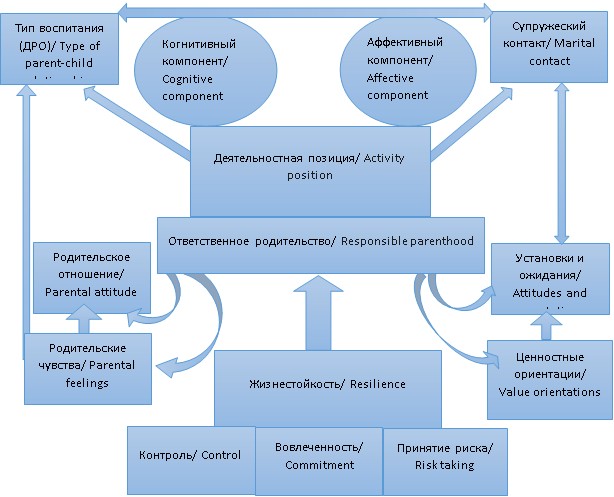
The presented diagram (Fig.) includes the most important, in our opinion, components that could theoretically be associated with resilience.
The “settings and expectations” component of spouses' relationships with each other as parents is associated with parents' desire for a harmonious marital relationship and marital satisfaction (Ovcharova, 2003) and is designated in the diagram as “marital contact”. It can be hypothesized that high resilience will facilitate more constructive resolution of conflicts, facilitating the “distribution” of responsibility (challenge, control) and the enjoyment of fulfilling assumed functions and roles (commitment).
The “value orientations” component is diverse, specific to each family and each parent, and can serve as a foundation for shaping parental attitudes and expectations (Fig.). Its understanding is based on an analysis of semantic structures, ontological concepts, and socio-psychological and individual phenomena, which can be revealed through an assessment of parental resilience. Well-developed value orientations, coupled with a strong sense of resilience, can provide support to parents in times of frustration or trauma, enabling them to discover new meaning in the event (Maddi, Khoshaba, 1994). Parents often face situations that require high sensitivity and flexibility, calling for quick decisions that utilize personal resources and self-regulation processes. Parenting crises are associated with burnout, which can develop due to declining self-esteem and the perceived importance of parenting, among other areas of life. The “commitment” component of resilience can play both a positive and negative role in parental burnout. For example, the desire to be an “ideal mother” (according to D.W. Winnicott), which can manifest itself in specific behaviors and attitudes and disguise itself as “parental commitment”, can lead to disrupted parenting styles and parental burnout. Parental burnout is associated with the degree of family dysfunction and the level of family anxiety (Eidemiller, Yustitskis, 2008). Highly resilient parents have greater resources for building harmonious interactions; their resilient beliefs allow the family system to remain stable, overcome difficulties, and accept risks, which becomes an important resource (Khorosheva, 2011).
The “parental feelings” component emotionally colors and is linked to the “parental attitude” component (Fig.) (Ovcharova, 2003). Parental love is the highest expression of parental feelings, which develops throughout a person's life. In our opinion, when combined with high resilience, parental love not only creates favorable conditions for the child's development and a secure attachment but also influences the type of parenting used: it provides reasonable freedom while demonstrating an optimal level of care and responsibility for the child. Parental feelings and attitudes influence parenting styles (parent-child relationships) (Fig.), which has been studied in much greater detail than the influence of parental resilience (O'Sullivan et al., etc.).
The few studies of parental resilience show that fathers with high levels of resilience are actively involved in raising their children and continue to add “romantic notes” to their relationships with their spouses after living together for more than 10 years (Homa, 2012). Parental resilience mitigates the effects of stigma in cases of low rates of socialization of a child with developmental disabilities. In addition, family resilience reduces the likelihood of behavioral problems in children. A model of parental resilience has been developed (Ivanova, Shapovalenko, 2023).
The conducted theoretical analysis allows us to say that resilience as an integral personal competence can be associated with a special area of adult activity—responsible parenting, the type of parent-child relationships, and the construction of family relationships (in the diagram, “marital contact”) (Ivanova, Shapovalenko, 2025; Ovcharova, 2019; Eidemiller, Yustitskis, 2008).
Conclusion
Based on the analysis, the presented theoretical framework suggests a connection between resilience as an integral personality trait and responsible parenting as a specific area of adult activity. Empirical testing of the presented theoretical framework offers opportunities for further research and can contribute to the development of evidence-based practices in childhood studies, opening up new perspectives for psychoprophylactic work with children and parents aimed at identifying and strengthening parental resilience.
The analysis allowed us to formulate the following theoretical conclusions:
- We understand resilience as an integral, three-component personal competency that can be characterized as proactive or reactive. Resilience is divided into a resilient attitude and resilient behavior and two aspects of resilience—psychological and action-oriented.
- We understand responsible parenting as an active, proactive stance of parents toward the upbringing and development of their child. Parenting can be qualitatively different depending on the balance of the “components” of parents' active position—cognitive and affective—which may be a promising area for further research.
- Responsible parenting includes the following components of parenting: spouses' value orientations (family values); parental attitudes and expectations; parental attitudes; parental feelings; and components of parental resilience—involvement, control, and risk acceptance.
Limitations. Limited access to data.
1 Leontiev, D.A. (2018). Life position of the individual: from theory to operationalization. Professional online publication "Psychological Newspaper." URL: https://psy.su/feed/7109/ (date of access: 20.05.2025).