Introduction
Education is a key to sustainable development (Nousheen et al., 2020). Quality education is expected to produce superior human resources (Saini et al., 2023). Creating superior human resources is challenging because various factors, including educational resources, influence it. Educational resources are divided into two parts: primary resources, in this case, human resources, and supporting resources, which include budgets and infrastructure facilities. Additionally, it is influenced by the education implementation system (Glover, Levacic, 2015). These four educational resources are interrelated and mutually supportive of one another. However, upon further analysis, human resources are the primary and strategic components. Human resources are the main drivers in the implementation of education. Their performance can objectively assess the quality of human resources. Teachers have a strategic role as the spearhead that determines the success of the educational process. Teacher performance is one of the main dimensions in implementing quality education. Teachers perform well if they carry out their duties and functions professionally. Teacher performance is evident in classroom management (Bailey, Michaels, 2019). Teacher performance can be observed through various stages of the learning process, including planning, execution, and assessment (Octaviarnis et al., 2021). Teachers' performance in carrying out their duties is reflected in their roles and functions in the learning process as educators, teachers, and trainers (Suhayat et al., 2023).
International studies also highlight the importance of paying attention to teacher quality as a significant factor in learning success (Siami, 2025; Baharuddin et al., 2025). In Indonesian education, the quality of learning, supported by teacher performance, remains low. Data from the education report card indicate that the quality of learning remains low (Ministry of Education and Culture, 2024). Based on the results of the 2021-2024 education report card, the average national score for learning quality is below 63,00, placing it in the medium category. The learning quality score from 2021 to 2024 shows an increase. However, the increase at the junior high school level is the lowest compared to the elementary and high school levels. A low quality of learning can lead to poor student learning outcomes (Beatty et al., 2021). Therefore, the quality of learning, particularly in junior high schools, requires special attention to improve.
This phenomenon suggests that teacher performance remains low, necessitating a close analysis of related and influential aspects to enhance performance. In education, teacher performance is influenced by various factors, including ability, motivation, work environment, facilities, leadership, and opportunities provided by the organization (McShane, Glinow, 2010). At the same time, Atatsi et al. (2019) stated that the work environment, leadership, innovative work behaviors, and intrinsic motivation influence performance. Motivation is the driving force that inspires or motivates someone to behave in a specific way toward a particular goal. Robbins, and Judge (2012) define motivation as a process that explains the intensity, direction, and persistence of effort to achieve a goal. McDonald (1959) describes motivation as a change in energy within a person characterized by the emergence of feelings and preceded by a response to the presence of a goal. Based on this view, it can be elaborated that motivation is reflected in the response and behavior of the stimulus provided.
According to Maslow, the motivation that drives a person to do something is tiered, including physiological needs, the need for safety, the need for belonging and love, the need for self-esteem, and the need for self-actualization (Bandhu et al., 2024). According to the behavioral psychology school, specifically in the form of incentive theory, it is argued that external stimuli in the form of rewards and punishments can trigger physiological needs and safety needs, thereby motivating people to respond with various behaviors to secure these two needs (Liu et al., 2025; Urhahne, Wijnia, 2023). In the context of education, stimulus in the form of salary and bonuses to fulfill physiological needs as well as stimulus to remain a teacher, ensure job security, and avoid dismissal generates motivation and responses to demonstrate various behaviors as a good teacher.
Meanwhile, the three needs that are higher up — the need for belonging and love, the need for self-esteem, and the need for self-actualization — are included in the theory of intrinsic motivation, where stimuli in the form of personal values and interests generate motivation and responses to engage in certain behaviors or activities that are personally interesting or satisfying (Coscioni et al., 2023; Murayama, Keyserlingk, 2025). In the context of education, the stimulus in the form of the principle of lifelong learning and interest in the world of education generates motivation and response to continue carrying out various behaviors or activities to improve knowledge and skills as a professional teacher because it is based on a sense of belonging and love, self-esteem, and self-actualization. Regardless of external or internal motivation, what is certain is that work motivation is a predictor that influences teacher performance. Motivated and goal-oriented teachers tend to be more responsible and perform better (Alhempi et al., 2024). In addition, Galeazzo et al. (2024) further investigated the relationship between inspirational motivation and an organization's performance, specifically in the context of a school.
A school's performance is greatly influenced by the desire and participation of teachers to mobilize all their abilities in educating students (Sabu, Manoj, 2020). Participation is a person's involvement, whether through energy, thoughts, mentality, even emotions and feelings, as a form of responsibility by contributing to efforts to achieve predetermined goals (Liu et al., 2025). Participation itself grows from three value beliefs: achievement value, intrinsic value, and utility value. Achievement value motivates someone to participate effectively in a task because it relates to their identity and self-esteem. Intrinsic value encourages someone to volunteer to participate, even making sacrifices, because it relates to the enjoyment gained from completing a task. Utility value motivates someone to participate in a task to achieve current and future goals in social, educational, professional, or everyday contexts (Urhahne, Wijnia, 2023).
Low teacher performance is also caused by less empowered teacher participation, according to empirical findings (Sudargini, 2021). While participation is closely related to performance (Berdicchia, Masino, 2019; Stor, 2024). Low teacher performance is also attributed to low self-efficacy and low involvement in work, which serve as obstacles to the development of innovative work behaviors (Putri, Rini, 2021). On the other hand, it was found that there was a lack of appreciation from superiors; awards from superiors were instrumental in triggering and encouraging teachers to be creative and accomplished (Silver et al., 2021). The right award for teachers can increase motivation to improve the quality of education and their performance.
Furthermore, Alateeg and Alhammadi (2024) state that work engagement is a crucial factor influencing innovative work behaviors. Sari et al. (2021) emphasize that employees who are emotionally and intellectually committed to their jobs are more likely to actively participate in creative and innovative endeavors. The contribution of innovative work behavior is crucial to the successful delivery of high-quality services. It influences and directly enhances performance (Jankelová et al., 2021; Pham et al., 2024). Teachers with innovative work behaviors tend to be proactive in finding solutions, applying new ideas, and developing creative learning methods that have a positive impact on the learning process. According to open innovation theory, innovation is greatly supported by cooperative efforts and the exchange of knowledge relevant to education (West, Bogers, 2016).
Innovative work behavior is essential for organizational success and can improve the quality of education and the work environment (Bawuro et al., 2020). Factors such as self-efficacy, empowering leadership, and well-being play crucial roles in enhancing innovative behavior, which in turn can improve teacher motivation and teaching practices. Innovative work behavior in teachers has a significant impact on teacher performance, motivation, job satisfaction, student outcomes, and academic performance. Recent research also emphasizes that innovative work behavior fosters teachers' job satisfaction individual job performance (Eken et al., 2024). Self-efficacy, leadership, organizational climate, and teaching motivation are essential in fostering innovative work behavior.
By integrating multiple factors influencing teacher performance, it is expected that a more comprehensive performance enhancement can be achieved. Numerous empirical studies have explored the direct influence of work motivation, participation, and innovative work behavior on teacher performance. However, a significant gap remains in terms of how creative work behaviors moderate these relationships. Therefore, exploring further how innovative work behaviors, participation, and work motivation can influence and catalyze improvements in teacher performance is essential. Filling this gap is necessary, as it can provide valuable insights into strategies that schools and policymakers can adopt to enhance teacher performance. By understanding the roles of participation, work motivation, and innovative work behaviors, schools can strengthen these areas to improve teacher performance.
The novelty of this study lies in its examination of innovative work behavior as a moderating variable that strengthens the influence of work motivation and participation on teacher performance. Previous studies have mostly treated innovative work behavior as an independent or mediating variable, but this study explores its moderating role, which has rarely been investigated in educational settings, particularly among junior high school teachers in Indonesia. Furthermore, by integrating social exchange theory and open innovation theory, this study provides a new conceptual framework for understanding how teachers' innovative behaviors enhance the effects of motivation and participation on performance. Thus, this research contributes to theory by extending existing models of teacher performance and offering evidence-based recommendations for improving school management and teacher development policies.
Social exchange theory states that, based on subjective cost-benefit analysis, resources are exchanged (Blau, 2017; Cropanzano et al., 2017). Social exchange theory posits that, based on a subjective cost-benefit analysis, resources are exchanged, affecting a person's psychological aspects, such as motivation and participation, which can ultimately enhance and improve performance. Further analysis based on humanistic psychology and social psychology suggests that humans need to develop their potential, gain appreciation, and achieve self-actualization (Maslow, 1970; Rogers, 1961). Therefore, participation is seen not only as physical involvement, but also as self-expression and an internal drive to contribute that is closely related to motivation, a sense of belonging, and psychological satisfaction in work. Teacher participation reflects the socio-psychological process of communication, cooperation, and collaboration with colleagues and the principal. In addition, a person's work motivation is supported by innovative work behavior that is sensitive to change, continually develops knowledge, generates new ideas, and applies them to enhance their performance further. For this reason, psychological and social aspects, especially based on social exchange theory, were taken into account in developing the questionnaire indicators in this study. The theoretical framework is described in the theoretical model as follows.
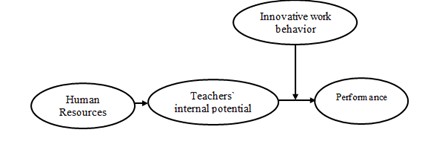
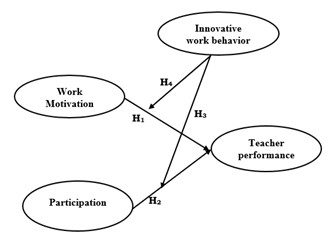
This study presents four hypotheses. The third and fourth hypotheses serve as the core focus of this study. The third hypothesis states that when teachers are more innovative, their motivation has a substantial impact on their performance. The fourth hypothesis examines how innovative work behaviors can intensify the influence of participation on teacher performance. The hypotheses in this study highlight teacher performance improvement strategies and introduce a new perspective on teacher performance that empirically links work motivation, participation, and innovative work behaviors. Therefore, this broadens the scope of work motivation and participation in enhancing teacher performance. Figure 2 presents the proposed research model.
Materials and methods
This is a quantitative study using an ex post facto method. It revealed data on events that have occurred and existed in the respondents without giving treatment or manipulating the variables studied.
3.1 Sample size and data collection procedures
The population of this study included all teachers from State Junior High Schools in Temanggung Regency, comprising 1517 individuals across 42 schools in 20 sub-districts. A proportional random sampling method was employed, and the sample of 316 respondents was calculated using the Slovin formula with a 5% margin of error. The data collection technique was non-test. The instruments used were a questionnaire, which consists of 4 instruments to measure teacher performance, participation, work motivation, and innovative work behavior. The instruments were arranged using a 5-point Likert scale.
3.2 Data analysis
This study employed the PLS-SEM approach to develop the SEM model and analyze the data using outer and inner model analysis (Legate et al., 2023). The purpose of the outer model is to assess construct validity, ensuring that the indicators accurately represent the intended latent variable (Edeh et al., 2023). The constructs of work motivation (WM) and participation (P) are exogenous variables. Work motivation refers to the change in energy to perform or not perform work, derived from internal and external factors, as measured by stimulus, response, and behavioral indicators. Participation is active, involving both mental, emotional, and physical engagement, with indicators of utilizing all abilities and skills, and taking the initiative. Innovative work behavior (IWB) is a moderating variable. Innovative work behavior is characterized by proactive and creative actions demonstrated by a person at work, including identifying opportunities, generating new ideas, and applying newly acquired knowledge. Teacher performance (TP) is an endogenous variable. Teacher performance is the result of the teacher's work in fulfilling their duties and functions. In terms of appearance, his/her actions and work achievements can be observed through indicators such as planning the teaching and learning process, implementing the process, creating optimal learning conditions, and assessing learning outcomes. Teacher performance is then assessed based on self-evaluation. In the context of this research, teacher performance was only measured using a questionnaire instrument.
The outer model analysis in Smart PLS focuses on three key components: outer loadings, construct validity and reliability, and discriminant validity. For hypothesis testing, the inner model analysis employs various methods, including R-squared, Q-squared, and t-statistics.
Results
4.1 Descriptive analysis
The demographic details of 316 respondents provided a comprehensive picture of the junior high school teacher population in Temanggung Regency. The gender distribution was relatively even, with 41% of respondents male and 59% female. The majority of the age distribution was among individuals aged 51–60 years (28,5%), followed by those aged 31–40 years (25,7%). The most extensive work experience was in the range of less than 5 years (24,2%), followed by a working period of 16–25 years (23,3%) and 26-35 years (21,1%). In addition, the respondents’ educational background was a diploma (0,9%), S1 (90,5%), and S2 (8,6%).
4.2 Measurement model
The evaluation of the outer or measurement model encompasses three core elements: outer loadings, construct validity, reliability, and discriminant validity. The SmartPLS 4 results present the outer loading coefficients for each variable, as shown in Table 1.
Table 1
Outer loading value
|
Latent variables |
Manifest variables |
Loading factor |
Annotation |
|
Work motivation |
WM1 |
0,876 |
valid |
|
WM2 |
0,925 |
valid |
|
|
WM3 |
0,902 |
valid |
|
|
Participation |
P1 |
0,887 |
valid |
|
P2 |
0,945 |
valid |
|
|
P3 |
0,910 |
valid |
|
|
Innovative work behavior |
IWB1 |
0,939 |
valid |
|
IWB2 |
0,921 |
valid |
|
|
IWB3 |
0,948 |
valid |
|
|
Teacher performance |
TP1 |
0,844 |
valid |
|
TP2 |
0,914 |
valid |
|
|
TP3 |
0,903 |
valid |
|
|
TP4 |
0,869 |
valid |
Table 1 shows that all indicators exhibited outer loading values exceeding 0,7, indicating that they met the required criteria and were suitable for use in this study.
Table 2
Cronbach's Alpha and composite reliability values
|
Variables |
Cronbach's Alpha |
Composite reliability (rho_a) |
Composite reliability (rho_c) |
|
Teacher performance |
0,889 |
0,908 |
0,924 |
|
Work motivation |
0,854 |
0,863 |
0,911 |
|
Innovative work behavior |
0,885 |
0,918 |
0,928 |
|
Participation |
0,852 |
0,852 |
0,911 |
Construct validity and reliability were assessed through Cronbach's Alpha and Composite reliability. The data in Table 2 provide Cronbach's Alpha values, which ranged from 0,852 to 0,889. Composite reliability (CR) values greater than 0,700 indicate the reliability and internal consistency of the proposed model.
Table 3
Heterotrait-Monotrait Ratio
|
Variables |
Teacher performance |
Work motivation |
Innovative work behavior |
|
Work motivation |
0,732 |
|
|
|
Participation |
0,763 |
0,891 |
|
|
Innovative work behavior |
0,766 |
0,840 |
0,853 |
Discriminant validity was calculated by the Heterotrait-Monotrait Ratio (HTMT) (Hair et al., 2020; Edeh et al., 2023). The recommended HTMT value is less than 0,9, indicating an approximate correlation between the factors, as shown in Table 3. The HTMT values ranged from 0,732 to 0,891. This value is below 0,90, indicating that the entire construct met the criteria for discriminant validity.
4.3 Structural model
The structural or inner model is a component of SEM that examines and evaluates the relationships between latent constructs. It aims to validate the causal links between exogenous (independent) latent variables and endogenous (dependent) latent variables, as outlined in the proposed hypothesis (Hair et al., 2020).
Structural model testing can determine whether the relationships between variables show significance that aligns with the established hypothesis. Structural model testing was carried out using R2 and Q2. The model goodness-of-fit test, also known as an alignment test, was assessed by the R-squared value. There are three classifications for interpreting R-square values: values of 0,75 are categorized as strong, 0,50 as moderate, and 0,25 as weak (Legate et al., 2023).
Table 4
R-square value
|
Variables |
R-square |
Adjusted R-square |
Prediction model |
|
Teacher performance |
0,702 |
0,695 |
Moderate |
Table 4 presents the results of the analysis, indicating that the TP variable had an adjusted R-squared value of 0,695, suggesting that WM, P, and IWB variables collectively account for 69,5% of the variability in TP.
Q² is a metric used to evaluate the predictive accuracy of the constructed structural model. This value reflects how closely the model’s predicted outcomes align with the actual values in structural testing. The interpretation of the value of Q² is as follows: if Q² > 0, then the model has the predictive ability of endogenous variables; if Q² = 0, then the model has no predictive ability; and if Q² < 0, then the model’s prediction is worse than the average (Legate et al., 2023; Lisboa, 2017). The analysis results, as presented in Table 5 using Smart PLS, show that the Q² value for the TP variable is 0,469, indicating strong predictive power of the exogenous variables regarding TP, with the level of prediction relevance classified as high.
Table 5
Q-square value
|
Variables |
SSO |
SSE |
Q² (=1-SSE/SSO) |
|
Teacher performance |
1264,000 |
671,592 |
0,469 |
4.4 Hypothesis testing
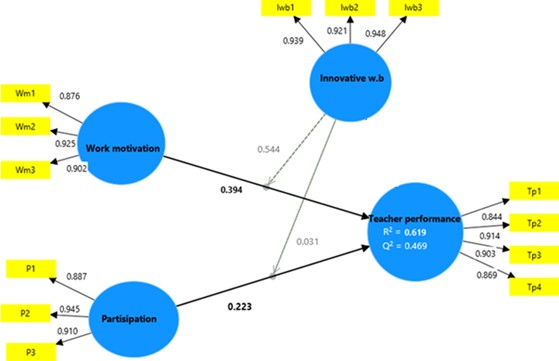
The first hypothesis (H1) suggests that WM positively and significantly affects TP. The analysis confirmed this, showing a positive impact (β = 0,394, p = 0,00 < 0,05). Similarly, the study also supports the second hypothesis (H2), demonstrating that P has a positive and significant influence on TP (β = 0,223, p = 0,043 < 0,001).
The role of IWB moderation was assessed in H3 and H4. The Smart-PLS 4 analysis showed that IWB significantly moderated the relationship between WM and TP, with a coefficient of β = 0,544 and a p-value of 0,000 < 0,05, thereby supporting hypothesis H3. However, the fourth hypothesis, which posited that IWB moderated the effect of participation on TP, was not supported, as indicated by a coefficient of β = 0,031 and a p-value of 0,685 (> 0,05). The outcomes of hypothesis testing and structural model analysis are detailed in Table 6 and illustrated in Figure 3.
Table 6
Hypothesis testing results
|
|
Path |
β |
t-value |
p-value |
Remarks |
|
H1 |
Work motivation > Teacher performance |
0,394 |
3,923 |
0,000 |
Supported |
|
H2 |
Participation > Teacher performance |
0,223 |
2,036 |
0,043 |
Supported |
|
H3 |
Innovative work behavior x Work motivation > Teacher performance |
0,544 |
12,898 |
0,000 |
Supported |
|
H4 |
Innovative work behavior x Participation > Teacher performance |
0,031 |
1,406 |
0,685 |
Not supported |
Discussion
Empirical results showed that WM positively impacted TP, indicated by an influence coefficient of 0,394 and a p-value of 0,000, which fell below the 0,05 significance level. Increased WM was associated with improved TP. Suppose you look deeper into the indicators of WM, namely stimulus, response, and behavior. In that case, the higher the teachers’ responses and working behavior to the existing stimulus, the more their performance can be improved. The results of this study were consistent with prior research, which found a direct effect of WM on TP (Chien et al., 2020; Pham et al., 2024; Supartini et al., 2025).
Strong motivation is essential in supporting learning success, not only for students to achieve academic success but also for teachers as lifelong learners to continue improving their mastery of content, pedagogical skills, and authority in exemplifying commendable behavior. WM is a catalyst that influences teachers' actions and behaviors in performing their responsibilities. Teachers with strong WM are generally more enthusiastic, creative, and innovative when planning lessons. They are also more motivated to enhance the quality of education, develop effective learning materials, and foster positive relationships with students and peers. Thus, WM significantly affects performance.
Teachers' WM is influenced by several factors, including the self, which contains information about self-efficacy, values, expectations, and attribution patterns, and facilitates social comparison; goals, which provide standards for self-evaluation of progress; behavioral processes such as activity selection, effort, persistence, regulation, and achievement, which are closely related to the actions and outcomes of the modeled actions; and environmental processes, including feedback, opportunities for self-evaluation, and rewards (Murayama, Keyserlingk, 2025; Urhahne, Wijnia, 2023). In the context of education in Indonesia, most teachers have a moderate or middle level of motivation between the controlled level of motivation in the form of employment status and social security and financial benefits that can meet physiological needs and safety needs; and the autonomous level of motivation that comes from more intrinsic beliefs and values including responsibility and attention to teaching, intellectual stimulation, and self-evaluation to meet the needs of belonging and love, self-esteem, and self-actualization (Irnidayanti et al., 2020; Irnidayanti, Fadhilah, 2023).
The findings of this study revealed that participation has a positive influence on TP, as evidenced by an influence coefficient of 0,223 and a P-value of 0,043, which is below the 0,05 significance threshold. Greater participation in TP is likely to enhance performance, whereas lower teacher participation tends to result in reduced performance. On the contrary, the lower the teacher's participation, the lower the performance. The participation indicators used in this study included abilities and skills, as well as taking initiative. The higher a teacher utilizes their abilities and skills and takes the initiative, the more likely their performance will improve. These results align with previous research, which suggests that participation has a direct impact on performance (Sabu, Manoj, 2020; Stor, 2024).
The research findings, which reveal that participation positively affects TP, are relevant to social exchange theory, which states that resources are exchanged based on a subjective cost-benefit analysis (Blau, 2017; Cropanzano et al., 2017). A person who feels involved in a job strives to do well. A person who participates highly tends to have the initiative to do the job well. Judging from the social benefit analysis, an individual who actively participates gains good judgment and prestige from their friends, which in turn leads to improved performance. The economic benefit analysis shows that active participation can impact career development.
Teacher participation involves utilizing their abilities and skills to engage in various school activities, collaborating with colleagues, and doing their best for students and the school. In terms of learning, teachers who utilize all their abilities and skills strive to find ways to apply their knowledge and skills in the learning process, incorporating information technology into classroom learning. Such efforts directly relate to the TP indicator, which focuses on creating an optimal learning atmosphere and implementing the teaching and learning process. Teachers who actively participate take the initiative in various things, such as taking the initiative to take part in training, enjoying searching for new information to improve the learning process, proposing new ideas related to improving the quality of education, taking the initiative to invite colleagues to discuss learning innovations, and taking the initiative to design more effective learning strategies. Teachers who participate highly tend to utilize all their abilities and skills, taking the initiative to improve their capabilities, enhance the quality of learning, and design effective learning strategies that ultimately improve their performance.
Empirical findings showed that innovative work behaviors are not statistically significant in strengthening the influence of participation on TP, with a P value of 0,685 > 0,05 and a t-statistic of 1,406 < 1,96. IWB associated with TP and P were found not to affect the outcome. The theory of planned behavior can explain the empirical findings of this study, revealing that individual behavior, including IWB, is highly dependent on intention, attitudes toward these behaviors, subjective norms, and perceptions of control (Ajzen, 2020). In a highly participatory work environment, individuals may feel innovative behaviors are unnecessary if job goals can be achieved through existing methods. School environments that have already supported participation cause teachers to focus on in-role behavior rather than generating new ideas. These findings align with previous research (Caniëls, Veld, 2019; Wijayana et al., 2022).
Based on social exchange theory, P provides individuals with the opportunity to receive rewards and benefits, both from a social and economic perspective, thereby strengthening performance. However, these empirical findings indicate that IWB does not enhance the relationship between participation and performance. This may be due to the innovation not being aligned with the needs of the organization or the education system, and the complexity of the innovation process. IWB carried out by teachers may be less relevant or less supported by the organizational environment. In addition, IWB requires significant time, resources, and managerial support. It is crucial to understand that if the organizational culture is not supportive, IWB can become an additional burden, which may divert attention and focus from primary tasks relevant to performance, highlighting the need for change.
IWB are proactive and creative actions that individuals demonstrate to generate new ideas, solutions, and practices. Empirical data showed that the direct effect coefficient of work motivation on TP was only 0,394. However, when work motivation is mediated by IWB, its impact on TP rises significantly to 0,544. IWB appears to enhance performance outcomes further, indicating that high work motivation alone may not optimally improve TP unless accompanied by strong IWB. Strong work motivation supported by IWB improves TP.
Teachers with IWB tend to be eager to discover opportunities, discover ideas, and apply new ideas or knowledge. This IWB foster strong work motivation, which is manifested in the exploration of innovative and interactive learning methods, resulting in innovative ways to overcome challenges in the learning process and creating an engaging learning environment. On the other hand, strong work motivation can be hampered by various obstacles such as limited infrastructure, a strict curriculum, and a lack of support from colleagues. However, IWB can help students find solutions to overcome these obstacles, thus maintaining optimal motivational impact on performance. Furthermore, strong work motivation, supported by IWB, can accelerate skill development and technological mastery, leading to sustainable performance improvements.
Performance intersects with activities that require innovation and the ability to master information technology, which depend highly on IWB. Even if a person's motivation is high, if it is not supported by IWB, their performance tends to be ordinary. Teachers who exhibit IWB tend to have a desire to find opportunities, generate ideas, and apply their new knowledge or insights. With IWB, strong work motivation is manifested in exploring innovative and interactive learning methods, devising creative solutions to overcome challenges in the learning process, and fostering an enjoyable learning atmosphere. Through the application of open innovation theory, IWB enhances the effect of work motivation on TP (Chesbrough, Appleyard, 2007; West, Bogers, 2016). Teachers who are motivated to learn and apply new knowledge and ideas tend to improve their performance. The findings on the moderating effect of IWB align with those of previous research (Zyl et al., 2021; Lee, Kim, 2024). In the context of Indonesian education, the IWB comprises six domains of effective teaching behavior that can be observed in classroom practice, including a safe and stimulating learning climate, efficient classroom organization, clear instructions, engaging teaching, differentiated learning, and the use of learning strategies (Irnidayanti et al., 2020; Kholifah et al., 2024). Furthermore, Junusi et al. (2023) found that IWB and proactive behavior significantly mediated the relationship between employee engagement and employee performance.
Conclusions
The results of this study demonstrate that work motivation, participation, and innovative work behavior have a significantly positive impact on teacher performance. Increased work motivation, greater participation, and higher innovative work behavior are associated with improved teacher performance. Innovative work behavior amplifies the effect of work motivation on teacher performance, indicating that high work motivation, when combined with innovative work behavior, can further enhance teacher performance. The empirical findings suggest that a person's work motivation is supported by innovative work behaviors that are responsive to change, continually develop knowledge, generate new ideas, and apply them to enhance their performance. Strong work motivation supported by innovative work behavior is a guarantee that teacher performance is high. Likewise, on the other hand, strong work motivation that is not supported by highly innovative work behavior does not necessarily produce good performance.
This study offers valuable insights for educational leaders and policymakers on how to enhance teacher performance by strengthening work motivation, promoting greater participation, and fostering and supporting innovative work behaviors. Strengthening motivation can be achieved through programs that improve continuous work motivation, such as encouraging teacher morale, offering appreciation for teacher performance, and providing moral support and non-financial rewards. Increasing participation can involve teachers in formulating school policies, developing curriculum and activities, encouraging collaboration, and allowing teachers to take the initiative. Fostering and promoting innovative work behaviors can be achieved by creating an adaptive and creative environment that fosters innovation and the generation of new ideas in learning.
Limitations and future research
In this research, teacher performance is seen from the results of the teacher's work in carrying out his duties and functions as shown in his appearance, actions, and work achievements as seen from the indicators of planning the teaching and learning process, implementing, creating optimal classroom conditions, and assessing learning outcomes. The limitation of this study is that teacher performance is only assessed based on self-assessment techniques, where teachers complete questionnaires. Future research in evaluating teacher performance can develop more comprehensive indicators.
Participation in this study was examined using social exchange theory, which relies on bottom-up participation. The data showing a low level of participation (questionnaire data values are not optimal) indicates that not every teacher has a strong awareness of fulfilling their primary responsibilities. Therefore, to strengthen participation, urgent and important intervention from leaders, both the principal and the education office, is necessary. Further research needs to examine the existence of interventions or elaboration so that the emergence of participation can also be top-down, with the presence of organizational roles, so that participation emerges more optimally. Furthermore, it is necessary to examine whether the presence of organizational roles and IWB will strengthen the influence of participation on performance.