Introduction
According to international projections, the proportion of older age groups continues to grow, which impacts employment structures and the long-term functioning of social systems1,2 (Shcherbakova, 2019; Bloom, Luca, 2016). In the education system, this process is reflected in an increasing share of teachers in older age groups, making the issue of professional longevity a factor in workforce sustainability. According to data from OECD countries, in 2023, on average about one third of primary school teachers were aged 50 and older, while at the secondary education levels this share reached 35–40%3 OECD, 2025a). Russian statistics show a comparable trend: in recent years, the proportion of teachers over 60 has increased, while the number of workers under 35 has remained relatively stable (Anchikov et al., 2025). At the same time, increases in teaching loads and regional heterogeneity in the staffing structure are observed. Thus, professional longevity in education is not merely an individual characteristic of workers but a structural parameter of the system's functioning.
In its most general form, professional longevity is defined as an integrative characteristic of a specialist, reflecting their ability throughout the legally established period of working activity to steadily and effectively solve professional tasks while maintaining a high level of performance quality and full professional capacity for work. (Shkarin et al., 2022). Unlike demographic longevity, which reflects life expectancy, professional longevity is associated with continued participation in labor activity, the preservation of professional identity, and the maintenance of work capacity within a specific profession. For teaching activity, this phenomenon is multidimensional in nature. At the same time, teaching activity is viewed as a system of requirements that define the profile of functional load and the criteria for professional effectiveness. The professional longevity of a teacher in education, therefore, is determined not only by the duration of employment but also by the preservation of functional suitability for performing teaching activities in changing contexts of demands and resources.
The purpose of this review is to identify the key determinants in the structural organization of the phenomenon of professional longevity among teachers as presented in contemporary scientific research on the education system.
Methods and materials
The search for scientific literature sources was carried out in the eLIBRARY.ru, OpenAlex, and Google Scholar databases. Queries in Russian included the words and phrase "профессиональное долголетие" ("professional longevity") with the specification “педагог/учитель/воспитатель” ("teacher/educator").
Inclusion criteria: (1) original empirical studies, reviews and meta-analyses, regulatory documents; (2) published between 2020 and 2025 (earlier works on the topic were also used when necessary); (3) with a focus on age 55 and above; (4) relevance to the subject of teaching activity.
At the first stage, a search for publications was conducted, along with initial screening and the formation of a corpus of texts (n = 1775 documents). At the second stage, a qualitative content analysis of the publications was carried out to identify key aspects of professional longevity among teachers. The review includes publications that meet all the inclusion criteria (n = 43 documents).
Results
A systematization of current research in the field of professional longevity in the pedagogical sphere allows us to identify the main directions of analysis, focusing on the conditions that ensure the continuation of work activity in late adulthood.
During the analysis of the corpus of publications, four groups of factors reflecting different aspects of professional longevity were identified: individual, organizational, sociocultural, and institutional.
The individual level of a teacher's professional longevity comprises a set of functional, motivational-meaningful, and regulatory characteristics of the subject of professional activity, which determine the possibility of continuing that activity while maintaining effectiveness and quality. An analysis of current research allows us to identify several interconnected blocks: work capacity and psychophysiological resources, value-meaning regulation and professional identity, motivational parameters, resources of self-regulation and vitality, and cognitive characteristics of late career.
Studies show that the intention to continue working (or to stop working earlier than planned) is consistently associated with indicators of work ability. In studies of older teachers (aged 50 and over), Work Ability Index (WAI) scores, levels of psychosocial stress, and the severity of professional burnout demonstrate a relationship with attitudes toward early retirement. An imbalance in the "effort-reward" ratio increases the risk of professional exhaustion, while the preservation of functional resources serves as a basic condition for career extension (Kreuzfeld, Seibt, 2024).
Health-preserving aspects play an important role in extending the teaching career. An empirical study conducted between 2022 and 2024 on a sample of 190 teachers and 132 medical examinations revealed a strong influence (over 4,3 points on a 5-point scale) of physical activity, environmental conditions, and stress management on well-being and work longevity; 36,1% of respondents reported a negative impact of work on their health. Working conditions are rated highly (4–4,2 points), while access to medical care is rated moderately (3,9 points) with a wide range of opinions, which highlights the need for mandatory medical monitoring and emotional support for career continuation at retirement age (Temaev et al., 2025).
At the same time, work ability is not exhausted by somatic condition. It includes subjective assessment of physical and mental health, satisfaction with quality of life, as well as the experience of professional competence. The professional potential of older-generation teachers is also operationalized through a combination of criteria: subjective satisfaction with quality of life, work motivation, and readiness for life-creativity (Mazurchuk et al., 2025).
A significant contribution to understanding individual determinants comes from the analysis of the teacher's value-meaning sphere. Professional longevity is described as a dynamic formation that includes a hierarchy of professional preferences, readiness for self-development, time perspective, and professional reflection. Studies have shown that at the late career stage, a non-linear dynamic of life-meaning orientations (LMOs) is possible: after a crisis-related decline in the middle of the professional path, a renewed increase in LMOs indicators is observed among teachers with extensive experience, which allows this stage to be interpreted as a phase of meaningful reorganization of activity (Zotova, 2018).
It is fundamentally important to distinguish between two career completion strategies: "professional longevity" and "vegetating in the profession". The former is characterized by the preservation of internal commitment to the profession, a focus on mentoring, a positive professional identity, and high job satisfaction. The latter is associated with the predominance of extrinsic (primarily material) motives, reduced engagement, and an expectation of leaving the profession. Thus, the continuation of work is determined not only by age or health status but also by the structure of goal orientations in professional self-determination (Zotova, 2018).
Research on professional development in late adulthood shows a significant relationship between intrinsic motivation, quality of life, and characteristics of professional activity. Among workers over 60, the motive for stable working conditions is more pronounced; however, when intrinsic motivation is maintained, professional activity and job satisfaction remain high (Zeer et al., 2018).
Of particular importance is the distinction between constructive and destructive strategies for coping with the crisis of professional loss. The constructive strategy is characterized by goal-setting, a striving for development, a positive assessment of professional achievements, and higher levels of hardiness and psychological well-being. The destructive strategy is accompanied by devaluation of the profession and a narrowing of the professional perspective. The presence of a constructive strategy serves as an individual resource for professional longevity (Symanyuk et al., 2021).
The multicomponent nature of the phenomenon of professional longevity is reflected in the resource approach, which distinguishes resources of resilience, motivational and instrumental resources, as well as self-regulation resources (subjective control, flexibility in goal-setting, strategies for interacting with uncertainty). In late career, the ability to self-regulate serves as a mechanism for maintaining engagement in professional activity amid changing external conditions (Symanyuk et al., 2021).
A special place is occupied by psychological resources of self-regulation, understood as stable control strategies in a broad sense—subjective control, outcome expectancies, flexibility in goal-setting, and ways of interacting with complexity and uncertainty. The relationship between self-regulatory resources and the ability to mobilize energy aligns with the tenets of self-determination theory (Ryan, Deci, 2008), in which the maintenance of autonomous motivation is associated with the release of psychological energy and the sustainability of activity.
Research on cognitive aging in the workplace shows that the cessation of employment in itself does not necessarily or sharply lead to a decline in cognitive functions. Much more important are the nature of the prior activity and its level of cognitive complexity (Alvarez-Bueno et al., 2021; Takase et al., 2024). Longitudinal studies comparing trajectories of cognitive functioning before and after retirement note that individuals employed in professions with high demands on the cognitive domain demonstrate a more gradual decline in memory, attention, and executive function scores, and sometimes even relative stability in older age (Alvarez-Bueno et al., 2021). This is attributed to the fact that complex activity over many years requires constant solving of non-standard problems, retaining large amounts of information, rapid task-switching, and multitasking, which contributes to the formation and maintenance of cognitive reserve.
It should be noted that teaching activity imposes a number of demands, including the need to simultaneously hold in focus the instructional content, the dynamics of classroom interaction, students' individual characteristics, administrative and organizational tasks, as well as to constantly adapt to changes in curricula and technologies (Gámez-Genovart, Oliver-Trobat, Rosselló-Ramon, 2025). As a result of long-term professional activity, older teachers who successfully continue working accumulate a significant volume of stable subject-specific and methodological schemas, professional scripts, and patterns for responding to typical pedagogical situations (Park, Festini, 2017). Research on pedagogical thinking has shown that the key cognitive mechanisms underlying effective teacher performance are not so much about finding solutions "from scratch", but rather about drawing on accumulated professional knowledge and stable ways of analyzing pedagogical situations. In real time, a teacher categorizes classroom events, quickly matches them with typical classes of tasks, and selects actions based on previously formed professional schemas and scripts, which allow them to act under conditions of uncertainty and time constraints (Margolis, 2026).
Such thinking, in its psychological nature, is close to the crystallized intelligence (Gc). It draws on experience, professional concepts, "wisdom of practice", a repertoire of explanations, and lesson scripts. This accumulated cognitive capital allows experienced teachers to maintain the quality of their performance in late career and partially compensate for age-related changes in fluid components (information processing speed, working memory), reducing the need for resource-intensive problem-solving in the fluid intelligence (Gf) mode. Empirical data on the age-related dynamics of intelligence show that, with a decline in fluid abilities in older age, verbal comprehension, vocabulary, and the use of life experience remain more stable, especially among people with higher education and complex professional activity (Noss, 2024; Kremen et al., 2022). In practical terms, this manifests in the fact that an experienced teacher may work not faster, but more efficiently—expending fewer resources on finding a solution, relying on ready-made professional scripts, and more accurately predicting the consequences of their actions.
An important characteristic of professional longevity is cognitive reserve. It is not a fixed quantity formed only in youth but continues to develop and be utilized under the influence of current demands (Takase et al., 2024). The late professional activity of a teacher can maintain and actualize this reserve if the work environment, on the one hand, presents manageable yet sufficiently complex cognitive tasks and, on the other hand, provides resources for recovery and learning. If the activity of older teachers is artificially simplified, reduced to routine functions, or, conversely, overloaded with unbalanced demands amid a lack of support, the cognitive reserve is either not utilized or is depleted under conditions of chronic stress (Kreuzfeld et al., 2024).
In addition to objective characteristics of the activity, the realization of cognitive reserve is influenced by subjective factors—motivation to learn, digital self-efficacy, and professional identity. The willingness to master new technologies, participate in professional development programs, and reflect on one's own practice in late career creates additional opportunities for replenishing the reserve. Conversely, the internal acceptance of stereotypes such as "I'm too old to learn" and "new technologies are not for my age" can lead to a voluntary narrowing of the zone of cognitive activity, which accelerates functional aging regardless of chronological age (Brouhier et al., 2023; Tanhua-Piiroinen, Viteli, 2024).
Finally, it is important to emphasize that cognitive reserve should not be understood as exclusively an individual characteristic determining the "fitness" or "unfitness" of a particular teacher for continuing to work. Within the logic of multilevel analysis, it is the result of a prolonged interaction between individual capabilities, the work environment context, and institutional frameworks (Gámez-Genovart, Oliver-Trobat, Rosselló-Ramon, 2025; OECD, 2025a). Long-term employment in teaching activity, with adequate support and adaptation to working conditions, can contribute to the preservation of cognitive health and social activity in older age (Alvarez-Bueno et al., 2021). From this follows an important conclusion — the cognitive component of professional longevity should be viewed not in isolation, but in conjunction with motivation, work organization, and institutional strategies for active longevity (Takase et al., 2024).
Research on motivation and professional identity demonstrates a connection with retention in the profession in the context of the poles of "meaning of life", "commitment to the profession", and "exhaustion". In a longitudinal study of turnover intentions (over a 5-year interval), half of the teachers reported intentions to leave at some point, and the stability of these intentions was maintained for a significant proportion, with reasons grouping into systemic, organizational, and personal levels, including frustration with the system, workload, and the erosion of professional engagement (Räsänen et al., 2020).
In this context, it can be noted that "vitality" can also serve as an important resource for professional longevity. Under increased mental, physical, and stressful loads, the expenditure of vitality increases, leading to a shortening of the working period of life. At the same time, there are mechanisms for restoring vitality, including socio-economic compensation, optimization of rest patterns, use of personal resources, and interpersonal interaction (Berezina, 2025).
Thus, at the individual level, professional longevity is determined not only by health status, work ability, and cognitive reserves, but also by the structure of goal orientations in professional self-determination, which provide personal meaning for continuing the activity.
The organizational determinants of professional longevity are most often described through demand–resource models related to work ability and parameters of "work quality" (workload, control, support, climate) (Hlad'o, Harvánková, 2025). Flexible forms of employment and workload management serve as a mechanism for extending working life by preserving work ability. In the analysis of predictors of earlier departure from the profession among teachers over 50, risk factors such as stress and effort–reward imbalance are distinguished (Kreuzfeld, Seibt, 2024). Data from Russia also show an increasing workload among teachers, which raises the significance of organizational interventions specifically at the level of educational institutions (allocation of hours, compensation, support, and designing the "final career stage") (Anchikov et al., 2025). Working conditions directly affect retention in the profession. For example, large classes (more than 30 students) increase stress and the motivation to leave, while a lack of support from management exacerbates burnout (Nwoko et al., 2025).
The organizational determinants also include mentoring and the professional roles of "experienced" teachers, which have a dual potential: retaining older teachers by recognizing the value of their expertise and transferring practices. A European review of career structures has shown that in some systems, the role of mentor and coordination functions are institutionalized and sometimes accompanied by financial or time compensation. This allows mentoring to be viewed as an element of age-friendly career design (Europian Commission, 2021).
The meta-analysis of 185 studies published over 40 years (from 1984) on the antecedents of teacher turnover and factors of retention in the profession showed that stress, burnout, and conflicts—as a direct consequence of the organizational culture within the school—have the strongest influence on the desire to leave both the school and the profession. Teachers who have greater autonomy in their work and receive higher salaries are significantly more likely to remain in the teaching profession. At the same time, salary retains teachers in the profession but not necessarily in a particular organization. Regarding the intention to stay, it is more often expressed by teachers in schools with a developed organizational culture, where they experience safety and autonomy and have access to quality professional development (Gundlach, Slemp, Hattie, 2024; Scherzinger et al., 2024).
The possibility of continuing professional activity and effectiveness in later age is largely associated with the presence of organizational support, under which older employees can remain a valuable resource, possessing a unique combination of professional experience, stable motivation, and readiness to transfer knowledge (Carmichael, Ercolani, 2016; Schuring et al., 2013). Another critically important factor for the continuation of professional activity among "third age" teachers is lifelong learning (Davydova et al., 2025). At the same time, older workers often experience difficulties related to health status, fatigue, as well as a lack of skills in using new technologies. These circumstances significantly limit their ability to adapt to a rapidly changing professional environment, especially in the context of digitalization and the information saturation of work activity (Nagarajan et al., 2019). Digital support for teachers, especially after the COVID-19 pandemic, has become a separate dimension of the organizational component of work for older teachers (Pareto, Willermark, 2022). A study on self-assessed digital competence of teachers shows that confidence and competence decrease with age, but after a prolonged period of distance learning, improvements are observed, including in the 50+ and 60+ groups (Tanhua-Piiroinen, Viteli, 2024). Therefore, support programs for professional longevity must simultaneously address both organizational conditions (workload patterns, access to training) and the attitudes of the teachers themselves, normalizing the idea of lifelong learning and development (OECD, 2025b). Here it is also necessary to take into account that "universal" professional development programs in late career may produce uneven effects and require personalization (Brouhier et al., 2023).
Expectations of "digital adaptability" and "readiness for change" can be attributed to the sociocultural determinants of professional longevity. Research data show a relationship between increasing age and decreasing confidence in digital competence, which can reinforce stereotypes and intensify self-limitation if not compensated by support and the normalization of learning in late career (Tanhua-Piiroinen, Viteli, 2024). The prevalence of experienced age discrimination among specialists at the mid-to-late career stage is also documented, and the need for implementing age-friendly hiring policies and professional skills development is substantiated (OECD, 2025b).
Thus, maintaining work motivation is associated with access to professional learning opportunities, adaptation to working conditions, and the presence of an environment that perceives age as a resource. At the same time, older employees often face institutional barriers, including the lack of flexible forms of employment, low investment attractiveness in the eyes of employers, and persistent prejudices regarding their productivity and ability to learn.
The institutional determinants of professional longevity include pension policies, educational system reforms, and active aging strategies. The International Action Plan for the Decade of Healthy Aging insists on the need to consider work and labor markets as part of the healthy aging environment4. Within the framework of pension reforms in various countries, there is a tendency to raise the statutory retirement age, which creates institutional pressure on the education system regarding the retention of older workers. At the same time, as the workforce ages, the demands placed on the profession expand (including digitalization, reporting, updating of standards), which is documented in the analytics on the teacher labor market (Anchikov et al., 2025; Nagarajan, Sixsmith, 2023).
In this regard, of particular importance is an approach focused on the need, given longer and more continuous career trajectories, for the development of professional skills and lifelong learning, as well as the adaptation of social protection systems to the aging of the population (Booth et al., 2021). In the context of the idea of expansive learning, professional longevity can be interpreted as the need to engage in cycles of activity expansion rather than falling out of them (Augustsson, 2021).
For the education system, this means that professional longevity cannot be reduced to individual "resilience" — institutional solutions (pension rules, qualification requirements, standards, digitalization programs, etc.) set the "contours of the task", within which the school and the teacher seek a solution (Green Paper on Ageing..., 2021).
At the national level, the strategy for the benefit of the older generation, adopted in the Russian Federation in 2025, sets the framework of "active longevity" as a state goal, but for the education sector, the question of specific implementation tools within educational institutions remains open (financing of employment flexibility, age-friendly roles, prevention of professional risks)5.
Discussion
Comparison of research findings allows us to identify the key determinants of teacher professional longevity, which can be represented as a multilevel system, where the continuation of professional activity while maintaining quality of functioning is determined not by "age per se", but by a combination of: individual resources, organizational mechanisms, sociocultural environment, and institutional frameworks (see Fig.). With regard to the factors of teachers' longevity in the profession, we can speak of a structural organization of the phenomenon of professional longevity. In older age, retaining teachers in the profession requires the preservation of the leading motive of professional activity, the ability to restructure the operational structure of its implementation, and the transformation of the means of performing professional actions.
To summarize, the institutional context (IC) can be described as a macro-regulatory level. Its content is shaped by educational reforms, pension and personnel policies, national longevity strategies and their effects, as well as legally established requirements within which teaching activity unfolds. The sociocultural environment (SCE) is defined by cultural meanings and social expectations, perceptions of age, the status of the profession, and notions of career trajectories. The work organization (WO) belongs to the operational level and includes the balance of demands and resources, the nature of role distribution, the presence of support from colleagues and management, employment flexibility, and opportunities for development. The individual level (IL) is reflected in indicators of work ability, stress, engagement in professional activity, professional identity, and the availability of resources for recovery.
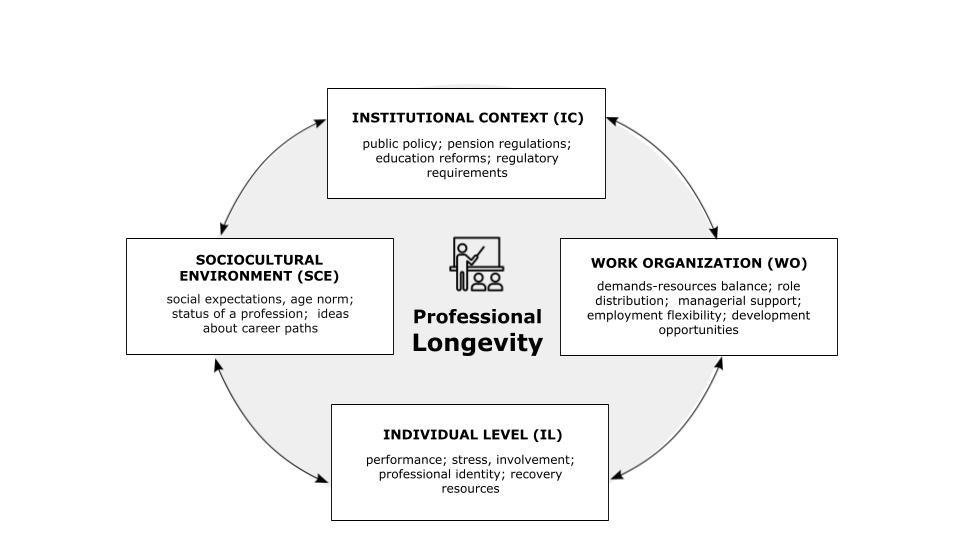
The interconnections among the determinants are illustrated by the example of digitalization in education. The institutional context (IC) – at this level, digitalization is set by state programs for the digital transformation of education: regulatory requirements for the use of electronic grade books, platforms, distance learning formats; standards for digital reporting; the development of EdTech tools. The sociocultural environment (SCE) – digitalization becomes a cultural expectation, a social norm, and a symbol of professional competence: the perception of a "modern teacher" as someone proficient in digital technologies. Here, age-related stereotypes may operate ("older teachers are less capable of mastering digital tools"). The work organization (WO) – digitalization becomes a concrete working condition: increased digital workload (platforms, reporting), the need for online communication, the presence or absence of technical support, and a new distribution of roles. The individual level (IL) – digitalization "meets" individual capabilities and becomes a factor that either strengthens or weakens a teacher's work ability: visual strain, fatigue, cognitive speed of information processing; digital self-efficacy, motivation to learn, professional identity ("I am a modern teacher"), stress in the face of technological uncertainty, access to equipment, and time to master new programs.
Summing up the results of the analysis of research on the phenomenon of professional longevity in teaching activity, it should be noted that in contemporary scientific discourse it has been insufficiently studied. An important problem remains the absence of a unified criterion for "professional longevity". Currently, it is understood as extending employment up to or beyond retirement age (1); sustained well-being or the absence of burnout in professional activity (2); and the preservation of professional potential and the quality of teaching activity (3). This calls for an interdisciplinary model that integrates indicators of career duration and quality of functioning in the profession.
The age boundaries of the "older teacher" in research are also heterogeneous, ranging from 40+ (as "late-career") to 50+ and 60+, which creates a risk of incorrect generalization and requires separate research procedures.
There is a notable lack of longitudinal studies tracking the professional trajectories of teachers over the age of 55–60 that would allow for an examination of the relationship between age-related effects, work environment contexts, and the continuation of employment.
The empirical base regarding the effects of specific tools for psychological and institutional support of older teachers remains fragmentary.
Another deficit is the lack of diagnostic tools to support late-career employment in the education sector. For Russian practice, validated short batteries are important, allowing for the differentiation between "manageable" organizational risks (workload, support, role, digital demands, etc.) and physical limitations, without stigmatizing age.
A promising direction in this field could be research focused on longitudinal panels of teachers with extensive work experience (30+ years), incorporating a comparison of administrative data (e.g., workload or teaching format) with psychometric indicators, as well as the evaluation of the effects of organizational interventions (workload flexibility, digital mentoring, prevention of professional risks).
The development of a methodology for extending professional longevity becomes relevant, based on health preservation, including the prevention of age-related decline in workers' functional capabilities, the development of a system of diagnostic tools for assessing the factors of professional longevity, as well as methodological materials for the system of planning and designing work activity for elderly persons.
Conclusion
The conducted analysis allows us to consider teacher professional longevity as a multilevel system in which individual resources, organizational mechanisms, sociocultural expectations, and institutional frameworks form an interconnected structure regulating the continuation of professional activity. Career termination in older age is associated not with age per se, but with a mismatch between the profile of professional demands, the dynamics of psychological and physical resources, and a deficit of organizational and institutional support. At the same time, the specificity of the teaching profession implies significant compensatory potential, in which the effectiveness of activity is ensured not by speed, but by the structural organization and depth of professional thinking.
A promising direction in supporting professional longevity is the design of age-friendly organizational conditions that involve flexible workload distribution, role variability, and the possibility of reallocating functions based on the teacher's strengths. The institutionalization of mentoring makes it possible to use the crystallized experience of older teachers for the benefit of the education system. The prevention of professional burnout and systematic support for work ability recovery should be viewed as elements of personnel policy, rather than as the individual responsibility of the employee.
Support for cognitive functioning and the development of digital self-efficacy in late career require particular attention. Training in new technologies should be designed taking into account the age-related and individual specificities of teachers. The development of diagnostic tools for supporting late career appears to be a necessary condition for transitioning to a managed model of professional longevity, providing targeted solutions at the level of both the educational organization and the system as a whole.
From a strategic perspective, support for professional longevity in education should be viewed not as part of an abstract "active aging" agenda, but as a task of ensuring the quality of education. Retaining motivated and professionally competent teachers from older age groups is a resource for the sustainability of the educational system in the context of demographic changes and staffing shortages. This requires coordinated solutions at the institutional, sociocultural, organizational, and individual levels, ensuring alignment between the demands of the profession and the capabilities of the worker.
A transition is necessary from the spontaneous extension of employment to a managed model of the teaching career life cycle. Such a model implies early prevention of professional risks, planning of professional transformation stages, the development of late-career roles, and the creation of mechanisms for systematic support. Only then will professional longevity serve not as a forced consequence of demographic processes, but as the result of a deliberate educational policy aimed at preserving the quality and sustainability of the education system.
Limitations. The present study has several limitations. First, due to restricted access to certain information in international scientific publication databases, the review is based on the analysis of a limited corpus of publications selected from three search sources (eLIBRARY.ru, OpenAlex, and Google Scholar), which may not fully reflect the entire body of research on teachers’ professional longevity. Second, the corpus includes studies that differ substantially in their methodologies, samples, and operationalisation of the concept of “professional longevity”, which limits the possibilities for direct comparison of the results. Third, a considerable proportion of the analysed works are descriptive or review-based in nature and do not contain longitudinal data that would allow tracing the dynamics of teachers’ professional trajectories in older age groups.
1 Eurostat (2023). Population projections in the EU. European Commission. URL: https://ec.europa.eu/eurostat/statistics-explained/index.php?title=Population_projections_in_the_EU (viewed: 15.02.2026).
2 United Nations Department of Economic and Social Affairs, Population Division. (2022). World Population Prospects 2022: Summary of results. United Nations. URL: https://desapublications.un.org/publications/world-population-prospects-2022-summary-results (viewed: 15.02.2026).
3 Organisation for Economic Co-operation and Development (OECD). (n.d.). Teachers & educators [Data set]. In Education GPS: Explore data by topic. URL: https://gpseducation.oecd.org/IndicatorExplorer?plotter=h5&query=12&indicators (viewed: 15.02.2026).
4 UN Decade of Healthy Ageing: Plan of Action 2021–2030: Plan of Action of the World Health Organization. (2020). Geneva. URL: https://cdn.who.int/media/docs/default-source/decade-of-healthy-ageing/decade-proposal-final-apr2020-en.pdf (viewed: 15.02.2026).
5 On Approval of the Strategy for Action in the Interests of the Older Generation in the Russian Federation until 2030: Decree of the Government of the Russian Federation No. 830-р dated April 7, 2025 (2025). М. URL: http://static.government.ru/media/files/3s71wNjjcii0hB2DJxdhBlAJawkT1SBE.pdf (viewed: 15.02.2026).