Introduction
The increasing globalization and interconnection of the world highlight the importance of forming and consolidating national identities for individuals and societies. National identity is a complex interaction between social, cultural, and historical factors and plays an important role in shaping a person's sense of self
[Markus, 1991],
sense of belonging [Triandafyllidou, 1998] and participation in society
[Druckman, 2023]. National identity gives an individual a sense of belonging and connection to a larger social group, the nation
[Windari, 2021]. This creates a sense of national identity, strengthening unity and common goals among individuals.
National identity can be shaped by various factors, such as an individual's belief in control over the outcome of events in their life
[Krampen, 1991]. In regards to nationality, believing in one's potential to contribute to the development of the country can increase their sense of belonging and identification with their nation
[Lun, 2016]. The way we identify ourselves as belonging to a particular nation is often influenced by our perception of our own competence. This perception reflects our general expectations about how we might act in different situations or circumstances
[Blank, 2003].
Individuals who possess a high internal locus of control tend to believe that their effort and correct decision-making can lead to positive outcomes
[Rotter, 1966]. Confidence in making personal choices and effective decision-making can positively impact self-competence
[Cascio, 2013]. People view themselves as unique individuals who have the ability to accomplish objectives and surmount obstacles in various areas of life. Possessing a favorable self-perception of one's own proficiency can have a far-reaching impact on a person's life, including their sense of belonging to their nation
[Prahara, 2023]. Self-perception of competence and capability can empower individuals to contribute to the progress and welfare of their nation
[Bush, 2004].
The relationship between locus of control and national identity is connected through the self-concept of one's own competence. When individuals perceive themselves as competent and capable, they are more likely to engage in activities that strengthen their national identity
[Sarmini, Warsono, Rizaq, 2022; Tutuarim, 2020]. This article aims to investigate the relationship between internal locus of control, self-concept of own competence, and national identity. Specifically, it will explore how an individual's belief in control over social phenomena can affect their perception of their own competence and their identification with their community. The authors will examine the theoretical foundations that support these constructs and their potential interconnections, using empirical evidence and theoretical frameworks to provide a comprehensive explanation of the mechanisms involved. Additionally, the article will touch on the importance of community engagement in fostering a positive self-concept.
An understanding of the relationship between internal locus of control, self-concept of own competence, and national identity holds significance not only for developing theoretical understanding but also for practical applications in various fields, including psychology, sociology, education, and policymaking. As societies continue to evolve in an increasingly interconnected world, studying the dynamics that contribute to the formation of national identities can provide valuable insights into how individuals navigate their roles as citizens of the world and members of different states.
National Identity
National identity is an integral part of personal identity within the context of a large social group known as a nation. In simple terms, national identity refers to a feeling of belonging to one's country. It can be seen as a shared sense of collective identity, encompassing self-image and understanding of the nation as a whole
[Marschelke, 2020]. National identity is closely tied to social identity and cannot be separated from it
[Korostelina, 2013]. National identity is closely tied to social identity and cannot be separated from it.
The concept of national identity emerged alongside the development of modern nationalism, a political and social movement rooted in an ideology that originated during the French Revolution. Today's nation-state is a direct result of the politics of modern nationalism
[Liu, 2018]. Every modern nation-state consists of two essential components. The first component is the nation-state system, which refers to the political organization and structure of the country. The second component is the national identity of the people living within the country's borders. Culture is an important factor that influences personal, ethnic, and national identity. It represents the social characteristics of human beings
[Han, 2010]. National identity is the recognition of citizens belonging to a particular nation, resulting from their sense of connection to the nation's traditions, history, culture, moral values, beliefs, national sovereignty, and other defining characteristics. This sense of national identity emerges when individuals or groups feel that they are part of the political community of a nation.
National identity can be traced back to childhood
[Baydhowi, 2023]. There are multiple studies from different countries that support the idea that individuals start developing a sense of national identity at the age of 5, which becomes stronger as they grow older, specifically within the age range of 11 years old. Another study conducted across several countries found that the agreement on national identity starts at the age of 5 and continues to increase with awareness of the attributes of national identity until around 11 years old
[Barret, 2000]. During adolescence, individuals often search for their identity and strive to connect with their social environment
[Baydhowi, 2023]. The phase culminates in adulthood where individuals form a solid understanding of national identity through experiences and learning
[Baydhowi, 2022].
The discussion about national identity is connected to citizenship and ethnicity as a means of defining national identity. Although these two concepts are related, they have distinct characteristics that set them apart. While some argue that national identity is based on the similarities in the history of the region or homeland, the legend of the homeland, and the historical and cultural aspects in which they grew up, national identity is not solely based on ethnic similarities
[Tkachenko, 2016]. National identity can also be based on group membership that has similar residences and tolerance for members of other ethnic groups living in the same country. This involves individual decisions
[Tkachenko, 2016]. This study indicates that national identity is not only based on similarities between individuals within a nation-state system, but also linked to the decisions made by those individuals. Individuals who recognize their identity as part of a nation will play a crucial role in shaping that national identity, as well as the decisions and actions taken after.
In a social psychology perspective, national identity is a person's attachment to a nation. which is understood as a sincere sense of belonging to the nation
[Davidov, 2011]. By following this formulation, national identity can be understood as a subjective feeling or internalization of a sense of belonging to a nation
[Huddy, 2007]. According to gh the concept of national identity, the pattern of acceptance, internalization and self-identification of a nation by individuals will be described
[Blank, 2003]. This opinion is in accordance with the theoretical elaboration carried out by Čorkalo & Kamenov (2003) referring to a psychological approach rooted in Tajfel and Turner's theory
[Tajfel, 2004] which interprets national identity as a sense of membership in a group as a place to convey a sense of belonging and attachment.. National identity is characterized into several aspects, including: are (1) National pride, which includes a sense of belonging to the nation and a feeling of the high value of all elements related to the nation; (2) Exclusive national belonging, which is characterized by emphasizing a sense of unity and togetherness to distinguish it from people from other nations; (3) National devotion which includes loyalty to the nation that transcends personal interests
[Baydhowi, 2022].
Internal Locus of Control
Locus of control refers to individuals' beliefs regarding their ability to control their lives or whether external factors dictate their circumstances
[Rotter, 1966a]. Individuals with an internal locus of control assume responsibility for their actions and feel empowered to impact the results of their actions. Studies indicate that internal locus of control is closely related and significantly contributes to two other constructs, namely self-efficacy (one's ability to achieve a particular success or goal) and competence (the capacity or ability of an individual to effectively perform tasks, solve problems, and achieve goals within a specific domain or context)
[Ashagi, 2015; Claire, 2019; Naditch, 1975]. All three concepts are rooted in the belief that individuals have control over situations, outcomes, and their own behavior
[Wallston, 2001]. When individuals perceive themselves as active agents in achieving a goal, their motivation to improve their quality and competence increases. Therefore, individuals with an internal locus of control tend to be more self-confident, take initiative, and take responsibility for their decisions. When confronted with challenges, they exhibit a proactive approach, exerting effort to address issues and surmount obstacles.
In the context of national identity, individuals with internal locus of control may feel more confident in identifying themselves as part of a specific nation or culture. They are less swayed by external opinions and instead focus on their personal experiences and the values they believe represent their national identity
[Smith, 1991]. Moreover, national identity is significantly shaped by the cultural and environmental factors individuals grow up in. Those with an internal locus of control actively manage the influence of culture and environment on their identity. They have the capacity to explore various cultural aspects and make informed choices about how these aspects contribute to their national identity. This may involve selecting values, traditions, or languages they perceive as integral to their desired national identity
[Brown, 2015]. Meanwhile Krampen
[Krampen, 1991a], added that a positive assessment of an event related to oneself in the social environment will create trust in oneself. And conversely, a negative assessment will lead to the belief that the event will occur if he personally does not make efforts to prevent it.
Individuals with an internal locus of control may also feel a sense of responsibility towards their community or nation. They believe they have the power to influence the direction and development of national identity. This motivates them to actively participate in activities that support or strengthen the values, traditions, and historical narratives of national identity. They see themselves as significant contributors to preserving and enhancing the national identity they take pride in
[Rotter, 1966]. They may advocate for social justice, political reforms, and cultural preservation, seeing themselves as active agents in shaping the course of their country's history. This proactive attitude and sense of responsibility can foster a deeper and more meaningful connection to national identity, as individuals perceive themselves as integral parts of the broader social fabric of their nation.
Self-Concept of Own Competence
The perception of one's own abilities in a given situation constitutes the self-concept of competence
[Blank, 2003]. This ability encourages individuals to use creativity in finding solutions to the problem
[Martini, 1991]. In the context of national life, individuals within a nation faced with national problems assess their abilities and the resulting outcomes
[Krampen, 1988]. Individuals will participate in politics as a way to show concern for their nation, when they have a high self-concept of their own competence
[Krampen, 1991].
The concept of one's own competence materializes as an overall expectation of the likelihood of various actions that can be taken in response to a situation or life
[Martini, 1991]. When citizens are faced with a national question, they consider their abilities in relation to the desired outcomes
[Krampen, 1988].
In academic studies, there is a correlation between an individual's perception of their own competencies and their sense of national identity. People who have a high self-concept of their own abilities are more likely to make positive contributions to their country, but their actions will be tailored to their ability to strengthen their national identity. Therefore, they will carefully consider their capabilities and the anticipated outcomes, ensuring that their actions are aligned with their abilities to protect and advance their nation.
Method
Participants. The study included 504 college students, out of which 176 were men and 328 were women. The age of participants ranged from 18 to 25 years, with an average age of 22 years (SD = 2,3). The participants were recruited from 20 public and private universities in DKI Jakarta, representing both state and independent campuses.
Measures. The variables internal locus of control and self-control of their own competence is measured using the general control belief scale developed by the author by referring to the theory of the action theoretical model of personality (AMP) developed by Krampen
[Krampen, 1991a]. This theory was also developed from the theory of locus of control developed by Rotter
[Rotter, 1966]. In the general control belief scale, internal locus of control is measured with a five-item that assesses their confidence in their ability to influence outcomes through personal actions. The response options for these five statements range from 1 (Highly Compatible) to 5 (Highly Conforming). In addition, participants' self-concept of their own competence can be measured using a six-item instrument that evaluates their perceptions of their skills, abilities, and effectiveness in different areas of life. The response options for this instrument range from 1 (Highly incongruous) to 5 (Highly Conforming). The National Identity Scale is used to measure the national identity of the participants
[Baydhowi, 2022]. The survey contains 18 questions that measure participants' sense of belonging and identification with their community. Responses range from 1 (highly incongruous) to 5 (highly conforming).
Procedure. The research study was conducted for a duration of one year. The participants were recruited through social media announcements and were required to provide informed consent before taking part in the study. They were asked to fill out a series of online questionnaires that focused on their internal locus of control, self-concept of own competence, and national identity. The questionnaire was designed to measure various aspects of their personality and was administered online.
Data Analysis. Data were analyzed using structural equation models (SEM) to investigate hypothesized mediation models. SEM allows simultaneous examination of various relationships between variables and assessment of direct and indirect impacts. The theoretical model was tested using Lisrel 8.7.
This analysis starts by defining a mediation model where internal locus of control is the predictor variable, self-concept of own competence is the mediator, and national identity is the outcome variable. Then, the estimation model is tested to determine whether the proposed theoretical model is consistent with the data gathered. Maximum likelihood estimation is used for this method. The model's fit is assessed using several indices, including the Chi-square statistic (> 0,05)
[Alavi, 2020],
Comparative Fit Index (CFI) (> 0,9)
[Xia, 2019],
Root Mean Square Error of Approximation (RMSEA) (< 0,06)
[McNeish, 2017], and
Standardized Root Mean Square Residual (SRMR) (< 0,08)
[Hu, 1999; Pavlov, 2021]. This process concludes with interpreting the direct and indirect effects of independent variables on outcome variables, mediated by mediator variables.
Result
According to Baron and Kenny
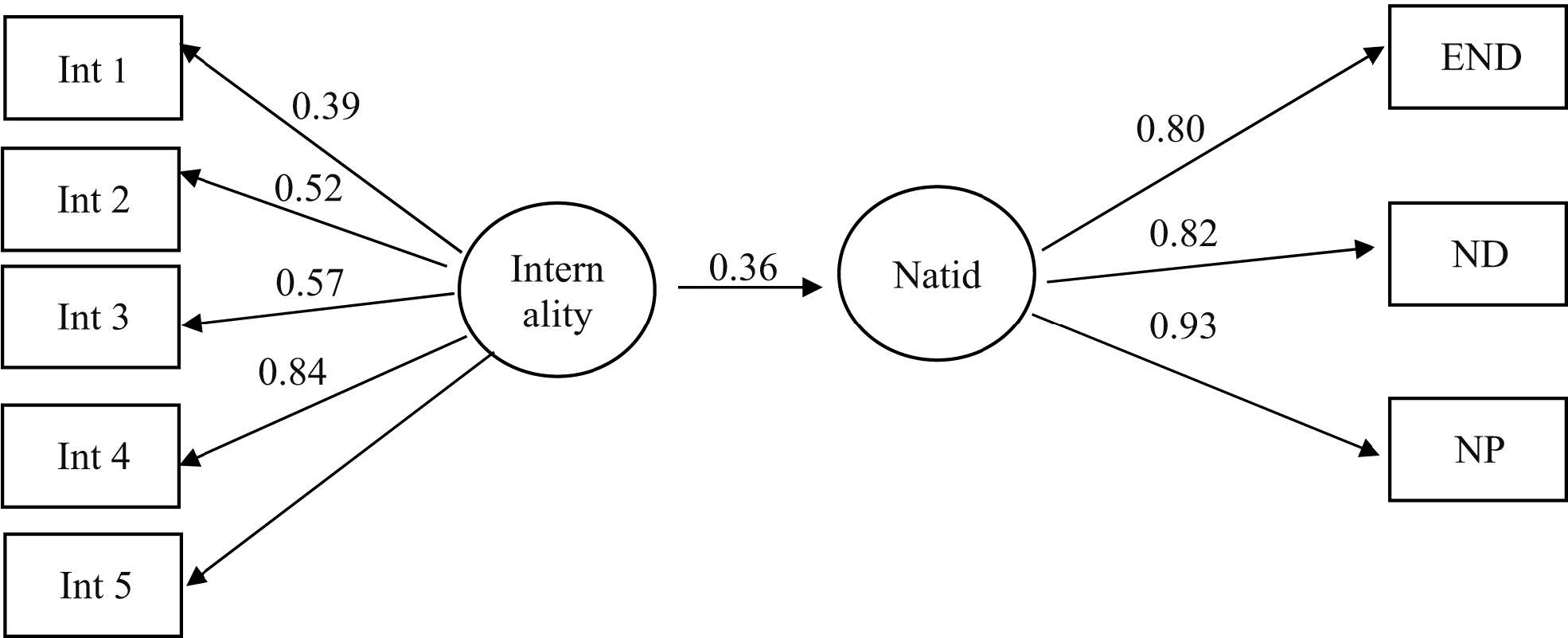
[Tkachenko, 2016], mediation analysis involves two stages. The first stage tests the relationship between the independent variables and the outcome. The second stage tests the relationship between the independent variables and variable outcomes through mediators. Figure 1 below shows the analysis model for the first stage.
Fig. 1. Path diagram model of Structural Equation Modelling (SEM): Int is item of internal locus of control, NP is national pride, Internality is internal locus of control, END is exclusive national belonging, Natid is national identity and ND is national devotion
From the analysis results that the model match is tested using several indices. Chi-square statistic = 0,077( > 0,05), CFI = 1 (> 0,9), RMSEA= 0,024 (< 00,06), and SRMR = 0,026 (< 0,05). The available data has been analyzed using various indices, and based on the results, it has been determined that the model is fit for the given data.
Table 1
Indices of measurement models for each variable
|
No
|
Indicator/relation
|
Construct
|
SLF
|
SE
|
t-value
|
|
1
|
Int 1
|
Internality
|
-
|
-
|
-
|
|
2
|
Int 2
|
Internality
|
0,52
|
0,13
|
10,23
|
|
3
|
Int 3
|
Internality
|
0,57
|
0,15
|
9,68
|
|
4
|
Int 4
|
Internality
|
0,84
|
0,42
|
5,11
|
|
5
|
Int 5
|
Internality
|
0,99
|
0,48
|
5,31
|
|
6
|
NP
|
Natid
|
-
|
-
|
-
|
|
7
|
END
|
Natid
|
0,82
|
0,02
|
56,41
|
|
8
|
ND
|
Natid
|
0,93
|
0,11
|
10,60
|
|
9
|
Internality è Natid
|
-
|
0,36
|
0,13
|
5,87
|
It is known from Table 1 that the internality plays a significant role in national identity due to its high t-value. (5,87) > 1,96. By exploring the role of mediators, we can better understand how internality relates to national identity.
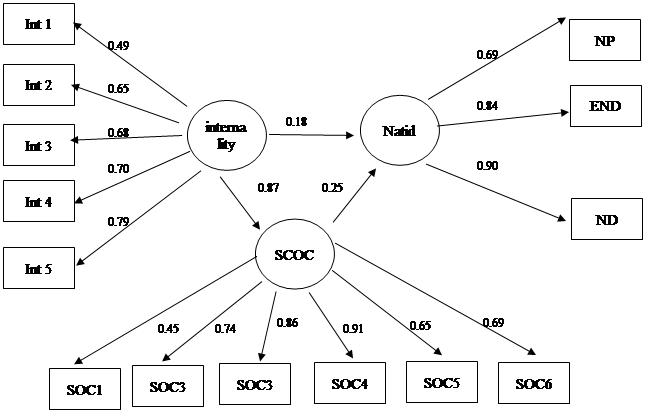
Fig. 2. Path diagram model of Structural Equation Modelling (SEM): SCOC is self-concept of own competence, SOC is Item of self-concept of own competence
Based on the analysis results, the model match was tested using several indices., Chi-square statistic = 0,077 (> 0,05), CFI = 1 (> 0,9), RMSEA = 0,24 (< 00,06), and SRMR = 0,026 (< 0,05). The available data has been analyzed and based on the indices; it has been determined that the model is fit.
Table 2
Indices of Measurement Models for Each Variable
|
No
|
Indicator relation
|
Construct
|
SLF
|
SE
|
t-value
|
|
1
|
Int 1
|
Internality
|
-
|
-
|
-
|
|
2
|
Int 2
|
Internality
|
0,52
|
0,13
|
11,55
|
|
3
|
Int 3
|
Internality
|
0,57
|
0,15
|
9,68
|
|
4
|
Int 4
|
Internality
|
0,84
|
0,42
|
5,11
|
|
5
|
Int 5
|
Internality
|
0,99
|
0,48
|
5,31
|
|
6
|
NP
|
Natid
|
-
|
-
|
-
|
|
7
|
END
|
Natid
|
0,82
|
0,02
|
56,41
|
|
8
|
ND
|
Natid
|
0,93
|
0,11
|
10,60
|
|
9
|
SOC1
|
SCOC
|
-
|
-
|
-
|
|
10
|
SOC2
|
SCOC
|
0,74
|
0,16
|
10,27
|
|
11
|
SOC3
|
SCOC
|
0,86
|
0,18
|
10,38
|
|
12
|
SOC4
|
SCOC
|
0,91
|
0,19
|
10,44
|
|
13
|
SOC5
|
SCOC
|
0,65
|
0,16
|
9,17
|
|
14
|
SOC6
|
SCOC
|
0,69
|
0,16
|
9,55
|
|
15
|
Internality è Natid
|
-
|
0,18
|
0,18
|
1,41
|
|
16
|
Internality è SCOC
|
-
|
0,87
|
0,11
|
7,49
|
|
17
|
SCOC è Natid
|
-
|
0,25
|
0,19
|
2,06
|
|
18
|
Internality è SCOC è Natid
|
-
|
0,22
|
0,15
|
2,07
|
From table 2 above, it can be seen that all indicators measure all latent variables. In addition, the structural relationship between internal locus of control with national identity and self-competence is significant and the relationship between self-competence and national identity is also significant. On the other hand, the structural relationship between internal locus of control and national identity mediated by self-competence is also significant. Given that the influence of internal locus of control on national identity remains significant after involving mediator variables, the role of self-competence is partial mediation.
Discussion
The findings of the study provide valuable insights into the complex interactions between internal locus of control, national identity, and the mediating role of self-concept of own competence. The analysis supports the hypothesized model, which reveals a significant relationship between internal locus of control and national identity, further mediated by the self-concept of own competence. These results align with the existing literature on psychological factors that contribute to the formation and strengthening of national identities.
The study found a correlation between an individual's internal locus of control and their national identity. This suggests that people who believe in their ability to impact outcomes through their behavior are more likely to feel a sense of nationalism towards their country. These findings are consistent with the Locus of Control theory, which emphasizes the behavioral and motivational consequences of internal orientation
[Ahlin, 2015].
According to mediation analysis, the way individuals perceive their own competence is crucial in explaining how internal locus of control strengthens national identity. In simpler terms, people who believe they are competent in different areas have a better chance of contributing to the advancement of their country. This aligns with the self-determination theory which highlights the importance of competence as a psychological need that motivates and engages individuals
[Biel, 2023; Deci, 2015].
The individual's self-concept of their own competence plays a mediating role in explaining the relationship between their internal locus of control and national identity. This is consistent with self-concept theory, which suggests that an individual's beliefs about their abilities and effectiveness significantly impact their attitudes, behaviors, and affiliation with their nation
[Schäfer, 2013].
The findings of this study have significant implications for both theoretical and practical aspects. Theoretically, these findings contribute towards a better understanding of the intricate mechanisms involved in the development of national identity. By identifying the self-concept of personal competence as a mediating factor, the study sheds light on previously unexplored psychological constructs that interact to influence an individual's identification with their nation.
The results of this study have practical implications for interventions aimed at improving national cohesion, cultural preservation, and community involvement. By acknowledging the role of internal locus of control and self-concept of own competence in fostering a sense of national identity, interventions can be designed to increase individual confidence in their ability to make a positive contribution to their nation. This can be supported by developing a mindset, providing opportunities for skill development, and emphasizing the value of individual contributions to the collective.
It is important to note that this study has some limitations, including variations in how the variables studied are interconnected across different cultures. Therefore, in the next study, it would be necessary to examine how these variables relate to each other in diverse cultural contexts. To gain a more comprehensive understanding, a mixed-method approach should be used.
Conclusions
This study helps us to better understand how internal locus of control, self-concept, self-competence, and national identity work together in different ways. By revealing the role that self-concept plays in mediating self-competence, this research provides a more complete understanding of the psychological processes that influence a person's sense of belonging and national identity.