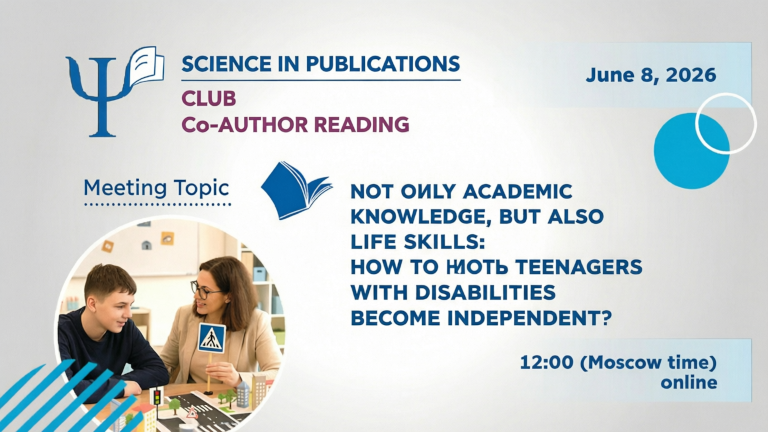
On June 8, 2026, with the support of the MSUPE Boiling Point, a meeting of the “Co-Author Reading Club” will take place as part of the “Science in Publications” series. The topic of the meeting is “Not Only Academic Knowledge but Life Skills: How Can We Help Adolescents with Disabilities Become More Independent?”
Life competence is one of the key personal outcomes of education for children and adolescents with disabilities. It is enshrined in the federal adapted educational programs, and its importance is unanimously recognized by the professional community. But what exactly does this concept include? What skills constitute life competence, and how do they develop with age? How can support programs be designed if there is no clear structure of what needs to be developed?
The authors of a study published in the journal “Clinical Psychology and Special Education” (2025) proposed a systematic, evidence-based description of the content of all five domains of life competence in relation to adolescents with disabilities. Their work is grounded in L.S. Vygotsky’s cultural-historical theory, the activity approach, and the concept of the lifeworld.
During the webinar, we will take a detailed look at the findings of this theoretical study and discuss how they can be applied in practice.
Topics for Discussion
- What is the structure of life competence: its concept, identified domains, and their interrelations?
- What might the developmental logic of life competence look like, and how can changes in an adolescent’s life skills be recognized?
- How can the theoretical model be transformed into specific assessment tools and the content of corrective and developmental interventions?
- How can life competence be fostered in educational practice and family upbringing?
- What unresolved questions and scientific challenges remain in the study of life competence development in children and adolescents with disabilities?
The webinar will be especially useful for educational psychologists, special education teachers, speech-language therapists, and specialists in psychological and educational support; teachers and educators working in inclusive and special education settings; parents and legal guardians of adolescents with disabilities interested in supporting independence and social adaptation; undergraduate and postgraduate students in psychology and education, as well as researchers in special education, developmental psychology, and clinical psychology.
Speakers:
Natalia V. Babkina, Doctor of Science (Psychology), Head of the Laboratory of Education and Comprehensive Habilitation of Children with Developmental Delay, Institute of Special Education, Moscow
Anna M. Fedoseeva, Candidate of Science (Psychology), Associate Professor, Senior Research Associate, Laboratory of Education and Comprehensive Habilitation of Children with Developmental Delay, Institute of Special Education; Academic Supervisor of the “Generation, Transfer and Acquisition of Knowledge” Area, Cognitive Research Center, Sirius University of Science and Technology, Moscow
Recommended Reading:
Babkina, N.V., Fedoseeva, A.M. (2025). Life Competence of Adolescents with Disabilities: Structural Content and Developmental Logic in Psychological and Educational Support. Clinical Psychology and Special Education, 14(2), 5–20. https://doi.org/10.17759/cpse.2025140201
For questions regarding the webinar, please contact Anna V. Shekhorina at shehorinaav@mgppu.ru.
Date and time: June 8, 2026 (Monday), 12:00 PM (Moscow time)
Format: Online via the MTS Link platform.
The Book Club meeting is held with the support of the MSUPE Boiling Point.
Curator of the Co-Author Reading Club: Anna A. Shvedovskaya, Candidate of Science (Psychology), Head of Information and Publishing Projects, Associate Professor of the L.F. Obukhova Department of Developmental Psychology, Faculty of Educational Psychology, MSUPE.
Calendar of webinars and meetings of the “Science in Publications” project for 2026.