Introduction
In recent decades, BRICS countries — Brazil, Russia, India, China, and South Africa — have gained increasing relevance in shaping global educational agendas. Together, they account for more than 40% of the world’s population and nearly a quarter of global GDP (IMF, 2023). Their education systems have expanded rapidly, with improved access to primary education, rising enrollment in secondary and tertiary levels, and growing participation in transnational initiatives (UNESCO, 2014; Gupta, 2017). However, this quantitative progress reveals persistent structural contradictions. Educational inequalities remain stark, quality is uneven, and policies often fail to reflect the sociocultural realities of marginalized populations (Wolhuter, 2023).
The recent expansion into BRICS+, incorporating countries such as Egypt, Ethiopia, Iran, Saudi Arabia, and the United Arab Emirates, has added layers of geopolitical and cultural complexity. These countries bring diverse educational histories, infrastructures, and social challenges. Although this enlargement may strengthen South-South cooperation, it also intensifies the challenge of developing educational policies that are both inclusive and responsive to contexts marked by inequality and historical injustice.
Reports on BRICS educational systems emphasize the uneven distribution of progress. Gupta (2017) notes that despite improvements, India and South Africa still struggle with gender parity and equitable access, whereas Brazil and Russia stand out for their relative investment in public education. A UNESCO (2014) urges alignment across education levels, as a tool for both economic growth and social justice. More recently, Wolhuter (2023) points to the exacerbation of existing disparities during the COVID-19 pandemic, especially among marginalized communities, and highlights the need for systems that promote inclusion, resilience, and flexibility — objectives that remain distant in many BRICS+ contexts.
These disparities are further illustrated in Table 1, which summarizes key educational indicators across the five original BRICS countries — Brazil, Russia, India, China, and South Africa. The comparison includes models, literacy rates, and education investment. These figures highlight how uneven policy implementation, structural investments, and historical legacies continue to shape educational outcomes. For instance, while South Africa shows the highest percentage of GDP invested in education, it still faces the effects of apartheid’s legacy in its hybrid model. India, with the lowest literacy rate, struggles to reconcile rapid economic development with inclusive access. Brazil stands out for investment levels, yet continues to reproduce inequalities through under-resourced schools, particularly in peripheral regions.
Romariz (2019) argues that educational inequality in BRICS countries results from stratified school systems, low investment in human capital, and limited access to quality education. In Brazil, despite legal guarantees and urban expansion, regional disparities persist, and public schooling often reproduces silencing and symbolic violence.
This aligns with the concept of ethical-political suffering (Sawaia, Strappazzon, & Maheirie, 2022), a structural form of pain rooted in the denial of one’s capacity to act and transform lived conditions. Rather than fostering liberation, schools frequently reinforce conformity and exclusion.
Han’s (2015) notion of the performance society intensifies this suffering: freedom is reframed as obligation, and individuals internalize the imperative to self-optimize, interpreting failure as personal fault. Education becomes a site of anxiety, self-surveillance, and affective depletion.
Souza’s (2019) concept of precarious habitus expands this critique by showing how racialized and working-class populations in Brazil internalize feelings of inferiority and fatalism. Instead of disrupting this logic, schools often reproduce it through rigid assessments and neoliberal standards of success.
Against this backdrop, the Brincadas-COLINA Project emerges as a counter-narrative. Developed in peripheral communities in São Paulo, it engages children, educators, and families in insurgent acts of play, storytelling, ecological exploration, and collective meaning-making.grounded in Freirean pedagogy (Freire, 1970), cultural-historical theory (Vygotsky, 1997), and a transformative activist stance (Stetsenko, 2023).
This article investigates how the first Brincada of 2023 operates as a transformative pedagogical practice within the BRICS+ educational context. Through engaged multiliteracies and curriculum de-encapsulation, it explores how collaborative, dialogical, and multimodal practices confront structural injustices and reclaim agency, resistance, and emancipatory educational futures in the Global South.
Ethical-political suffering, the performance society, and the precarious habitus
This section deepens the analysis of educational exclusion and resistance in Brazil, which contradictions mirror broader BRICS+ tensions. It connects theoretical concepts such as ethical-political suffering, precarious habitus, and the performance society to the lived realities of students and educators, situating Brazil within global debates on neoliberalism, symbolic violence, and affective economies in education.
In Brazil, exclusion is ontological and political. Ethical-political suffering (Sawaia et al., 2022) describes the systemic denial of one’s power to act and transform reality — a structural effect of domination that erodes voice, agency, and belonging. This suffering is exacerbated by neoliberal reforms that dismantle collective bonds and promote self-management disguised as freedom, aligning with Han’s (2015) concept of the performance society. In this context, schools shift from spaces of emancipation to arenas of competition, docility, and burnout.
Table 1. Key educational indicators in BRICS сountries
|
Aspect |
Brazil |
Russia |
India |
China |
South Africa |
|
Educational model |
Federal, decentralized |
Centralized with state control |
Mixed, private influence |
Centralized, national goals |
Hybrid, legacy of apartheid |
|
Compulsory education |
Ages 4—17 |
Ages 6—17 |
Ages 6—14 |
Ages 6—15 |
Ages 7—15 |
|
Literacy rate |
~94% |
~99,7% |
~78% |
~96,8% |
~87% |
|
Internationalization |
Limited, with funding challenges |
High scientific output, low mobility |
Growing, with focus on IT and medicine |
Leader in academic mobility and scholarships |
Increasing efforts, but still limited |
|
Education investment (% of GDP) |
~5,9% |
~3,8% |
~3,0% |
~4,0% |
~6,2% |
Han clarifies the emotional economy of schooling: autonomy masks coercion; success and failure are internalized as personal responsibility. Education becomes a site of permanent assessment, where creativity and play are marginalized. Crucially, this regime overlays deep racial and economic inequalities. Souza’s (2019) precarious habitus demonstrate how Brazil’s working vulnerable internalize inferiority, forming dispositions of exclusion and fatalism. Schools often reinforce this symbolic violence by demanding neoliberal performances from students who are denied basic recognition and stability.
This contradiction, between the call for autonomy and the reality of exclusion, results in subjective disintegration. Students and teachers are encouraged to see themselves as agents yet constantly reminded of their conditional worth. Ethical-political suffering thus becomes both a diagnosis and a call to restore collective agency and reimagine education.
These dynamics intersect with Mbembe’s (2018) necropolitics and generate a necroeducation (Liberali, 2020) in Brazil: a system that disciplines some bodies while erasing others, valuing merit over collective survival. Despite formal schooling, symbolic and material violence persist. In this context, concepts like performance society (Han, 2015) and precarious habitus (Souza, 2019) become operative logics rather than descriptors.
This system normalizes abandonment: overburdened teachers (Amaral, Meaney & Lemos, 2024), disconnected poor and Black students (Toquetãoa, 2024), and silenced LGBTQIA+ learners (Fiorotti, 2024) are symptoms of structural design. Garrido (2024) names this the necrocurriculum, which erases Black, Indigenous, and popular epistemologies. Soares (2024) and Oliveira (2024) show how Deaf Indigenous students and sign language educators are excluded from curriculum, and from recognition.
Here, exhaustion is racialized, gendered, and classed. Meritocratic ideals mask necropolitical exclusion. Yet resistance persists. The Brincadas Project (Liberali & Carrijo, 2024; Modesto, Diegues & Tiso, 2024) offers a powerful response through collective play, memory, and imagination. At CIEJA Perus I, educators addressed basic needs and restructured learning amid policy neglect (Fialho et al., 2024). Dantas (2024) calls for curricular representation of marginalized communities, Garrido (2024) advocates for a curriculum of life grounded in care and resistance.
These initiatives challenge the pedagogy of death and point to insurgent alternatives for the BRICS+ educational landscape. In a world marked by global inequalities, the task is to dismantle the architectures of exhaustion that define who learn, who rests, and who is left behind. Brazil reveals the workings of necroeducation and the potential of insurgent pedagogies (Liberali, 2020).
A transformative insurgent pedagogy for BRICS+ education
This section outlines an insurgent pedagogy responding to ethical-political suffering, necroeducation, and neoliberal subjectivation. Drawing from critical pedagogy, cultural-historical theory and decolonial thinking, it proposes learning as co-authorship and resistance, to confront symbolic violence in BRICS+ systems.
Transformative pedagogy, under conditions of structural exclusion and exhaustion, must center collective agency, ethical engagement, and insurgent imagination. This entails rethinking what is taught, how learning occurs, and whose knowledge is legitimized. Freire (1967, 1970) and bell hooks (1994, 2008) insist on education as a political practice of freedom grounded in love, community, and dialogical participation. Love sustains critical consciousness and cultivates solidarity.
Vygotsky (1933/1966) frames play as a symbolic activity through which children exceed immediate conditions and imagine new realities. Symbolic transformation begins in early development and continues through collective world-making. Stetsenko (2017) expands this view by defining agency as an ethical stance that emerges through shared action. Education, then, invites participation in constructing new social orders rather than adapting to existing ones.
These perspectives challenge dominant curricular models that isolate school knowledge from lived experience. Engeström (1991) names this disconnection as curricular encapsulation, where learning centres on abstract symbols rather than meaningful activity. Encapsulated schooling privileges routine and performance while marginalizing relevance and agency.
Engeström (1987; 2015) proposes expansive learning as an alternative: a process rooted in contradiction, critical reflection, and the collective reorganization of practice. More recently Engeström, Rantavuori, Ruutu and Tapola-Haapala (2023) introduced expansive de-encapsulation, emphasizing student-led projects that transcend institutional and disciplinary boundaries.
Building on these concepts, Liberali (2023; 2025) introduces curriculum de-encapsulation as both pedagogical and epistemic intervention. Curriculum is redefined as a historically situated, dialogical activity system, shaped by ethical and political engagement. Rather than a fixed sequence of content, it becomes an open and evolving space grounded in learners’ realities.
Curriculum de-encapsulation challenges hegemonic hierarchies by including excluded voices and dismantling rigid structures. It integrates socially urgent content and affirms knowledge as a contested, lived, and co-created process. Central to this is the notion of funds of perezhivanie (Liberali et al., 2023), experiential resources formed through lived tensions and relational histories. These resources, activated through language, image, and memory, mediate agency and collective transformation.
Within this framework, the Brincadas Project takes shape as insurgent pedagogy. Through collective play, multimodal creation, and co-authored meaning-making, Brincadas enacts curriculum de-encapsulation. It creates spaces of presence in contexts of symbolic erasure, where play mediates educational justice and affective repair. Liberali, Mazuchelli & Modesto-Sarra (2021) show how these practices resist symbolic violence and affirm the capacity to imagine different futures, especially among racialized and LGBTQIA+ communities.
Curriculum de-encapsulation confronts performative, technocratic, and exclusionary models by grounding education in relationality, plurality, and collective authorship. In BRICS+ contexts shaped by inequality, this insurgent pedagogy enables learners and educators to co-create dignified, transformative educational realities.
Toward a transformative, insurgent pedagogy: Brincadas and the de-encapsulation of curriculum
Ethical-political suffering, precarious habitus, and performative violence demand a reconfiguration of education, especially in BRICS+ contexts of inequality and epistemic erasure. Education, in these settings, must become a critical, collective, and insurgent praxis oriented toward justice and transformation.
Vygotsky (1933/1966) emphasizes imagination and play as symbolic tools central to development and transcendence. This symbolic capacity fuels the co-construction of alternative realities. Stetsenko (2017) expands this by framing human development as collaborative world-making: agency arises through ethically situated, collective action to transform oppressive conditions.
In this dialogical and affective process, funds of perezhivanie (Liberali et al., 2023) are activated, understood as historically rooted emotional-intellectual resources that mediate agency in contexts of constraint. They mediate the creation of new meanings and possibilities.
Within this framework, Liberali (2020, 2022) proposes engaged multiliteracy as a pedagogical stance that goes beyond multimodal skills. Literacy is approached as tool-and-result: a mediational process enabling ethical, critical, and collective action. Rather than a technical skill, it becomes a practice of reading and transforming the world, aligned with Freire’s (1970) emancipatory vision.
This orientation demands de-encapsulation of the curriculum (Liberali et al., 2022), an opening of rigid disciplinary boundaries in favor of relational, problem-based learning. A de-encapsulated curriculum is responsive to learners’ experiences, valuing epistemic diversity and collective inquiry over fixed content mastery. It centers knowledge production in lived tension and situated ethics.
The Brincadas Project exemplifies this approach through insurgent play, multimodality, and collaborative authorship. Ecological walks, TikTok manifestos, affective maps, and co-narration create spaces where participants imagine and reconstruct their worlds.
Brincadas mobilizes life experiences as epistemic resources, expanding participants’ funds of perezhivanie through shared tensions and re-signified memory. Each activity functions as both a mediating tool and materialization of agency, enabling participants to narrate other futures grounded in justice and affect.
This pedagogical stance offers an alternative to performance-oriented and colonial curricula. It proposes an education centred on ethical positioning, critical imagination, and collective leadership to resist it. Engaged multiliteracy, affirms the right to learn from life, to speak across modes and languages, and to transform shared realities from within.
Methodology
This study is part of the Brincadas-COLINA project, a pedagogical and research initiative grounded in Critical Collaborative Research (Magalhães, 2004; Liberali, 2018), which brings together researchers, educators, children, and families to collectively reflect on and transform educational practices. The methodological approach draws from the Creative Chain of Activities, a process in which participants engage in cycles of creation, reflection, and reconstruction, rooted in principles of equity, co-authorship, and situated knowledge.
The data analyzed in this article come from the first Brincadas session of 2023. Students and teachers from quilombola, indigenous, and urban public schools participated. The session was structured by engaged multiliteracy (Liberali, 2022) which is based on the Freirean conception in its three interconnected phases: immersion, emersion, and insertion. These phases guided participants through shared experiences involving play, storytelling, art, movement, and dialogue.
Data were generated through multimodal means: video and audio recordings, photographs, artistic artifacts, field notes, and interviews with participants. The analysis followed Smyth’s (1989), four critical reflective actions framework: Describe (what happened), Inform (understand the context), Confront (identify contradictions), and Reconstruct (imagine alternatives). This framework enabled a layered interpretation of how subjects engage with and respond to structural injustice.
Ethical procedures were ensured through informed consent, ongoing dialogue with participants, and collective reflection. The research privileges local knowledge and lived experience, resisting extractive logics and reaffirming the transformative potential of collaborative inquiry.
Findings and discussion
To explore the transformative pedagogical potential of the Brincadas Project in the context of BRICS+ education, we analyze the first meeting of 2023, held on March 25th. This meeting marks the beginning of the second phase of the project, in which the Collectives of Investigation and Action (COLINA) were formed. It functions as a threshold moment that inaugurates a new cycle of dialogical, affective, and political engagement among different educational communities. By revisiting this foundational session, we aim to understand how the practices ofimmersion, emersion, and insertion — rooted in Freirean pedagogy — generate spaces of collective agency, resistance, and curriculum de-encapsulation. The activities and interactions documented here serve as a powerful entry point to reflect on how ethical-political suffering, precarious habitus, and insurgent play are negotiated and reimagined through engaged multiliteracy practices.
The first session of Brincadas COLINA took place on March 25th, 2023, at the Pontifical Catholic University of São Paulo. Participants came from different schools; some members are part of quilombos, others belong to indigenous communities, while others come from rural and urban regions within the State of São Paulo.
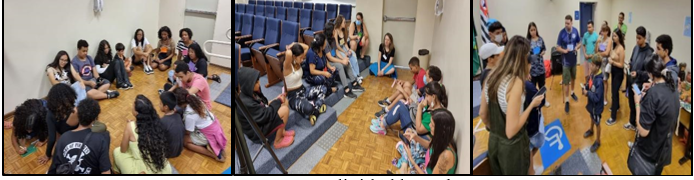
As an icebreaker during the immersion phase, participants played “What do they call me,” sharing names used by family and teachers. This activity enabled sharing identity markers and affective connections, drawing on their funds of perezhivanie (Liberali et al., 2023). Then, they were invited to walk around the auditorium to dance, forming pairs when the music stopped to exchange names, origins, and ages — beginning to build a collective presence and mutual recognition.
To deepen these connections, participants were divided into groups by colors (Fig. 1). Each received a strip of colored paper with questions to explore in a Poetic Circle: If the whole world gained superpowers, what would yours be? What is your biggest dream? What do you do when you get nervous or anxious? What do you do together? How do you feel about the past? How do you feel about the future? Among others. These poetic circles served as entryways into dialogical and creative engagement with each other’s histories while fostering principles of engaged multiliteracy (Liberali, 2022).
One of the groups created the following poem:
When I am well, I control time and a whirlwind of good and bad feelings comes to me We need to study for the future because we don’t know what is coming I train to forget the problems I study to ease the absence of my father — he is the one who encouraged me to start everything Even with time stopped, I feel the absence of my father, I can’t train my mind.
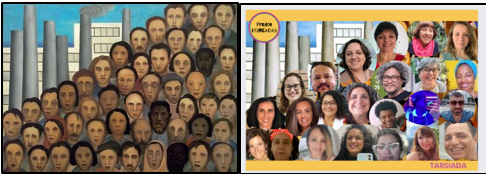
Following this, researchers presented a reconstruction of the painting Os Operários by Tarsila do Amaral (Fig. 2), integrating their own faces into the composition. This collective re-imagining of a Brazilian symbol of labor and diversity functioned as an act of curriculum de-encapsulation (Liberali, 2023), as it brought cultural, historical, and political imagery into the shared object of reflection. The proposal was that diversity and the fight for justice, as expressed by the painting, would also represent the research group.
By mobilizing visual and cultural memory as shared artifacts, this moment illustrates how curriculum de-encapsulation (Liberali, 2023) transforms symbolic resources into collective inquiry. As a tool-and-result (Newman, Holzman, 1993), this act redefined what counts as curriculum, shifting from standardized content to insurgent, situated meaning-making.
The icebreaking activities, poetic circle, and Os Operários moment enabled the creation of a dialogical field of shared meaning-making that transcended basic
introductions. As Freire (1967, 1970) and bell hooks (1994) propose, literacy is a practice of freedom — participants began to read and write the world together.
Moreover, it provides engaged multiliteracy, transcending the communications dimensions of the very first contact people from different settings had. By joining the three different moments participants could get to know each other and construct knowledge at the same time. The introductions provide an opportunity for participants to reflect on and share their ways of being in the world.
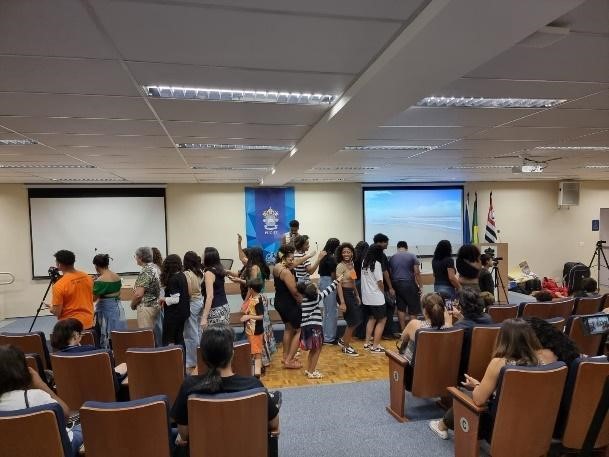
Next, in the emersion moment, two groups worked with two different tasks in four rooms. Groups A and B discussed Identities and Differences. The first task in these groups was to talk about privilege and race inequality. In the hallway, participants had to follow the instructions: If your parents were present in your childhood, take a step forward; If you have lost your home because you live in a risky area, take a step back; If you have never studied in a public institution in basic education, take a step forward; If you have had difficulty making friends or getting a job because of your race/ethnicity, take a step back. After answering these questions and walking accordingly, participants were asked to look around to check what they saw in the scene.
This embodied activity materialized what Souza (2019) defines as precarious habitus: the internalization of exclusion and inferiority by marginalized individuals, shaped by historical oppression and naturalized by the meritocratic discourse. Such habitus reproduces feelings of unworthiness and frames structural inequality as personal failure. As Souza (2019) and Han (2015) argue, such exercises surface the symbolic violence embedded in daily life, as well as the emotional economy of performance society.
After this embodied experience the groups were invited to discuss the game in smaller groups, in two rooms. As a second step, the researchers played two songs, addressing inequality, race and social struggle, besides asking the participants to pay attention to the respective lyrics to discuss inequalities, vulnerabilities and identities, correlating the songs to the game they played. They were asked to prepare a presentation to share their conclusions to the large group. Drawing from Freire (1970), these moments of critical reflection were acts of emergence — spaces to name the world in order to change it.
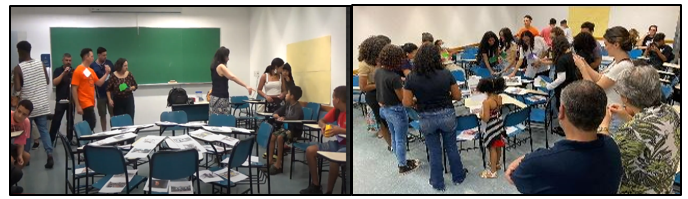
Simultaneously, Groups C and D developed proposals to promote critical reflection by relating environmental racism to the discussion on Identity. The groups created two installations with images and objects of people and places, which referred to an affluent area and a vulnerable area of the city (Fig. 3). After preparing their installations in the form of posters, the groups created a theoretical presentation about the installations. Later, there was a discussion on racism and prejudice, followed by a theoretical exposition on Ecological Racism.
Their presentation and subsequent discussion invoked necropolitical frameworks (Mbembe, 2003), situating their lived experiences within systemic racialized injustices. This dialogue revealed how systemic disregard for marginalized territories and communities exemplifies the workings of necroeducation, where the curriculum often erases racialized and impoverished lives, denying them recognition and space for epistemic agency (Liberali, 2024).
Participants were then invited to present themselves through dance, performance, and music — co-creating multimodal manifestos. These activities illustrate how knowledge production in Brincadas functions as tool-and-result (Newman, Holzman, 1993): creative acts that are both means and outcomes of transformation.
In the insertion into reality moment, all groups were involved in the construction of resistance collectives to discuss the concept of identity in relation to the topics addressed. Each group presented their performances, reflecting on the ideas discussed in the four rooms. Group A represented people looking at the cover of a book and not understanding anything. They used this reflection on the cover of a book as a metaphor for this attitude of people towards those different from themselves and the need to read different realities (Fig. 4).
Group B prepared a rap based on the following sentence All we have is us, from the song Principia by the rapper Emicida. The presentation consisted of a group of white people going into the room by the left side, while a group of black people going into the room by the right side, forming a mix of colors in the middle, singing a parody of Principia (Fig. 5).
You who think we are nobody,
We are much more than someone,
Black, white, indigenous, children and adults,
We repudiate racism, prejudice and insults,
We support equality, unity and social justice,
All we have is US!!!
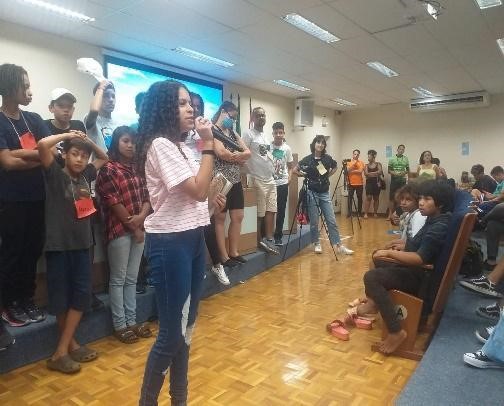
Group C portrayed the unfair conditions in which they lived and demanded that their rights be taken into consideration, using another Brazilian song (“Problema Social”) (Fig. 6):
Indigenous leader: If I could, I would demarcate indigenous and quilombola territories.
Quilombola leader 1: If I could, I would offer quality education to everyone.
Quilombola leader 2: If I could, I would give quilombola territory to everyone.
These performances functioned as insurgent acts of co-leadership (Stetsenko, 2017), in which marginalized knowledge, pain, and desire became publicly visible. As bell hooks (2008) affirms, joy, music, and movement are radical pedagogical tools that affirm humanity in the face of dehumanization.
These multimodal performances are emblematic of engaged multiliteracy (Liberali, 2022), which, as a tool-and-result, mediates agency and meaning while being itself transformed through collective enactment. Here, literacy becomes an act of epistemic and political creation, that is central to insurgent pedagogy.
The entire process was resumed with the theoretical discussion about the three moments of the meeting: immersion, emersion and insertion, through photos.
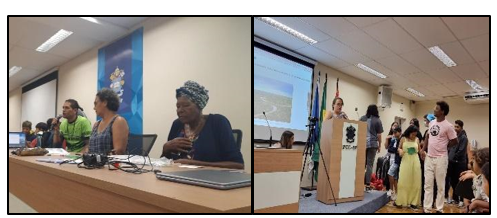
The session ended with all the participants dancing samba songs that refer to the creation of unity and collective.
Groups A, B, C and D collaboratively exposed unjust conditions rooted in racism and prejudice, resisting the neoliberal fragmentation that isolates and devalues collective life. By expressing their ethical-political suffering (Sawaia, 2006), shaped by racialized exclusion and territorial threat, they reaffirmed their power to act. Through collective communication and engaged multiliteracies, participants transformed pain into creative resistance, solidarity, and hope.
Ethical-political suffering, as conceptualized by Sawaia et al. (2022), emerges when subjects are denied the power to recognize and act upon the social structures that oppress them. Through the poetic circle, performances, and collective actions, participants began to restore their capacity to act by voicing their stories, memories, and hopes, disrupting silence and reclaiming visibility.
In this scenario, as we mentioned before, learning could be reimagined as a process of co-leadership and resistance as a way of challenging the symbolic violence education in BRICS+ societies. Through collective tools — language, image, movement, memory — they generated spaces of rupture and reconfiguration. They put into evidence the ethical political demands that emerged from their collectively lived experiences. Despite their different contexts, the different groups are exposed to situations of oppression and necropolitics and precarious habitus.
The first session was designed as part of the COLINA initiative, with the main objective of establishing the foundations for meaningful interaction among groups from different institutions. This initial moment served as a platform for participants to connect for the first time and recognize themselves as part of a larger collective. Throughout the encounter, the activities were carefully structured to foster integration, dialogue, and collaboration, encouraging participants to share their experiences, expectations, and visions. The session therefore focused on nurturing a sense of unity and a shared object — both essential for building a solid foundation for future project proposals and reaffirming the importance of cooperation and shared understanding in sustaining a proactive and engaged collective.
By collectively addressing themes such as racism, loss, exclusion, and identity, participants shared experiences of necroeducation and precarious habitus and reconstituted their ethical-political agency. Brincadas thus functioned as insurgent pedagogical spaces, where suffering was re-signified into action and lives deemed disposable under necropolitical regimes were reclaimed through collective voice and creativity, as summarized in the Table 2 below.
Through the analysis of the first session of 2023, which inaugurated the second phase of the project and launched the COLINA, we shared how Brincadas cultivates educational spaces of insurgency. These spaces enable participants to re-signify suffering into collective agency and transformative praxis. In doing so, Brincadas confronts the isolation and instrumentalism imposed by neoliberal schooling, reclaiming curriculum as a co-authored, plural, and justice-driven endeavor.
Final remarks
The Brincadas-COLINA project exemplifies how education can operate as an insurgent force against structures of exclusion and epistemic erasure. Rooted in Socio-Cultural-Historical Activity Theory and informed by critical, decolonial perspectives, the project mobilizes collective play, multiliteracies, and curriculum de-encapsulation as practices of resistance and re-existence.
By engaging children and educators from historically marginalized communities in dialogical and creative processes, Brincadas reconfigures learning spaces into territories of co-authorship and political imagination. The transformation of ethical-political suffering into expression and action illustrates how affect, embodiment, and meaning-making are central to educational transformation.
Instead of positioning participants as passive recipients of knowledge, the project recognizes them as epistemic subjects capable of naming the world, confronting structural contradictions, and imagining alternatives. In doing so, Brincadas challenges conventional schooling logics that reproduce silencing and hierarchization.
As BRICS+ nations face increasingly complex educational inequalities, the Brincadas experience invites researchers, educators, and policymakers to rethink curriculum as a living process anchored in voice, territory, and justice. The pedagogical movements offer a methodology that is capable of activating transformative agency.
By reclaiming play as a serious act of world-making, Brincadas affirms education as a space of possibility, where collective experiences generate knowledge, belonging, and hope.
Table 2
Summary of the first encounter’s contributions to project goals
|
Component |
Key activities |
Theoretical contributions |
Response to project goals |
|
Immersion |
Games, poetic circle, identity sharing |
Funds of Perezhivanie ((Liberali et al., 2023); Engaged Multiliteracy (Liberali, 2022) |
Establishing collective presence and affective connection |
|
Emersion |
Privilege walk, song analysis, installations |
Precarious Habitus (Souza, 2019); Necropolitics (Mbembe, 2003); Freirean Pedagogy |
Critical reflection on structural inequalities and positionality |
|
Insertion |
Performances, manifestos, samba circle |
Co-Authorship (Stetsenko, 2017); Curriculum De-encapsulation (Liberali, 2023); Hooks (2008) |
Creation of collective responses and resistance pathways |
1 Collectives of Investigation and Action.
2 Translator’s note: Insurgent Pedagogy is a term describing an educational approach that opposes traditional, authoritarian, or oppressive teaching methods. It focuses on developing critical thinking, resisting social and political injustices, and actively engaging students in the process of knowledge creation and social transformation.
3 Коллективы исследования и действия.
4 Мятежная педагогика (Insurgent Pedagogy) — это термин, описывающий образовательный подход, который противостоит традиционным, авторитарным или подавляющим методам обучения. Он ориентирован на развитие критического мышления, сопротивление социальной и политической несправедливости, а также на активное вовлечение учащихся в процесс создания знаний и осуществление социальных преобразований (прим. переводчика).