Introduction
Mental development and learning are interrelated throughout a person's life, which, according to sociocultural theories of the mind, is due to the unity of innate properties and the social situation of development (Vygotsky, 1966). At the same time, the reported strength of this relationship varies widely—from close associations at the initial level of education to weak ones in the upper grades (Tikhomirova, Malykh, Malykh, 2020), indicating the uniqueness of the relationship for each specific age.
The tenet of cultural-historical psychology concerning the age-specific nature of the environment—particularly specially organized educational conditions—underscores the need to study the strength of the relationship between mental development and learning “...during the transition from age to age” (Vygotsky, 1966, p. 93). In this context, the most notable changes characterize the transition from preschool education to primary general education, which brings changes in the format of instruction, the educational organization, and so on. Indeed, significant changes in the educational environment can make psychological characteristics more salient and, accordingly, lead to changes not only in the strength of the relationship between individual indicators of mental development and academic skills but also in its direction.
At the first two levels of general education—preschool and primary—among the indicators of mental development that ensure the effective solving of educational tasks are the mental operations that form the core of verbal-logical thinking (Davydov, 1996; Zaporozhets, Zinchenko, Elkonin, 1964). The basic processes of registering, logically transforming, and applying incoming information—the mental operations of abstraction, classification and generalization, and analogy—on the one hand, act as the driving force behind the development of the child's cognitive sphere, and on the other hand, are influenced by educational events of varying intensity.
According to research, the ability to identify essential features of objects or phenomena (the operation of abstraction) is formed before other mental operations and serves as the basis for their development (Davydov, 1996). Abstraction is associated with the awareness of the true essence of objects and makes it possible to move beyond the boundaries of immediate perception, which is “within the capabilities” of children in the preparatory group of kindergarten, although sometimes “essential and non-essential features are still not differentiated” (Davydov, 1996, p. 3). Accordingly, the development of the abstraction operation continues in the primary grades of school, and the temporal stability of the ability to identify essential features is presumably moderate at the “kindergarten—school” stage. The ability to distribute objects into groups and combine them based on common essential features (operations of classification and generalization) develops intensively in older preschool age, but research results indicate that they are formed only in an “elementary form” (Davydov, 1996, p. 3). Analogy—the ability to make inferences by analogy with proposed logical relationships between concepts—is associated with the transfer of experience to perform similar tasks and is formed later. Empirical research indicates the increased complexity of tasks on classification, generalization, and analogy upon completion of the preschool level of education (Tikhomirova, Malykh, 2025) and their intensive development at the beginning of schooling, which may manifest in extremely low temporal stability throughout the period covering the child's transition from kindergarten to school.
Among the learning processes, according to research and their meta-analysis, reading plays a primary role in the development of the basic mental processes of processing, logical transformation, and application of incoming information (Tikhomirova, 2026; Davydov, 1996; Ecalle et al., 2023; Holahan et al., 2018). Learning to read at the stage of transition from kindergarten to school is associated, on the one hand, with the absence of reading skills as a target indicator in the Federal State Educational Standard for preschool education, but, on the other hand, with large individual differences in reading ability among kindergarten graduates, related primarily to parental attitudes regarding the need to teach reading before entering school. Studies have reported moderate temporal stability of reading skills at the “kindergarten—first grade” stage, and further, until the completion of primary school, stability increases, reaching a plateau (Furnes et al., 2024).
Indeed, the development of mental operations occurs in the context of educational conditions, and the debate on the relationship between development and learning is both fundamental in nature and highly relevant to practice. Empirical analysis of this contested problem is best carried out using a longitudinal design, which opens up the possibility of determining the direction of the relationship and, accordingly, assessing cause-and-effect relationships between individual indicators over a specific time interval (e.g., Watkins, Styck, 2017). In such works, it becomes possible to calculate the predictive effects of previously measured traits on the further formation of associated traits, even in the presence of bidirectional significant relationships characterizing mutual influence during development, and to draw conclusions about the predominant causal direction (Killingly et al., 2025).
Longitudinal studies involving students at different levels of education are complex to organize, which makes them scarce in research on the cause-and-effect relationships between indicators of verbal-logical thinking and the degree of reading skills acquisition. However, existing longitudinal studies provide empirical evidence in favor of three main solutions to the problem of the relationship between mental development and learning.
Thus, one group of studies reports the existence of a single significant direction of the relationship between mental development and learning—“learning influences development”—and the results are interpreted within the framework of cultural-historical psychology (Vygotsky, 1966; Zaporozhets, Zinchenko, Elkonin, 1964; Davydov, 1996). It has been shown, in particular, that children with more advanced reading skills (with fewer errors and a high degree of comprehension) subsequently cope better with tasks requiring understanding and logical transformation of verbal information (Ecalle et al., 2023; Sucena, Silva, Marques, 2023; Holahan et al., 2018). Furthermore, in a longitudinal study with five measurements from ages 7 to 16, previously developed reading skills are identified as one of the most important causes of the further development of not only verbal intelligence but also general mental abilities (Ritchie et al., 2015). It is argued that it is the educational environment that is the source and the driving force of mental development: the processes of development “follow” learning, which creates “zones of proximal development” (Vygotsky, 2013, p. 18).
Another group of studies presents an alternative perspective on the problem of the relationship between mental development and learning to read, providing evidence in favor of the direction “development—as the basis for learning success” (Quinn et al., 2015; Watkins, Styck, 2017). For example, a study with two measurements over the period from 8 to 11 years showed that intellectual development is a strong predictor of subsequent academic success in all school subjects, including reading (Watkins, Styck, 2017). The authors conclude that this causal direction is highly stable throughout schooling; however, the need to account for the socio-economic conditions of the child's development at an early age is noted (Quinn et al., 2015; Reynolds, Turek, 2012).
The third solution to the problem of the relationship between development and learning is offered by a group of researchers, reporting bidirectional relationships between verbal-logical thinking and reading (Killingly et al., 2025; Yan et al., 2021; Ferrer et al., 2007). Longitudinal data analysis in these works revealed a bidirectional nature of the relationship, but with the predominance of one direction or another in certain time periods. For example, a longitudinal study with five measurements covering the age period from 6 to 10 years reports bidirectional positive associations between verbal abilities and reading acquisition (Killingly et al., 2025). However, the direction “from early reading to further development of the ability to operate with verbal material” was characterized by a more pronounced predictive effect (Killingly et al., 2025). Moreover, in certain time intervals (in particular, from 6 to 7 years and from 9 to 10 years), the influence of reading on the successful performance of verbal tasks later turns out to be the only significant relationship (Killingly et al., 2025), indicating the age-specific nature of bidirectional models of the development–learning relationship.
These conflicting findings may reflect the diversity of linguistic, cultural, and age contexts of the participants in longitudinal projects, the vast majority of which were conducted in Western Europe and the USA. Longitudinal studies involving Russian children, aimed at studying the relationship between mental development and academic outcomes—with two or more measurements of the same respondents—are few. Moreover, the number of longitudinal studies spanning the transition from preschool to primary education is vanishingly small due to their particular organizational complexity: children from one kindergarten enter different schools, often changing their area of residence. However, it is precisely at the “kindergarten—school” stage that the results of longitudinal projects have especially high practical relevance, associated with the scientific search for “preschool” psychological markers of difficulties in mastering academic skills that may arise during subsequent schooling.
The present study aims to analyze the mutual influence between verbal-logical thinking and reading skills at the stage of a child's transition from the preparatory group of kindergarten to the first grade of school. Achieving this aim will yield empirical data needed to address a fundamental and socially pressing problem in psychology—the problem of the relationship between mental development and learning.
The study aims to determine the cause-and-effect relationships between development and learning, specifically the links between the mental operations of abstraction, classification and generalization, and analogy with the degree of reading skills acquisition over the time period including the transition from preschool to primary general education. Which direction of the relationship is more pronounced: does the level of development of a child's verbal-logical thinking in older preschool age influence the formation of their reading skills by the end of the first year of schooling, or, conversely, does the acquisition of reading skills in older preschool age stimulate the further development of verbal-logical thinking? In addition, the temporal stability of all analyzed indicators will be determined and, accordingly, the resulting tendency towards variability under conditions of instruction, upbringing, and development at the preschool and primary levels will be described.
These objectives can only be achieved in a longitudinal study where the same indicators of development (verbal-logical thinking) and learning (reading skills) of each child are measured twice—in the preparatory groups of kindergartens and 1 year later, upon completion of the first grade.
Materials and methods
Participants
Data from 260 children were analyzed, of which 50,1% were girls, who completed, on two occasions one year apart, tasks measuring verbal-logical thinking and reading skills. All children attended preparatory groups of various kindergartens in the urban district but were enrolled in one school upon transition to primary general education. At measurement 1 (preparatory groups of 11 kindergartens), participants' mean age was 6,82 (SD = 0,3), at measurement 2 (first grades of one school)—7,83 (SD = 0,3).
Procedure
The tasks were administered individually in April–May by the researcher together with the educational psychologist working at the kindergarten at measurement 1 or at the school at measurement 2, in strict accordance with the protocol. Written informed consent had been obtained beforehand from parents for their child's participation in the longitudinal study.
Instruments
“Verbal-logical thinking”. Each participant completed computer-based tests measuring verbal-logical thinking in a separate room in the kindergarten (measurement 1) or in the school computer lab (measurement 2). The tasks were built on the material of the mental development test for children of preschool and primary school age (see: Tikhomirova, Malykh, 2025) and were scored as the number of correct answers. Instructions for the tasks were read aloud by the researcher regardless of the child's ability to read.
“Abstraction”. These tasks require the ability to identify only the essential features of objects. The participant is given the instruction to select the single word from several proposed options that correctly completes the sentence. For example, the beginning of the sentence “A tree always has...” is read and words are listed to choose one solution: “flowers, root, fruits, leaves, shadow”.
“Classification and Generalization”. These tasks assess the ability to sort objects into groups based on given criteria and combine them based on common features. The participant is instructed to combine four words into a group, name it, and then identify one extra word that does not fit the others. For example, a series of words is read: “river, lake, sea, bridge, swamp”—and then the participant is asked to complete the task.
“Analogy”. These tasks engage the ability to make inferences by analogy with proposed logical relationships between concepts. For example, the researcher reads the task: “The words 'flower—vase' are related to each other in the same way as the words in the second pair. Choose the appropriate word for the word in the second pair: 'bird' is related to what?”. Then a series of words is read to choose from: “beak, seagull, nest, egg, feathers”.
Reading skills. At measurements 1 and 2, each participant was asked to read excerpts from V.P. Kataev's work “The Seven-Color Flower” (at measurement 1 if they could read in any way). The researcher recorded each respondent's reading method—whether they can read by letters, by syllables, by syllables and words, or in whole words.
Statistical data analysis algorithm
At stage 1, indicators of verbal-logical thinking development, measured by the tests “Abstraction”, “Classification and Generalization”, “Analogy”, were standardized within each measurement (Z-transformation).
At stage 2, based on the reading method data, an index of reading skills was constructed: at measurement 1—from absolute inability to read to reading whole words, and at measurement 2—from reading by letters to the ability to read whole words. Reading skills acquisition indicators at each measurement were transformed into ordered factors with five levels, ensuring correct interpretation in models with ordinal dependent variables.
At stage 3, data analysis of verbal-logical thinking and reading skills from measurements 1 and 2 was performed using a cross-lagged panel model in the R environment (“lavaan”). Model fit was assessed using DWLS estimation, which is suitable for ordinal dependent variables, and the interpretation of model parameters and R² was performed using standardized coefficients. Three types of relationships between indicators of verbal-logical thinking and reading at two measurements with a one-year interval were calculated:
- Cross-lagged relationships in two directions, showing how much the variation in the prior measurement of one indicator (e.g., the degree of reading skills acquisition in the kindergarten preparatory group) explains the variation in the subsequent measurement of another indicator (the level of development of the verbal-logical thinking indicator in the first year of schooling).
- Within-time associations, assessing the total variation of indicators within each of the two measurements.
- Autoregressive relationships, reflecting the stability of the indicator over time and, accordingly, the tendency to change as the educational level shifts.
Results
Table 1 presents the mean values and standard deviations of verbal-logical thinking indicators measured in the kindergarten preparatory group and in the first year of schooling.
Table 1
Descriptive statistics of verbal-logical thinking indicators at preparatory groups of kindergarten and grade 1
|
Verbal-logical thinking indicator |
Preparatory groups of kindergarten |
Grade 1 |
|
Abstraction |
6,0 (2,0) |
7,4 (1,5) |
|
Classification and Generalization |
5,1 (2,2) |
6,3 (1,7) |
|
Analogy |
4,8 (2,4) |
6,1 (2,4) |
Table 1 shows the mean number of correct answers in the tasks “Abstraction”, “Classification and Generalization”, and “Analogy” with a maximum possible range from 0 to 10.
According to Table 1, an annual increase in mean values is observed for all analyzed indicators. Notably, the increase in the number of correct answers is slightly larger in the task on generating inferences by analogy—27.1% compared to tasks on abstraction, classification, and generalization (23.3% and 23.5%, respectively).
Table 2 shows the percentage ratio of study participants by the degree of reading skills formation at two measurements—in the kindergarten preparatory groups and by the end of the first grade.
Table 2
Percentage of children by level of reading skills at preparatory groups of kindergarten and grade 1
|
Method of reading |
Preparatory groups of kindergarten |
Grade 1 |
|
They can't read at all |
5,9% |
0% |
|
By letters |
7,4% |
1,5% |
|
By syllables |
47,8% |
12,4% |
|
By syllables and words |
26,6% |
48,8% |
|
By whole words |
12,3% |
37,3% |
According to Table 2, despite the absence of target indicators in the form of developed reading skills in the Federal State Educational Standard for preschool education, only 5,9% of the study participants in the kindergarten preparatory group cannot read. At the same time, almost 47,8% of children read by syllables, 26,6% read by syllables and words, and 12,3% of the study participants confidently read whole words already at the preschool level of general education. This situation is due to parental attitudes regarding the need to teach reading before entering school and, accordingly, the opportunities for additional education where children are purposefully taught to read.
By the end of the first year of schooling, the largest percentage groups are study participants reading by syllables and words—48,8% and their peers reading whole words—37,3%. At the same time, there are still first-graders reading by syllables (12,4%) and by letters (1,5%), indicating large individual differences among children under conditions of relative uniformity when learning to read in primary school.
Cross-lagged structural equation modeling
According to the results of the cross-lagged analysis, the theoretical cross-lagged model demonstrated a high fit to the empirical data (χ2(6) = 2,74, p = 0,841; CFI = 1,000; TLI = 1,07; RMSEA= 0,000; SRMR = 0,023). The model made it possible to determine the nature of the relationship between verbal-logical thinking and reading skills over the time period including the change in the level of general education. The figure shows a graphical representation of the cross-lagged model of the relationship between individual mental operations—abstraction (“ABSTR”), classification and generalization (“CL&GEN”), analogy (“ANALOG”)—and reading skills (“READING”) at the stage of transition from kindergarten (“KIND”) to school (“GRADE 1”). The model, along with cross-lagged relationships determining the direction of influence of verbal-logical thinking and reading skills in the process of development and learning, also includes synchronous correlation relationships at each educational level and autoregressive paths showing the temporal stability of all analyzed indicators. Solid lines indicate statistically significant relationships with standardized coefficients (p < 0,05), dotted lines indicate non-significant relationships.
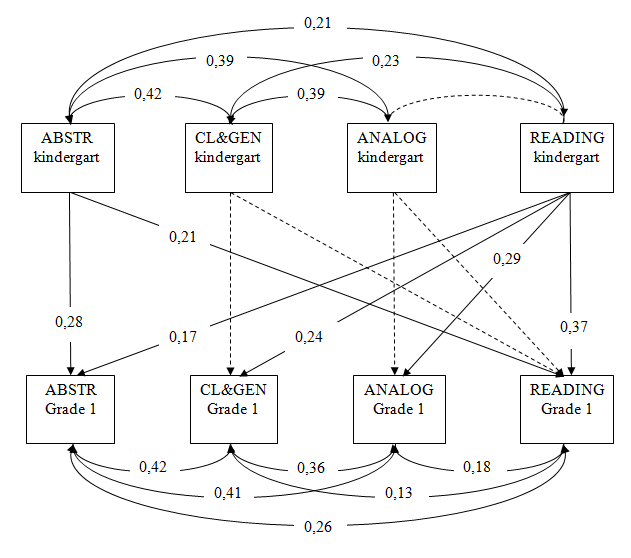
The analysis of cross-lagged regression relationships in the direction of the influence of the child's verbal-logical thinking in kindergarten on the degree of reading skills acquisition by the end of the first year of schooling showed a weak positive contribution from only the mental operation of abstraction (β = 0,21). According to the structural modeling data, the contributions of the level of development of the operations of analogy, classification, and generalization, measured at the kindergarten stage, were not significant for the degree of reading skills acquisition by the end of the first year of schooling (p > 0,05).
Conversely, the effects of reading skills formed by the end of preschool on the development of the child's verbal-logical thinking in the first grade are more numerous and more pronounced. Thus, the degree of reading skills acquisition at the preparatory group stage makes a significant positive contribution to the development of each indicator of verbal-logical thinking in the first school year. At the same time, the contribution of “preschool” reading skills to “school” verbal-logical thinking varies depending on the type of mental operation—from a minimum for abstraction (β = 0,17) to a maximum for analogy (β = 0,29) with an intermediate value for classification and generalization (β = 0,24). Such differences in the dependence of individual mental operations on previously developed reading skills may be associated with the specificity of their temporal stability and, accordingly, the severity of the tendency towards their own variability under the influence of educational, upbringing, and developmental conditions.
Indeed, the analysis of autoregressive coefficients showed that among mental operations, only abstraction demonstrates significant, albeit weak, temporal stability, reflecting a pronounced tendency towards variability of mean values during the transition from kindergarten to school (β = 0,28). At the same time, autoregressions for analogy, classification, and generalization did not reach statistical significance (p > 0,05), confirming the extremely high intensity of their formation and development during the school period. For reading skills, higher temporal stability was shown (β = 0,37), which may indicate the importance of already developed reading skills at the preschool level of education for subsequent progress in reading.
Within-time correlations between verbal-logical thinking and reading skills are most evident at the end of the first year of schooling (0,13 < r < 0,26) compared to the kindergarten preparatory groups, where there is an absence of significant relationships, in particular between analogy and reading (p > 0,05). However, at both analyzed levels of general education, the relationships between individual indicators of verbal-logical thinking—the operations of abstraction, classification and generalization, and analogy—vary within the same range of values (0,36 < r < 0,42). These associations are moderately positive.
Discussion
Based on longitudinal data analysis with two measurements, the bidirectional nature of the relationship between verbal-logical thinking and the degree of reading skill acquisition at the stage of the child's transition from kindergarten to school was determined. On the one hand, the degree of reading acquisition upon completion of preschool education influences the development of verbal-logical thinking operations at the primary level, and, on the other hand, the “preschool” level of development of individual verbal-logical thinking operations stimulates the acquisition of reading skills in the first grade. These longitudinal data, obtained for the first time on a sample of Russian children, are fully consistent with studies of the relationship between verbal abilities and reading in children from China (Yan et al., 2021), Australia (Killingly et al., 2025), and the USA (Ferrer et al., 2007), confirming the theoretical idea of the mutual dependence of learning and development processes (Vygotsky, 1966). Indeed, the reciprocal relationship between verbal-logical thinking and reading skills does not imply an opposition between development and learning; rather, it demonstrates the distinctiveness of their dynamics and mutual influence at individual age stages.
However, with the reciprocal nature of the model, the results of the analysis of cause-and-effect relationships between individual mental operations that form the core of verbal-logical thinking and the degree of reading skill acquisition at the “kindergarten—school” stage confirmed their different strengths and directions. Thus, the most pronounced positive effect is found in the direction where the degree of reading skill acquisition developed upon completion of the preschool level of education stimulates the further development of verbal-logical thinking during schooling. According to cross-lagged relationships, the degree of reading acquisition at the preschool level makes a positive contribution to the development of all mental operations analyzed by the end of the first grade: abstraction, classification and generalization, and analogy. These longitudinal data can serve as empirical evidence for the most important thesis of cultural-historical psychology that the processes of mental development “follow” learning, which creates “zones of proximal development” (Vygotsky, 2013, p. 18). According to research, children who at the age of 6—7 years read the text faster, made fewer mistakes when reading, and already practiced reading whole words while monitoring comprehension, coped better with tasks requiring understanding and logical transformation of verbal information at later ages (Rachanioti, Alevriadou, Charitaki, 2025; Ecalle et al., 2023; Sucena, Silva, Marques, 2023; Holahan et al., 2018). Moreover, in a longitudinal study of monozygotic twin pairs, a higher degree of reading skill acquisition by one of the twins at age 7 proved to be the most important cause of later advantages on tests of not only verbal intelligence but also general intellectual abilities compared to the other twin from the pair (Ritchie et al., 2015).
At the same time, the second possible direction—the influence of individual verbal-logical thinking operations upon completion of kindergarten on the degree of reading skill acquisition in the first grade—is characterized by a single significant relationship, in which the “preschool” level of development of the abstraction operation makes a small contribution to the acquisition of reading skills at the beginning of schooling. According to research, the ability to identify essential features of objects or phenomena not only serves as the basis for the development of other mental operations (Davydov, 1996) but also determines individual differences in the success of reading skill acquisition during subsequent schooling (Quinn et al., 2015; Watkins, Styck, 2017). In particular, verbal intelligence test scores at age 9, based, among other things, on performing tasks involving the identification of essential features of objects, were highly predictive of academic success in reading and, in particular, reading comprehension at ages 11 and 15 (Reynolds, Turek, 2012). A longitudinal study covering a longer period of schooling showed differences in the influence of individual indicators of verbal-logical thinking measured at early stages of learning on progress in reading acquisition during further schooling, which is associated with the heterogeneous development of mental operations in ontogenesis (Holahan et al., 2018).
During structural modeling, the temporal stability of all analyzed indicators was determined and, accordingly, the tendency towards variability under the conditions of education, upbringing, and development at the preschool and primary general education levels was described.
Among the indicators of verbal-logical thinking, the most unstable and therefore highly susceptible to the conditions of instruction, upbringing, and development during the transition from preschool to primary general education, are the mental operations of analogy, classification, and generalization. Thus, it is these mental operations that begin to form most actively under the influence of systematic schooling, while in older preschool age these mental processes are carried out without “going beyond” the limits of immediate perception and are possibly based only on an “elementary form” of concepts (Davydov, 1996, p. 2—3). Indeed, it is in tasks aimed at actualizing the abilities to distribute objects into groups based on given criteria and combine them based on common essential features, and to generate inferences in accordance with proposed logical relationships, that an intensive increase in mean values is observed during the first year of schooling. Conversely, the mental operation of abstraction has a significant, albeit weakly expressed, temporal stability and, accordingly, is characterized by a less pronounced tendency towards variability compared to the operations of analogy, classification, and generalization. According to research, the ability to abstract is the basis for the development of other mental operations, which means it is formed earlier in ontogenesis: already at the kindergarten stage, children on average can identify truly essential features of objects (Tikhomirova, 2026; Tikhomirova, Malykh, 2025). It should be noted that for almost all mental operations, more noticeable individual differences are observed during the preschool period compared to the primary level of general education, which indirectly confirms the effects of the influence of systematic education on development. At the same time, for the operation of analogy, the range of variability remains stable, indicating greater individual differences and, according to the data, greater complexity of tasks on establishing logical relationships by the end of the first year of schooling.
The temporal stability of reading skills during the transition from kindergarten to school is moderate, confirming the importance of developed reading skills at the preparatory group stage for subsequent mastery of the skill and its stabilization. These data are consistent with the results of a five-year longitudinal study involving children from the USA and Sweden, indicating moderate stability of reading skills at the stage of transition from kindergarten to school with a further increase in their predictive power throughout primary education (Furnes et al., 2024). Indeed, at the kindergarten stage, there is no targeted reading instruction, yet it is this period that shows very large individual differences in the level of reading skill: from children who cannot read at all to children who confidently read whole words. Such individual differences in the absence of systematic reading instruction are due to parental attitudes regarding the need to be able to read before entering school (Tikhomirova, Malykh, 2025) and provide the uniqueness of bidirectional directed connections between the development of verbal-logical thinking and learning to read during the transition from kindergarten to school.
Conclusion
For the first time in a longitudinal study involving Russian children, the specificity of cause-and-effect relationships between verbal-logical thinking and reading skills during the child's transition from the kindergarten preparatory group to schooling was analyzed. The study identified the directions of cross-lagged relationships between individual mental operations forming the core of verbal-logical thinking and reading skills, and also assessed the temporal stability of indicators, indicating variability under the influence of educational, upbringing, and developmental conditions at the preschool and primary general education levels.
The results of cross-lagged structural equation modeling of data with two measurements allowed us to formulate the following main conclusions.
- The relationship between verbal-logical thinking and reading over the period including the child's transition from kindergarten to school is characterized by bidirectionality, where, on the one hand, the degree of reading skill acquisition upon completion of the preschool level of education influences the further development of verbal-logical thinking at the primary level, and, on the other hand, individual indicators of verbal-logical thinking recorded in kindergarten stimulate the further acquisition of reading skills at school. However, the magnitude of each of these directions is different.
- A. The most pronounced positive effect is found in the direction where the degree of reading acquisition on completion of preschool influences the development of verbal-logical thinking during the first school year. At the same time, the preschool level of reading acquisition has a positive predictive effect on the further development of all mental operations—abstraction, classification, generalization, and analogy.
- B. Conversely, the opposite direction of the relationship between verbal-logical thinking and reading skills is characterized by a single significant relationship, where the preschool level of development of the mental operation of abstraction makes a small contribution to the acquisition of reading skills at the beginning of schooling.
- The temporal stability of verbal-logical thinking at the “kindergarten—school” stage is extremely low, confirming a high degree of variability. Only the mental operation of abstraction—the ability to identify essential features of objects and phenomena—is characterized by significant but weak temporal stability, reflecting a pronounced tendency towards variability under the influence of educational conditions at the stage of the child's transition from kindergarten to school. The mental operations of analogy, classification, and generalization are extremely unstable at the “kindergarten—school” stage, indicating their own highest variability under conditions of schooling.
- The temporal stability of reading skills during the transition from kindergarten to school is moderate, indicating that its change over time is relatively predictable and thus confirming the importance of correctly developed reading skills at the preparatory group stage for subsequent school success in reading.
Limitations. The authors are unable to make the dataset available due to the absence of a clause in the informed consent regarding the placement of “raw” data of the participants