Introduction
Academic success for master’s and postgraduate students increasingly rests on what they are able to do with information that reaches them through many channels at once. Reporting on a project, defending a position in a seminar, turning research into a talk or a publication — each of these tasks asks a learner to take in material from disparate sources, make sense of it, and recast it as a text of their own (Ruiz-Madrid, Valeiras-Jurado, 2020). The setting in which such skills are formed, however, is no longer the one teachers were trained for: mobile applications, content platforms, and social media have moved to the centre of instruction, and the speed at which they change keeps teachers and students alike in a state of continual learning (Lim, 2018). For the instructor this means rethinking how a lesson is built and how its materials are chosen (Mhlongo, Mbatha, Ramatsetse, 2023); for foreign language teaching specifically, it means coming to terms with the many shapes a text can take and the many routes by which knowledge is now absorbed (Cárdenas-Claros et al., 2023; Kress, 2004; Lim, Unsworth, 2023; Ruiz-Madrid, Valeiras-Jurado, 2020).
When information arrives without pause and in textual, numerical, graphic, audio, and video guises at once, more than one channel of perception is recruited to handle it — the auditory, the visual, the discrete (Kibrik, 2010). Multimodality is exactly this: the co-presence and mutual play of those channels inside a single context (Kibrik, 2010); taken more widely, it names the way distinct semiotic resources — a spoken word, a glance, a gesture — act together in a given situation (Kibrik, 2010; Lim, 2018). Present-day practice leans towards the visual and the aural and towards saying more with less, and the longread — a long written text that images, clips, and infographics break into segments — is one settled product of that turn (Kolesnichenko, 2022). Where this leaves oral skills, and the monologue and speaking skills at their core, is the question that makes multimodal support worth examining closely.
Why lean on images, recordings, clips, and infographics at all — on this spread of devices for carrying information across different sensory channels (Kibrik, 2010)? For two reasons. They let an instructor meet learners on the terms of their own modalities, and they stir the cognitive and learning effort through which material is taken in, retained, and understood, which matters most precisely when a student is speaking and assembling a monologue.
A monologue, in the sense used here, is an extended and connected utterance that one speaker shapes from linguistic means to pass on information or to give an account of facts and events (Glukhov, 2005; Leontiev, 2005, 2015). Putting thought into writing and putting it into speech are both productive uses of language (Glukhov, 2005; Leontiev, 2005, 2015), and speech of any quality presupposes that what was read, heard, or seen has first been grasped and weighed — receptive work that begins in perception (Glukhov, 2005). Description, narration, and reasoning are the forms a monologue takes (Glukhov, 2005). Its hallmark is a built, composed quality (Vygotsky, 1999): a thematic, semantic, and structural wholeness; a layout that honours the conventions of opening, body, and close (Glukhov, 2005); a logic carried by statements that link up in sequence (Glukhov, 2005); an attentiveness to the situation of utterance; a turn towards the listener, in clarity and accessibility and a feel for the audience (Glukhov, 2005); and a finished grammatical frame that puts elaborated means to work.
The form a monologue takes — written or spoken — follows from the channel of communication. In writing, a cluster of cognitive tasks comes into play, all turning on the tangled tie between the one who produces the utterance, the one who receives it, the message, and the slice of reality it points to. One face of these tasks is relational, concerned with how those elements hang together; another is strategic, concerned with the moves by which thought is grown and given form; a third is textual, resting on discourse skill — the knack of marshalling linguistic material into a single coherent fabric (Burns, 2019).
Spoken monologue runs differently. It is accompanied by gesture and expression, by intonation and pause, and it can leave an utterance unfinished, elliptical (Glukhov, 2005); what it does not leave to chance is its subject matter, which is fixed and mapped out beforehand. Trouble still finds the student: in unpicking information in a foreign tongue, in reading it back while a monologue is being built, and in speaking with others, where a narrow vocabulary and a loose hold on grammar work against fluency. Speech skills are those language skills that let an act of speech unfold; a language skill that never enters speech is, for its owner, of no use at all (Glukhov, 2005). That is why building oral skills sits among the first aims of language teaching wherever a monologue is the goal. Language competence, on this reading, is knowing linguistic phenomena and being able both to wield them in one’s own productive speech and to read them in the speech of others (Burns, 2019). Language activity lives in speaking, listening, writing, and reading (Zimnyaya, Mazaeva, Lapteva, 2020), and of these speaking is the oral and productive mode (Glukhov, 2005). Three things underpin its teaching: knowledge of the language, speaking skills, and communicative strategies (Burns, 2019).
Knowledge of the language reaches from the segmental — sounds, syllables, words, phrases — to the suprasegmental of stress and intonation, and on to grammar and vocabulary, to a sense of how segments of speech join, and to the capacity to bind them into speech that holds to a theme (Burns, 2019). Speaking skills are about voicing thought as it is produced; cultivating them turns on fluency — the run and evenness and tempo of speech, the well-placed pause, the parcelling of an utterance into units of sense, the connectives that tie ideas one to the next. They reach, too, into steering a conversation — picking up a prior turn, watching for understanding, mending a misunderstanding, returning feedback — and into steering production itself, opening a topic, trading roles, beginning or ending an exchange (Burns, 2019). A communicative strategy, for its part, is the shape given to speech behaviour so that the larger aim of communication is reached (Burns, 2019; Mikhalskaya, 1996): some strategies are cognitive, papering over gaps in knowledge by paraphrase, approximation, or sidestepping; some metacognitive, planning ahead or second-guessing what an interlocutor will say; some interactional, asking for a repeat, recasting, paraphrasing, checking that one has been understood (Burns, 2019).
To stand ready to give a monologue, to hold a topic, and to steer both talk and its production, a student must first amass and digest a fair body of material on whatever has been set. Bringing multimodal texts into teaching takes weight off that labour (Cárdenas-Claros et al., 2023; Lim, 2018; Lim, Unsworth, 2023) while acquainting learners with a span of modalities — fitting, since the present array of information formats in the digital world is itself founded on interactivity and multimodality (Cárdenas-Claros et al., 2023; Lim, 2018; Lim, Unsworth, 2023). Put to this purpose, audio and video, infographics, and images do learning good and pull students further into it (Hadizadeh, 2025; Raja, Lakshmi Pria, 2022; Ruiz-Madrid, Valeiras-Jurado, 2020).
What gives this study its point is a double need: to help students past the obstacles that meet them in oral communication, and to sharpen teaching materials by way of multimodal texts that may carry language acquisition further. The article proceeds in steps. It first takes the measure of how hard learners find the relevant tasks, in acquiring speaking skills and in readying a monologue alike; it then reads off how students rate the activities that move oral skills forward, and sets the survey returns out for analysis and discussion. It goes on to propose several ways of folding multimodal texts into particular monologue- and speaking-oriented activities, and to argue their worth in quickening the learning process and sharpening how material is perceived and understood. It ends with conclusions and with the questions left for later work.
Materials and methods
This study sets out to examine and bring order to the ways multimodal texts can be worked with in the service of oral skills, so that the difficulties students meet in readying a monologue might be eased.
Its quantitative evidence rests on three exploratory questionnaires. Taking part were nine groups of master’s and postgraduate students — 320 respondents all told — for whom a foreign language was a required course of study. The survey was conducted at Peter the Great St. Petersburg Polytechnic University over the period from 2024 to 2026. The respondents were enrolled in History and Philosophy programmes and studied English as a foreign language. Master’s students were, on average, between 23 and 27 years of age and postgraduate students between 28 and 43; men accounted for 64% of the sample and women for 36%. The questionnaires were administered in English and completed in written form, each item offering a binary, closed-response choice; participation was voluntary and anonymous.
The first questionnaire, of six items, asked how demanding students find the tasks that go into preparing a monologue: grasping information critically; condensing and ordering it; covering the set topic; mounting an argument; learning a speech by heart; and carrying speech through coherently and cohesively. Every item was closed, the respondent marking an activity as either the less or the more demanding of two.
The second, of ten items, gauged the difficulty met in oral communication, ranging over the sounding of words; the right use of parts of speech; the right use of verb forms; the fitting choice of words; the handling of prepositions, conjunctions, and articles; the building of sentences; the want of fluency; the mastering of a fear of error; and the critical weighing and the perceiving of an interlocutor’s speech. Here too each item was closed, the choice lying between less and more difficult.
The third, of nine items, looked into which activities carry oral skills forward: studying sources and putting a monologue together; talking things through in a group; debating the topics under study; viewing video; hearing audio; watching films; writing a monologue; speaking from a prepared plan; and giving a presentation. The respondent marked each as contributing to a greater or to a lesser extent.
Responses were analyzed using descriptive statistics: for each item, the frequency (percentage) of respondents choosing a given option was calculated. The findings then shaped a proposed model for working with multimodal texts, its steps laid out to track the order a monologue’s preparation ought to follow.
Results
How taxing students find the verbally and cognitively loaded tasks of monologue preparation emerged from the first survey (Fig. 1). Four tasks drew most of the respondents to the demanding side. Learning a monologue by heart and condensing and ordering information stood level at the top, each named by 57%; close after came grasping information critically at 55% and covering the set topic at 51%. Mounting an argument split the group evenly, troubling 50%, while only 31% pointed to the job of carrying material through logically, in coherent and cohesive speech.
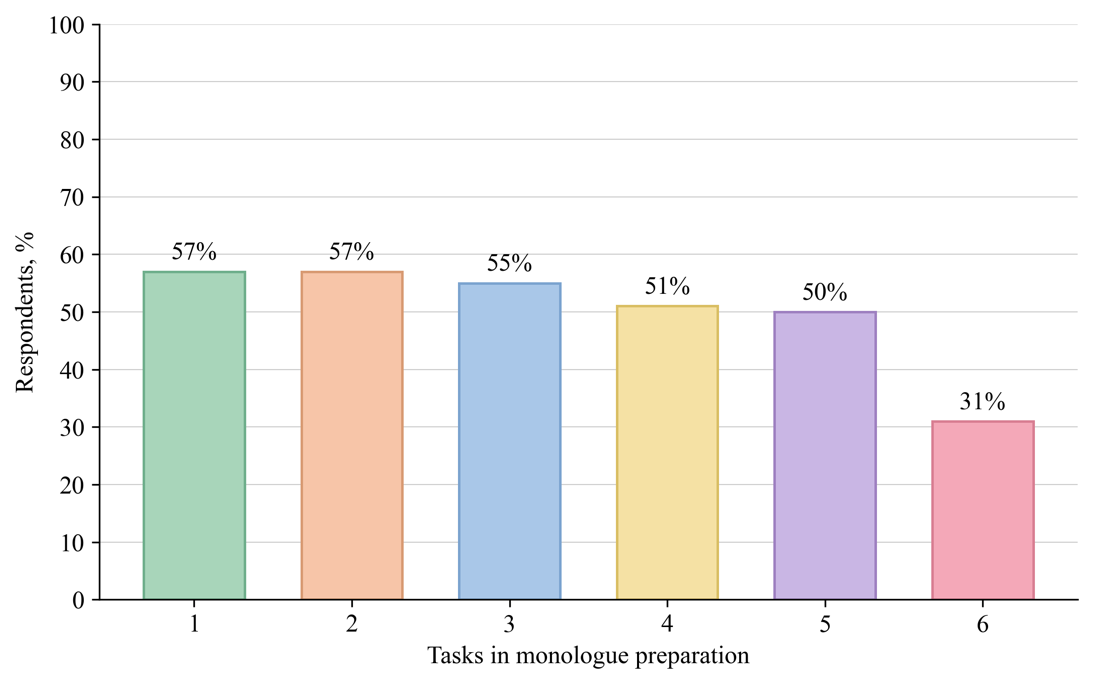
Fig. 1. Types of activities: 1 — memorizing a speech; 2 — summarizing and structuring information; 3 — critical comprehension of information; 4 — covering the topic under discussion; 5 — developing argumentative speech; 6 — developing speech in a coherent and cohesive way
Рис. 1. Виды деятельности: 1 — запоминание речи; 2 — обобщение и структурирование информации; 3 — критическое осмысление информации; 4 — раскрытие обсуждаемой темы; 5 — развитие аргументативной речи; 6 — развитие связной и логичной речи
Vocabulary and grammar, being pillars of the language that ask for thorough command, were the focus of a second survey into the difficulty students meet in communicating (Fig. 2). At the head of the list stood the right use of parts of speech, marked by 90% of respondents. Verb forms and the fitting choice of words followed, at 73% and 71%. Prepositions and conjunctions weighed on 58%, a shortfall in fluency on 57%, and the catching of an interlocutor’s speech on 54%. Getting the better of a fear of mistakes proved hard for 48%, and, at the lower end, the critical weighing of an interlocutor’s speech, the sounding of words, and the building of sentences were named by 47%, 45%, and 43% in turn.
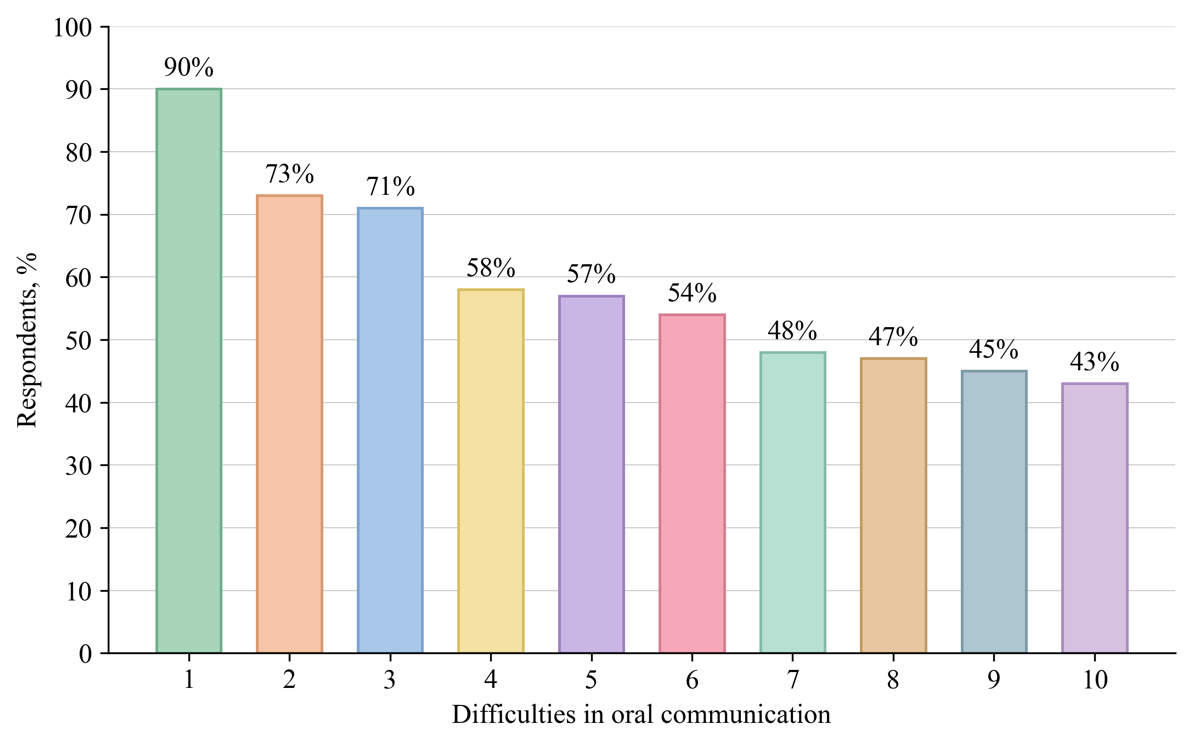
Fig. 2. Difficulties in oral communication encountered by students: 1 — the proper use of parts of speech; 2 — the proper use of verb forms; 3 — appropriate word choice; 4 — the use of prepositions, conjunctions, articles; 5 — lack of fluency; 6 — perception of an interlocutor’s speech; 7 — overcoming the fear of making mistakes; 8 — critical reasoning about an interlocutor’s speech; 9 — pronunciation of words; 10 — sentence formulation
Рис. 2. Трудности в устном общении, с которыми сталкиваются учащиеся: 1 — правильное употребление частей речи; 2 — правильное употребление глагольных форм; 3 — правильный выбор слов; 4 — употребление предлогов, союзов, артиклей; 5 — отсутствие беглости речи; 6 — восприятие речи собеседника; 7 — преодоление страха совершить ошибку; 8 — критическое отношение к речи собеседника; 9 — произношение слов; 10 — построение предложений
Because speaking matures hand in hand with reading and with monologue work — each classroom task opening onto one of speech — a third survey of nine items asked what drives oral skills forward (Fig. 3). Group discussion came first, named by 86%, with debate of the topics under study at 80% and the viewing of video at 71% behind it. Speaking from a prepared plan helped 69%; studying sources and composing a monologue, together with watching films, drew 68% and 67%. Past the halfway mark still stood the writing of monologues at 63%, the hearing of audio at 60%, and the giving of a presentation at 59%.

Fig. 3. What contributes to the development of oral skills: 1 — collaborative group discussion; 2 — discussion of topics under study; 3 — watching video materials; 4 — speech delivery supported by a prepared plan; 5 — studying resources and composing a monologue; 6 — watching films; 7 — writing monologues; 8 — listening to audio materials; 9 — delivering a presentation
Рис. 3. Что способствует развитию навыков устной речи: 1 — групповое обсуждение; 2 — обсуждение изучаемых тем; 3 — просмотр видеоматериалов; 4 — выступление с опорой на подготовленный план; 5 — изучение ресурсов и составление монолога; 6 — просмотр фильмов; 7 — написание монологов; 8 — прослушивание аудиоматериалов; 9 — презентация
The breadth of information formats the digital environment now affords — interactive, hypertextual, multimodal — leaves ample room to work past the difficulties just charted. How multimodal texts might be threaded into the activities that surround monologue preparation is set out, with commentary, in the table below, which names in turn each activity, the multimodal text that stirs perception and understanding, and the methods and techniques fitted to it.
Table / Таблица
The use of multimodal text in teaching foreign language communication
Использование мультимодального текста в обучении иноязычной коммуникации
|
|
Type of activity / Вид деятельности |
Multimodal text / Мультимодальный текст |
Teaching methods and techniques / Методы и приемы обучения |
|
1 |
Reading for critical comprehension, with a close look at the multimedia elements that bear on the topic. / Чтение с целью критического понимания, с детальным анализом мультимедийных элементов, раскрывающих тему. |
A longread — a written text into which images, video, background music, presentations and similar elements are woven. / Лонгрид — письменный текст, в который органично вплетены изображения, видео, фоновая музыка, презентации и подобные элементы. |
Working through content and language; teasing out the principal meaning-bearing blocks and their order (naming the central ideas, subtopics and microtopics; raising and answering questions; discussion). / Проработка содержания и языка; выявление основных смысловых блоков и их последовательности (называние центральных идей, подтем и микротем; постановка и ответы на вопросы; обсуждение). |
|
2 |
Building vocabulary and grammar. / Расширение словарного запаса и отработка грамматики. |
A multimedia presentation that mixes formats — images, video and audio, infographics — with interactive, game-like exercises. / Мультимедийная презентация, сочетающая различные форматы (изображения, видео и аудио, инфографику) с интерактивными игровыми упражнениями. |
Vocabulary and grammar practice delivered through game techniques, which awaken attention, sharpen visual and verbal perception, and reinforce memory in support of acquisition. / Отработка лексики и грамматики с помощью игровых приемов, которые пробуждают внимание, обостряют зрительное и речевое восприятие и укрепляют память для поддержки усвоения материала. |
|
3 |
Condensing and organizing material. / Сжатие и систематизация материала. |
Interactive infographics, in which information is rendered as compact verbal and visual components that hold its key ideas. / Интерактивная инфографика, в которой информация представлена в виде компактных вербальных и визуальных компонентов, содержащих ее ключевые идеи. |
Hands-on engagement with graphically presented information and its ordering — generalizing and synthesizing, setting aside the inessential, flagging keywords, compressing text — all of which feed critical and verbal thinking. / Практическая работа с графически представленной информацией и ее упорядочиванием: обобщение и синтез, отсечение несущественного, выделение ключевых слов, компрессия текста — все это развивает критическое и речевое мышление. |
|
4 |
Reproducing a secondary text coherently and logically. / Связное и логичное воспроизведение вторичного текста. |
An interactive board or wall the group fills in together, voicing arguments, justifications and reasoning and responding to one another’s judgements. / Интерактивная доска или стена, которую группа заполняет совместно, озвучивая аргументы, обоснования и рассуждения, а также реагируя на суждения друг друга. |
Written-speech work — composing clarifications and explanations, elaborating and supplementing facts and definitions — that trains clear, well-reasoned expression. / Письменно-речевая деятельность: составление уточнений и пояснений, детализация и дополнение фактов и определений, что тренирует ясное и аргументированное выражение мыслей. |
|
5 |
Committing material to memory. / Запоминание материала. |
A multimodal mind map the group creates together, setting out a topic’s primary and secondary ideas through statements, definitions, pictures, images and video. / Мультимодальная интеллект-карта (ментальная карта), которую группа создает совместно, раскрывая первичные и вторичные идеи темы с помощью утверждений, определений, картинок, изображений и видео. |
Techniques that follow the principle of meaningful learning: anchoring a new topic in what learners already know or have lived through, so that associative links form and aid recall. / Приемы, основанные на принципе осмысленного обучения: опора новой темы на то, что учащиеся уже знают или пережили, чтобы сформировать ассоциативные связи, способствующие запоминанию. |
In practice, a multimodal text can be put to work across the stages of monologue preparation as set out below. Step 1. Reading for critical comprehension. As a group, learners assemble a multimodal text — a longread — and gather the audio and video that bear on the chosen topic. Group work, the graphic presentation of material, and the comparing, contrasting, and sorting of information together ease understanding and critical appraisal. Step 2. Building vocabulary and grammar. A multimedia presentation carries the load: words and collocations surface as images that fasten in memory, while topic-bound video models the sounding of unfamiliar words. Step 3. Condensing and organizing material. Interactive infographics bring word and image together; marking keywords and compressing text hone the work of summary. Step 4. Reproducing a secondary text coherently and logically. Learners reason and justify by filling an interactive board or wall, airing their own judgements and answering those of their groupmates. Step 5. Committing material to memory. Together the group builds a multimodal mind map, setting a topic’s primary and secondary ideas before the eye through statements, definitions, pictures, images, and video.
Discussion
The hardest tasks, for nine in ten students, turned out to be the right use of parts of speech, the right use of verb forms, and the fitting choice of words. Against these, multimedia presentations and game-laced interactive drills may tell: vocabulary shown to the eye rouses attention and helps a fresh word take hold (Schmitt, Rodgers, 2020, p. 45), and topic-bound video steadies the sounding of words not met before. Putting vocabulary before the eye through infographics serves the same turn, aiding both retention and the live use of new words (Mohsen, 2023). The summarizing and the memorizing of material were ranked the most exacting parts of monologue preparation, yet group discussion was named the surest road to oral skills — and the joint building of a multimodal mind map, alongside interactive infographics and boards, may answer both at a stroke by drawing students into the work, for to take part is already to be involved (Schmitt, Rodgers, 2020, p. 172). Infographics, knitting text to image, have been shown to spur active learning and engagement in higher education (Jaleniauskienė, Kasperiūnienė, 2023), and techniques cut to the principle of meaningful learning lay down the associative links on which recall leans (Ausubel, Novak, Hanesian, 1978). Once one allows how far communicative practice has shifted, in shape and in format, towards the multimodal and the digital (Mhlongo, Mbatha, Ramatsetse, 2023; Raja, Lakshmi Pria, 2022), how particular the semiotic make-up of multimodal texts is (Burns, 2019; Kibrik, 2010; Lim, 2018), and how communication draws not on language alone but on a range of multimodal resources to make meaning across settings (Cárdenas-Claros et al., 2023; Hadizadeh, 2025; Lim, 2018), multimodality stands at the heart of teaching that works. How students take in multimodal texts of differing design is, on this showing, a question both open and worth the pursuing.
Conclusions
As information comes more and more to the eye and the ear, the multimodal text crosses over from a convenience to a condition of teaching. (1) The survey showed that students find grammatical accuracy the chief obstacle to oral communication and rank summarizing and memorizing as the most demanding stages of monologue preparation, while group discussion is seen as the most effective route to oral skills. (2) On this basis, a five-step model for working with multimodal texts was proposed, aligned with the sequence of monologue preparation, from critical reading to memorization; its practical value lies in tying each multimodal resource to a concrete stage of the task. (3) Future work should empirically test the model in classroom settings, with pre- and post-intervention measures, and examine how students perceive multimodal texts of differing structure.
Ограничения. У исследования есть ряд ограничений. Полученные результаты основаны на самоотчетах участников, полученных с помощью закрытых вопросов с бинарным выбором, которые позволяют оценить воспринимаемую, а не измеряемую сложность. Выборка, хоть и достаточно большая, была сформирована из студентов одного учебного заведения и не сравнивалась с контрольной группой. Что еще более важно, предложенная модель еще не прошла эмпирическую проверку: ее эффективность в развитии навыков устного монологического высказывания еще предстоит подтвердить в ходе последующих исследований в учебных классах.
Limitations. The study has several limitations. The findings rest on participants’ self-reports, gathered through closed binary-choice items, which capture perceived rather than measured difficulty. The sample, although sizeable, was drawn from a single institution and was not compared with a control group. Most importantly, the proposed model has not yet been empirically tested: its effectiveness for developing oral monologue skills remains to be verified in subsequent classroom-based research.