Introduction
According to the theory and methodology of activity approach [Shadrikov, 2013; Shadrikov, 2020a], analysis of learning activity objectives is a relevant and significant issue for understanding the process of learning and professional development. The analysis of activity category as a psychological functional system implies distinguishing functional blocks in it, among which goals and motives occupy a special place [Slepko, 2019]. In particular, “the goal is the key and determining, i.e. system-forming factor of formation and functioning of any system... Motivation is the main and extremely complex system of determinants for all aspects of initiation and deployment, structure and genesis of learning activity” [Karpov, 2009, p. 6]. The importance of the functional block of goals is determined by the fact that it directs the activity, ensures the achievement of its result, together with motivation determines the formation of personal meaning of the implemented activity.
Modern psychology is characterized by a variety of studies devoted to the problems of goals and motivation of educational, educational-professional and professional activity. The analysis of the role of the target unit in the implementation of learning and professional activity suggests the following. The formation of learning goal orientation in students increases their perception of self-efficacy and learning motivation [Grosemans, 2018]; transfer of learning goals to individual, personally meaningful level increases students’ involvement in the learning process and positively affects the growth of academic performance [Martin, 2015]. In addition, the effectiveness of professional training in higher education increases with the development of the ability to self-regulate the student’s learning goals [Fryer, 2014]. Objectives also play an important role in the conditions of professional pedagogical activity. For example, the development of goal-setting ability positively influences the adaptation to professional activity of young professionals [Lee, 2009], the formation of a positive attitude of the teacher to the classroom and the experience of learning outcomes [Wang, 2016], preservation and development of microclimate in the school [Bombieri, 2019].
A lot of research is devoted to the analysis of the problem of motivation of educational-professional and professional activity. Learning motivation influences students’ attitude towards self-development, self-education and self-realization [Puliaeva, 2020; Soloveva, 2021], changes in students’ perceptions of themselves during professional training [Vasilevskaia, 2021; Aguayo-Estremera, 2021; Lyndon, 2019], positive adaptation to learning in university [Fryer, 2018; Noyens, 2019; Núñez, 2016]. It influences not only the nature of students’ attitude towards the learning process [Kuznetcova, 2021; Hernesniemi, 2019], but also its effectiveness [Ponomarenko, 2021; Balogun, 2017; Datu, 2017]. An important area of research is the assessment of the role of motivation in the formation of willingness to professional activity — mastering professional competencies [Ochnik, 2020; Tarakanov, 2020; Datu, 2018], competencies that ensure innovative activity of a future professional [Buravleva, 2020]. Also, for example, the nature of students’ values and beliefs is considered as an important condition for the formation of students’ perceptions of professional self-efficacy [Green, 2017].
Motivation is also considered as a factor that ensures the effectiveness of professional activity, formation of psychological system of teacher’s activity [Shadrikov, 2020; Shadrikov, 2019; Shadrikov, 2019a]. It occupies a significant place in teacher’s work with students — in the development of their learning motivation [Gordeeva, 2021; Zedan, 2021]. At the same time motivation of teachers’ teaching activity is characterized by non-linearity and uneven development [Gorbushina, 2020; Ozhiganova, 2021].
It has already been pointed out above that academic success is often considered in the context of the influence that learning motivation has on it. However, learning success is also the subject of much research. The influence of new information technologies on academic achievement [Sorokova, 2021], the influence of volitional regulation of activity [Shliapnikov, 2021], and family upbringing styles [Batool, 2019] are the subjects of research. An important area of research is the study of students’ attitudes towards their learning effectiveness — assessing their perceptions of academic success [Yaroshevskaia, 2021; Cobo-Rendón, 2020], the dynamics of changes in these perceptions in the process of learning [Kapustina, 2021], as well as the study of the influence of the socio-economic status of the family on students’ attitudes towards learning self-efficacy [Xu, 2021], etc.
The diversity of the above-mentioned studies once again confirms the special place of goals and motivation in the structure of activity. Meanwhile, Russian and foreign studies focus mainly on the problem of motivation and its influence on the success of educational and professional activities of a teacher. Much less attention is paid to the issues of goal development in teacher’s professional learning.
The study presented here analyses the dynamics of learning activity goals in the process of studying in a teacher training university. This involves not only characterizing the dynamic features of goal development, but also establishing their relationship with motivation and success of learning activities. The necessity of setting and solving the indicated tasks is justified by the fact that from the position of the theory of systemogenesis [Ansimova, 2001; Shadrikov, 2013], the goal is a system forming factor of activity. Of particular interest is the question of how the student’s learning activity combines the need for solving academic problems and preparing for future professional activity? Will there be a contradiction between the vision of current (mastering educational programme) and future (pedagogical activity) result of educational-professional development? Thus, the subject of the present study is the development of motivational and goal-oriented block of learning activity in the process of professional pedagogical education.
Sampling and Research Methods
The study was conducted by a cross-sectional method and included a psychological analysis of the goals, motives, and academic performance of the 1st-4th year students at a pedagogical university. The students are studying in the field of “Primary Education” and they are future primary schools’ teachers. The sample size is 118 respondents aged 17 to 22 years (M=19.5; SD=1.24), 99% are female. The sample size of the 1st year — 42 students aged 18 to 19 years (M=18.1; SD=0.41), 2nd year — 24 aged 18 to 20 years (M=19.3; SD=0.56), 3rd year — 27 aged 19 to 21 years (M=20.1; SD=0.58), 4th year — 25 aged 20 to 22 years (M=21.0; SD=0.61).
The analysis of learning objectives was carried out using the questionnaire “Learning Objectives” [Ansimova, 2001]. Students were asked to give a detailed answer to the questions: “What would you like to be taught at university?”, “Why do you need it?”, “What have you already learned?”. Interpretation was made on the basis of the answers to the first question, which allowed assessing the significance for the student of learning and professional activity, the normatively approved result of which is readiness to pedagogical work.
In order to quantify the significance of the implemented activity, the answers were evaluated on a 3-point scale. Each point corresponded to the degree of significance of the learning and professional activity: 3 — a response with a description of perceptions of the learning outcomes of higher education related to mastering the methods of teaching and raising schoolchildren, ways of communicating with children and parents, solving conflict situations, etc.; 2 — a response with a description of intermediate, indirect learning outcomes (for example, “Gain new knowledge, professional experience”, “Communicate with people, understand human psychology”); 1 — a response with a description of learning outcomes external to the content of teacher work (for example, “Define my destiny”, “Learn to lead an adult, responsible life”). The higher the score the student got for the answer, the more meaningful the normative goal of learning in higher education is considered to be for him/her.
The study of learning motivation was carried out using the questionnaire “Diagnostic technique of learning motivation and emotional attitude towards learning” [Prihozhan, 2000]. The questionnaire assesses the development of cognitive motivation to learn and achievement motivation, as well as the experience of the process and outcome of learning. Despite the fact that the questionnaire is designed for subjects under the age of 16, its structure as well as affirmation questions correspond to the peculiarities of studying students’ learning motivation (for example, check [Berezhkovskaia, 2014]).
Successful performance was assessed by analysing students’ academic performance in the midterm.
Statistical processing of the data was performed using SPSS Statistics 19, Microsoft Office Excel. Before processing, the data were checked for normality of distribution (λ-Kolmogorov-Smirnov criterion). The results of the λ criterion allow us to conclude that the distribution of the data of the students of all courses is normal. Statistical processing was carried out by methods of primary descriptive statistics (arithmetic mean, Cv — coefficient of variation), comparison methods (Mann-Whitney U test), correlation analysis methods (r-Spearman).
The Dynamics of Students’ Learning
Activity Goals
The data presented in Figure 1 allow us to assess the dynamics of the significance of students’ learning objectives. The indicator measured reflects the significance of the normative outcome of higher education — readiness for pedagogical activity in school.
The results suggest a gradual decrease in the significance of normative goals in the process of learning in higher education. The non-linear dynamics of significance is manifested in the fact that in the 3rd year there is a short-term increase in the significance of learning objectives, which can be interpreted as a result of long-term inclusion of students in intensive pedagogical practice. It is in their third year of primary education that students undertake an internship as a teacher and give lessons in a school. One of the most significant results of the internship is the realisation that their current level of development does not meet the requirements of the profession. This leads to a restructuring of the psychological system of activity. This result confirms the previously obtained data [Mazilov, 2020; Mazilov, 2020a; Mamontova, 2016] on the role of pedagogical practice in the process of students’ professionalization.
Important conclusions can be reached by referring to the measure of variability (Cv) in the relevance of learning activity goals (Table 1).
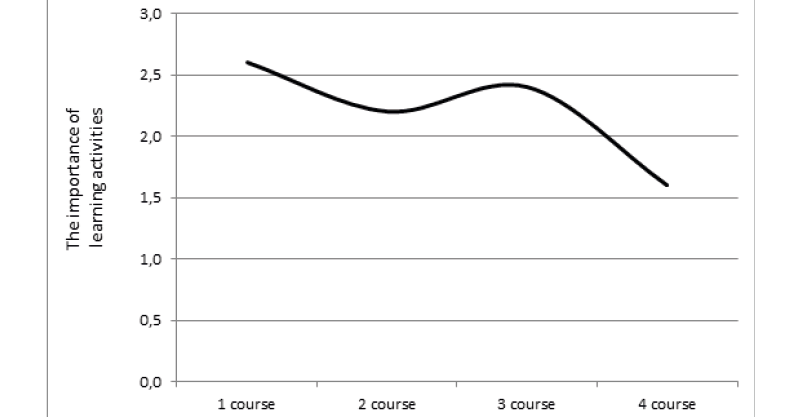
Fig. 1. Dynamics of the significance of students’ learning activity goals
Note. The significance of learning activities is an indicator of the arithmetic mean of the significance of learning activity goals of students in different courses. Calculated based on the evaluation of the answers to the question “What would you like to be taught at university?”
The variability in the relevance of learning activity objectives increases with each course of study, interrupted in year 3. This suggests that the role of individual interpretation of normatively defined objectives increases in the learning process. At the same time, by the end of the study the ways of interpreting the objectives are maximally polarised along the vector of acceptance-unacceptance of pedagogical activity in the school. In the 3rd year, while there is a short-term increase in the importance of normative learning objectives (Picture 1), there is also a short-term decrease in the variability of students’ assessment of them. This suggests that prolonged pedagogical practice has an impact on the majority of students who are aware of the discrepancy between the actual and required level of professional development.
Further, let us turn to the results of the analysis of students’ learning motivation, who assess the significance of normative learning goals differently.
Learning Motivation with Varying Degrees of Importance of Learning Activities
First, let us clarify the differentiation of students from one course to another according to the importance of normative learning goals. The sample of each course was divided into extreme subgroups: the first one — students with low importance of normative learning objectives, the second one — with high importance. This allows for a more rigorous identification of the specifics of students’ learning motivation with different importance of normative learning objectives. The results presented in Table 2 allow identifying the specific features of students’ learning motivation.
Increasing differences in the motivation of cognitive activity (indicator 1) lead to the fact that in the 4th year there are statistically significant differences in the level of expression of this indicator. This indicates the demand for students with a high level of acceptance of the goals of learning the content of the educational programme, which agrees well with the high variability of the indicators of significance of the goals in the 4th year after the pedagogical internship. Awareness of the contradiction between the current and required level of professional development of students with high acceptance of learning objectives leads to an increase in their cognitive activity. The latter is aimed at mastering those parts of the educational programme for which insufficient knowledge is realised.
Table 1
Changing the Relevance of Learning Activity Goals in Higher Education
|
The importance of learning activity goals |
Course of study |
|||||||
|
1 |
2 |
3 |
4 |
|||||
|
Мх |
Cv |
Мх |
Cv |
Мх |
Cv |
Мх |
Cv |
|
|
2.60 |
19 |
2.20 |
28 |
2.40 |
22 |
1.60 |
45 |
|
Note. Mx — arithmetic mean; Cv — coefficient of variation. Cv: 0—10 — low variation, 11—20 — medium, ≥21 — high.
Table 2
Learning Motivation of Students with Different Relevance of Learning Activities
|
Cour-se |
Rele-vance |
Indicator 1 |
Indicator 2 |
Indicator 3 |
Indicator 4 |
||||||||
|
Мх |
Cv |
p |
Мх |
Cv |
p |
Мх |
Cv |
p |
Мх |
Cv |
p |
||
|
1 |
low |
30.80 |
13 |
U=166 |
29.20 |
12 |
U=132 |
30.90 |
11 |
U=121* |
28.90 |
7 |
U=150 |
|
high |
29.10 |
11 |
29.20 |
13 |
28.20 |
11 |
31.60 |
11 |
|||||
|
2 |
low |
27.40 |
14 |
U=51 |
28.90 |
8 |
U=34 |
28.90 |
12 |
U=46 |
29.90 |
11 |
U=32* |
|
high |
29.60 |
9 |
27.00 |
10 |
30.60 |
14 |
27.10 |
13 |
|||||
|
3 |
low |
18.00 |
19 |
U=70 |
19.90 |
16 |
U=65 |
18.50 |
10 |
U=77 |
19.80 |
16 |
U=40* |
|
high |
20.80 |
21 |
20.30 |
19 |
17.90 |
25 |
17.20 |
20 |
|||||
|
4 |
low |
13.00 |
25 |
U=36* |
15.20 |
29 |
U=67 |
12.50 |
12 |
U=53 |
16.00 |
18 |
U=20*** |
|
high |
14.60 |
20 |
18.30 |
20 |
11.10 |
15 |
12.50 |
14 |
|||||
Note. * — p≤0.05; ** — p≤0.01; *** — p≤0.001. Indicators: 1 — cognitive engagement; 2 — achievement motivation; 3 — anxiety about process and learning outcomes; 4 — anger about process and learning outcomes.
The absence of statistically significant differences in achievement motivation (Indicator 2) in each course suggests that students in each compared group identify work as the immediate life perspective. However, the differences are evident in the goals of future activity. For example, in the 1st year, students with low importance of normative learning goals represent “learning how to write curriculum”, “avoid problems in work”, “how to be a teacher”, etc.; students with high importance represent “teaching methodology, education”, “learning the profession, teaching methodology”, “teaching methodology, understanding children, knowing the psyche of children”, etc. By the 4th year, the perceptions of students with high importance of normative goals do not actually change, whereas in the group of students with low importance there is a diffusion of goals. It appears in the loss of specificity in the ideas about the results of studying in higher education. It is expressed in typical goals — “to learn everything I want”, “everything I need in the profession”, “knowledge for work and for life”, “organisation of my work”.
Differences between the groups in anxiety about the process and result of learning (indicator 3) are statistically significant only in the 1st year. This appears to be due to adaptation to the new learning environment and higher anxiety arising in a situation of less clear perceptions of learning outcomes. From the 2nd year onwards, the different significance of normative goals for students is accompanied by statistically significant differences in anger towards the process and outcome of learning (indicator 4). This suggests that the low importance of normative goals leads to an increase in negative feelings about the process and result of learning. This is consistent with the idea that non-acceptance of normative learning conditions leads not only to an increase in contradictions regarding activity content, but also to the formation of an inadequate psychological system of activity [Slepko, 2019; Shadrikov, 2013].
An Idea of the Normative Learning Objectives for Students with Different Levels of Achievement
Studying the relationship between perceptions of normative learning objectives and academic success is an equally important aspect of the problem in focus. The analysis revealed a weak relationship between students’ acceptance of normative learning objectives and academic success (1st year — r=0.23, 2nd year — r=-0.23, 3rd year — r=0.27, 4th year — r=-0.17). At the same time, only in the 3rd year the relationship between the indicators is statistically significant at the p≤0.05 level. The result obtained should not be regarded as a contradiction for a number of reasons. It was shown previously that students do not formulate high academic grades as meaningful learning goals — even diffuse goals of the 4th year students are related to future achievements and results. Similarly, it has been found [Yaroshevskaia, 2021] that not only academic success does not reflect the results of real progress of professional learning, but also students themselves do not consider it as an adequate reflection of learning success.
The result obtained allows us to formulate the idea that adjustments related to the real assessment of students’ professionalisation should be made in the content of vocational education and training. It is not only a question of revising the traditional methods of interim assessment, but also the final assessment of the educational programme.
Conclusions
It was found that the dynamics of the significance of normative learning objectives in HEIs are of a descending irregular nature. Pedagogical internship in the 3rd year plays an important role in changing the significance of the goals. It leads to the awareness of the contradiction between the actual and required level of professional development. The lack of awareness of this contradiction results in an increasing number of students whose perceptions of learning objectives are diffuse towards the end of their studies.
The analysis of motivation of students with different significance of normative goals showed increasing differences in emotional attitudes towards the process and outcome of learning. A decrease in the importance of normative learning objectives leads to an increase in the feelings about the relevance of the process and the learning outcomes to the students’ needs.
The assessment of the connection between the significance of normative learning objectives and academic success has confirmed the existing evidence of low reliability of using academic achievement to assess the process and outcome of learning in higher education. This suggests the need to expand the ways of assessing the formation of professional competencies in higher teacher education contexts.
The study has a number of limitations. First of all, this applies to the sample — Primary Education students. Therefore, the findings and conclusions apply to students planning to work as primary school teachers. Therefore, a comparative analysis of the changing perceptions of normative learning objectives of students in other pedagogical and non-teaching profiles is relevant. This will also require extending the ways in which learning success can be assessed to include, for example, peer assessment methods.
An important aspect of the problem discussed is a comparative analysis of the obtained data with the peculiarities of changes in the perception of normative goals of students completing in 2021—2022 academic years of the FSES 3++ cycle of education. The specifics of the latter is a twofold increase in the volume of practice, which can lead to changes in the dynamics of formation of the psychological system of activity, its individual components (goals, motives of activity, etc.).
The results obtained can be used in the process of psychological and pedagogical support, counselling of students and teachers of pedagogical higher education institution. The objectives of support and counselling can concern the problems of adaptation to the learning process, interim and final attestation, change of learning motivation, change of learning profile, etc.