Introduction
The modern context of an uncertain, dynamically changing social situation in the country—such as the aggravation of the military, political, and economic situations, the growth of international tensions and social isolation, cyberattacks, and information stressors—brings to the forefront theoretical and empirical studies in the field of increasing the resilience of Russian youth to variable risks and threats of "new wars," finding resources for effective socialization, identifying mechanisms for overcoming barriers to self-realization, inertia, lack of initiative, and detachment; as well as developing and implementing technologies for fostering social flexibility, adequacy, and creativity in individuals. Scientific research confirms that armed and unarmed (informational, economic, sociocultural, etc.) methods of destructive influence associated with the conduct of the special military operation (Abdrakhimov, Liksok, 2024) trigger the development of negative psychological states in young people (Andreev, Andreev, Slobodenyuk, 2022), reduce the level of psychological well-being and quality of life (Samokhvalova et al., 2022). The last three years, characterized by a period of global turbulence (Kolennikova, 2023), have resulted in disunity among young people and shaken their worldview and attitudes towards themselves and their entire generation (Muraschenkova, 2024 https://stratpro.hse.ru/social-policy/news/811726959.html)
The most important resource for overcoming social difficulties and the intrapersonal problems of young people associated with such difficulties is the social creativity of personality (Samokhvalova et al., 2023). In contrast to communicative creativity, which allows finding original communication scenarios, social creativity allows elaborating extraordinary solutions to social problems, interpersonal interaction problems, and behavioral responses to external community factors (Korsakova (Kovalenko), 2023). A review of existing approaches to understanding social creativity allows defining it as an integrative trait of a personality, which enables one to quickly find and apply original, effective, and socially acceptable solutions to topical problems in interpersonal interaction. In the structure of social creativity we distinguish the motivational and value component, which focuses on extraordinary, but socially acceptable ways of behavior; cognitive component, which complements creative search with planning and predicting of activities; communicative component, which endows the communication form and content with creative plasticity; emotional component, which ensures relaxedness and congruence in the expression of feelings; behavioral component, which is expressed in the readiness to demonstrate creative manifestations in social interaction; reflexive component, enabling to make an objective assessment of social reality (Korsakova (Kovalenko), 2023).
Higher educational establishments play a crucial role in developing adaptability, enterprising, and resilience in today's youth. Project activities gained a new vertex of topicality in the matters of youth policy and higher education (Order of the Ministry of Education and Science of the Russian Federation, 2020). We assume that it is a project activity that offers numerous potentials for developing the social creativity of personality: problematization and creative search for optimal, extraordinary solutions to social issues; multiplicativity of strategies for achieving goals; communication dynamicity under the conditions of simultaneous competition and collaboration; the emotiogenicity of intense and diverse joint activities; the uncertainty of the actions of different persons and the variability of behavioral scenarios; a comprehensive examination of the cause-and-effect relations, critical analysis of the process and the results of work.
The concepts of problem-oriented learning served as the methodological basis of the study, which determined the content of the experimental work: focus on the learning process rather than on the result, students’ independence in their work, facilitation and tutoring by a follow-up faculty member rather than management; interdisciplinarity, activity-based learning, collaboration, and group work. The social constructivism of problem-oriented learning presumes students’ independence in working with available information, choosing the forms and content of educational activities, and establishing meaningful contacts with the social environment for achieving self-development goals (Khamidullin, 2020).
The performed analysis allowed to formulate the goal of the study: to identify and verify psychological and pedagogical conditions for the effective development of students' social creativity in the educational environment of a higher educational establishment by engaging them in socially significant project activities by means of a specially developed program. In the study presented here, the following hypothesis was tested: implementing a program for engaging students in rich communicative and creative project activities in a reflective, heuristic environment of a higher educational establishment promotes the development of their social creativity.
Materials and methods
The study was performed using a quasi-experimental design with non-randomized groups. The sample group consisted of 142 first-year students from Kostroma State University, aged 17 to 20 years (M – mean value = 18,2; SD = 2,7), who were divided into one control group (CG; N = 86) and three experimental groups (EG; N = 56). The first experimental subgroup consisted of students engaged in project activities in the higher educational establishment environment during their school years (N = 16); the second subgroup consisted of students of the same academic group (N = 18); the third subgroup included students from different academic groups, including that of non-pedagogical fields of study (N = 22).
The study design included three stages.
The ascertaining stage included a primary assessment of the initial level of creativity in the social, communicative, and emotional spheres using a combination of methods: A.A. Korsakova's (Kovalenko's) questionnaire aimed at determining the level of the social creativity of personality (α = 0,87) (Korsakova, 2024), A.G. Samokhvalova's questionnaire "Difficulties in communicating with peers and adults" (α = 0,90) (Samokhvalova, 2014); T.Yu. Osipova's test "Communicative creativity" (α = 0,82) (Osipova, 2000); J. Averyll's questionnaire "Emotional creativity" (α = 0,85) adapted by E.A. Valueva (Frolova, 2017).
The formative stage included the implementation of a project-based activity program in the experimental groups during an academic year. As part of the development and implementation of a socially significant project, each subgroup was engaged in active intra-group interaction, social challenges, interaction with the external environment, routine reflection, analysis, and adjustment of individual and group goals, under the follow-up of the higher educational establishment faculty members. The program included the following components: defining individual development pathways through project activities (self-determination, problematization), project development (consolidation of knowledge and development of creative thinking skills, effective communication, and fruitful heuristic collaborative work), project implementation (application of acquired competencies in the practice of socially significant activities), analysis and reflection (analysis of achieving the individual, group, and project goals).
The control stage involves repeated measurement of indicators to assess the dynamics of changes 10 months after the start of the program.
Data processing was performed using mathematical data analysis methods: descriptive statistics, Pearson correlation analysis to establish correlations between the variables studied, Student's t-test for comparing two independent groups, and the Kruskal-Wallis H-test for comparing three independent groups, followed by pairwise comparisons using the Mann-Whitney test. Initially, the control and experimental groups were tested for distribution normality. The SPSS 21.0 software package was used for data processing.
The lack of randomization was compensated for by the control over the exogenous variables (age, field of study) and by comparable initial indices in the groups. The substantiation for using a quasi-experimental approach is related to the natural limitations of the educational environment, where randomization is not always possible. At that, a clearly arranged intervention allows establishing cause-and-effect relations.
Results
The results of the ascertaining stage of the experimental work made it possible to identify the initial development level of social, communicative, and emotional creativity in students of two groups, as well as their communication difficulties arising in the process of interpersonal interaction (Table 1).
Table 1
The level of development of creativity and current communication difficulties of students (according to descriptive statistics)
|
Parameters |
Groups |
Mean Value (standard deviation) at the ascertaining stage M(SD) |
Mean Value (standard deviation) at the ascertaining stage / M(SD) |
Standard results / (m) |
|
Social creativity |
||||
|
Motivational-value component |
CG |
2,89 (0,98) |
2,89 (0,98) |
2,5≤m≤3,9 |
|
EG |
2,85 (1,02) |
3,13 (1,06) |
2,5≤m≤3,9 |
|
|
Cognitive component |
CG |
3,36 (0,90) |
2,93 (1,02) |
2,5≤m≤3,9 |
|
EG |
3,33 (0,86) |
3,30 (0,88) |
2,5≤m≤3,9 |
|
|
Communicative component |
CG |
2,56 (0,99) |
2,88 (0,95) |
2,5≤m≤3,9 |
|
EG |
2,42 (1,05) |
3,24 (0,93) |
2,5≤m≤3,9 |
|
|
Emotional component |
CG |
3,03 (1,02) |
2,95 (1,03) |
2,5≤m≤3,9 |
|
EG |
3,04 (0,95) |
3,36 (1,11) |
2,5≤m≤3,9 |
|
|
Behavioral component |
CG |
2,31 (1,00) |
2,79 (0,95) |
2,5≤m≤3,9 |
|
EG |
2,32 (1,08) |
3,31 (0,97) |
2,5≤m≤3,9 |
|
|
Reflexive component |
CG |
2,79 (0,91) |
2,79 (0,91) |
2,5≤m≤3,9 |
|
EG |
2,77 (0,95) |
3,38 (0,92) |
2,5≤m≤3,9 |
|
|
General level of social creativity |
CG |
2,83 (0,63) |
2,89 (0,60) |
2,5≤m≤3,9 |
|
EG |
2,79 (0,61) |
3,40 (0,62) |
2,5≤m≤3,9 |
|
|
Communicative creativity |
||||
|
Level of communicative creativity |
CG |
15,20 (5,03) |
14,97 (4,95) |
14≤m≤19 |
|
EG |
14,80 (4,97) |
16,75 (5,09) |
14≤m≤19 |
|
|
Emotional creativity |
||||
|
Preparedness |
CG |
25,86 (7,13) |
26,26 (6,75) |
23≤m≤30 |
|
EG |
25,32 (7,44) |
28,41 (5,72) |
23≤m≤30 |
|
|
Novelty |
CG |
39,22 (13,57) |
39,78 (13,76) |
38≤m≤52 |
|
EG |
38,95 (14,15) |
46,02 (13,29) |
38≤m≤52 |
|
|
Efficiency |
CG |
18,50 (5,21) |
18,57 (5,42) |
14≤m≤20 |
|
EG |
18,68 (5,12) |
20,39 (3,84) |
14≤m≤20 |
|
|
Authenticity |
CG |
12,66 (3,56) |
11,84 (3,66) |
11≤m≤16 |
|
EG |
12,04 (3,16) |
13,75 (3,43) |
11≤m≤16 |
|
|
General level |
CG |
96,24 (25,90) |
96,44 (25,78) |
90≤m≤113 |
|
EG |
94,98 (25,73) |
108,57 (22,71) |
90≤m≤113 |
|
|
Communication difficulties |
||||
|
Basic difficulties |
CG |
16,69 (8,32) |
16,14 (8,13) |
14≤m≤27 |
|
EG |
16,46 (8,49) |
12,34 (7,39) |
14≤m≤27 |
|
|
Content difficulties |
CG |
17,28 (8,66) |
17,69 (9,37) |
14≤m≤27 |
|
EG |
17,55 (8,86) |
12,59 (7,20) |
14≤m≤27 |
|
|
Instrumental difficulties |
CG |
15,55 (7,32) |
15,26 (7,63) |
14≤m≤27 |
|
EG |
15,46 (7,34) |
11,70 (6,42) |
14≤m≤27 |
|
|
Reflexive difficulties |
CG |
16,55 (8,07) |
15,87 (8,25) |
14≤m≤27 |
|
EG |
16,38 (8,78) |
11,82 (7,06) |
14≤m≤27 |
|
Note: EG– experimental group (n = 56); CG – control group (n = 86).
The lowest indices of students' social creativity were detected in the behavioral, communicative, and reflective domains. The level of communicative creativity in both groups was below average, which was supported by the presence of variable communication difficulties among students, that were related to participants' personal traits (difficulties in empathy, aggressiveness, egocentrism, diffidence, conformism), and instrumental difficulties manifesting at the behavioral level (verbal and nonverbal difficulties, difficulties in establishing contact and maintaining a leadership position, difficulties in listening and self-control). The emotional and cognitive components of social creativity were more developed. However, emotional creativity, with average indices of preparedness and novelty, has very low values in terms of effectiveness and authenticity parameters, which means that the students, having planned and elaborated original solutions to problems, experienced significant barriers in emotional self-expression, in expressing their individuality in interpersonal interactions, which influences the effectiveness of social contacts.
It had been determined that the sample group followed the law of normal distribution, and the Student's T-test was selected for statistical data analysis of independent sample groups. A comparison of the experimental and control groups at the first test revealed no significant differences between the two sample groups (p ≥ 0,05), which confirms the randomization of the groups by age and gender, as well as by the level of creativity (social, communicative, emotional), and by communication difficulties.
Using Pearson correlation analysis, a significant direct correlation between the overall level of the social creativity, the communicative creativity (r = 0,31; p = 0,003) and the emotional creativity (r = 0,43; p = 0,02) of student youth has been established, as well as an inverse correlation with communication difficulties: the basic ones (r = -0,37; p = 0,001), the substantive ones (r = -0,47; p = 0,03) and the instrumental ones (r = -0,53; p = 0,002). Consequently, the more communicable, empathetic, adequate, and flexible a student is in terms of communication, the more ready he is for free self-expression, for choosing creative, unconventional solutions in difficult situations of social interaction; the less often he experiences difficulties in establishing contacts, goal-setting, and planning his communications, selecting verbal and non-verbal means of influence on his partners.
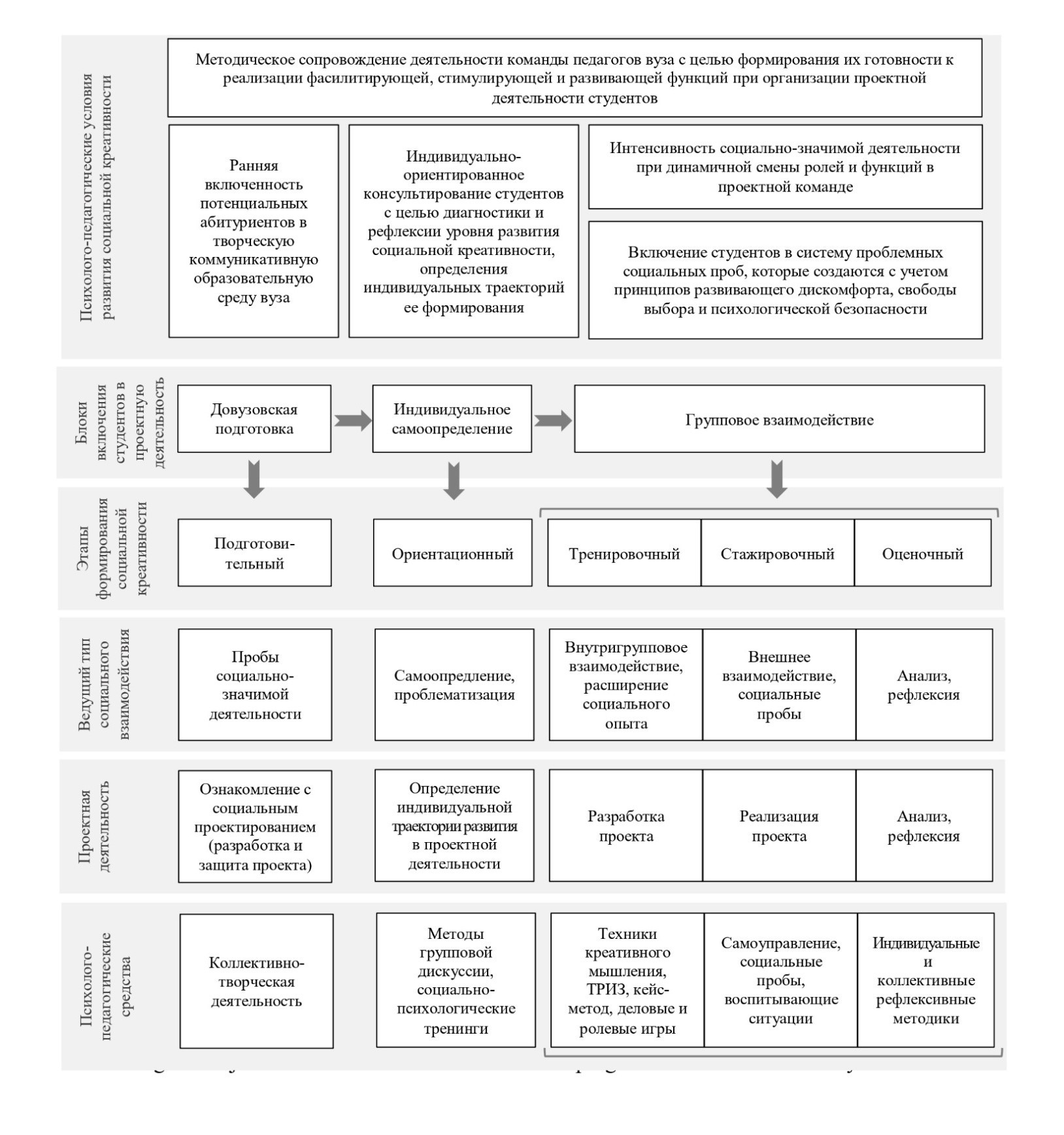
At the formative stage of the experimental work, in the educational environment of the Institute of Pedagogy and Psychology of Kostroma State University, a project program aimed at developing the social creativity of the experimental subgroups' participants was implemented. The logic of the experiment’s formation phase is shown in Figure 1.
The preparatory stage of the program was performed only for the first experimental subgroup and involved immersing schoolchildren—future students of the institute—in project activities through three intensive courses held in the university environment (practicing skills in identifying the project problem, planning solutions to overcome it, and public defense of the developed project idea). The orientation stage was organized at the beginning of the first year with the aim of finding strategies for developing social creativity within the framework of project activities and included incoming diagnostics of all three experimental subgroups followed by individual counseling of students. The training stage involved developing projects using specially selected psychological and pedagogical tools (creative thinking techniques, business and role-playing games, case studies, training exercises, etc.) for facilitating the solving of real-world social interaction problems. The internship stage corresponded to the direct implementation of the developed project and allowed participants to practice and consolidate the previously acquired competencies in the sphere of creative social interaction. The psychological and pedagogical tools at this stage included social challenges, educational situations, and team self-management. The assessment stage, with the use of follow-up assessment, individual and group analysis methods, and reflection, made it possible to evaluate the dynamics of each participant's social creativity development, preferred behavioral patterns, and the degree of engagement in collaborative activities and their performance.
In order to implement the program, weekly classes were held for students outside of school hours, lasting 3-4 hours, depending on the content of the work. Furthermore, the interaction intensity was maintained through regular communication in messenger chats, the project team students and following-up faculty members were the participants, and additional meetings were arranged to address topical issues related to the project's preparation and implementation.
During the experimental work, adjustments were made to the participants' individual social creativity development pathways by way of selecting specific exercises, rotating roles within the team, redistributing project assignments, and changing the level of the students' involvement in solving various project tasks. The in-process adjustment was possible due to social creativity monitoring, which included individual discussions with the following-up faculty member; reflective techniques (a letter to yourself, unfinished sentences, balance wheel, etc.); collective analysis of the process and the results of joint activities; mutual assessment; self-assessment and expert assessment scales reflecting the development level of separate components of social creativity and the nature of students’ interaction.
The projects implemented by the experimental groups were aimed at reorganizing extracurricular activities for university students, promoting voluntary work among the youth of the region, and establishing a creative residency to support the initiatives of the student youth.
At the control stage of the experimental work, a follow-up assessment was performed in both the experimental and control groups to check the effectiveness of the implemented program in engaging students in project activities aimed at developing their social creativity. While the initial Student's t-test revealed no significant differences between the two groups, the final stage showed significant differences in the studied indices between the groups (Table 2).
Table 2
Differences in the expression of the studied variables in students at the control stage of the experimental work
|
Parameters |
Groups |
Mean Value |
Standard error of the mean |
Value of the Student's T-test |
Cohen's d value |
|
Social creativity |
|||||
|
Motivational-value component |
CG |
2,89 |
0,11 |
1,4 |
0,24 |
|
EG |
3,13 |
0,14 |
|||
|
Cognitive component |
CG |
2,93 |
0,11 |
2,2* |
0,39 |
|
EG |
3,30 |
0,12 |
|||
|
Communicative component |
CG |
2,88 |
0,1 |
2,2* |
0,38 |
|
EG |
3,24 |
0,12 |
|||
|
Emotional component |
CG |
2,95 |
0,11 |
2,2* |
0,38 |
|
EG |
3,36 |
0,15 |
|||
|
Behavioral component |
CG |
2,79 |
0,1 |
3,2** |
0,54 |
|
EG |
3,31 |
0,13 |
|||
|
Reflexive component |
CG |
2,79 |
0,1 |
3,8*** |
0,65 |
|
EG |
3,38 |
0,12 |
|||
|
General level of social creativity |
CG |
2,89 |
0,06 |
4,9*** |
0,84 |
|
EG |
3.40 |
0.088 |
|||
|
Communicative creativity |
|||||
|
Level of communicative creativity |
CG |
14,97 |
0,53 |
2,1* |
0,36 |
|
EG |
16,75 |
0,68 |
|||
|
Emotional creativity |
|||||
|
Preparedness |
CG |
26,26 |
0,73 |
2* |
0,35 |
|
EG |
28,41 |
0,76 |
|||
|
Novelty |
CG |
39,78 |
1,48 |
2,7** |
0,46 |
|
EG |
46,02 |
1,78 |
|||
|
Effectiveness |
CG |
18,57 |
0,58 |
2,2* |
0,39 |
|
EG |
20,39 |
0,51 |
|||
|
Authenticity |
CG |
11,84 |
0,39 |
3,1** |
0,54 |
|
EG |
13,75 |
0,49 |
|||
|
General level |
CG |
96,44 |
2,78 |
2,9** |
0,5 |
|
EG |
108,57 |
3,04 |
|||
|
Communication difficulties |
|||||
|
Basic difficulties |
CG |
16,14 |
0,88 |
2,8** |
0,49 |
|
EG |
12,34 |
0,99 |
|||
|
Content difficulties |
CG |
17,69 |
1,01 |
3,5*** |
0,62 |
|
EG |
12,59 |
0,96 |
|||
|
Instrumental difficulties |
CG |
15,26 |
0,82 |
2,9** |
0,51 |
|
EG |
11,70 |
0,86 |
|||
|
Reflexive difficulties |
CG |
15,87 |
0,89 |
3,0** |
0,53 |
|
EG |
11,82 |
0.94 |
|||
Note:* – significance at p ≤ 0,05; ** – significance at p ≤ 0,01; *** – significance at p ≤ 0,001.
At the control stage of the experiment, no statistically significant changes were found in the overall value of social creativity in the control group (p ≥ 0,05). Analysis of separate criteria reveals statistical significance of the behavioral and communicative components (p ≤ 0,01), which is caused by the intensity of the institute's youth policy and educational activities.
The overall value of social creativity of the experimental group at the control stage demonstrates positive dynamics in its formation (p ≤ 0,01). The increase in the mean values for each social creativity criterion was found to be statistically significant, except for the cognitive one (p ≥ 0,05). This displays a common trend for all students participating in the study: a lower self-assessment of the cognitive component of social interaction at the second assessment, which is explained by the increased demands on the students' cognitive abilities in the educational environment of a higher educational establishment.
The greatest positive shift in students of the experimental group happened in the expressiveness of the overall level of social creativity, and also in its behavioral and reflexive components, which means that students started demonstrating unconventional, improvisational behavior patterns in interpersonal interaction situations, finding creative ways to overcome the emerging difficulties, utilizing variable social roles and functions; they have also learned to identify non-obvious cause-and-effect relations in social situations, to evaluate the impact of their own actions on outcomes comprehensively and creatively. This is also confirmed by the fact that the level of emotional and communicative creativity of students from the experimental group increased significantly; they started experiencing communication difficulties more seldom, while finding adequate solutions in interaction situations. However, no significant differences were found in the motivational-value component of social creativity, although the average value of the index has increased slightly in the experimental group (from 2,85 to 3,13), which means that the developed qualities may prove to be unstable and not consolidate in the system of individual values and motives.
Kruskal-Wallis H-test was used to identify differences in the level of social creativity development in the three experimental subgroups, which showed that the highest result was achieved in the first subgroup.
Table 3
The significance of the Kruskal-Wallis criterion for experimental subgroups at the control stage of the study
|
Experimental subgroups |
Number of people |
Middle rank |
Level of significance |
|
|
1 |
16 |
40,75 |
13,159 |
0,001 |
|
2 |
18 |
21,78 |
||
|
3 |
22 |
25,09 |
By way of pairwise comparison of the subgroups of the experimental sample group at the control experiment stage using the nonparametric Mann-Whitney test, the significant differences in the social creativity parameter between the subgroups 1 and 2 (U = 56; p = 0,002), 1 and 3 (U = 68; p = 0,001) were confirmed, but no differences were identified between subgroups 2 and 3, which indicates the homogeneity of the experimental results received for these groups. In the first group, the social creativity index clearly exceeds the values of the other subgroups, which we attribute to the fact that these students had experience of participating in project activities in the educational environment of a higher educational establishment before getting enrolled in it.
Results and discussion
The research performed and the statistical data obtained confirmed the main hypothesis that the engagement of students in rich communicative and creative project activities by means of a specially designed program contributes to the development of their social creativity.
The results obtained are consistent with earlier studies, which demonstrated that social creativity develops in accordance with the increase in abilities in the field of self-actualization, motivation, communication and social imagination (Popel’, 2005); that it is necessary to highlight and develop motivational, cognitive and pragmatist components in the structure of social creativity (Myagkova, 2013); the effective interaction, which includes objectivity, external expression of activity, subordination to situational conditions, understanding of the mutual expectations of the subjects and their impact on each other should become a criterion for the social creativity formation (Osipov, 2010). In addition to the enlisted components, the communicative, emotional, and reflexive components were identified and substantiated in our study, along with the respective criteria of their formation.
The results obtained also confirmed that project activities enable developing the qualities that lay the foundation for social creativity, such as the ability to interpret and design situations of interpersonal contact, predict the course of social interaction, maintain meaningful contact, assess the feelings and emotions of the interlocutor objectively, and ecologically defend one’s positions and views (Sorokumova, 2019); form value orientations and tolerance of personality (Barysheva, 2006); develop entrepreneurial competencies and intentions (Zhang et al., 2022); reduce the risk of asocial creativity emergence in a threatening social context (Meshkova, 2023). In fact, project activity in the educational environment of a higher educational establishment is a tool for mindful learning, which is understood as a person’s conscious involvement in the learning process, whereby students notice contextual specifics, apply critical thinking, and take a creative approach. At that, the search for new knowledge, one’s own conclusions, and ratiocinations must be perceived by the student as significant ones, and must be followed up with the support of a faculty member (Hassed, 2014). Project activities, in our opinion, are consistent with the basic principles of mindful learning – being open to all new things, attentiveness to differences, presence in the moment, sensitivity to context, conscious self-regulation and emotion management, conscious choice and action, awareness of the existence of more than one perspective, flexible thinking (Bordunos, Miletich, Volkova, 2024).
In addition to that, the specific feature of the suggested author’s model for developing social creativity in students is that the focus is put into social projects built on the ideas of goodness, mutual help, and care for another Person, rather than into educational and professionally oriented projects. Such care is focused on supporting and helping another Person and arises from recognition of his value, respect for his personality, compassion in a difficult situation; and also in the manifestation of optimism in life, strong moral principles, and faith in the best (Ryaguzova, 2024).
In the process of experimental work, the effectiveness of psychological and pedagogical conditions for the development of social creativity in students was proven. Thus, assessment and individually oriented counseling of the participants based on a systematic analysis of the process and the result of the activity, regular evaluation of the dynamics of the social creativity level and its separate indices, contributed to motivation for development and self-realization along individual pathways. In our work, we ensured the inclusion of students in the system of problematic social challenges by taking into account the principles of development, stimulating discomfort, freedom of choice, and psychological safety. In the context of the resource approach, these two conditions form a conscious self-regulation, which is a reflexive psychological tool including a system of regulatory competencies of the operational and cognitive (planning, modeling, programming, evaluation of results), regulatory and personal (flexibility, independence, responsibility, and reliability) levels (Morosanova, Filippova, Fomina, 2023). The intensity of socially significant activities was ensured by means of dynamically changing the roles and functions of the project team students. Each time a student is plunged into a situation of uncertainty, having to undertake new roles and choose a method for interaction. In such situations, integrity and identity are developed as integral characteristics of a personality; while overcoming the complexity and uncertainty of a specific situation, students work on “identifying themselves,” “putting together” and “acquiring” themselves (Grishina, 2024).
The early engagement of potential applicants in the creative communicative educational environment of a university, in the “social-creative environment of a higher educational establishment” (Kaminskaya, Ertman, 2024) made it possible to ensure “adaptive readiness” of the students for project activities, which are regarded as a systemic personal education, characterized with the experience of entering educational environment at psychophysiological, psychological, socio-psychological levels, whereby the mechanisms that ensure its successful acquisition in new situations of higher educational establishment learning are launched (Shamionov, Sharov, 2025).
And, finally, the methodological support for the activities of higher educational establishment faculty members has become a necessary condition for mastering the roles of a facilitator and moderator in relation to a student project group. Faculty members must be ready to act for students as Mentors, who will become a catalyst for the process of professional and personal self-determination, who will mediate the orientation of a maturing participant in terms of building a professional career and developing certain values and worldview position (Krasilo, Repeshchuk, 2025).
Conclusion
- The demand for developing adaptability and flexibility, forming positive life strategies, and developing social and communicative abilities among young students can be satisfied by means of targeted development of such integrative personality traits as social creativity, which includes a person’s emotional and communicative creativity, reflects the originality, activity, constructiveness, and social standardness of interpersonal interaction, enabling to overcome the emerging difficulties in communication and interpersonal relations in an effective manner.
- The formation of each social creativity component can be ensured by project activities that possess an entire range of potentials: problematization and creative search for optimal, extraordinary solutions for social problems; multiplicativeness of strategies for achieving a goal; dynamism of communication under the conditions of simultaneous competition and cooperation; emotiogenicity of intensive, diverse joint activities; uncertainty of the actions of various participants and the variability of behavioral scenarios; comprehensive consideration of cause-and-effect relations, and critical analysis of the process and the results of work. Within the framework of project activities, such students' social creativity development mechanisms are actualized as a focus on high social effectiveness, attribution of new social interaction scenarios, identification with creative partners, internalization of social values, empathy, and reflection.
- The psychological and pedagogical conditions which determine the effectiveness of the students' social creativity development through their engagement in project activities include systematic diagnostics and individually focused counseling aimed at developing self-understanding and reflection, identification of individual social creativity development pathways; engaging students in a system of problematic social challenges with gradually increasing complexity of content, that are created while taking into account the principles of development stimulating discomfort, freedom of choice, and psychological safety; ensuring the intensity of socially significant activities under the dynamically shifting roles and functions within the project team; ensuring the early engagement of potential applicants in the creative communicative educational environment of a higher educational establishment; methodological follow-up over the team’s activity by faculty members in order to develop their readiness to perform facilitating, stimulating, and developing functions in arranging the students’ project activities.
- The implementation of a specially developed project-based activity program promotes the targeted, stage-by-stage development of social creativity in the student. The selection of psychological and pedagogical tools to be used in the program must be based on a subject-oriented approach. Such tools as collaborative creative work, group discussions, social and psychological training, creative thinking techniques, inventive problem-solving methods, case studies, business and role-playing games, self-management, social challenges, educational situations, individual and group reflection techniques have proven to be effective.
The perspective of the study includes identifying the resources for social creativity development at different stages of a student's life, as well as developing mechanisms for providing a socially creative environment at a higher educational establishment.
Limitations. Limitations of the study include the small sample size, non-randomization of comparison groups by gender and size, and the dominance of a nomothetic approach to data collection.