Introduction
In recent years, the research on school engagement has increasingly focused on studying its effects on maintaining academic success, developing the skills and social capital necessary for adolescents to successfully transition to adulthood [Wang M.-T, 2018]. Leading researchers in the area suggest to define school engagement as sustainable and active participation of students in educational activities and school life in general, including cognitive, behavioral, emotional, and social components [Fredricks, 2019; Wang M.-T, 2019]. School engagement is a relatively new construct in both foreign and domestic psychology [Fomina, 2020a]. There are closely related constructs actively studied in Russian psychology, in particular, motivation for learning, attitude towards learning, and the internal position of a student [Andreeva; Bozhovich, 2008; Lubovsky]. However, these concepts relate rather to the motivational-emotional sphere, whereas the school engagement also includes behavioral and regulatory (cognitive) components. Their development allows the student to accept school norms and rules, develop learning strategies, demonstrate flexibility in solving learning problems, and make efforts aimed at mastering knowledge and skills [Fomina, 2020a]. Recent works on this topic focus mainly on its relationships with psychological variables that are important for ensuring academic success [Israel, 2023; Li, 2022; Morosanova, 2022a]. Research shows that a high level of school engagement is associated with developed conscious self-regulation and high academic performance [Fomina, 2022; Morosanova, 2022a]. It has been shown that the development of conscious self-regulation in the middle school (8th grade) prevents a decrease in cognitive engagement and cognitive activity in the high school [Bondarenko, 2022].
A current trend in research is the study of individual-typological manifestations of school engagement [Fredricks, 2019]. In contrast to the classical understanding of the individual-typological approach, which emphasizes individual differences in the temperament and the nervous system, in modern psychological works in the field of developmental psychology and educational psychology, its implementation usually involves investigating into differential psychological characteristics of students. Differences between typological groups are revealed on the basis of identifying the “profiles” considered as naturally occurring combinations of related psychological phenomena at the individual level [Magnusson, 2006]. The use of the individual-typological (or differential) approach allows to most accurately reflect the manifestations of multidimensional psychological phenomena [Potanina, 2023]. Studies of individual manifestations of school engagement convincingly demonstrate that students with a profile distinguished by high cognitive and behavioral engagement are characterized by the highest academic performance [Pöysä, 2020] as well as high self-regulation [Dai, 2022; Estévez, 2021].
Despite the increased interest in the study of individual-typological features of school engagement, there is a small number of works aimed at investigating the dynamics of engagement profiles (e.g., [Widlund, 2021]). In this regard, it seems necessary to study both the variability of engagement profiles and the resources for its maintenance throughout schooling. In line with the differential and resource approaches [Morosanova, 2021; Morosanova, 2022], a large amount of data has already been accumulated indicating the role of conscious self-regulation as a meta-resource not only in ensuring educational results, but also in maintaining and developing school engagement (e.g., [Morosanova, 2021; Morosanova, 2022a]). Nevertheless, no attempt has previously been made to comprehensively study the individual-typological trajectories of school engagement and their dynamics as well as the resource role of conscious self-regulation in ensuring them.
The study presented in this article aimed to reveal the individual-typological trajectories of school engagement and the prognostic role of conscious self-regulation in their determination in adolescents educated in grades 6–8. Research questions: 1) What are the individual-typological trajectories of school engagement in the students of 6-8th grades? 2) What are the dynamics of the individual-typological trajectories of school engagement in the students of 6-8th grades? 3) What are the regulatory and personality characteristics of students with “variable” individual-typological trajectories of school engagement? 4) What are the prognostic effects of self-regulation in determining individual-typological trajectories of school involvement in students in grades 6–8?
Sample and methods
The sample of the longitudinal study consisted of students of the 6th grade from schools in cities of Moscow and Kaluga (105 individuals, average age – 12 y.o., 48% were girls), of the 7th grade (83 individuals, average age – 13 y.o., 48.2% girls), and 8th grade (80 individuals, average age – 14.26 y.o., 48.8% girls).
The following methods were used in the study:
- Wang et al.'s “Multidimensional School Engagement Scale” [Wang M.-T, 2019] adapted by Fomina, Morosanova [Fomina, 2020]. Scales: behavioral, cognitive, emotional, social engagement, integrative indicator – general level of school engagement.
- Morosanova’s “Self-Regulation Profile of Learning Activity Questionnaire” (SRPLAQ-52). Scales: planning, modeling, programming, results evaluation, flexibility, reliability, independence, responsibility, integrative indicator – general level of conscious self-regulation of learning activity.
- "Big Five – Children’s Version" adapted by Malykh et al. [Malykh, 2015]. Scales: extraversion, agreeableness, neuroticism, conscientiousness, openness to experience.
- "Scale of Academic Motivation of Schoolchildren" by Gordeeva et al. [Gordeeva, 2017]. Scales: cognitive motivation, achievement motivation, self-development motivation, self-respect motivation, motivation for parents’ respect, introjected motivation, external motivation, amotivation.
- Andreeva, Prikhozhan’s questionnaire "Attitude to Learning in Middle and Senior School" [Andreeva, 2006] modified by Bondarenko et al. [Bondarenko, 2018]. Scales: cognitive activity, achievement motivation, anxiety, anger, motivation to avoid failure.
Statistical analysis was performed by specifying and analyzing latent profile and transition models using the AIC, BIC, and BLRT information criteria, logistic regression analysis using the AIC and BIC information criteria as well as Nagelkerke and Tjur's R2, and comparing mean values using the Wilcoxon test. The JASP program (ver. 0.18.3.0) and the R statistical environment were used for the analysis: the tidy LPA package for specifying and analyzing latent profile models, the lmest package for specifying and analyzing latent transition models.
Data Analysis Procedure
The data analysis was carried out in the logic of our previous studies of the individual trajectories of students' psychological characteristics using the Latent Profile Analysis (LPA) method (e.g., [Morin, 2016]). LPA is a powerful technique that allows for identifying the types or groups of individuals with different structures and parameters of psychological characteristics profiles based on the data on their "latent" aspects [Spurk, 2020]. In this study, engagement profiles were identified at each of the three longitudinal points: in the 6th, 7th, and 8th grades. Two types of models with two, three, and four profiles were compared: with fixed/free variances and zero/non-zero covariances of profile components (behavioral, cognitive, emotional, and social engagement).
Latent transition analysis (LTA) is an extension of latent profile analysis (LPA) used to model the changes between them over time by calculating transition probabilities [Nylund-Gibson, 2023]. In this study, LTA was carried out in the logic proposed by K. Nylund-Gibson [Nylund-Gibson, 2023]: in the first stage, latent profiles were analyzed and then, in the second stage, the results of this analysis were used to study the transition probabilities between the identified profiles.
Results
1. Latent Profile Analysis (LPA)
In the first stage of the study, we conducted a latent profile analysis for each longitudinal point. The model was selected based on the AIC (Akaike Information Criterion) and BIC (Bayesian Information Criterion) as well as the bootstrap likelihood ratio test (BLRT), in which a low probability value (p<0.05) indicates the likelihood of improving the model by identifying a larger number of profiles. According to the obtained results, the following models turned out to be the best in terms of information criteria: 4 profiles with fixed variances and zero covariances between components in the 6th grade (AIC=809.9, BIC=864.7, BLRT_p=0.01) and 2 profiles with free variances and non-zero covariances in the 7th grade (AIC=747.2, BIC=816.3, BLRT_p=0.03) and in the 8th grade (AIC=741.6, BIC=810.7, BLRT_p=0.01). Nevertheless, since for the analysis of prognostic effects and transition probabilities between profiles we need them to be structurally and configurally similar, we tried to select the same number of profiles at each point of the longitude. Thus, the model with two profiles was chosen as the best one as it was significant at all three points of the longitudinal study and had acceptable fit indices in the 6th grade (AIC=834.2, BIC=865.2, BLRT_p=0.01), 7th grade (AIC=840.6, BIC=871.5, BLRT_p=0.01), and 8th grade (AIC=813.9, BIC=844.8, BLRT_p=0.01). Notably, the identification of a large number of typological groups, including, in particular, the group characterized by the average values of engagement, led to a decrease in the classification quality and in the significance of the models. Figure 1 shows the profiles identified in the 6th, 7th, and 8th grades.
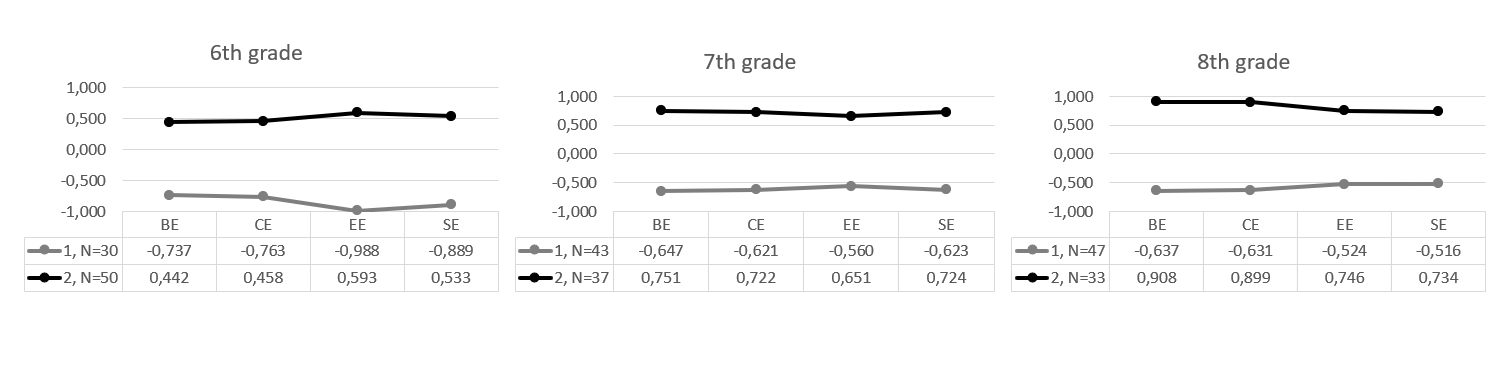
Fig. 1. Profiles of school engagement in grades 6, 7, and 8: BE – behavioral engagement, CE – cognitive engagement, EE – emotional engagement, SE – social engagement
Thus, the analysis results revealed two groups of students with profiles that are stably reproduced at all three points of the longitudinal study: with low and high values of all engagement components. The identified groups are characterized by a similar quantitative composition as well as similar mean values of engagement components that underlie them. It should be noted that the ratio of students with “high” and “low” profiles of engagement changes when they transition from the 6th to the 7th and 8th grade. Thus, in the 6th grade 62% of the total sample are the students with a high level of engagement and 34% - with its low level, whereas in the 7th grade - 47% with a high level and 53% with a low level, and in the 8th grade - 42% with a high level and 58% with a low level of engagement. Note that in this case we are not talking about the dynamics of engagement trajectories, but only about the quantitative ratio of groups with “high” and “low” engagement in each of the grades. The dynamics of engagement trajectories, their stability and variability will be discussed in the corresponding section below.
Next, we conducted logistic regression analysis to identify the predictive effect of personal and regulatory resources on engagement at the later points in the longitudinal study. The group (profile) membership was a dependent variable (DV), and the independent variables (IV) were the general level of conscious self-regulation, integrative indicator of attitude toward learning, indicators of cognitive motivation, extroversion, neuroticism, and openness to new experience. The results of the analysis are presented in the table below.
Table. Logistic regression models of predictive effects of profile membership in grades 7 and 8
|
Model 1. DV – profile membership in grade 7, IV – regulatory and personality indicators in grade 6 χ2=83,67, df=76, AIC=87,67, BIC=92,39, Nagelkerke R²=0,357, Tjur R²=0,279, p=0,001 |
||
|
Predictor |
Β |
Odds ratio |
|
Openness to new experience |
0,15** |
1,165 |
|
Model 2. DV – profile membership in grade 8, IV – regulatory and personality indicators in grade 7 χ2=57,87, df=73, AIC=63,87, BIC=70,87, Nagelkerke R²=0,611, Tjur R²=0,519, p=0,001 |
||
|
General level of conscious self-regulation |
0,16** |
1,174 |
|
Extraversion |
0,14** |
1,154 |
Note: ** – p<0.01. Low profile membership is coded as 0, high profile membership – 1, for all regression models.
According to the results (see table), high openness to new experience in the 6th grade serves as a resource for forming a profile with a high engagement in 7th-graders, while for the 8th-graders such resources are developed conscious self-regulation and high extroversion in the 7th grade.
2. Latent transition analysis (LTA)
To identify the dynamics of individual-typological trajectories of school engagement during transition from grades 6 to 8, we performed latent transition analysis (LTA). For this purpose, the transition probabilities between groups with “high” and “low” engagement profiles were calculated. Figure 2 shows a model describing the averaged transition probabilities between a profile with high engagement and a profile with low engagement at all three points.
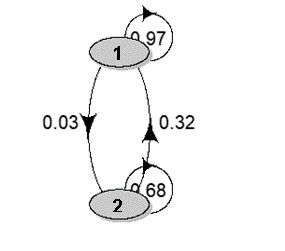
Fig. 2. Average probabilities of transitions between a profile with high engagement and a profile with low engagement: 1 – profile with low engagement, 2 – profile with high engagement, 2->1 – average probability of transition from a group with a high engagement profile to a group with a low engagement profile, 1->2 – average probability of transition from a group with a low engagement profile to a group with a high engagement profile, circular arrows – average probability of keeping the engagement profile unchanged
According to the obtained results, the identified individual-typological trajectories of school engagement are, in general, quite stable: students with both low and high engagement are more likely to maintain their engagement level and the corresponding profile. At the same time, while probability of increasing engagement is extremely low (close to zero), the probability of decreasing it is quite high. In this regard, we analyzed in more detail the ratio of stable and variable groups. According to the obtained data, 60% of the entire sample of students (N=48) are characterized by stable trajectories of engagement. Among students with variable trajectories (40% of the sample, N=32), the most common groups are those characterized by a decrease in engagement upon transition to senior grades (75% of students from the sample with variable trajectories, N=24), which correlates with the results of the latent transitions analysis. Notably, 18.75% of students with variable trajectories (N=6) are characterized by an increase in engagement. Among the students with variable trajectories one can very rarely (N=2, 6.25%) find the students with a decrease in high engagement in the 7th grade and its increase in the 8th grade (N=1) or with an increase in low engagement in the 7th grade and its decrease in the 8th grade (N=1). The most common variable group (N=16, 50% of students from the sample with changeable trajectories) is characterized by the following dynamics of engagement: high engagement in the 6th grade, low engagement in the 7th and just as low engagement in the 8th grade.
We then analyzed this group to identify the indicators responsible for this change using the Wilcoxon test. According to the data obtained, a decrease in engagement is observed in this group during transition from the 6th to the 7th grade, mainly due to a decrease in its cognitive component (W=-3.26, p<0.001). The general level of self-regulation in this group changes insignificantly, probably due to an increase in the modeling indicator (W=2.11, p<0.01), although the regulatory-personal properties of reliability (W=-2.64, p<0.01) and responsibility (W=-2.58, p<0.01) significantly decrease. The cognitive activity significantly decreases (W=-2.53, p<0.05). The group average indicator of conscientiousness significantly decreases as well (W=-2.28, p<0.05), which is probably associated with a decrease in cognitive engagement.
Discussion
The results revealed two groups of students with different profiles of school engagement: with low and high expression of all its components. The identified typological groups are stably reproduced at all three points of the longitudinal study and are characterized by a similar quantitative composition and mean values of engagement components, but a variable frequency ratio. The results obtained are consistent with the data of previously conducted studies [Potanina, 2023a; Dai, 2022].
For the first time, the study analyzed the dynamics of individual-typological trajectories of school engagement of students during transition from grades 6 to 8. It was found that most students (60% of students) are highly likely to maintain the level and corresponding profile of engagement. However, the variable trajectories were also found, and the most common group among them (50% of students) was characterized by a profile with high engagement in grade 6 and its decrease in grades 7 and 8. The obtained result is consistent with the data on the decrease in school engagement among adolescents, especially in grades 7 and 8 [Fomina, 2021].
The study presented an analysis of the regulatory-personal characteristics of a group of students with the most common "variable" trajectory of school engagement. It was found that a decrease in engagement during the transition from the 6th to the 7th grade in this group is associated with a decrease in cognitive engagement, which apparently occurs due to a decrease in the regulatory-personal features of responsibility and reliability as well as the personality trait of conscientiousness. A significant decrease in cognitive activity is also found, which correlates with the results of research on the dynamics of school engagement in a sample of secondary school students [Bondarenko, 2022]. Thus, the data obtained in the study confirm the well-known patterns of age-related development of adolescents aged 12-15 which are described in the context of the cultural-historical approach, namely: changes in the motivational sphere, reorientation of adolescents to personal self-determination, a change in the leading activity from learning to intimate and interpersonal communication [Bozhovich, 2008; Goutkina, 2018].
For the first time, it has been shown that development of conscious self-regulation in the 7th grade is a significant resource for the formation of a profile with high engagement in the 8th grade, which correlates with the data on the resource role of conscious self-regulation in maintaining high school engagement in the 8th grade and confirms its predictive role in maintaining engagement at the later stages of education [Potanina, 2023a]. In addition, the study revealed the resource role of extraversion in the formation of such a profile during the transition to the 8th grade, which also correlates with research data [Israel, 2023]. It was found that a “high” profile of engagement in the 7th grade is observed in the students with high indicators of openness to experience in the 6th grade. As research demonstrates, openness to experience is associated, first of all, with the emotional and social components of engagement [Ishmuratova, 2021]. It can be assumed that the formation of a “high” profile of school engagement at this age is associated primarily with the development of these aspects. However, this assumption requires further empirical verification.
Conclusion
- The study has revealed the groups of students characterized by two individual-typological profiles of school engagement: with low and high values of all its components. The identified groups are stably reproduced at all three points of the longitudinal study, but their frequency ratio changes during the transition from the 6th to the 7th and then to the 8th grade.
- It is shown that 60% of students are characterized by a stable trajectory of school engagement. Half of the students with variable trajectories demonstrate high engagement in the 6th grade, and then its decrease in the 7th and 8th grades. This group is characterized by lower indicators of the regulatory-personal features of responsibility and reliability, the personality trait of conscientiousness, and cognitive activity during the transition from the 6th to the 7th grade.
- It has been demonstrated that development of conscious self-regulation is associated with the formation of a harmonious profile of school engagement with high values of all its components in the students during their transition from the 7th to the 8th grade. During the transition from the 6th to the 7th grade, the formation of such a profile is ensured by openness to experience.
The obtained results are of high practical importance, since they make it possible to predict the dynamics of school engagement at the individual-typological level, as well as to develop the programs to support it at the “critical” moment of its greatest decline – in the middle school.
A limitation of this study is the small sample size, which does not allow for identifying a larger number of informative typological groups that are distinguished by greater variability in both the general level of school engagement and its components. In this regard, the prospects for further research into the dynamics of individual-typological trajectories of school engagement are associated with a thorough empirical verification of the identified patterns on the larger longitudinal samples. A promising direction also seems to be the study of individual-typological trajectories and psychological resources of school engagement at senior levels of school education.