Introduction
The modern world is characterized by rapid digitalization across various spheres of life and the growing significance of online spaces in everyday activities, giving rise to a new anthropological type – a human augmented by digital devices, various applications and programs, along with their usage patterns – what scholars term the "technologically extended self" (Soldatova & Voiskounsky, 2021). The concept of using cultural tools and merging with them traces back to L.S. Vygotsky's works. Variants of externalist methodology, which examines humans through the lens of their external augmentations and extensions, have been reflected in various theoretical frameworks (Soldatova & Voiskounsky, 2021). This highlights the importance of understanding psychological processes within the context of our rapidly changing world where digital technologies play a pivotal role.
Modern individuals who actively employ technologies to expand their capabilities are mastering new activity formats that may facilitate the development of constructive adaptation strategies in digitally saturated environments requiring simultaneous engagement in both physical and virtual spaces.
One response to these new challenges for technologically extended individuals has been the growing popularity of multitasking – simultaneously combining or switching between multiple tasks (Soldatova et al., 2020; Ophir, Nass, & Wagner, 2009) – as a potential strategy for success in contemporary conditions. The ability to multitask is increasingly listed as a job requirement across various professions and is being recognized as a crucial meta-competency (Varlamova & Sudakov, 2021) that determines success regardless of specialization and requires cultivation within educational systems (Zeer et al., 2019). In the context of education digitalization, multitasking has become not only a competency to be developed in students but also a requirement for effective educators (Petrash & Sidorova, 2021).
However, the scientific community remains divided regarding the benefits or harms of multitasking and its specific form – media multitasking (MMT) – for child and adolescent development, as well as its actual effectiveness (Soldatova et al., 2020; May & Elder, 2018; Popławska, Szumowska, & Kuś, 2021). Within Russian pedagogical circles, doubts have been raised about the value of developing MMT skills in both students and teachers amid education digitalization (Polikarpova, 2020; Sidorova, 2021). The contradictory discourse surrounding MMT in modern educational environments raises questions about how significant adults involved in child and adolescent socialization perceive this phenomenon. The attitudes toward MMT conveyed by adults may either promote or restrict this practice among younger generations.
The aim of our study is to examine how parents and teachers with varying levels of digital competence and user activity perceive media multitasking and its effectiveness among school students. As shown in other research, digital competence can be viewed as a criterion for successful management of technological augmentations by extended selves, while user activity serves as a quantitative indicator of engagement with these augmentations (Soldatova, Chigarkova, & Ilyukhina, 2024).
The study tests the following hypotheses:
-
Teachers and parents generally hold more positive attitudes toward MMT and its effectiveness in daily life compared to educational settings.
-
Higher levels of digital competence and user activity among parents and teachers correlate with more positive evaluations of MMT in daily life and its perceived importance for future success.
-
Parents and teachers who rate their own MMT abilities highly will demonstrate more favorable attitudes toward its use in daily life and will be more inclined to develop this ability in children.
Materials and Methods
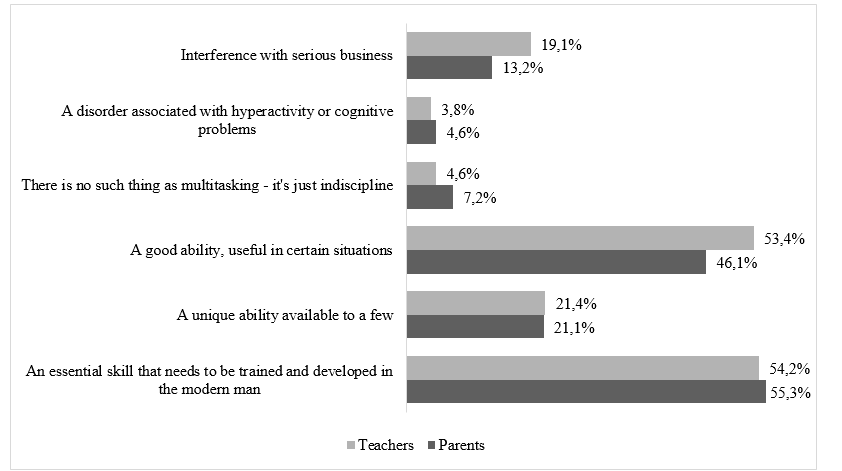
In accordance with the research objectives and hypotheses, a diverse methodological toolkit was employed. To assess attitudes toward MMT in general, teachers and parents were asked to select no more than two response options out of six, such as: "A unique ability available to few" or "An obstacle to serious matters." Three responses corresponded to positive attitudes, three to negative attitudes (see Fig. 1). Comparative analysis examined two groups based on predominantly selected responses - a group with positive attitudes toward MMT and a group with negative attitudes toward MMT.
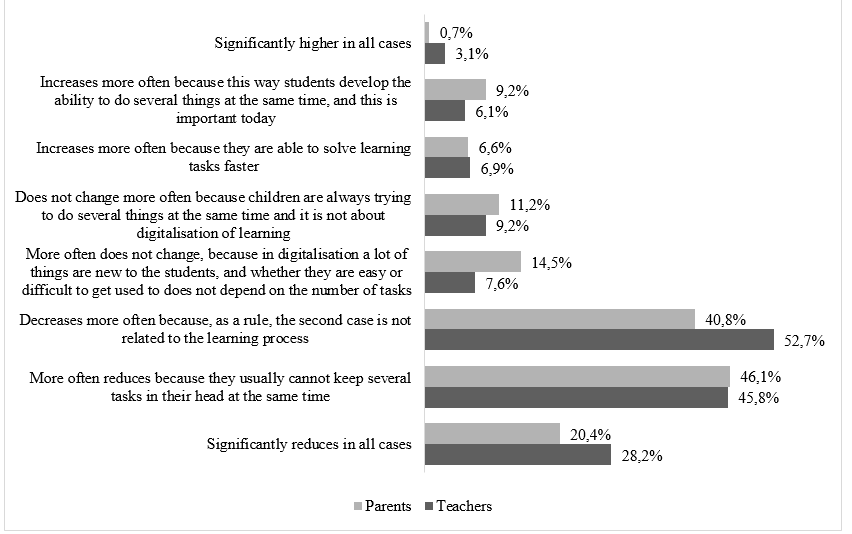
To evaluate perceptions of MMT effectiveness in the educational process, teachers and parents selected no more than three responses out of eight, for example: "Substantially decreases in all cases" or "Mostly remains unchanged because students always try to do multiple things simultaneously, and it's not related to educational digitalization" (all response options - see Fig. 2). For comparing opinions of parents and teachers, they were divided into four groups: positive assessment of effectiveness (improves), neutral (effectiveness remains unchanged), negative (decreases), and contradictory (equal number of responses about decreasing and increasing effectiveness).
To assess perceptions of the importance and demand for MMT skills for future success, respondents were asked to choose one of six response options: "Yes, it will be one of the key skills," "Yes, but far from the most important," "Yes, in some professions," "No, one can easily do without it," "No, multitasking is only needed when people fail to plan their time properly," or "No, because the world will quickly realize that doing multiple things simultaneously leads to poor performance in all tasks." When comparing groups, the first three responses were classified as positive assessments of MMT importance, while the last three were considered negative.
Teachers and parents were asked to rate their own MMT on a 5-point scale (from 1 - "rather single-tasking" to 5 - "rather multitasking") and their desire to enhance this ability (from 1 - "don't want to change anything" to 5 - "want to become much more multitasking"). Parents were also asked to evaluate their children using these same parameters.
Digital competence level was assessed using the "Digital Competence Index (Soldatova, Rasskazova, 2018). User activity assessment included questions about time spent online on weekdays and weekends, with 12 response options ranging from "little or almost none," "about half an hour" to "about 12 hours or more" in 1-hour increments.
The study sample consisted of 283 respondents: 131 teachers (46,3%) and 152 parents (53,7%), of whom 87,3% were female. 226 participants (79,9%) were from Moscow and the Moscow region, while 57 (20,1%) came from other regions. The average age was 41,8 (SD = 8,7) years. The average teaching experience among educators was 19,6 (SD = 10,6) years.
Data collection took place from autumn 2020 to winter 2021. Statistical analysis was performed using IBM SPSS Statistics v. 23.0. The analysis employed Pearson's χ² test, Kruskal-Wallis test, ANOVA, and Spearman's rank correlation test. When no differences were found between teacher and parent groups, analysis was conducted on the entire sample. The database is available in the repository (Soldatova, Chigarkova, Koshevaya, 2024).
Results
The statistical analysis yielded data showing the distribution of parents' and teachers' assessments regarding their own media multitasking (MMT), children's MMT, attitudes toward MMT, and its perceived effectiveness for children in the learning process. The analysis also revealed differences in these assessments among parents and teachers with varying levels of user activity, digital competence, and perceptions of their own MMT. Let us examine these findings in detail.
Perceptions of Personal and Children's MMT
More than half of teachers and parents (58%) rated themselves as multitaskers (4-5 points on the assessment scale), 29,7% reported incorporating some elements of MMT in their activities (3 points), while only 12,4% considered themselves predominantly single-tasking (1-2 points). Nearly half of parents (46,7%) viewed their child as primarily single-tasking, with only one in five parents (22,4%) perceiving their child as a multitasker. Two-thirds of respondents (69,3%) expressed a desire to enhance their MMT capability (scores 3-5 on the assessment scale), and a majority of parents (77,6%) wished the same for their children.
Attitudes Toward MMT
Parents and teachers demonstrated consensus in their positive attitudes toward MMT. Approximately half of respondents believed MMT to be either: (1) a necessary skill that modern individuals should cultivate, or (2) a valuable ability useful in specific situations (Fig. 1). One-fifth of parents and teachers considered it a unique capability possessed by few. Among negative assessments, the most prevalent view characterized MMT as an impediment to serious work, held by one in five teachers and one in seven parents. Perceptions of MMT as detrimental to cognitive development or indicative of poor discipline were uncommon. When respondents were categorized into three groups based on response patterns, 78,8% exhibited positive attitudes toward MMT, 12,4% held negative views, and 8,6% expressed ambivalent opinions (selecting both positive and negative items).
Attitudes toward the effectiveness of children's MMT in learning
The majority of parents and teachers believe that learning effectiveness tends to decrease in MMT mode, most often because the other activity is unrelated to studies or due to children's inability to keep multiple tasks in mind simultaneously (Fig. 2). Differences between parents' and teachers' opinions were analyzed by dividing them into four groups according to multiple response options: positive assessment of effectiveness (improves), neutral (effectiveness remains unchanged), negative (decreases), and contradictory (equal number of responses about decreasing and increasing effectiveness). The results showed that 10.2% of teachers and 12.5% of parents believe that a child's effectiveness improves when using MMT mode in learning; 85% of teachers and 74,3% of parents believe it decreases; 3,1% of teachers and 11.8% of parents believe the child's effectiveness remains unchanged; 1,6% of teachers and 1,3% of parents have contradictory opinions (χ2 = 7,971, df = 3; p = 0,047). Parents are slightly more optimistic in their assessment of MMT, believing it does not affect effectiveness in the learning process, while teachers more often think that MMT interferes with it (Fig. 2).
Thus, most educators and parents demonstrate a positive attitude toward MMT in daily life while maintaining a negative assessment of its effectiveness for school students in the learning process, which confirms the first hypothesis.
Digital Competence and Attitudes Toward MMT
A one-way ANOVA revealed marginally significant differences in digital competence (DC) levels depending on attitudes toward MMT (F = 2,721, df = 1, p = 0,069). Respondents with more favorable attitudes toward MMT demonstrated higher DC levels.
The sample was divided into three groups based on DC levels (maximum score = 100 points): оne-fifth (21.6%) showed low DC (20,9±5,86); two-thirds (64%) demonstrated moderate DC (46,7, SD = 9,27); one-seventh (14,5%) exhibited high DC (67,62, SD = 6,59). Marginally significant differences emerged between DC groups in self-assessed MMT (F = 2,956, df = 2, p = 0,054). Post hoc Scheffé tests indicated that high-DC respondents rated their MMT higher than low-DC respondents (p < 0.09).
Significant between-group differences were found in desire to enhance MMT skills (F = 5,675, df = 2, p = 0,004). Post hoc Scheffé tests revealed that high-DC respondents expressed stronger desire to improve MMT abilities than both low-DC (p < 0,01) and moderate-DC (p = 0,01) groups.
Respondents who believed MMT skills should be developed had higher DC indices, while those opposing skill development showed lower DC (F = 8,504, df = 1, p = 0,04).
User Activity and Attitudes Toward MMT
To compare MMT attitudes among adults with different user activity (UA) levels, four groups were established based on weekday and weekend internet usage time (Table).
Table. Teacher and parent user activity groups on weekdays and weekends
|
Days |
Groups |
User activity |
|||
|
Low (up to 1 hour) |
Medium (2-4 hours) |
High (5-7 hours) |
Hyperconnectivity (more than 8 hours) |
||
|
Weekdays |
Teachers |
4,6% |
7,6% |
24,4% |
63,4% |
|
Parents |
19,1% |
19,1% |
37,5% |
24,3% |
|
|
Weekends |
Teachers |
15,3% |
18,3% |
35,9% |
30,5% |
|
Parents |
40,8% |
22,4% |
28,9% |
7,9% |
|
Pearson's chi-square analysis revealed no significant differences in attitudes toward MMT among teachers based on their UA levels. However, significant differences in MMT attitudes were found among parents depending on UA levels (χ² = 13,116, df = 5, p < 0,05). Parents with high UA demonstrated the most positive attitudes toward MMT, while those with low UA showed the least favorable views.
The Kruskal-Wallis test identified significant differences between UA groups in self-assessed MMT based on weekend usage (χ² = 10,936, df = 3, p = 0,012). Higher UA levels among both teachers and parents correlated with higher self-ratings of MMT capability.
Significant differences in perceived importance of MMT for future success were found among weekday UA groups (Kruskal-Wallis χ² = 13,687, df = 6, p = 0,033). Respondents with moderate (94,9%), high (87,6%), and hyperconnected (80,8%) UA considered MMT skill development most important, while those with low UA (68,6%) valued it least.
These findings regarding MMT attitudes and their perceived importance for future success among respondents with varying UA and DC levels confirm the second hypothesis.
Assessment of subjective MMT and related attitudes
Parents and teachers who rated themselves as more multitask-oriented showed more negative attitudes toward MMT (r = -0,238, p < 0,001). Parents with higher self-ratings of MMT desired to enhance this ability in their children (r = 0,363, p < 0,01). Thus, the third hypothesis was partially confirmed: while parents and teachers with high self-assessed MMT were more negative about its everyday use, parents who considered themselves more multitask-capable wanted to develop this skill in their children.
Results discussion
The findings reveal several key characteristics in the "average" profile of parents and educators as active online users with moderate digital competence who frequently engage in multitasking to varying degrees. Overall, both parents and teachers tend to view MMT (media multitasking) positively - as either a necessary skill for modern life, a useful ability under certain conditions, or a unique talent possessed by few. While most parents express a desire to develop this ability in themselves, an even greater proportion wish to enhance it in their children. Interestingly, although many parents consider themselves media multitaskers, only one in five perceives this capability in their children. This contrasts with research showing high prevalence of MMT among children and adolescents, particularly when using digital technologies (Soldatova et al., 2020; Soldatova et al., 2022; Baumgartner et al., 2017; Ettinger & Cohen, 2020).
While adults generally evaluate MMT positively when considered abstractly, most parents and teachers agree that MMT tends to reduce student effectiveness in educational contexts. This aligns with findings from MMT research in education (Zhou & Deng, 2022) and confirms our first hypothesis, while simultaneously highlighting the contradictory perceptions of MMT. On one hand, MMT is seen as a clear advantage for success in our complex, nonlinear world; on the other, the school as a socialization institution preparing students for professional life is viewed by key socialization agents as having no place for developing this ability. Consequently, children who frequently prefer task-switching or parallel task execution - including during learning activities (Soldatova et al., 2020; 2022; Soldatova & Koshevaya, 2023) - receive limited conscious, instrumental support from adults in mastering and appropriately applying this approach.
Parents and teachers with greater digital socialization success - those spending more time online and demonstrating higher digital competence - hold more positive attitudes toward MMT. Unlike their less digitally engaged counterparts, they consider MMT an important future advantage, confirming our second hypothesis. This suggests that adults with extensive virtual environment experience and effective online navigation skills view MMT as a valuable capability-enhancing strategy, consistent with research on technologically extended selves (Soldatova, Chigarkova, & Ilyukhina, 2024). Notably, multitasking parents also want to develop this ability in their children. However, adults who subjectively rate themselves as multitaskers show greater skepticism about MMT in daily life, partially refuting our third hypothesis. This initially paradoxical result becomes understandable when considering that adults, like children, typically develop MMT strategies independently while coping with increasing information flows and new challenges, often without formal training or adequate consideration of their cognitive limits (Kahneman, 1973). For them, MMT may represent a demanding, resource-intensive coping strategy rather than a consciously developed skill.
Skepticism about MMT's educational effectiveness and the reservations of self-identified multitaskers appear justified given the frequent unconscious engagement in MMT - what researchers often term "digital distraction" (Aagaard, 2019). Nevertheless, the growing prevalence of MMT among younger generations and employer demand for this skill represent responses to digital world challenges, including unprecedented information volume and velocity. As an adaptation strategy for digitally extended individuals in our complex world, MMT emerges as a sophisticated tool requiring deliberate cultivation. Developing metacognitive abilities - those governing understanding and conscious management of one's own cognitive processes (Popławska, Szumowska, & Kuś, 2021) - may represent the optimal approach for mastering MMT as a task-appropriate strategy aligned with cognitive resources.
Conclusions
The findings of this study demonstrate that teachers and parents generally perceive MMT as a positive phenomenon important for effective functioning in modern society. Successful digital socialization manifested through greater immersion in online spaces and possession of knowledge, skills, and responsibility for ensuring safe and effective online activities, correlates with more pronounced positive attitudes toward MMT among parents and teachers. Presumably, adults who actively engage with digital environments personally recognize the necessity of this ability in the digital world through firsthand experience. Reflection on this experience could serve as a foundation for developing more targeted practices to cultivate conscious MMT skills in younger generations —an area currently lacking sufficient support.
At the same time, adults who frequently engage in multitasking exhibit more negative attitudes toward MMT, likely due to its perceived labor-intensity and the often obligatory nature of adopting it as an efficiency strategy. Both parents and teachers also reject the applicability of MMT in educational settings. This contradiction in adult perceptions ("a crucial skill to develop, yet detrimental to learning") highlights the absence of established strategies for managing MMT within families and schools. Given that adolescents inevitably develop MMT habits independently — often with high subjective assessments of its effectiveness — socialization institutions must provide guidance to help them manage MMT appropriately without compromising their development.
MMT emerges as an adaptation strategy for digitally extended individuals navigating a dense sociotechnological environment, and successful adaptation depends on mastering self-regulation tools through metacognitive development. Schools, as key socialization institutions — including digital socialization — can contribute to fostering effective MMT strategies aligned with developmental stages, learning objectives, and digital environment demands.
Limitations. Study limitations include sample size and gender composition (predominance of mothers and female teachers) as well as respondents' geographical concentration (Moscow and Moscow region). Additionally, the methodological design relied on fixed-response options, which may have constrained response variability.