Introduction
Music performance anxiety (MPA) is defined as fear of and/or actual impairment of one's performance abilities, regardless of musical aptitude, training, or level of preparation (Kenny, 2011). MPA is a traumatic form of nervousness (Yoshie et al., 2009) that has a significant impact on how musicians perceive themselves and others, as well as their feelings when they believe they have not performed to their full potential (Wilson & Roland, 2002). As a result, musicians may experience emotional stress as a result of a perceived threat to their self-worth (Dickerson & Kemeny, 2004). MPA symptoms include stomach discomfort, sweaty palms, negative self-talk, dry mouth, excessive swallowing, shortness of breath, fuzzy thinking, avoidance, and giving up (Wesner et al., 1990).
MPA is common among musicians (Wilson & Roland, 2002), affecting over 58% of musicians (Wesner et al., 1990; van Kemenade et al., 1995; Yoshie et al., 2011). While some thrive under the additional stress, others struggle, doubting their abilities. Many well-known musicians reportedly suffered from MPA: From Chopin, who performed less than 40 times in his 30-year career, to Horowitz, who repeatedly retired due to severe MPA (Kenny, 2011).
Clinical studies revealed that cognitive-behavioural psychotherapeutic interventions effectively reduce MPA (Osborne et al., 2007; Kenny, 2011; Fernholz et al., 2019). Fine motor coordination and flexibility, high aesthetic and interpretative skills, intense concentration, and good memory work are all required for music performance (Palmer, 1997; Zatorre et al., 2007; Altenmüller & Ioannou, 2016). Students must also have excellent technical skills in order to overcome the psychological and physical demands of performing in front of an audience (Ackerman et al., 2014; Osborne et al., 2014). The best performances are a result of years of training, consistent practice, and a high standard of self-evaluation (Ericsson et al., 1993; Morijiri & Welch, 2022).
Notably, violinist Tom Eisner found that performing in a group reduced his anxiety because his performance was not the only focus (Kenny, 2011). The intensity of music performance anxiety (MPA) differs based on the nature of the performance, being more pronounced in public performances than in private ones (Craske & Craig, 1984; Fancourt et al., 2015; Aufegger & Wasley, 2018; Fredrikson & Gunnarsson, 1992). Moreover, individual performances evoke greater MPA levels compared to group performances (Cox & Kenardy, 1993; Papageorgi et al., 2011). Additionally, the level of significance attributed to the performance (Yoshie et al., 2009), as well as the specific musical instruments involved, can also lead to varying degrees of performance anxiety (Iusca & Dafinoiu, 2012). However, there is a gap in research when it comes to comparing MPA in the context of live and recorded tertiary music exams, especially during the COVID-19 pandemic.
Music performance in UM and its changes during COVID-19
At Universiti Malaya (UM), music performance is a core subject in the three-year music programme, involving weekly recitals, faculty-organized showcases and a final graduation recital.
In November 2019, the outbreak of the COVID-19 virus led to a global pandemic which prompted lockdowns on a global scale (Barrero et al., 2020). On March 18, a nationwide lockdown was imposed in Malaysia, mandating the closure of all non-essential businesses, including colleges and universities (Lim, 2022). The announcement of the Movement Control Order (MCO) led to the implementation of New Teaching and Learning (T&L) online standards, with the exception of certain academic programmes and subjects. UM had activated e-learning mode in March 2020, before transitioning to hybrid mode beginning in December 2021.
Students that enrolled in the first semester of 2021/2022 had to take online/remote exams (recorded) during their first year of study. As the government began gradually lifting the MCO, the students from 2021/2022 had to return to the campus and undergo live performances and exams, such as their weekly recitals, music showcase and their final exam, within the span of 14 weeks. This situation is vastly different from their previous year of learning, which comprised of recordings that could be done at their own discretion as long it was submitted before the due date.
Hence, this study investigated the level of MPA experienced by the 2021/2022 intake music students and aims to find out if there were any differences in the anxiety level between the recorded and live performances. Additionally, this study seeks to understand the students’ perspectives and the factors that influence their anxiety levels on the two different exam formats.
Research Design
This study applied explanatory sequential mixed-method design with purposive sampling. At the end of their first year of study (when exams were conducted in the form of recorded performance), the music students were briefed on the research objectives, during which their consent to participate in this research was obtained. Following that, questionnaires (K-MPAI-R) were distributed to the students via email, to be filled in anonymously.
To gain more insight, follow-up interviews were conducted and recorded via Zoom with the respondents. Each interview lasted 30-45 minutes, allowing the participants to sufficiently explain the challenges they faced during the recorded exam, followed by the discussion on their stress factors. By the fifth interview, common themes emerged regarding factors that affect the participants’ stress levels, indicating data saturation. Therefore, no further interviews were conducted. Subsequently, verbatim transcriptions of the interviews were prepared, and coded, capturing all comments, exclamations and pauses. The following topics were covered by the interview questions: 1) What are their views on the recorded and live exam and performance, 2) What are the difficulties in taking the recorded and live exam and performance, and 3) What are the factors that cause them to be anxious about their performance. Before analysis, the transcripts were reviewed by the five participants. The same iterative process was repeated at the end of their second year of study for the live exam.
Participants
This study examines the impact of MPA on undergraduate music majors at UM. 28 second-year undergraduate music students from the intake 2021/2022 were recruited for the study. Participants were required to have completed a year of recorded exams and performance, followed by a year of live exams and performance, as part of the selection criteria.
Tools/Measures
K-MPAI-R was used in this study, a questionnaire designed to assess music performance-related anxiety by evaluating symptoms associated with MPA such as anxiety, tension and memory alterations. In 2009, Kenny revised her Music Performance Anxiety Inventory (Kenny et al., 2004), which resulted in the revised Kenny Music Performance Anxiety Inventory (K-MPAI-R; Kenny, 2009). While the initial K-MPAI self-assessment questionnaire consisted of 26 items, the revised version comprises 40 items. Both questionnaires are graded on a 7-point Likert-type scale (where 0 = strongly disagree and 6 = strongly agree; or inversely, depending on the statement). Both the K-MPAI and the K-MPAI-R recorded an internal reliability of 0,94 Cronbach’s alpha, with adequate predictive validity, and positive and significant correlations with the STAI (Spielberger, 1983) and with the Performance Anxiety Questionnaire (Cox & Kenardy, 1993), a specific instrument to assess MPA, which certifies the K-MPAI-R concurrent validity (Kenny, 2011). Higher total scores indicate greater levels of anxiety and MPA-related distress.
Diagnostic Criteria
Cut-off indicators for performance anxiety according to the K-MPAI-R vary across publications. Paliaukiene et al. (2018) deemed scores above 130 as falling under the “high MPA” group. This cut-off point was determined based on the principle of one standard deviation above the mean. Typically, clinical diagnoses are based on Youden’s Index, which sets 104 and above as a high MPA group. Therefore, the cut-off point to designate high MPA through the M-MPAS was determined through linear regression with the overall K-MPAI-R score for the four experience related factors. Following that, the score would then be scaled from 0-240 for the 40 items upon which the published cut-offs are based on. The least squares linear regression equation to estimate the conversion from K-MPAI-R to the M-MPAS for the present dataset explained 62,89% of the variance and can be expressed as: The K-MPAI-R cut-off of 104 (out of 240) can therefore be estimated as 11.0 (out of 30) on the M-MPAS.
Findings
Table
A comparison between first and second MPA level
|
Year |
Mean |
SD |
T-Value |
P-Value |
Cohen’s d |
|
1 |
127,379 |
27,032 |
10,364 |
< 0,001 |
0,433 |
|
2 |
138,621 |
24,816 |
The analysis begins with statistical analysis using IBM SPSS Statistics (version 29.0), followed by thematic analysis using ATLAS.ti 23. Table displays the results of a comparison between the MPA levels of first- and second-year students.
Before data analysis, all variables were subjected to a normality test, and the results showed that the data was normally distributed. Therefore, a parametric test was carried out using a paired sample t-test to determine the difference between the MPA levels of students in year 1 versus year 2. The 95% confidence interval of the mean difference ranged from 9,02 to 13,46, indicating the difference between the sample means. The results reveal a statistically significant difference between the mean MPA score in the first year (M = 127,379; SD = 27,032) and the mean MPA score in the second year (M = 138,621; SD = 24,816); [t (28) = 10,364, p = 0,001]. Lastly, the effect size was close to medium (d = 0,433).
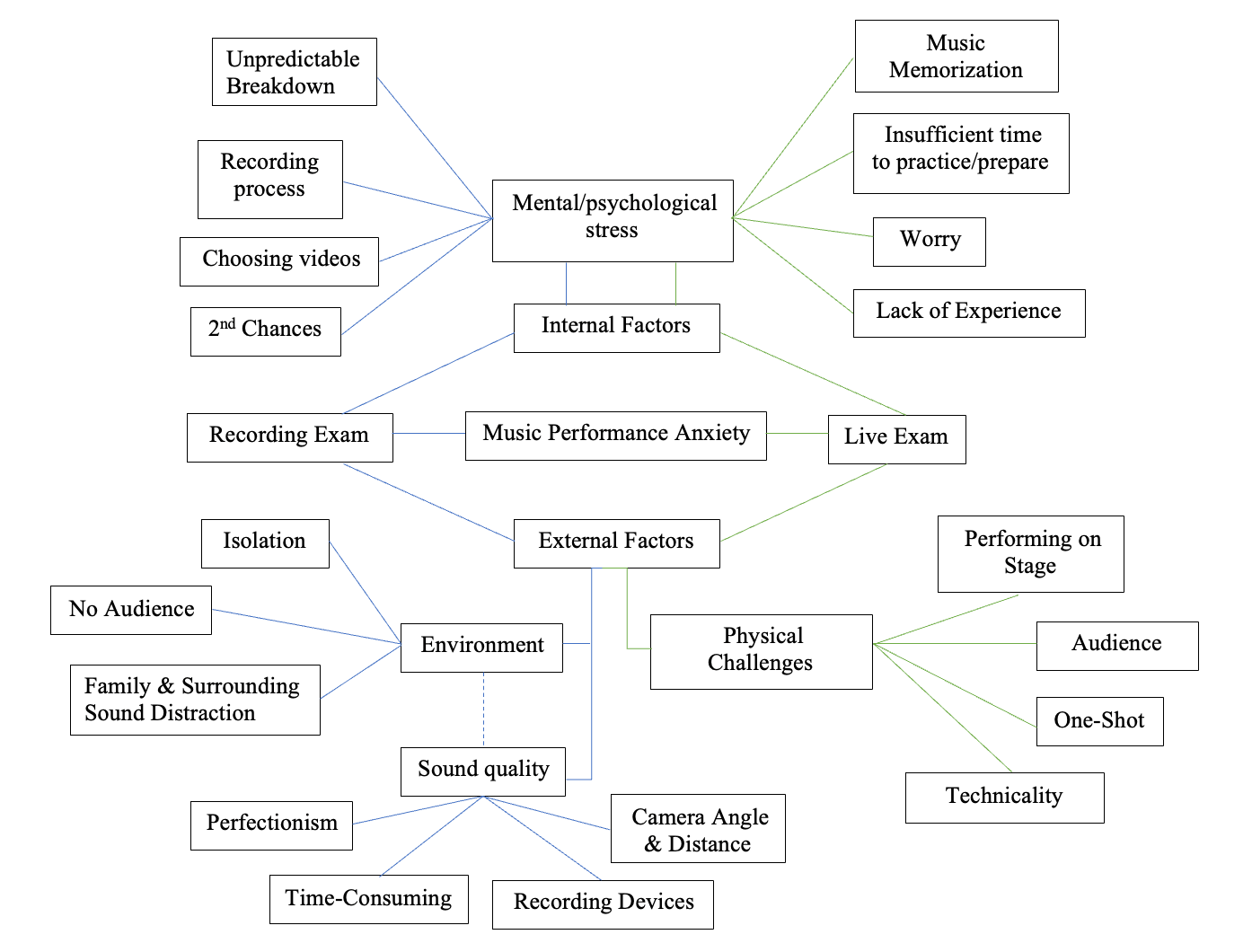
The researchers performed independent data familiarisation and coding, and then concluded the four emergent themes, classified as either internal or external factors. The emergent themes are depicted in the thematic analysis map below:
Recorded Exam
For the recorded exam, three main themes were derived from the data, namely: (1) Environment, and its sub-themes (a) Isolation, (b) No Audience, (c) Family and Surrounding Sound Distraction; (2) Sound Quality, and its sub-themes (a) Perfectionism, (b) Time-consuming, (c) Recording Devices, (d) Camera Angle and Distance; and (3) Mental/psychological Stress and its sub-themes (a) Unpredictable breakdown, (b) Recording Process, (c) Choosing Videos, (d) 2nd Chances.
Theme 1 – Environment (External factors)
The theme ‘environment’ is conceptualised as the surroundings or conditions in which the recording was conducted and consists of several sub-themes as listed below.
Isolation
To curb the spread of the virus, quarantine and social isolation measures were implemented. This resulted in increased levels of loneliness and social isolation. Participant 2 expressed feelings of isolation and loneliness, as he was alone in a room for hours during recording sessions, “Enduring endless repeated recordings on my own as I struggled with my mental health due to the isolated lifestyle caused by the MCO.”
No Audience
All participants agreed that video recordings were detrimental to the performance because they did not capture the ambiance and atmosphere of a live performance. Furthermore, because they had never performed in front of an audience, the participants were concerned about their future prospects. "Overall, the performance can feel less genuine than in live sessions," said participant 1.
Family & Surrounding Sound Distraction
Participants 3, 4, and 5 stated that the main issues they encountered while video recording their performances were family and surrounding sound. "My family must remain quiet for 3-5 hours because I am recording," said participant 3. The sound of a passing car or even birds chirping will have an impact on performance." In addition, participant 4 stated, "Recordings are less nerve-racking, but they take a long time." Not only because of re-recordings due to errors, but also because of external factors such as family members or unexpected noises from outside." "My family members listen to me record," Participant 5 said, reinforcing the statements of Participants 3 and 4.
Theme 2 – Sound Quality (External Factors)
The theme ‘sound quality’ is conceptualised as a perceptual reaction to the adequacy of sound/audio from a recording and consists of several sub-themes as listed below.
Perfectionism
Most participants had to record several takes to capture the “perfect” video. This notion of perfectionism exacerbated their stress in the process of recording their performance. When they hear themselves play in the recording, they became hyper aware of their mistakes. "I feel annoyed and stressed while recording," said Participant 1, “I must continue recording in order to submit the most satisfying video." "I feel stressed when I can't get the "perfect" recording," said Participant 2. However, Participant 2 mentioned a benefit of recorded evaluations: "I got to force myself to listen to my own recording and submit the "best take" I could get. I was able to review my own performance before others." Participant 5 said "There is an unspoken sense of perfectionism because you can re-do a recording and submit the best," said participant 5.
Time-consuming
All participants mentioned how time-consuming video recording is, leaving them physically and mentally exhausted. "Video recording is terribly exhausting," said participant 5. “To me, it must be flawless. It took three days to record a 2-minute video for my weekly recital, let alone the entire set of programme pieces." In line with that, participant 3 said, "Having to do recording for recitals and final jury was exhausting as I was thinking I can do better with each recording."
Recording Devices
Students' anxiety stemmed not only from the threat of COVID-19, but also from their unfamiliarity with the new learning platforms. The quality of the recordings is determined by the recording devices used. The recording quality and technical issues were raised by all participants. "There is the technological sound aspect to worry about," participant 1 said, "resulting in the need to invest in better gadgets for optimal recording quality."
Camera Angle & Distance
The placement of the camera is an important consideration when recording. For a pianist, the camera should be positioned on the right side so that the microphone captures more treble than bass. "The sound captured by the recording device sometimes does not give out a good balance as many surrounding factors such as camera angle and distance may affect the sound quality," Participant 2 said.
Theme 3 – Mental/Psychological Stress (Internal factors)
The theme ‘mental/psychological stress’ is conceptualised as psychological experience of distress and anxiety caused by processes and factors contributing to the onset and maintenance of a variety of mental conditions during the recording process and consists of several sub-themes as listed below.
Unpredictable breakdown
The participants spent years honing their abilities and building their confidence through practice, yet breakdowns during performances are common. Participant 3 stated:
“Our performance is fine until the end, when the spike in adrenaline causes us to mess up the very last section. We might think that we can record as many times as we wish, but one will get physically and mentally drained after one recording because of the focus and concentration needed.”
According to Participant 1, "recording causes more stress because you have to start over if you make a mistake. Each time you restart, your hands will become more tense as you go through a mental and physical breakdown."
Recording Process
Recording a performance is not an easy task, and it usually takes several attempts to achieve the desired result. "I spent a few days trying to get one good recording," said participant 3, “I planned my schedule so that I could record, and I informed my family that I would need to record so that they could lower their voices."
Choosing Videos
All participants stated that they had to go through several videos in order to submit the best one after extensive recording sessions.
2nd Chances
Some students may feel the pressure to re-record multiple times in search of perfection. However, once they have made a mistake, they are likely to make the same mistake in the next recording, which causes them to focus on the specific section. Participant 2 said, “I feel mentally stressed when I keep making mistakes while recording. We make more mistakes near the end because we are afraid of recording again. The longer I do the recording, the more mistakes I will make.” Participant 4 reported the same issue, “Re-recording is not good. I discovered this when performing live and during physical exams. I always thought there would be opportunities to re-record, so I didn’t bother to correct my mistakes.” Participant 5 brought up a positive side to recorded evaluations, “Video recordings provide us with more opportunities to make the performance perfect. I won’t be afraid of making mistakes since I can record again.”
Live Exam
For live exam, two main themes were derived from the data, namely: (1) Physical Challenge, which consists of the following sub-theme (a) Performing on Stage, (b) Audience, (c) One-Shot, (d) Technicality; and (2) Metal/Psychological Stress which consists of the following sub-themes (a) Music Memorisation, (b) Insufficient time to practice/prepare, (c) Worry, (d) Lack of Experience.
Theme 1 – Physical Challenge (External Factors)
The theme ‘physical challenge’ is conceptualised as external factors and conditions that have an impact on the success of the live performance and consists of several sub-themes as listed below.
Performing on Stage
Participants expressed their performance anxiety and their fear of not performing their best during the actual live performance despite practicing a lot. Participant 1 said:
“Dealing with the live final jury was more complicated. Although I practiced a lot, I cannot guarantee my performance will be alright. There’s only one chance to perform during the jury. Our mental preparation, familiarity with the stage, flexibility in terms of listening and response will significantly reflect how good we are when we play on the stage, and it's not just about the technique or dexterity. It requires a lot of focus and concentration as most of us will experience trembling in our hands or legs due to stage fright, or cold temperature in the hall that may affect our performance.”
Audience
The presence of an audience during the live performance caused anxiety in the participants. Participant 3 said, “When performing live for the weekly recital the first time, I felt very nervous because there was an audience listening. When my hands were shaking, it had an influence on the performance.” Participants 4 & 5 also experienced similar feelings.
One-Shot
Another drawback of live exams is the fact that the performer only has one chance, whereas a recording could be re-recorded. Participant 2 said, “Live performances cannot be repeated. We practice for six months but perform for less than 15 minutes. We must do our best when playing.” Similarly, Participant 4 shared, “Live performance is more challenging, but it helps me to stay out of my comfort zone and boost my confidence. There is only one chance. Hence, I will appreciate it by practicing hard to ensure there are no mistakes.”
Technicality
The participants expressed their insufficient/lacking technical ability as one of the factors that contributes to their anxiety during live performance. Without the correct technique, musicians may not be able to achieve their fullest potential, and their dexterity and mobility could be constrained. Participant 2 expressed his/her concern of lacking technique affecting his performance “My technique was not very concrete to begin with, and this causes a huge worry in my performance, especially in challenging passages.”
Theme 2 – Mental/Psychological Stress (Internal factors)
The theme ‘mental/psychological stress’ is conceptualised as psychological experience of distress and anxiety caused by processes and factors contributing to the onset and maintenance of a variety of mental conditions during the live performance and consists of several sub-themes as listed below.
Music Memorisation
Most participants stated that they have no prior experience in memorising the music for their performance before enrolling into the music program. Participant 3 said, “It is undeniable that the nervousness for live performance is much higher than video recording, occasionally there will be some negative thoughts that appear before live performance, such as what if I lost my memory, what if I play the wrong notes, etc.”
Insufficient time to practice/prepare
Transitioning from remote lessons to physical lessons caused some time management issues to the students, resulting in insufficient time to practice for their performance. Participant 2 shared, “I lack practice because of time constraints. It is challenging to attend classes from morning to evening. There’s not much time for practicing.”
Worry
All participants expressed concern about their performance. Participant 3 shared their experience of feeling anxious when performing live, saying, "I was constantly thinking about how the audience would judge my performance. I felt extremely worried that I might not perform well in front of an audience. This significantly affects my level of performance, and I don't do as well as I do in practice."
Lack of Experience
When the participants first enrolled in the music program, the performances were conducted remotely, through the means of video recording. None of the participants had experience performing live in front of an audience throughout the first year of their study. Participant 1 illustrated this, “When I first performed in the weekly recital, my hands were shaking. This continued until the final jury. I tried to not think too much about the exam and focused on playing music as practice.” Also, participant 2 said, “I didn’t have much opportunity to do a live performance previously. There are a lot of possible mistakes that we could make during a live performance. For example, forgetting the score or pressing the wrong keys.” Furthermore, Participant 5 said:
“I rarely performed alone on stage with audiences. I tried to play in front of my friends and helped my friends out as their piano accompaniment so that I can get more opportunities to step onto the stage. This actually helped me cope with anxiety by getting me more involved on stage.”
Discussion & Conclusion
According to the National Institute of Mental Health, MPA affects approximately 73% of musicians, making it the most frequently cited fear. A survey of 48 ICSOM orchestras revealed that 76% of musicians reported at least one medical issue affecting their performance, with MPA being the most prevalent medical issue. The MPA level on the recorded exam (M = 127.379) was lower than on the live exam (M = 138.621), the difference was significant. As the cut-off point for high-level MPA level is 130 (Paliaukiene et al., 2018) and 104 (Paliaukiene et al., 2018), the recorded exam MPA level was still deemed high (Kenny, 2015). A majority of the participants in this study viewed the recorded exams as less stressful and anxiety-inducing than the live exams. Although the difference in the MPA level between recorded and live exam was statistically significant, their MPA scores were only marginally different, indicating that both exam modes were equally difficult and emotionally taxing. Further exploration into their MPA through an in-depth interview also revealed that both exam modes were equally difficult and emotionally taxing, but in different ways.
Two external factors – environment and sound quality – affected the participants MPA level during recorded examination. In the Environment theme, participants grappled with the consequences of pandemic-induced isolation, experiencing loneliness, which can have a negative impact on physical and mental health during the recording sessions (Torales et al., 2020). The absence of a live audience raised concerns about the authenticity of their performances, while family and environmental noise distractions added stress. According to Ryan et al. (2021) and Spahn (2015), it is difficult to capture a perfect performance because students, like any other performer, would be nervous. In this study, the Sound Quality theme highlights the pursuit of perfection among students, which led to repeated recordings and heightened stress due to performance nerves and errors. This is in line with Kotani & Furuya (2018), who stated that mistakes are exacerbated by the stress of having to record the performance. The time-consuming nature of video recording leaves participants physically and mentally drained, with technical issues further exacerbating their anxiety (Kotani & Furuya, 2018).
In contrast, the external factor of MPA in live examinations revolves around physical challenge. This involves performing on stage, which triggers stage fright and performance anxiety, impacting the musicians' academic and professional progress negatively (Angelidis et al., 2019). LeBlanc (2021) stated that negative emotions such as stage fright and anxiety can arise in any situation where one feels that they are being judged. This is prevalent in this study, where according to the participants, audience presence intensified their nervousness as they felt like they were being judged. Furthermore, the one-shot nature of live exams adds worry and pressure to excel, which according to Burin & Osório (2017) is one of the causes of MPA. On top of that, technical proficiency is vital, as incorrect technique can lead to errors (James, 2018).
Both recorded and live exam revealed mental/psychological stress as an internal factor contributing to MPA, albeit in different ways. In the recorded exam, participants expressed that unpredictable performance breakdowns, which are common recurrences (Ioannou et al., 2016), particularly towards the end of recordings, create physical and mental tension. The recording process demands meticulous scheduling, and selecting from numerous recorded videos adds complexity. However, some participants find a sense of achievement in redoing the recordings, boosting their self-esteem. The pressure to achieve perfection through multiple re-recordings is both a source of stress and an opportunity for improvement. On the other hand, in the live exam, the participants grapple with internal stressors such as music memorisation, time constraints, worry, and a lack of prior live performance experience. In addition, their anxiety is amplified by fears of judgment from the audience (LeBlanc, 2021).
Suggestions for Future Research
Future research should address this study's limitations, particularly its focus on students' perspectives. Expanding the sample to include lecturers could provide deeper insights into the teaching-learning process and MPA. Additionally, exploring lecturer experiences may develop a broader understanding on how various elements interact and influence exams. Participants were limited to second-year students who had completed recorded exams in their first year and live exams in their second. COVID-19 has undoubtedly caused psychological distress among students; however, this unprecedented event will strengthen them and prepare them for future threats because they have learned to adapt to these rapidly changing times.