Introduction
Life in modern society has numerous phenomena and events that contribute to the emergence of contradictions and conflicts, while demonstrating tendencies toward isolation, favoritism toward certain social groups, and discrimination against others. This circumstance underscores the relevance of comprehensive study of the phenomenon of social ostracism (social exclusion).
The overwhelming majority of researchers, including E.E. Boikina, V.N. Borodina, A.S. Vasilchenko, S.A. Vekilova, Yu.E. Guseva, O.A. Kichigina, E.Yu. Kurzina, I.V. Morozikova, E.V. Nikolaeva, O.V. Rudyhina, E.V. Ryaguzova, G.V. Semenova, I.B. Tershkina, and others, employ K.D. Williams' model of ostracism (Williams, 2009; Wesselmann, Wirth, Williams, 2019) as theoretical foundation for their studies. The core tenet of this model posits disrupted individual needs in conjunction with the duration of ostracism exposure. The essence of the model lies in the sequential progression of the ostracized individual through three stages: the reflexive stage, characterized by an immediate reaction to the ostracism situation at the moment of impact; the reflective stage, which mediates subsequent thoughts, feelings, and behavior; and the acceptance (resignation) stage, wherein the individual experiences a depressive state, inability to fulfill frustrated needs, potentially leading to exhaustion and alienation due to rejection by a significant social group.
The typology of ostracism developed by K.D. Williams (Williams, 2009) includes: pseudo-ostracism, when the ostracized individual mistakenly perceives the subject's behavior as ostracizing; role-based ostracism, prescribed by a specific situation and the roles performed within it; and punitive ostracism, employed to demonstrate disapproval from certain group members or society.
In addition to K.D. Williams' propositions, the methodological foundation for understanding the essence of the ostracism phenomenon is provided by the research of: a) D.M. Twenge (Twenge, 2017; Twenge et al., 2001), who conceptualizes it as a situation in which an individual experiences solitude due to isolation by a group or society, without the necessary presence of hostility; and b) M. R. Leary, according to whom ostracism is akin to rejection and is defined as the explicit or implicit decision by a group or individual to refuse interaction with others, impacting the behavior, motivation, and self-regulation of the rejected person (Kelly, Leary, et al., 2013).
Analysis of the current studies of the social ostracism problem by E.E. Boikina and R.V. Chirkina revealed that the ostracism situation is characterized by the disruption of several basic needs highlighted by K.D. Williams, associated with an individual's life in society, such as self-esteem, control, sense of belonging, and meaningfulness of existence (Boikina, Chirkina, 2020). Distinctive features of ostracism embrace: adaptability necessary for survival and change; totality, whereby any individual can become the object of ostracism an unlimited number of times at a given moment; and perceptual imbalance, in which the ostracizing subject does not perceive their actions as ostracism, while the inadvertently ostracized individual interprets the subject's actions precisely as ostracism (see Ulyanova, 2021). An important feature of the ostracism phenomenon is its integration with neurobiological processes, as humans belong to social species and thus poorly tolerate social isolation, which can serve as a risk factor leading to distortion of cognitive functions overall; accelerated decline in cognitive abilities; impairment of executive functions; intensification of depressive and negative cognitive processes, including bias in social cognition; and heightened sensitivity to social threats in particular (Cacioppo, Hawkley, 2009).
Interpersonal exclusion constitutes a variant of ostracism that has an unexpected and unilateral rupture or restriction of social ties at the interpersonal level (Teresjkina et al., 2021). It manifests as a commonplace and occasionally necessary societal practice of excluding the Other, conceptualized as the cancellation of interpersonal relations within the "I–Other" dyad in both real and virtual domains (Rjaguzova, 2023). The reason for the breakdown of relationships and rejection may be the identified dissimilarity or otherness with whom interaction takes place. (Semenova, Kichigina, 2022). Violation of basic needs and interpersonal relationships leads to the emergence of ostracism in educational environments.
Ostracism in educational environments
Research demonstrates that social ostracism is widely prevalent in school and university settings alongside other social phenomena. One of the leading researchers in social ostracism, E.E. Boikina, has shown that the influence of persistent social ostracism contributes to the emergence and development of antisocial behavior in early adolescent minors, with the experience of ongoing rejection being closely linked to aggressive and self-destructive behavior as well as low levels of psychological resilience (Boikina, 2023). Y.S. Chukhlanzev, R.V. Chirkina, and E.A. Kupriyanova examined a sample of adolescents aged 12–17 years, including orphans and children without parental care raised in specialized institutions. The authors identified a connection between coping behaviors among ostracized participants and their deviant behavior (Chukhlanzev et al., 2021). Social ostracism has also been found to relate to adolescents' academic self-determination and prosocial behavior (Arslan, 2021). A.I. Ageeva noted that the phenomenon of ostracism in schools is sufficiently widespread; however, it is not regarded by educators as a distinct phenomenon but rather as a stage of bullying. According to the author, this perception results in the recognition of bullying issues in certain anti-bullying projects, whereas ostracism—even when viewed as a component of bullying—is more challenging to isolate, leading to significantly less frequent implementation of preventive measures (Ageeva, 2024). Nevertheless, effective ostracism prevention requires educators to conduct awareness-raising activities among parents and students (e.g., when a new pupil joins the class). Educators must themselves understand the conditions under which ostracism may arise toward a newcomer from the group, its potential impact on the student's personality, and the associated consequences (such as suspiciousness, low self-esteem, aggressiveness, negativism, and others), while possessing the skills to manage these situations and teach others accordingly.
I.V. Ulyanova identified a variety of ostracism situations possible within the educational system: between children, between a teacher and a child, between support staff and a child, between a teacher and a group of children, between parents and a child, and so forth (Ulyanova, 2021). L.N. Kostina and E.Yu. Kostina highlighted the causes of ostracism emerging in educational institutions toward adolescents. Specifically, ostracism may be triggered by the adolescent's appearance deviating from that of peers; health peculiarities – physical or intellectual; or personality and character traits, such as low academic performance or lack of awareness in significant topics. It should be noted that ostracism may originate from either peers or adults (Kostina, Kostina, 2021).
In educational environments, one-time instances of ostracism without humiliation of the learner's personality by the teacher are possible (Kostina, Kostina, 2021). Drawing on V.S. Mukhina's view that personality alienation exerts a dual influence, the positive effect of human alienation has been demonstrated, enabling better concentration on activities when isolated from others (Chernaya, Bodrukhina, 2020).
In pedagogical universities, awareness-raising efforts are conducted with students – future teachers – to comprehend the role and place of the ostracism phenomenon in their prospective professional activities. In a study of representations of ostracism, M.P. Asylbekova and I.B. Shaikhymuratova revealed that students conceptualize the phenomenon differently: over one-third identified it as devaluation; one-third as lack of interest; and the remainder as emotional distress. Overall, students attribute ostracism to devaluation, lack of interest, and personal characteristics. From their perspective, its consequences manifest as negative experiences and feelings of uselessness (Asylbekova, Shaikhymuratova, 2023).
In the process of education students at pedagogical universities, it is essential to consider that learners often experienced ostracism themselves during adolescence and/or early youth. Among students, there are both those who have been subjected to ostracism and those who have observed its manifestations toward others. Without reflection on their own experiences, they will struggle to fully assist others in ostracism situations and, consequently, fulfill their pedagogical role. Supporting this, L.N. Kostina and E.Yu. Kostina noted that such future professionals are unable to recognize the negative consequences of experiencing ostracism on children's personalities and their future development, thereby casting doubt on their professional competence (Kostina, Kostina, 2021).
I.V. Kazakova and O.A. Kocheulova observed that in the university educational environment, conflicts in student groups are resolved unproductively – this occurs as a mechanism of self-assertion during the formation of informal structures within the student collective through the rejection and ignoring of a participant who does not fit in – or in the "Teacher–Student" dyad. Ostracism manifests in both academic and extracurricular activities, with the authors attributing its causes to imperfections in information dissemination channels, failure to account for students' individual features, and suboptimal functioning of the university's psychological services (Kazakova, Kocheulova, 2023).
In the practice of psychological services at pedagogical universities, the following measures are employed for preventing ostracism manifestations in educational environments: conducting training sessions and organizing discussions, as well as fostering an atmosphere of respect and recognition within student groups. Key directions of this work include enhancing communicative competence, developing empathy, and strengthening the influence of values such as mutual assistance and support (Shaikhymuratova et al., 2023). M.P. Asylbekova and I.B. Shaikhymuratova emphasize that to increase the effectiveness of prevention, it is necessary to cultivate motivational readiness among educators for active ostracism prevention efforts, elevate their pedagogical expertise, and enhance group cohesion among learners (Asylbekova, Shaikhymuratova, 2023). At the same time, the specific features of ostracism in school settings highlight the task of developing students' understanding of ostracism (Kurzina, 2024) and its consequences (Shaikhymuratova et al., 2023) in pedagogical university curricula.
Approaches to the theoretical investigation of the ostracism phenomenon are characterized by diversity and multi-facetedness. Analysis of representations of ostracism among students at pedagogical universities is absent.
Given the foregoing, it can be concluded that approaches to conceptualizing ostracism are diverse and necessitate comprehensive analysis; however, studies of ostracism in education are rare and fragmentary. This fact underscores the need for further investigation of the phenomenon within educational environments.
In the educational environment, we define ostracism as a form of social exclusion of a student (in school) or a college/university student from the collective, manifesting as systematic ignoring, isolation, and refusal to interact by peers, teachers, or administration. Ostracism can be overt (open rejection, mockery) or covert (silent boycotting, exclusion from groups and projects). Most often, ostracism is employed to maintain group norms or protect the "status quo" in the classroom or student group. We posit that attitudes toward ostracism manifestations develop according to the schema: I–Other–Others and can change through targeted interaction among learners, which served as the foundation for our study, wherein the experience of mutual assistance among student-pedagogues becomes a means of such transformation.
Research program
Objective is to identify changes in student- pedagogues' attitudes toward ostracism following their acquisition of mutual assistance experience.
Hypothesis. Specification of students-pedagogues’ attitudes toward the phenomenon of social ostracism, coupled with their acquisition of mutual assistance experience, leads to positive changes in their attitudes toward situations of ignoring and exclusion in group interactions, as well as alterations in the balance between individual and social needs.
Materials and methods
Sample. The study involved 280 undergraduate students from pedagogical universities (M = 21,6, SD = 2,3, 82% female), comprising 250 participants in the experimental group (EG) and 30 in the control group (CG). The EG and CG were formed using random selection.
Methods. The study employed an introductory narrative (the story of girl Sonya about ostracism manifestations in school) and three questionnaires. The questionnaires assessed ostracism position, attitudes toward ostracism manifestations, and basic needs in ostracism situations embrace:
-
Authorial questionnaire "Assessment of Ostracism Experience in School" (20 questions, 5 per position).
-
Modified K.D. Williams questionnaire "Questionnaire on Ostracism Manifestations in the Student Environment" (6 questions with 3–4 response options).
-
Modified D.J. Hovas questionnaire "Basic Needs Questionnaire" (9 statements with a binary "yes/no" response scale).
The authorial questionnaire accounted for four positions of attitudes toward ostracism: I–Other, Other–Other, I–Others, Others–Others. An inverse Likert scale was used, where 1 ball indicated strong ostracism manifestation and 5 indicated weak1. The other two questionnaires were modified for the study's objectives, drawing on K.D. Williams and I. van Beest's "Need Threat Scale" in ostracism situations (2014) and D.J. Hovas's "Basic Needs Scale" (2012). The modified K.D. Williams questionnaire required selection of one option per question, while the D.J. Hovas one employed a dichotomous scale, where respondents agreed or disagreed with each statement. The content of the original questionnaires was substantially adapted considering: a) the learner demographic (university students); b) the educational environment; c) the student group context. The questionnaire on ostracism manifestations in the student environment incorporated items exploring ostracism as information reflecting the sequence of events and its manifestations. These items illustrate key components of youth self-awareness, their attitudes toward ostracism manifestations, and relational tendencies within student groups.
Procedure and research stages. The research procedure comprised three stages:
-
Preparatory stage. Presentation of a case study (Sonya’s story from school life) and completion of the authorial questionnaire "Assessment of Ostracism Experience in School." We assumed that students' school experiences and prior encounters with ostracism in the past would facilitate recognition of the phenomenon in the current student environment. The stage's objective was to identify ostracism situations.
2. Experimental stage. Execution of mutual assistance tasks in groups of 10–15 participants using modified K.D. Williams and D.J. Hovas questionnaires before and after the experiment. Students were assigned to provide mutual help, with recipients and providers selected randomly (students drew lots). Mutual assistance tasks titled "Help for a Classmate" were implemented during practical sessions. Following the instruction to "assist group classmates," students identified real issues among group members – personal problems, family difficulties, academic challenges, or interpersonal conflicts with peers. The group pinpointed problems, defined mitigating or resolving tasks, and then individually addressed them through mutual support. In our view, assistance to group mates directed attention toward the Other and their needs, potentially altering evaluations of attitudes toward ostracism and needs – both one's own and those of group mates. The control group (CG) received no mutual assistance tasks. The stage's objective was to assess changes in evaluations of ostracism manifestations following student mutual assistance.
-
Concluding stage. Summarization of research findings.
Data analysis employed statistical methods (descriptive statistics, z-transformation, χ² and McNemar tests, effect sizes: Cramer's V, phi coefficient, Cohen's g).
Results
Descriptive statistical analysis of the authorial questionnaire revealed shifts in the I–Other position (question: "I am ready to support a classmate even if they went against the majority"): M = 2,01, SD = 0,77, and I–Others position (question: "I feel part of the class rather than isolated"): M = 1,93, SD = 0,72, indicating respondents' reluctance to defend an isolated classmate and preference for remaining on the sidelines. Lower scores on the inverse scale evidence uncertainty and a sense of relational distance. Meanwhile, respondents did not perceive the class as either closed and fragmented with everyone for themselves, or conflict-ridden; nor as friendly with mutual classmate support, or cohesive (Other–Other, Others–Others positions), suggesting equivalent responses despite the problem's presence and stereotypical perceptions of classroom relationships and the class as a whole group. Personal school experiences underscored the topic's sensitivity for respondents, with ostracism residing in a zone of reduced recognition. Ostracism development was registered in the I–Other schema link without progression to the Other–Others link. The experiment targeted identification of transitions from I to Other and from Other to Others.
No differences were found between the experimental group (EG) and control group (CG) prior to the experiment across the two methodologies ("Ostracism Manifestations in the Student Environment" /K.D. Williams/ and "Basic Needs Questionnaire" /D.J. Hovas/) using χ² and McNemar tests (p > 0,05), except for the question 7 in the D.J. Hovas questionnaire ("I felt influential in control (influential in the group)"), where affirmative responses were more frequent in the CG (p = 0,014). This difference persisted post-experiment (p = 0,002).
The results of the K.D. Williams methodology using z-distribution analysis of response proportions pre-experiment in the EG showed that responses to the ostracism definition question ("What does ostracism mean?") most frequently identified it as "unlawful action toward a group member" (42,8%), compared to "perceiving someone as hostile" (39,2%) and "intolerance and dislike toward someone" (18%). Post-experiment, perceptions of ostracism as an unlawful action strengthened (54,8% of responses), while other options weakened (30,8% and 14,4%, respectively). Differences were statistically significant for hostility (p = 0,019) and unlawful action (p = 0,002). For the question "How do you feel about relationship issues in student groups where ostracism toward someone may occur? What is your attitude?", most respondents selected "equal attitude toward all, regardless of traits or conditions" – 65,2% and 69,6% pre- and post-experiment. Other responses received fewer selections. Differences across responses were not statistically significant (p > 0,05), except for the option regarding possible ostracism if a classmate is unpleasant – it declined post-experiment from 16,6% to 10,8% (p = 0,046). No pre-post differences emerged in the EG for this question (χ² = 6,633, p = 0,083). See Table 1. For the question "Evaluate statements about the nature of interpersonal relationships in your student group," priority was given to the response regarding equal rights of students at the university – 59,6% and 66% respectively. Differences for this and other response options were statistically nonsignificant (p > 0,05). The results for the question "Do you allow for the possibility of ostracism toward your classmate?" indicated that the preferred response was "I cannot allow such a situation toward anyone" – 57,6% and 66,8% in the EG (p = 0,065, no differences). Response distributions for the question "Do you believe that certain classmates influence the manifestation of ostracism toward someone?" showed no substantial fluctuations, except for the response "Yes, I allow for such a situation where certain classmates significantly influence ostracism manifestations in the group toward specific students," which more than doubled – from 14,4% to 32,4% (p = 0,0001), indicating greater reflection on group mates' mutual influence. Despite equal opportunities for behavior in interpersonal relationships (p > 0,05), every student in the group reported personal experiences of ostracism and its manifestations – responses to the question: "Yes, I experience constant hostility or avoidance toward myself from classmates." These indicators decreased post-experiment from 20,8% to 13,2% (p = 0,015). Additionally, students acknowledged that they themselves might behave this way toward group mates (following the principle "The best defense is offense!"). Among the four response options to the question "Have there been instances when you experienced feelings of hostility or avoidance from classmates toward yourself?", statistically significant changes occurred in two: "Yes, I allow for such a possibility" (p = 0,032) and "Yes, I can allow for such a situation on par with other classmates" (p = 0,046). Post-experiment, these indicators declined by 1,5 times (14,4% vs. 8,8% and 15,6% vs. 9,6%).
Thus, post-experiment, reflection on potential mutual influence intensified – for response options to the question: "Yes, I allow for such a situation where certain classmates significantly influence ostracism manifestations in the group toward specific students" – from 14,4% to 32,4% of cases (p = 0,0001); alternatively, instances of failing to notice such situations decreased from 46% to 36% (p = 0,023).
Analysis of D.J. Hovas’ questionnaire results using z-distribution revealed significant differences across all statements (p = 0,0001), except for "I felt ignored (assessment of exclusion/inclusion status)" (p = 0,074), although this indicator decreased post-experiment from 54% to 46%. Proportion difference evaluation demonstrated that student response shares statistically predominated for items such as: "I felt part of the group" (68,8%), "I felt satisfied with myself in self-esteem" (81,2%), "I felt likable" (86,4%). Conversely, lower proportions were observed for: "I felt superfluous in group belonging" (30,4%), "I felt invisible in meaningful existence" (22%), "I felt no one would notice if I left the group" (29,6%), "I felt influential in control" (26%), "I felt like a leader" (18,8%).
The primary results of the comparative analysis of the EG pre- and post-experiment for both questionnaires (M1 & M2) are presented in Table.
Table
Differences in the results of the experimental group before and after the experiment and effect size according to two methods (M1 and M2) (N = 250).
|
Методика / Method |
Вопрос / Question |
χ² |
p |
Величина эффекта / Effect Size |
||
|
V Крамера / Cramér's V |
Коэффициент φ / phi coefficient (φ) |
g Коэна / Cohen's g |
||||
|
М1 (К.Д. Вильямс / K.D. Williams)
|
В1 / Q1 |
9,852 |
0,007 |
0,14 |
|
|
|
В2 / Q2 |
6,633 |
0.083 |
0,115 |
|
|
|
|
В3 / Q3 |
2,003 |
0.366 |
0,063 |
|
|
|
|
В4 / Q4 |
6,258 |
0. 099 |
0,112 |
|
|
|
|
В5 / Q5 |
10,284 |
0.016 |
0,143 |
|
|
|
|
В6 / Q6 |
22,873 |
0.0001 |
0,214 |
|
|
|
|
М2 (Д.Ж. Ховас / D.J. Hovas)
|
В1 / Q1 |
66,694 |
0.0001 |
|
0,517 |
0,392 |
|
В2 / Q2 |
61,361 |
0.0001 |
|
0,495 |
0,376 |
|
|
В3 / Q3 |
119,512 |
0.0001 |
|
0,691 |
0,56 |
|
|
В4 / Q4 |
70,297 |
0.0001 |
|
0,53 |
0,408 |
|
|
В5 / Q5 |
139,862 |
0.0001 |
|
0,748 |
0,624 |
|
|
В6 / Q6 |
176,191 |
0.0001 |
|
0,84 |
0,728 |
|
|
В7 / Q7 |
88,889 |
0.0001 |
|
0,596 |
0,48 |
|
|
В8 / Q8 |
144,857 |
0.0001 |
|
0,761 |
0,624 |
|
|
В9 / Q9 |
3,077 |
0,074 |
|
0,111 |
0,08 |
|
Note: M1 – modified K. D. Williams methodology, M2 – modified D. J. Hovas methodology. For M1, χ², p-value, and Cramér's V are provided; for M2, χ², p-value, and the phi coefficient (φ), Cohen's g are given.
Analysis of K.D. Williams’ questionnaire results using the χ² criterion demonstrates that mutual assistance among group mates reduces ostracism manifestations and alters attitudes toward it. Significant findings emerged for questions on ostracism (χ² = 9,852, p = 0,07), the possibility of ostracism toward a classmate (χ² = 10,284, p = 0,016), and the influence of certain classmates on ostracism manifestations toward someone (χ² = 22,873, p = 0,0001) – corresponding to questions Q1, Q5, and Q6 in the table. Cramer's V effect sizes for these items exceeded those of others. Changes indicated a small effect boundary typical of educational interventions (effect size 0,1–0,2), while for question Q6 ("Have there been instances when you experienced feelings of hostility or avoidance from classmates toward yourself?"), the effect size exceeded 0,2 and surpassed other questions.
Regarding changes in basic needs per the D.J. Hovas methodology, McNemar’s criterion analysis –attributable to inclusion in mutual assistance activities – revealed significant differences across all needs (p = 0,0001), except the final statement. Effect sizes, expressed via phi coefficient and Cohen's g, were higher post-experiment compared to the K.D. Williams methodology, exhibiting medium to above-medium effects and even large effects (0,4–0,7). This suggests frustrated needs among students in ostracism situations and their potential fulfillment within the student environment.
Changes in attitudes toward ostracism in EG are presented in Figure.
р≤0,05
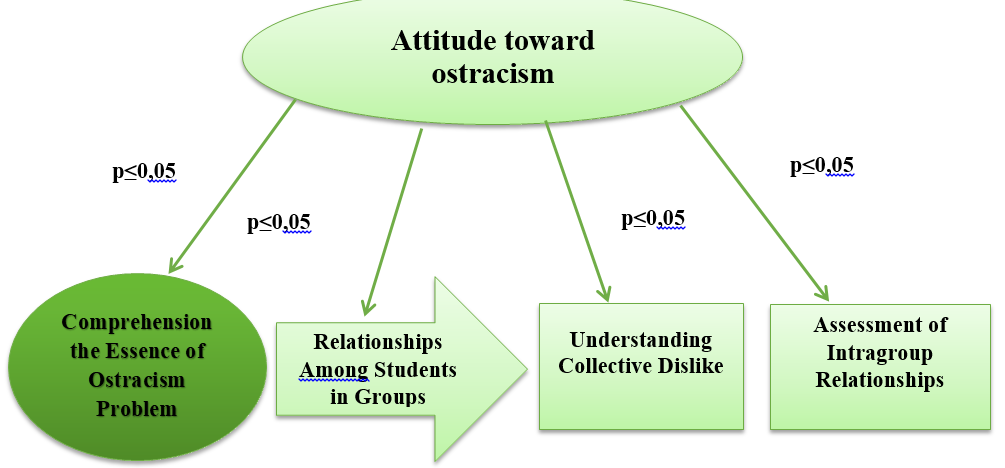
The results of the study indicate that comprehension of the ostracism phenomenon and shifts in attitudes toward it correlate with altered evaluations of intragroup relationship dynamics. The control group (CG) exhibited no statistically significant shifts, suggesting that the observed effects are attributable to the experimental intervention rather than natural mood fluctuations. Furthermore, postt-experiment, endorsements of ostracism acceptability toward classmates for personal reasons increased (p = 0,0001), while admissions of potential ostracism from others, hostility, or intolerance directed toward oneself decreased (p = 0,016), evidencing the efficacy of the student intervention. Consequently, in the experimental group (EG), fixation on "I–Other" positions diminished, fostering orientations toward "Others" (the group). Significant transformations occurred in basic needs: belonging, sympathy, and self-esteem needs intensified, whereas dominance needs and sensations of worthlessness or invisibility declined. The hypothesis – that specification of student-pedagogues' attitudes toward social ostracism, combined with mutual assistance experience, yields positive changes in responses to ignoring and exclusion in group interactions and rebalances individual versus social needs – was confirmed.
Discussion
Obtained data indicate that alterations in intragroup relationship evaluations, coupled with the emergence of group perceptions as a cohesive community rather than a disparate collection of individuals, are linked to substantive comprehension of ostracism and transformations in its conceptualization. This confirms that practical sessions with pedagogical university students reshape representations of social ostracism and intragroup relational dynamics.
In I.V. Morozikova's study, student- pedagogues' conceptions of the social ostracism phenomenon were examined. Findings revealed that a portion of students viewed prevention and mitigation of school ostracism as an internal regulatory matter within the classroom group (Morozikova, 2023).
Our study demonstrates that guiding students toward reflection on ostracism and their own intragroup interaction experiences through mutual assistance fosters autonomous discovery of personal space, delineates personality development trajectories, bolsters the self-concept, and serves as a primary criterion for characterizing the student's social milieu. This process heightens attentiveness to the Other and Others, thereby attenuating needs for control and self-assertion at others' expense while transforming ostracism representations. These shifts likely stem from initially constructing pathways from I to Other and Others, grounded in personal values and meanings.
The research results have shown that learners not only altered their conceptions regarding the possibility of intragroup regulation of ostracism situations but also acquired personal experience of such regulation. During the period of reflecting on the ostracism problem from various positions, new approaches to self-manifestation toward the Other and Others, specific activities, and situations emerge, which delineate the character of individual-group interactions in the future.
Thus, student interactions through mutual assistance promote reflection and heightened attentiveness to the Other and Others, as participants gain not only theoretical knowledge about ostracism regulation possibilities but also practical experience thereof.
Conclusions
Student responses to questions concerning personal safety and social integration (the questions 1 and 3 in authorial questionnaire) confirm the presence of ostracism and social isolation experiences. Post-experiment, the experimental group (EG) exhibited a stable positive effect:
- increased perceptions of support and safety,
- improved evaluation of the student group atmosphere, and
- significant enhancement of satisfaction with basic social needs.
In the EG, attitudes toward ostracism and intragroup student interactions transformed. Mutual assistance contributed to reduced acceptability of hostility and intolerance from others toward oneself, heightened awareness of influence on ostracism manifestations within the group (p < 0,05), and improved perceptions of social needs (p < 0,0001). Findings affirm that engaging student-teachers in conscious, active participation to address peers' issues yields positive shifts in ostracism situation evaluations within group relationships, fulfills social needs, and mitigates associated risks. No changes occurred in the control group (CG), indicating that observed transformations resulted from the experiment rather than external factors or natural group dynamics. Thus, the research objective was achieved, and the hypothesis confirmed.
Further development of ostracism studies in pedagogical university educational environments could involve applying mutual assistance experiences gained during pedagogical practice in schools to identify additional means of altering attitudes toward social ostracism situations, thereby preventing their emergence in student settings.
Limitations. The research is exploratory in nature. The predominance of female students was also a limitation, the use of questionnaire methods, and the small size of the control group.
1 For example, in question 1 "I am ready to support a classmate even if they went against the majority" (I–Other position): 1 – It is better not to intervene to avoid getting targeted myself; 5 – I will always stand by those who are excluded.