Introduction
From the moment the child is born, the parent faces a wide range of demands, an overabundance of which provokes the appearance of parenting stress (hereinafter referred to as PS). K. Deater-Deckard notes that "the key feature of any PS theory is to establish a balance between the parent's perception of the requirements of the parental role and access to available resources to meet them" (author’s translation) (Deater-Deckard, 2004). Together with the concept of PS, the term "parental burnout" (PB), which is used by I.N. Efimova, is defined as "a multidimensional construct that includes a set of negative psychological experiences and maladaptive behavior of the mother and father associated with child-parent interaction when parents carry out activities for the care of children, their upbringing and development" (Efimova, 2013).
The study of these phenomena in Russia has begun relatively recently. Most of the research in the world is devoted to the study of the factors and causes of PS and PB (Blanchard et al., 2023; Lee et al., 2013; Mikolajczak, 2019; Ilyina, 2021; Savenysheva, 2019).
Due to the fact that PS and PB occur during the interaction and care of a child, we consider it necessary to consider these phenomena in the context of parent-child relations, as well as taking into account the psychological characteristics of the child.
The results of research on the relationship of PS with emotional and behavioral difficulties in children are quite contradictory. Some researchers (Williford, 2007) believe that a child's bad behavior predicts a higher level of PS. The second group of researchers (Zhu et al., 2024; Xu, Zhu, 2024; Lee, Lee, 2024; Carapito et al., 2020) say that it is PS that predicts the external behavior of a child in the future, while the third group of researchers (Neece et al., 2012) report their combined influence on each other. The fourth group of researchers (Crnic et al., 2005; Benzies et al., 2014) conclude that it is not the child's behavior itself that has a significant impact on the PS level, but the parents' assessment of this behavior. Studies investigating the association of PB with emotional and behavioral difficulties in children are rare abroad (Ping et al., 2023; Chen et al., 2022; Woine et al., 2024) and absent in Russia. It was found that parental burnout of mothers and fathers has a predictive effect on the internal and external problems of children (Woine et al., 2024).
Cognitive difficulties in children are also considered in connection with the effects of PS and PB, which also demonstrate contradictory data. Some authors (Zha et al., 2024) report the negative effects of PS on a child's cognitive functions (concentration, planning, self-regulation, inhibitory control), while others (Täljedal et al., 2025) conclude that a child's cognitive difficulties contribute to an increase in PS levels, while others (Yakupova and Suarez, 2024) note that a high level of PB is associated with a child's better results in auditory-speech memory, which may probably indicate that parents who are more invested in the development of their children have a greater risk of PB.
The same differences can be traced in longitudinal studies. The results of a six-year study revealed the negative impact of PS on both children's prosocial outcomes and their cognitive development, through parental responsiveness (Ward, 2020). Another longitudinal study demonstrated the presence of dynamic mutual changes between PS, parent behavior, and child behavior over time. The negative behavior of the child (aggression) at an early age increased the level of PS, but did not affect the behavior of the parent, whereas the behavior of older children (5, 7, 10 years) contributed to the intensification of PS and negatively affected the behavior of parents (Mackler, 2015). The results of a cross-sectional study of the longitudinal relationships between internal and external difficulties of children and PS mothers showed the existence of links of small and medium effect. However, models of structural equations with cross-delay did not show predictive power of either behavior or PS (Paynter, 2024).
Few studies examining the links between PS and PB and parenting strategies have found that parents with high levels of PS are more likely to adopt neglectful and authoritarian parenting strategies (Ponnet, 2012). At the same time, parents who adopt an authoritarian parenting style were more likely to experience symptoms of PB (Mikkonen, 2023) and are more likely to be less responsive, inconsistent in parenting (Wang, 2019) and form an unsupportive behavior style (Lee, Lee, 2024). Parents with elevated PB levels are predisposed to an increased risk of neglect and violence towards their children (Mikolajczak et al., 2019).
When analyzing the relationship between either PS or PB, parenting characteristics and individual variables of the child (cognitive flexibility, behavior (externalizing and internalizing), social competence, insecurity, social skills), an indirect role of parenting characteristics is observed (Sun et al., 2025; Woine, 2024; Xu, Zhu et al., 2024; Lee, Lee, 2024; Carapito et al., 2020). The study of the connections of all the components we considered (PS, PB, emotional and behavioral characteristics of the child and parenting style) was found only in one study on fathers (Ping et al., 2023). The relevance of this work lies in the insufficient study of the phenomena of PS and PB in the context of child-parent relations and the psychological characteristics of a child in both foreign and domestic psychology.
The purpose of this work is to identify the relationship between PS, PB and the parenting style used by preschool mothers with emotional and behavioral problems in their children. Thus, the research focuses on the "relationship" between the variables studied: a) between PS and PB; b) between PS and the type of inharmonious upbringing (later, as a result of factor analysis, derived as the inharmonious parenting style); c) between the variables PB (namely emotional exhaustion) and the type of inharmonious upbringing; d) between the styles of inharmonious parenting and the emotional and behavioral difficulties of preschoolers; e) between PS and the emotional and behavioral difficulties of preschoolers; f) between PB (namely, emotional exhaustion) of mothers and the emotional and behavioral difficulties of preschoolers.
Mothers of preschool children were selected as participants in the study due to the fact that:
- most of the time, it is mothers who bear the main burden of raising children;
- they have a parenting style, and it can be diagnosed;
- they have not yet fully adapted to their parental role, which can provoke PS and PB.
We assume that: 1) PS, PB, violations in mothers' parenting and emotional and behavioral difficulties of preschoolers are closely interrelated: PS and PB affect the emotional and behavioral characteristics of a child directly and indirectly, through existing parenting disorders; 2) the presence of violations in the parenting process of preschool mothers (redundancy / insufficiency of guardianship and control (prohibitions, requirements)) can be both a cause and a consequence of maternal PS and PB.
Materials and methods
The study involved 76 mothers (26-47 years old, M = 36 years old) of preschoolers (4-7 years old, M = 5,3 years old) living in St. Petersburg (Russian Federation). 78% of mothers are officially married and raise a child with their spouse. 50% of mothers worked full-time, 28% did not work, and 22% had part-time jobs. A total of 34% of the mothers had only one child, 51% had two, and 14% had three. The participants were recruited in the state preschool educational institutions of St. Petersburg. The mothers agreed to participate in the study and chose a convenient format for filling out the questionnaires: paper or electronic.
To identify the stress levels of mothers (PS and PB), the following methods were used:
- The Parental Stress Scale by Berry and Jones (1995), validation of Yu.V. Misiyuk and I.V. Tikhonova (Misiyuk, 2022).
- Questionnaire on the level of parental burnout (Efimova, 2013).
To study the characteristics of the parenting style of mothers, the questionnaire for the analysis of family interaction (ACB) by E.G. Eidemiller and V.V. Justitskis (Leaders, 2007) was used, aimed at identifying the specifics of the inharmonious educational influence of parents towards their children (violations in upbringing) and determining the level of protection, the degree of satisfaction of needs, the number and quality of requirements for the child, the instability of parenting style. On the basis of which, the styles of maternal upbringing were derived in the work.
To identify emotional and behavioral difficulties in preschoolers, the questionnaire for assessing child behavior for the age group from 4 to 18 years (CBCL/4-18) by T. Achenbach (edited by I.V. Kuznetsov, 2010) was used.
Mathematical and statistical processing methods: analysis of mean values, frequency analysis, correlation analysis, factor analysis (SPSS Statistical 21), AMOS path model.
Results
The overall PS level of the mothers in the sample was 35,72 points, which is determined at a lower-than-average level. The frequency analysis also did not find high indicators for the overall level of PS, however, 24% of mothers showed high values on the scale of "parental stressors", which may indicate that mothers are overwhelmed by the demands of parenthood.
PB indicators are presented at different levels: mothers' emotional exhaustion is average (M = 17,05), depersonalization is low (M = 4,76), and reduction of parental achievements is high (the child is valuable) (M = 35,68). However, the results of the frequency analysis revealed the presence of critical values on all scales of PB: 20% of mothers experience exhausted of their emotional resources; 7% of mothers formally relate to the needs of the child and 18% are dissatisfied with themselves as a parent.
The analysis of the average values of the parenting characteristics of mothers did not reveal any critical values indicating the presence of violations in the parenting process. However, frequency analysis showed that 62% of mothers reached the level of critical values of impaired interaction with their child in at least one indicator. Mothers most often use strategies of minimal sanctions (32%), insufficient requirements-prohibitions (29%) and requirements-responsibilities (18%), as well as hyperprotection (9%).
An analysis of the average indicators of emotional and behavioral difficulties of preschoolers found that mothers are more likely to pay attention to aggressive manifestations and attention problems in their children.
The results of the correlation analysis of PS and PB demonstrate significant associations of all indicators of maternal emotional exhaustion and reduction of parental achievements with all indicators of PS (p < 0,01), whereas the scale of depersonalization is associated only with the general level of PS (r = 0,273; p < 0,05) and parental damage (r = 0,237; p < 0,05).
The results of a correlation analysis of PS and PB parameters with indicators of emotional and behavioral characteristics of preschoolers demonstrated that the overall PS level is associated with anxiety, attention problems, impaired socialization, aggression, internal and external problems of the child. Of the PB scales, only the emotional exhaustion of mothers is associated with all indicators, including the child's isolation, while the reduction of parental achievements is associated only with thinking problems, and there are no links on the depersonalization scale (Table 1).
Таблица 1 / Table 1
Результаты корреляционного анализа показателей РС, РВ с эмоциональными и поведенческими особенностями детей
The results of the correlation analysis of PS, PB indicators with emotional and behavioral characteristics of children
|
Эмоциональные и поведенческие особенности детей / Emotional and behavioral characteristics of children |
Общий уровень РС / General PS level |
Эмоциональное истощение / Emotional exhaustion |
|
Замкнутость / Closedness |
0,280* |
|
|
Тревожность / Anxiety |
0,319** |
0,327** |
|
Нарушение социализации / Disruption of socialization |
0,234* |
0,370** |
|
Проблемы внимания / Attention problems |
0,348** |
0,372** |
|
Агрессия / Aggression |
0,251* |
0,356** |
|
Внутренние проблемы / Internal problems |
0,311** |
0,338** |
|
Внешние проблемы / External problems |
0,250* |
0,364** |
|
Общий показатель нарушения адаптации / General indicator of adaptation disorder |
0,365** |
0,469** |
Примечание: «*» – корреляция значима на уровне 0,05, «**» – корреляция значима на уровне 0,01.
Note: «*» – correlation is significant at the 0,05 level; «**» – correlation is significant at the 0,01 level.
The overall rate of adjustment disorders in children is associated with both PS and PB, and the strength of the association with indicators of emotional exhaustion (r = 0,469; p < 0,01) is higher than with the overall level of PS (r = 0,365; p < 0,01). Thus, the results of this study reveal links between PS and PB with various types of emotional and behavioral problems in children.
As a result of the correlation analysis of PS and PB parameters with indicators of disorders in the upbringing process (Table. 2) it was found that all indicators of maternal PS and PB are associated with disorders in the parenting process such as hypoprotection and ignoring the needs of the child. In addition, indicators of the overall level of PS are associated with excessive sanctions. It should be noted that the PB indicator "reduction of parental achievements" has negative associations with hypoprotection and ignoring the needs of the child and a positive association with the minimization of sanctions. In addition, the instability of the maternal parenting style is associated with the general level of PS and the emotional exhaustion of the mother.
Таблица 2 / Table 2
Результаты корреляционного анализа показателей РС и РВ с имеющимися у матерей дошкольников нарушениями в процессе воспитания
The results of the correlation analysis of PS and PB indicators with the disorders of preschool children's mothers in the parenting
|
Нарушения, имеющиеся в процессе воспитания / Disoders in the process of parenting |
Общий уровень РС / General PS level |
Эмоциональное истощение / Emotional exhaustion |
Деперсонализация (формальное отношение) / Depersonalization |
Редукция родительских достижений / Reduction in parental achievement |
|
Гипопротекция Г- / Hypoprotection |
0,490** |
0,331** |
0,428** |
–0,445** |
|
Игнорирование потребностей У- / Ignoring the child's needs |
0,396** |
0,438** |
0,340** |
–0,303** |
|
Чрезмерность санкций С+ / Excessive sanctions |
0,283* |
|
|
|
|
Минимальность санкций С- / Minimal sanctions |
|
0,247* |
||
|
Неустойчивость стиля воспитания Н / Instability of parenting style |
0,265* |
0,237* |
Примечание: «*» – корреляция значима на уровне 0,05, «**» – корреляция значима на уровне 0,01.
Note: «*» – correlation is significant at the 0,05 level; «**» – correlation is significant at the 0,01 level.
To reduce the number of variable impairments in the parenting process (11 pieces) we conducted a factorization of parenting disorders (using a factor analysis using the principal component method with varimax rotation, KMO = 0,65), obtaining 3 factors corresponding to three styles of dysfunctional parenting: redundancy (includes excessive demands – responsibilities (0,533), prohibitions (0,691), sanctions (0,579) and instability of parenting style (0,537), insufficiency (includes indulgence (0,622) and insufficient requirements – duties (0,674), prohibitions (0,529), sanctions (0,551)) and hypoprotection (includes hypoprotection (0,599), ignoring needs (0,534) and a negative value of hyperprotection (-0,526). The cumulative percentage with a three-factor structure was 52,3% (11,573% redundancy, 19,845% insufficiency, 20,905% hypoprotection).
The results of the analysis of the relationship of integral indicators – PS, PB (emotional exhaustion), maternal parenting style with emotional and behavioral difficulties of preschoolers indicate that the dysfunctional style of maternal parenting: 1) redundancy and instability in requirements, prohibitions and punishments is associated with the general level of PS (r = 0,417; p < 0,01) and emotional exhaustion of preschool mothers (r = 0,263; p < 0,05); 2) insufficiency of requirements, prohibitions and sanctions is associated only with external behavioral problems of children (r = 0,227; p < 0,05); 3) hypoprotection and neglect – only with a general PS level (r = 0,234; p < 0,05).
The theoretical model and its empirical verification
Based on the results of correlation analysis (empirical data) and theoretical data (assumption of the direction of influence), we have proposed a theoretical model of the mutual effects of the studied indicators on each other. We assumed that a high level of PS leads to PB. Since the PB methodology does not have a general PB indicator, but consists of three scales, we consider the scale that showed the greatest severity and found the greatest number of links with indicators of parenting disorders and emotional and behavioral difficulties in children - "emotional exhaustion" (hereinafter – EE). At the same time, a high level of PS and EE contributes to the appearance of internal and external problems in preschoolers. High rates of PS and EE do not give mothers the opportunity to pay enough attention to their child, which leads to the use of a destructive parenting style such as hypoprotection. An additional influence on the appearance of external problems can be exerted by a parenting style based on "insufficient requirements, prohibitions and sanctions". The parenting style that manifests itself in the "excess of requirements, prohibitions and sanctions", contributes to an increase in the overall level of PS and EE of mothers.
Verification of the theoretical model by the path method in the AMOS software package (the use of this type of analysis meets the necessary requirements for the sample size) showed a good level of agreement between the model and the data: chi-squared = 15,859; df = 15; p = 0,391; CFI = 0,989; GFI = 0,946; RMSEA = 0,028; Pclose = 0,578. It has been revealed that the use of excessive demands, prohibitions and punishments by mothers and instability in their views on parenting lead them to develop PS, which provokes the appearance of EE, as a result of which mothers of preschoolers begin to reduce the measure of their care for the child, which as a result leads to the formation of a new parenting style such as hypoprotection. In turn, the appearance of external problems in preschoolers is provoked by the destructive style of maternal upbringing associated with excessive or insufficient requirements, responsibilities and sanctions. A parenting style based on insufficient requirements, prohibitions, and sanctions has a direct impact on the appearance of external difficulties in a preschooler. Whereas redundancy has an indirect effect on the external difficulties of the child, through the mother's PS. The reason for the appearance of internal problems of a preschooler is the direct influence of the mother's EE and the indirect influence of PS and a parenting style based on excessive demands, prohibitions and sanctions. The result of the empirical model is shown in the figure.
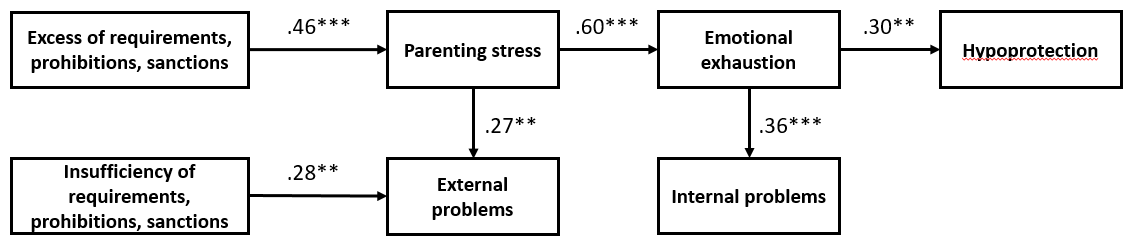
Рис. Эмпирическая модель интегральных показателей РС, эмоционального истощения, факторов нарушений в воспитании, а также эмоциональных и поведенческих нарушений у дошкольников
Fig. Empirical model of integral indicators of PS, emotional exhaustion, factors of disturbances in education, as well as emotional and behavioral disorders in preschoolers
Discussion
The effect of PS on PB that we found may be due to the fact that prolonged exposure to PS over time, according to theories of stress, including parenting stress, can lead to resource depletion. In this case, since the load falls heavily on the emotional sphere, it leads to emotional exhaustion. This result is confirmed by a few modern foreign studies investigating the relationship between PS and PB (Mikolajczak, 2018; Ping et al., 2023; Yahya, 2024; Xu, Hanafi, Zhang, 2024). Moreover, special attention is paid to the impact of PS on the depletion of mothers' emotional resources and, to a lesser extent, to the mother's participation in caring for the child and changing her feelings towards him.
The study of the relationship between PS and EE with parenting disorders in this study revealed that the source of PS in preschool mothers is the parenting style used, namely, the redundancy of requirements, prohibitions and sanctions and the instability of their application in relation to their children. Thus, our results complement and concretize studies demonstrating that an increase in PS is due to an increase in dysfunctional parent-child interaction (Putnick, 2010). At the same time, the data obtained in our work indicate that PS is not only the result of the parenting style used by mothers, but is also capable of further disrupting the educational strategies of preschool mothers through the mother's EE. Mothers experiencing EE are unable to adequately regulate their parenting tactics, which leads to the use of additional negative parenting methods, manifested in the child's withdrawal from the focus of the mother's attention, retaining only the ability to perform formal child care. These results are consistent with the work of the authors who found a significant impact of PS and PB on parenting in both mothers and fathers (Woine, 2024; Qian, 2024; Crnic, 2005) and on the deterioration of child-parent relationships (Ponnet, 2012; Wang, 2019). Parents with high levels of PS are more likely to adopt authoritarian and neglectful parenting strategies (Ponnet, 2013) and are more likely to be less responsive and inconsistent in parenting (Wang, 2019). In addition, this study demonstrated the influence of maternal parenting style through PS on the EE of mothers, which is also confirmed by work where it was revealed that parents using an authoritarian parenting style and negative parenting tactics most often experienced symptoms of parental burnout (Mikkonen, 2023; Ping, 2023).
The results of this work on the study of PS and EE with emotional and behavioral difficulties in children have demonstrated that the cause of the child's external problems is the direct influence of the maternal parenting style based on insufficient requirements, prohibitions and sanctions, and the indirect influence, through PS, of the style based on excessive requirements, prohibitions and sanctions. Thus, our data are close to the work of the second group of scientists who studied the relationship between PS and behavioral disorders in children, who report that PS predicts the appearance of external problems in a child in the future (Woine, 2024; Lee, Lee, 2024; Hu, Zhu et al., 2024; Zha et al., 2024; Zhu J. et al., 2024; Ward, 2020; Mackler, 2015; Benzies K.M., 2014) and do not confirm the results of studies that hold different views on the impact of negative child behavior on PS and their mutual influences (Williford, 2007; Neece et al., 2012; Paynter, 2024; Täljedal et al., 2025). This may be related, among other things, to the age of the children in the study sample (preschool age). The reason for the appearance of internal problems of preschoolers obtained in this work is the direct influence of mothers' EE and the indirect influence, through PS and EE, of a parenting style that imposes excessive demands on the child, which is partially consistent with the results of studies in which mothers' and fathers' EE can lead to increased external and internal problems (Guo, 2024; Ping, 2023; Chen, 2022; Beckmann, 2021; Tirfeneh, 2019). Due to the simultaneous consideration of PS and PB with behavioral and emotional problems of children, this study helped to identify that mothers experiencing PS are able to provoke external problems in the child (aggression, attention problems), while mothers in EE are able to provoke internal problems in the child (anxiety, isolation).
Thus, the maternal parenting style, PS, and EE of preschool mothers can cause external and internal difficulties for the child, as well as lead to detachment from the child. A distinctive feature of this study is that it affects 3 important family components: stress (PS and EE), parenting style, and assessment of the child's emotional and behavioral problems. Whereas previous studies have considered only two of these significant variables, and have also studied either PS or PB. This allowed us to examine the dynamic relationships between these parameters, including revealing that emotional and behavioral problems in preschoolers may be more a consequence of PS and EE than of the parenting style used.
Based on the data obtained, for psychoprophylaxis and correction of emotional and behavioral difficulties in children, it can be recommended to work on the prevention and reduction of PS and PB in modern mothers, as well as work on the formation of adequate parenting strategies for parents, since the factors of emotional and behavioral difficulties in children are redundancy and insufficiency of requirements, prohibitions and sanctions.
Conclusions
The overall PS level of the studied sample of preschool mothers is below average. The study of indicators of the PB level: EE – average; reduction of parental achievements – average; depersonalization (formality of relations) – low. PS is closely related to PB indicators.
PS and PB have the greatest number of connections with disorders in the parenting process: hypoprotection and ignoring the needs of the child.
Maternal PS and EE are associated with both external and internal emotional and behavioral difficulties in preschoolers.
A joint review of the indicators of PS, EE, maternal parenting style and emotional and behavioral difficulties in children revealed that the use of preschool parenting style by mothers based on excessive requirements, prohibitions and sanctions and the instability of their use provoke the appearance of PS, prolonged stay in which leads the mother to emotional exhaustion, as a result of which the mother may develop a style of hypoprotective parenting, and the child may have internal difficulties. While the parenting style, which defines insufficient requirements, prohibitions and sanctions, and mothers' PS provoke the appearance of external problems in preschoolers.
Thus, maternal PS and EE are both a consequence of the parenting styles used by mothers, and the cause of the appearance of a destructive parenting style and problems in preschool children (internal and external).
The present study has supplemented existing ideas about the mechanisms of development of maternal PS and PB. The hypotheses of the study were confirmed: the style of maternal upbringing has a differential effect on the manifestation of emotional and behavioral difficulties in preschoolers. Specifically, permissiveness and a lack of requirements/duties, prohibitions, and sanctions have a direct impact on externalizing problems in the child; whereas excessive demands/duties, prohibitions, and sanctions, along with instability of parenting style, have an indirect effect on externalizing problems in the child (through PS) and on internalizing problems in the child (through maternal EE). In turn, PS and EE provoke the appearance of hypoprotection.
Limitations. The limitations of this study include the small sample size. In addition, the sample included only mothers living in a large city. Furthermore, the assessment of children's emotional and behavioral indicators was carried out only by mothers, and not by other representatives of the child's social environment. Moreover, this study focused only on mothers of middle-aged and older preschool children, whereas the demands placed on parents vary across different age stages. In this regard, future research directions include: 1) expanding the sample to include (a) fathers; (b) mothers and fathers living in cities of different sizes; and (c) assessments of child functioning by fathers and preschool teachers; 2) comparing the indicators of parents of children from different age groups; and 3) conducting longitudinal studies to examine changes in the levels of PS, PB, and parenting tactics, as well as child characteristics, within the same families as the child grows older.