Introduction
The emergence of positive psychology has redirected research attention from focusing on deficits to emphasizing strengths. A key concept from this change is “flourishing,” which represents a state of optimal well-being and human potential (Kern et al., 2020). Flourishing is defined as the synergistic combination of hedonic well-being (e.g., experiencing positive emotions) and eudaimonic well-being (e.g., having a sense of purpose and mastery). It goes beyond the mere absence of mental illness, reflecting the full realization of an individual’s potential (Waigel, Lemos, 2023). This shift is critically needed in Chinese higher education, where 21,48% of undergraduates exhibit symptoms of depression and 45,28% are at risk of anxiety (Guo et al., 2022). Although the field has evolved, intervention strategies are still predominantly shaped by pathological models of human functioning (Liu et al., 2019).
Central to this discussion is the meaning in life (MIL), a multidimensional construct that integrates purpose, coherence, and a sense of existential significance (Steger, 2012). As a central element of Seligman’s (2011a) PERMA model, MIL not only protects against psychological distress but also fosters goal-directed behavior through its motivational functions (King, Hicks, 2021). However, the pathways by which existential purpose fosters holistic flourishing remain obscured by three key limitations. First, flourishing research has largely emerged from Western, individualistic contexts (Shdaifat et al., 2024), disregarding the distinctive cultural dynamics of China, where collectivist values and intense academic pressures distinctly influence Chinese students’ well-being. Second, while MIL features prominently in China’s mental health education reforms (MOE, 2021), its conceptualization frequently omits the temporal processes by which present meanings inform future aspirations. Third, although future orientation (FO), defined as cognitive-emotional engagement with future goals (Nurmi, 1991), is theoretically connected to both MIL (via Self-Determination Theory; Ryan, Deci, 2023) and flourishing (via expectancy-value models; Wigfield, 1994), its mediating role remains largely unexplored.
Emerging evidence indicates that future orientation (FO) may serve as a critical conduit between existential purpose and holistic well-being. Grounded in Markus and Nurius (1986) possible selves theory, FO enables individuals to translate abstract notions of meaning into concrete behavioral strategies, fostering resilience during key developmental transitions. This temporal mechanism aligns with Frankl’s (1984) assertion that meaning intrinsically propels individuals toward future-oriented action; however, empirical validation of this relationship within the Chinese context remains limited. The sociocultural environment in China, shaped by intense academic pressures and the legacy of the one-child policy, may influence these psychological processes in ways that challenge the assumptions of Western theoretical models. For instance, in Confucian-influenced societies, collective FO often redirects individual meaning in life toward family-oriented goals, thereby shaping distinct trajectories to flourishing (Lui et al., 2022).
The present study aims to address these gaps through two interrelated objectives: (1) to examine the relationship between meaning in life (MIL) and flourishing within China’s unique cultural context, and (2) to investigate future orientation (FO) as a mediator of this relationship. Specifically, the study proposes the following hypotheses: H1: MIL positively predicts flourishing among Chinese undergraduates; H2: MIL positively predicts FO among Chinese undergraduates; H3: FO positively predicts flourishing among Chinese undergraduates; and H4: FO mediates the relationship between MIL and flourishing among Chinese undergraduates. The conceptual framework underpinning these hypotheses is presented below (see Fig.).
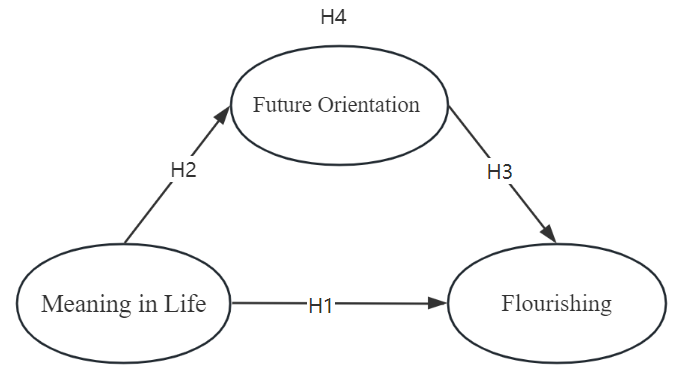
This investigation contributes to the development of positive psychology through three theoretical innovations. First, it introduces a temporal dimension to meaning-flourishing research, addressing the field’s longstanding neglect of time perspectives. Second, it integrates Eastern cultural perspectives on interconnectedness with Western models of well-being. Third, it identifies malleable intervention targets (i.e., MIL-FO pathways) for culturally adapted programs, which is a critical need given the escalating student mental health challenges among Chinese students. By bridging conceptual and cultural divides, this study offers a framework for understanding how existential purpose, when coupled with future time perspectives, can unlock flourishing in high-stress developmental contexts.
Method and materials
The research employed a quantitative correlational design to investigate the predictive relationships among MIL, FO, and flourishing. Furthermore, this study explored both the direct and indirect relationships between MIL and flourishing from a mediation perspective. The study targeted undergraduates across China, requiring participants to be (1) active and registered at a university in mainland China, (2) above 18 years old, and (3) Chinese nationals. Based on Krejcie and Morgan’s (1970) formula, a population of 19,6 million registered undergraduates (Yao, 2023) requires at least 384 participants for the sample. To ensure validity, 480 responses were collected. Using multistage cluster sampling, six universities from different regions of China were selected, and 12 classes were conveniently sampled. After excluding invalid data, there were 445 participants (82,3% female; age range 18-24 years; Mean = 20,39; SD = 1,42). Class levels were represented as follows: freshmen (23,4%), sophomores (43,4%), juniors (24,9%), and seniors (8,3%). Regional distribution spanned East (18%), North (17,7%), Southwest (17,3%), South Central (16,1%), Northeast (15,9%), and Northwest China (15%). Online questionnaires created on Wenjuanxing were shared by class lecturers, who briefed students on the study and invited them to voluntarily participate. Participants provided informed consent, completed the survey, and received the researcher’s contact information for follow-up.
The current study utilized the PERMA-Profiler (Butler, Kern, 2016), Meaningful Life Measure-Chinese Revised (Xiao et al., 2017), and Future Orientation Questionnaire for Adolescents (Liu et al., 2011). All three measurements used validated Chinese versions.
PERMA-profiler
The level of flourishing was measured using the PERMA-Profiler (Butler, Kern, 2016), which was developed based on M.E. Seligman’s (2011b) PERMA model. The 15-item scale comprised five dimensions: positive emotion, engagement, positive relationships, meaning, and accomplishment. Each question was rated on an 11-point Likert scale. Previous research has demonstrated that the PERMA-Profiler is a useful tool among Chinese EFL university students (Yang, Saad Mohd, 2021). The Cronbach’s alpha value in the current study was 0,944, reflecting good internal consistency.
Meaningful life measure-Chinese revised
The Meaningful Life Measure-Chinese Revised (MLM-CR) (Xiao et al., 2017) was used to measure the level of understanding that undergraduate students had about their life’s purpose, the value of their existence or their significance. The scale consisted of 23 items, covering five dimensions, including exciting life, accomplished life, principled life, purposeful life, and valued life. The total MIL score was the sum of scores across all five dimensions (Xiao et al., 2017). Item scores ranged from 1 to 7, with “1” representing “strongly disagree” and “7” representing “strongly agree”. The MLM-CR demonstrates good psychometric qualities for a comprehensive evaluation of the personal MIL of Chinese university students. In the current study, Cronbach’s alpha value for internal consistency was 0,929.
Future orientation questionnaire for adolescents
The current study used the Future Orientation Questionnaire for Adolescents (Liu et al., 2011) to measure undergraduates’ cognitive preferences and action tendencies as well as their subjective emotional experiences towards future time. It contained 31 items within three domains, including perception about the future, emotion about the future, and will to execute a plan. The five-point scale ranged from “1 = completely disagree” to “5 = completely agree”. In the current study, the internal consistency had a Cronbach’s alpha value of 0,919.
SPSS was adopted to analyze the descriptive data and correlations among the variables. Prior to the data analysis, tests for linearity, normality, and multicollinearity were conducted, and all assumptions were confirmed. Pearson correlation analysis was applied to determine the key variables’ correlation coefficients (Faizi, Alvi, 2023). To test the mediating effect of FO on the relationship between MIL and flourishing, the model of the study was run through the SPSS PROCESS macro (Sürücü et al., 2023), and Bootstrap samples were set at 5000.
Result
Level of the variables
The mean score of MIL was 110,75 (SD = 18,43), which fell within the 25th and 75th percentiles on the distribution of scores, indicating that most undergraduates had a moderate level of MIL. Similarly, most undergraduates in China had moderate levels of FO and flourishing, with mean scores of 104,57 (SD = 15,71) and 113,33 (SD = 19,86), respectively. Additionally, the results support the notion that well-being ratings are usually skewed towards the positive end, with a median of about 6,5 to 7,5 (Butler, Kern, 2016). On the other hand, the results of the t-test and one-way ANOVA showed no significant differences in MIL, FO, and flourishing based on gender, year of study, and university location.
Correlations between the variables
Based on the result of the Pearson correlation, all the variables (MIL, FO, and flourishing), were significantly correlated, ranging from 0,652 to 0,793 (p < 0,01). Based on the psychology field (Faizi, Alvi, 2023), these results suggest that there are significant, strong relationships between FO and MIL, and between MIL and flourishing, while there is a significant but moderate relationship between FO and flourishing. The correlation coefficients are presented in Table 1.
Table 1
Correlations of the three variables
|
|
1 |
2 |
|
1. MIL |
|
|
|
2. FO |
0,793** |
|
|
3. Fl |
0,750** |
0,652** |
Note: **p < 0,01, MIL = Meaning in Life, FO = Future Orientation, Fl = Flourishing.
Regression and mediation analysis
The study utilized PROCESS macro in SPSS to conduct regression and mediation analysis. The results revealed that MIL significantly predicted FO (B = 0,68, SE = 0,02, p < 0,001), which in turn significantly predicted flourishing (B = 0,19, SE = 0,06, p < 0,01), while MIL also directly predicted flourishing (B = 0,68, SE = 0,06, p < 0,001). The total effect of MIL on flourishing was significant (B = 0,81, SE = 0,03), confirming that both direct and indirect pathways contributed to the relationship. The indirect effect of MIL on flourishing through FO was significant (B = 0,13, SE = 0,05, 95% CI [0,038; 0,222]), indicating a partial mediation (see Table 3).
The ratio of the indirect to total effect was 0,1622, suggesting that 16,22% of MIL’s impact on flourishing was mediated by FO, while MIL maintained a substantial direct effect. Additionally, the R² mediation effect size was 0,4164, indicating that 41,64% of the variance in flourishing was explained by the indirect pathway. The model’s explanatory power was strong, with R² values of 0,57 for MIL → flourishing, 0,63 for MIL → FO, and 0,57 for FO → flourishing (see Table 2). These findings confirm that FO plays a mediating role in the relationship between MIL and flourishing, with MIL also exerting a direct influence on flourishing. This highlights the complexity and significance of this psychological mechanism. As a result, all the hypotheses in the current study were verified.
Table 2
Path analysis
|
Hypothesis |
B |
SE |
T |
p |
R² |
LLCI |
ULCI |
Decision |
|
H1: MIL → Fl |
0,68 |
0,06 |
12,03 |
<0,001 |
0,57 |
0,569 |
0,786 |
Accept |
|
H2: MIL → FO |
0,68 |
0,03 |
27,39 |
<0,001 |
0,63 |
0,627 |
0,724 |
Accept |
|
H3: FO → Fl |
0,19 |
0,06 |
3,00 |
<0,01 |
0,57 |
0,067 |
0,321 |
Accept |
Note: MIL = Meaning in Life, Fl = Flourishing, FO = Future Orientation.
Table 3
Mediation analysis
|
Model |
B |
SE |
LLCI |
ULCI |
Decision |
|
Total effect of MIL on Fl |
0,81 |
0,03 |
0,742 |
0,875 |
Accept |
|
Direct effect of MIL on Fl |
0,68 |
0,06 |
0,569 |
0,7866 |
Accept |
|
Indirect effect (H4: MIL→FO→Fl) |
0,13 |
0,05 |
0,038 |
0,222 |
Accept |
Note: MIL = Meaning in Life, Fl = Flourishing, FO = Future Orientation.
Discussion
From the results, there are several interpretations worth discussing. The results demonstrated that MIL exerted both direct and indirect influences on flourishing through FO among Chinese undergraduates through culturally distinct mechanisms. First, the robust direct pathway confirms MIL’s intrinsic role as the cornerstone of flourishing across cultures. This result is in line with findings among Western and Eastern counterparts (Fischer et al., 2021; Noordzij et al., 2024), which may reflect that both collective and individualistic cultural scripts can transfer meaning and purpose in life to well-being, especially among late adolescents.
Second, the path from MIL to FO was significant and substantial, indicating that people who believe their lives are purposeful are more likely to have an optimistic and goal-oriented attitude towards the future. The finding aligns with several theoretical frameworks within positive psychology and developmental psychology. For example, meaning in life fosters a forward-looking perspective, which is essential for motivation and goal setting (Batthyány, 2024). This result is also consistent with past empirical studies. Miao et al. (2021) suggested that meaning in life activates a future-oriented coping function. Additionally, people with a strong sense of meaning are more resilient and optimistic, which translates into proactive future-oriented behaviors (Miconi et al., 2022).
Third, FO’s small but significant indirect effect on the relationship between MIL and flourishing suggests a nuanced mediating mechanism. While MIL encourages future planning and goal setting, where the processes aligned with previous findings that FO enhances well-being (Felaco, Parola, 2022), its modest explanatory power implies that FO acts as a secondary pathway rather than a dominant driver. However, this does not negate FO’s relevance but contextualizes it: MIL’s broader influence on flourishing likely operates through multiple unmeasured channels, such as emotional regulation, social connectedness, or existential security (Van Tongeren, Showalter Van Tongeren, 2021). The limited mediation effect may also reflect cultural specificity. For Chinese undergraduates, FO is often shaped by China’s high-pressure educational environment, where future goals are frequently tied to academic competition and familial obligations rather than personal autonomy (Chen et al., 2023). This contrasts with Western contexts that emphasize self-directed, aspirational future orientations (Seginer, 2009). Consequently, FO’s mediating potential may be attenuated when students perceive future planning as a source of stress rather than hope, which is a critical boundary condition for applying Western theoretical models in collectivist settings.
Conclusion
This study reveals that MIL enhances flourishing primarily by fostering FO, which involves proactive planning and goal setting. The mediation analysis demonstrates a clear pathway: individuals who perceive their lives as meaningful are more likely to develop a positive outlook, which in turn contributes to their overall well-being. This finding extends the PERMA well-being model by emphasizing the role of FO as a bridge between existential meaning and holistic flourishing. Importantly, while the direct effect of MIL on flourishing remains strong, the identified indirect effect through FO suggests that interventions targeting future planning may amplify the benefits of meaning-centered practices. These results highlight the necessity of integrating temporal dimensions into frameworks of well-being, particularly for populations like undergraduates who are navigating both identity and life goals. Future research should explore whether this mechanism holds across diverse cultural contexts or life stages, and investigate additional psychological processes (e.g., resilience, self-efficacy) that may further explain how MIL translates into flourishing.
From a practical perspective, this study underscores the importance of interventions and strategies aimed at promoting both MIL and FO to enhance undergraduates’ well-being. Therapeutic approaches such as logotherapy (Wimberly, 2024), which focus on helping individuals find meaning in their lives, could be complemented by interventions designed to foster future-oriented thinking and goal setting. For example, therapists could incorporate techniques such as visualization exercises (Mertens et al., 2022), goal-setting activities, and action planning (Ingebrigtsen, 2022) to help clients develop a sense of purpose and direction for the future. Similarly, educational programs and workshops could emphasize the significance of meaningful goal pursuit and future planning in promoting personal growth and flourishing.
Additionally, future-oriented interventions should be implemented among undergraduates. Such interventions promote future-oriented thinking by enhancing future self-identification (Mertens et al., 2022), increasing future-oriented coping (Huang et al., 2021), and improving positive emotions related to the future, foresee their future in a cheerful and optimistic way, such as through the Best Possible Self intervention (Heekerens, Eid, 2021). Meanwhile, the modest role of FO mirrors studies showing that excessive future focus in China may actually exacerbate anxiety, suggesting that FO interventions must be culturally adapted to mitigate stress. Interventions aiming to enhance flourishing should prioritize cultivating MIL directly, while supplementing FO-focused strategies rather than relying on FO alone as an intermediary.
Recommendations for future research
Future studies could extend the present findings in several important directions. First, as this study employed a solely quantitative research design, incorporating qualitative methods or adopting a mixed-methods approach would provide more comprehensive insights. Additionally, the cross-sectional design limits causal interpretations, given that data were collected at a single point in time. Although meaningful associations were observed, temporal or causal relationships remain uncertain. Consequently, longitudinal research is recommended to more rigorously test the causality among these variables. Second, future studies should consider other potential variables that may influence relationships within the proposed mediation model. By controlling for these variables or examining their moderating roles, researchers could gain a better understanding of the underlying mechanisms linking meaning in life, future orientation, and flourishing. Finally, the reliance on self-report measures may have introduced social desirability bias, as respondents may not always provide truthful answers. These measures are also inherently subjective, relying on individual perceptions that may vary significantly. Thus, employing a broader arrange of assessment methods, including behavioral observations or third-party ratings, could address these concerns and strengthen the validity of future research outcomes.