Introduction
Artificial Intelligence (AI) is exerting an increasingly significant influence on educational activities, transforming student learning, teaching practices, and assessment procedures (Davis, 1989). As AI applications continue to expand within educational processes, the importance of integrating AI into learning environments grows accordingly, necessitating both technical and psychological adaptation among all participants in educational activities to effectively utilize these technologies (Tankevitch et al., 2023). Against the backdrop of this transformation, researchers have devoted particular attention to the cognitive and metacognitive aspects of students’ interactions with digital learning environments (Schepman, Rodway, 2022; Azevedo, Cromley, 2004). Despite the recognized effectiveness of intelligent educational assistants, studies have documented cognitive dissonances associated with distrust, decreased motivation, and heightened anxiety (Lan, Zhou, 2025). These findings support the assumption that barriers to AI adoption may emerge at the level of subjective attitudes toward AI technologies even among individuals with high levels of technological competence (Fan et al., 2024). A contradiction can be observed between the rational acknowledgment of AI benefits and emotional apprehension manifested in fears of losing control or diminishing learner agency (Dahri et al., 2024).
Particular interest lies in examining the structure of attitudes toward AI, which can be conceptualized as comprising cognitive, affective, and behavioral components (Binbasaran-Tuysuzoglu, Aydin, 2014). Research indicates that these components are closely associated with broader technological orientations, including technophilia and technophobia (D’Mello, Graesser, 2015). A predisposition toward technological openness tends to facilitate more positive evaluations of AI-assisted interactions, whereas pronounced technophobia may serve as a factor contributing to the avoidance of digital learning tools (Azevedo, Cromley, 2004).
According to contemporary models of learning that account for patterns of educational activity in digital environments, the effectiveness of learning increasingly depends on learners’ agency and reflective capacities (Azevedo et al., 2010). Approaches grounded in social-cognitive theory emphasize the role of metacognitive awareness as a necessary condition for the successful use of AI as a learning tool (Zimmerman, 2000). Empirical evidence suggests that students characterized by proactive self-regulation demonstrate stable strategies for purposeful use of intelligent prompts, particularly for planning, monitoring, and evaluating learning progress (Abdelshiheed et al., 2023). In contrast, learners relying on reactive regulatory strategies often engage with such tools only situationally or formally, thereby reducing their effectiveness (Mazari, 2025). Similar conclusions have been reported in studies of adaptive educational platforms in higher education settings, where metacognitive deficits reduced student engagement despite the presence of technological advantages (D’Mello, Graesser, 2015).
AI systems integrated into learning management systems provide a variety of educational tools, ranging from simple contextual prompts to sophisticated forms of analytical support capable of adapting to user behavior (Huang et al., 2024). However, it is critical to recognize that the effectiveness of AI components depends not only on system architecture but also on students’ readiness to interact with digital technologies as metasubject instruments for development (Dunlosky, Metcalfe, 2009). Consequently, understanding the psychological determinants underlying students’ selection and use of AI tools in educational activities has become central to the design of contemporary educational systems. One such determinant may be students’ attitudes toward the use of AI technologies as tools for educational activity. According to Schepman and Rodway, attitudes toward AI constitute a complex disposition encompassing both technological enthusiasm and trust, as well as critical apprehension (Schepman, Rodway, 2022). A similar perspective is expressed by Russian researchers, who argue that attitudes toward digital technologies may be inherently ambivalent, simultaneously incorporating elements of technological optimism and digital anxiety that coexist within a complex structure of individual technological adaptation (Soldatova et al., 2021).
Several contemporary studies have attempted to operationalize attitudes toward AI (Chen et al., 2020). For example, the Artificial Intelligence Attitude Scale (Aktay, Gok, Yildirim, 2024) includes three subscales (“Benefits of AI”, “Risks of AI”, and “Use of AI”); however, the rationale underlying the distinction between these dimensions remains unclear. The Attitude Towards Artificial Intelligence Scale (Sindermann et al., 2020) comprises two subscales: “Acceptance of AI” and “Fear of AI.” Similarly, the General Attitudes toward Artificial Intelligence Scale (GAAIS) includes two analogous dimensions (Schepman, Rodway, 2022) and is widely used in studies examining the digital transformation of various spheres of life (e.g., Yang, Xia, 2023).
Thus, contemporary instruments for assessing attitudes toward AI primarily employ bipolar dimensions aimed at identifying levels of AI acceptance and AI-related concerns. However, existing scales generally do not fully reflect the educational experiences of students, as they address attitudes toward AI within broader life contexts. At the same time, attitudes toward AI in education may possess unique characteristics resulting from AI’s influence on various aspects of the educational process, including assessment automation, individualized learning pathways, accessibility of educational resources, and changes in students’ cognitive activity. Furthermore, ethical considerations regarding the use of AI technologies in education have become increasingly prominent (Lim, 2025), highlighting the need for assessment tools specifically designed to evaluate attitudes toward AI as a means of educational activity.
The development of AI technologies in education requires a more precise conceptualization of the psychological constructs describing students’ attitudes toward such tools. International studies indicate that attitudes toward AI are not unidimensional but instead include both acceptance and trust as well as doubt, caution, and cognitive tension (Azevedo, 2005; Moon, 2020). Although several instruments have been developed to assess general orientations toward AI, only a limited number distinguish between positive attitudes and more complex forms of apprehension that emerge during educational use.
Drawing upon theoretical models of self-regulation (Winne, 1996; Corno, 1986) and studies examining perceptions of digital technologies (White, 2005; Binbasaran-Tuysuzoglu, 2014), it can be assumed that students develop two relatively independent components of attitude toward AI: (1) a positive perception of AI benefits, including accessibility, learning support, and workload reduction; and (2) apprehension associated with risks such as excessive dependence, reduced effort, or doubts regarding the reliability of automated systems. However, empirical evidence suggests that these two components may not manifest symmetrically. As demonstrated by the development and psychometric evaluation of the present questionnaire, statements intended to measure apprehension were frequently interpreted by students through an inverse logic—not as expressions of anxiety or risk, but rather as a contrasting background for more positive evaluations. As a result, the statistically most valid model was represented by a scale whose scores increased as apprehension decreased.
Accordingly, the final version of the instrument includes two scales: “Positive Attitudes toward AI”, reflecting perceptions of usefulness and benefits, and “Absence of Apprehension toward AI”, consisting of reverse-coded items that capture the degree to which apprehension, doubt, and concern are reduced. This structure provides a valid representation of the specific ways in which students perceive AI technologies. Although apprehension remains an important aspect of attitudes toward AI, its empirical assessment within a questionnaire format requires reverse coding. These interpretative characteristics were subsequently incorporated into the scoring procedure, data analysis, and discussion of findings.
Based on these considerations, the purpose of the present study was to develop and provide psychometric validation for the questionnaire “Students’ Attitudes toward the Use of Artificial Intelligence Technologies in Educational Activities”, designed to account for the specific characteristics of AI technologies when used as tools for educational activity.
The study hypothesized that attitudes toward AI as an educational tool would exhibit a two-factor structure consistent with findings from studies investigating attitudes toward AI beyond educational contexts. Specifically, attitudes toward AI were expected to represent a multidimensional construct encompassing both positive orientations (e.g., trust, effectiveness, and technological optimism) and elements of apprehension (e.g., anxiety, reduced autonomy, and distrust of algorithms).
The classical three-component model of attitude (Allport, 1935; Rosenberg, Hovland, 1960), according to which attitudes comprise cognitive, affective, and behavioral components, implies that questionnaire items should address not only rational evaluations of AI opportunities and risks in education but also the emotional responses and potential behavioral tendencies associated with these evaluations.
These considerations served as the basis for the development of the questionnaire, the process of which is described in detail in the next section of the article.
Materials and methods
The empirical study consisted of three stages: (1) item generation and expert evaluation of the questionnaire’s content validity; (2) a survey study aimed at assessing the main psychometric properties of the instrument; and (3) a repeated survey study conducted to evaluate test–retest reliability.
At the first stage, an initial pool of 29 items was developed based on the content of the Attitude Towards Artificial Intelligence Scale (Sindermann et al., 2020), which possesses a two-factor structure corresponding to the underlying theoretical construct. Eleven experts specializing in pedagogy, educational psychology, and digital technologies were recruited to evaluate the questionnaire. The experts assessed the clarity and comprehensibility of each statement using a 5-point Likert scale. Mean scores (M) and standard deviations (SD) were calculated for each item. Six items with scores below the established threshold (M − SD) were excluded, and several statements were revised in accordance with expert feedback.
At the second stage, data were collected through an online survey administered using Google Forms. All participants provided informed consent prior to participation. Data were collected anonymously and processed in accordance with established ethical standards for scientific research. The sample consisted of 503 students enrolled in various levels of higher and secondary vocational education. The sample encompassed all major levels of academic training. The largest subgroup comprised specialist-degree students (n = 295, 58,6%), followed by students enrolled in secondary vocational education programs (n = 105, 20,9%). Undergraduate students accounted for 68 participants (13,5%), master's students for 26 participants (5,2%), and doctoral students for 9 participants (1,8%). Women constituted 54,3% of the sample, whereas men represented 45,7%. Participants ranged in age from 17 to 32 years, with a median age of 20 years. The sample included students from psychology and education, engineering, medical sciences, humanities, and information technology programs.
Empirical data were collected using the preliminary version of the questionnaire Students’ Attitudes Toward the Use of Artificial Intelligence Technologies in Educational Activities. The initial version consisted of 23 items and was subsequently reduced to 20 items during psychometric validation. Responses were recorded on a 5-point Likert scale. Participants also completed the Technophobia and Technophilia Questionnaire (TTQ) developed by Soldatova et al. (2021).
At the third stage, conducted three months after the primary survey, a test–retest procedure was performed on a subsample of 21 students. Participants completed the final 20-item version of the questionnaire Students’ Attitudes Toward the Use of Artificial Intelligence Technologies in Educational Activities.
Statistical analyses were conducted using SPSS and Python software, including the factor_analyzer, pandas, and matplotlib libraries. Preliminary assessment of data suitability for factor analysis involved the Kaiser–Meyer–Olkin (KMO) measure of sampling adequacy and Bartlett’s test of sphericity. Exploratory factor analysis (EFA) was subsequently performed using principal axis factoring with Varimax orthogonal rotation. To verify the factor structure, confirmatory factor analysis (CFA) was conducted. Internal consistency was evaluated using Cronbach’s alpha coefficients.
To assess concurrent validity, correlation coefficients were calculated between the questionnaire scales and external variables represented by the dimensions of the Technophobia and Technophilia Questionnaire. It was hypothesized that the Positive Attitude toward AI factor would demonstrate positive correlations with technophilia, whereas the AI Apprehension factor would be positively associated with technophobia. Correlation analysis was also employed to evaluate the test–retest reliability of the questionnaire.
Scoring Procedure. Scale scores were calculated as the sum of responses to the corresponding questionnaire items. All items were rated on a 5-point Likert scale ranging from 1 (“strongly disagree”) to 5 (“strongly agree”). The second scale, Absence of Apprehension toward AI, was constructed from reverse-worded items. To obtain an interpretable measure, responses to these items were reverse-coded using the formula: Reversed score = 6 − raw score. Following reverse coding, higher scores indicate lower levels of apprehension and a more positive attitude toward AI, whereas lower scores reflect greater apprehension, doubt, and concern regarding the use of AI technologies.
Results
The expert evaluation of the questionnaire items included in the initial version of the instrument demonstrated that the mean expert rating of item clarity was M = 3,64 with a standard deviation of SD = 0,71, indicating an overall acceptable level of comprehensibility. Based on expert feedback, several item formulations were revised. For example, the statement “AI in education may lead to an ambiguous perception of the teacher’s role” was reformulated as “Excessive use of AI in education may reduce the significance of teachers’ work, as key instructional and feedback functions become delegated to automated systems”. Item 10, originally formulated as “The use of AI in education affects students’ learning motivation, although it is not always clear how”, was revised to “Because of AI, students become less responsible for their learning outcomes”. Item 21, initially stated as “AI either facilitates or hinders the development of students’ independent learning skills”, was reformulated as “AI deprives students of opportunities for independent information search”. As a result of the expert review process, the preliminary version of the questionnaire consisted of 23 items.
To identify the latent structure of the instrument, an exploratory factor analysis (EFA) was conducted on the 23-item version of the questionnaire. Prior to factor extraction, the suitability of the data for factor analysis was assessed. The Kaiser–Meyer–Olkin measure of sampling adequacy was 0,84, indicating a high level of adequacy of the correlation matrix for factorization. In addition, Bartlett’s test of sphericity was statistically significant (p < 0,001), confirming the presence of an underlying factor structure. Although preliminary indicators, including eigenvalues and inspection of the scree plot, suggested the possibility of a three-factor solution, the number of factors was fixed at two. This decision was guided by the intention to preserve the theoretically grounded bipolar structure of the questionnaire. Consequently, two stable factors emerged: (1) a factor comprising statements related to the usefulness, interactivity, and personalization capabilities of AI in education, labeled Positive Attitude toward AI, and (2) a factor including statements concerning the risk of loss of control, reduced learning motivation, and other potential negative consequences of AI use, labeled Absence of Apprehension toward AI. The EFA also served to evaluate item quality according to the following criteria: factor loadings of at least 0,30 and the absence of substantial cross-loadings. Through an iterative procedure involving the removal of items that failed to meet these criteria and recalculation of the factor structure after each step, the questionnaire was reduced to a final set of 20 items. The final exploratory factor solution revealed a two-factor structure accounting for 47,6% of the total variance (see Table 1).
Table 1
EFA results (N = 503)
|
Statements |
Factor 1 |
Factor 2 |
|
0,66 |
0,17 |
|
0,65 |
-0,04 |
|
0,23 |
0,38 |
|
0,08 |
0,77 |
|
0,14 |
0,48 |
|
0,64 |
-0,01 |
|
0,57 |
0,13 |
|
0,14 |
0,54 |
|
0,62 |
0,28 |
|
-0,06 |
0,79 |
|
0,68 |
0,16 |
|
0,68 |
0,05 |
|
0,09 |
0,41 |
|
0,65 |
-0,02 |
|
0,68 |
0,13 |
|
0,69 |
-0,05 |
|
-0,07 |
0,32 |
|
0,09 |
0,73 |
|
0,08 |
0,71 |
|
-0,11 |
0,54 |
|
Expl.Var |
4,39 |
3,63 |
|
Prp.Totl |
0,22 |
0,18 |
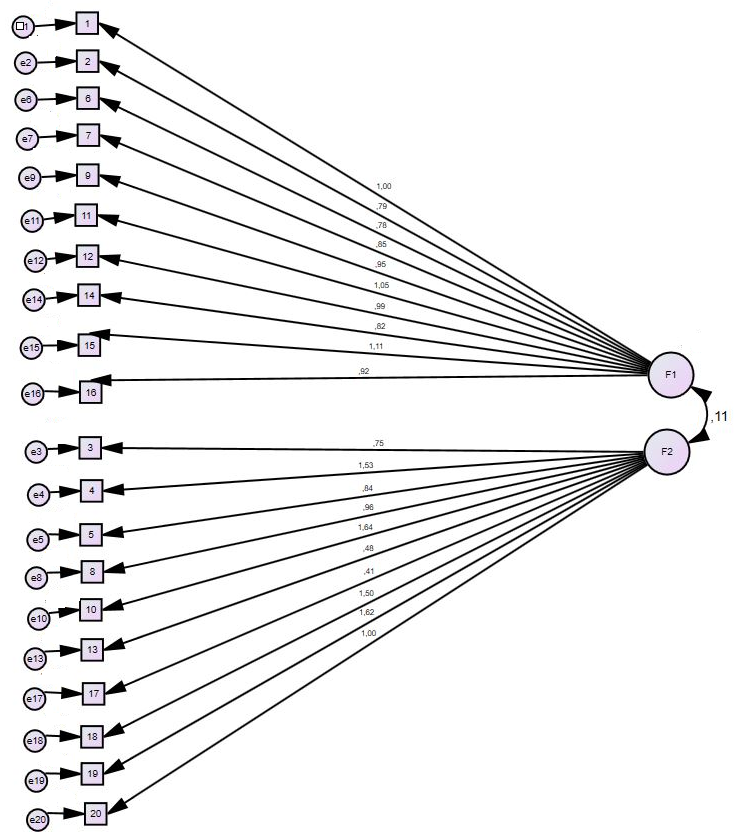
The next step involved testing the two-factor structure of the questionnaire using confirmatory factor analysis (CFA). The purpose of this stage was to evaluate the extent to which the empirical data fit the hypothesized model consisting of two latent variables: Positive Attitude toward AI and Absence of Apprehension toward AI. The model included the 20 items retained following the exploratory factor analysis, with each item specified to load on only one latent factor. The analysis was conducted using the Maximum Likelihood (ML) estimation method. Modification indices, residual correlations, and error distributions were additionally examined to evaluate potential sources of model misfit. The results of the CFA supported the adequacy of the proposed two-factor model. The chi-square to degrees of freedom ratio was χ²/df = 433,8/169 = 2,57, indicating an acceptable level of model fit. Furthermore, the comparative fit indices demonstrated good correspondence between the hypothesized model and the observed data, with CFI = 0,94 and TLI = 0,92. The RMSEA value of 0,06 also suggested an acceptable approximation of the model to the data structure (see Figure 1). Overall, the CFA findings provided empirical support for the proposed two-factor structure of the questionnaire and confirmed that the retained items adequately represented the latent constructs of Positive Attitude toward AI and Absence of Apprehension toward AI.
Subsequent analyses demonstrated that both questionnaire scales exhibited high internal consistency. Cronbach’s alpha coefficients were 0,84 for the Positive Attitude toward AI scale and 0,87 for the Absence of Apprehension toward AI scale.
To assess the concurrent validity of the questionnaire, correlation analyses were conducted between the two identified scales and the principal subscales of the Technophobia and Technophilia Questionnaire (TTQ). The results are presented in Table 2 as a correlation matrix showing the strength and direction of relationships among the variables. The Positive Attitude toward AI scale demonstrated a strong positive correlation with technophilia (r = 0,58), as well as moderate positive correlations with technorationalism (r = 0,32) and technopessimism (r = 0,41). The interpretation of correlations involving the Absence of Apprehension toward AI scale requires consideration of its scoring procedure. Since all items included in this scale were reverse-worded and transformed prior to score calculation using the formula 6 − raw score, the resulting scale score reflects lower levels of apprehension toward AI rather than greater apprehension. Consequently, the observed positive correlation between this scale and technophobia (r = 0,52) indicates that higher scores correspond to lower apprehension, whereas lower scores reflect greater apprehension toward AI technologies. This clarification allows for the correct interpretation of the observed relationships and prevents confusion between raw item responses and reverse-coded scale scores. Overall, the pattern of correlations provides evidence supporting the concurrent validity of the questionnaire and is generally consistent with the theoretical assumptions underlying its development.
Table 2
Correlation matrix reflecting the strength and direction of the relationships between the scales of the questionnaires “Students’ attitudes towards the use of artificial intelligence technologies in educational activities” and TTQ (N=503)
|
Indicators |
AI Positive Attitude Scale |
AI Absence of Apprehension Scale |
|
Technophilia |
0,58* |
- 0,15* |
|
Technorationalism |
0,32* |
0,12* |
|
Technopessimism |
0,41* |
- 0,09* |
|
Technophobia |
-0,25** |
0,52** |
Note: «*» — p < 0,001, «**» — p < 0,05.
Final scores for the Absence of Apprehension toward AI scale were calculated using reverse coding of all corresponding items according to the formula 6 − raw score. Higher values indicate lower levels of apprehension toward AI, whereas lower values reflect greater apprehension. All correlations reported for this scale were calculated using the reverse-coded composite scores.
The assessment of test–retest reliability revealed strong associations between the scores obtained during the initial and follow-up measurements. Statistically significant positive correlations were observed both at the level of individual items (r = 0,52–0,76, p < 0,05) and at the level of the overall factor scores. For the Positive Attitude toward AI scale, the test–retest correlation coefficient was r = 0,71 (p < 0,001), whereas for the Absence of Apprehension toward AI scale, the corresponding coefficient was r = 0,68 (p < 0,001).
These findings indicate satisfactory temporal stability of the questionnaire and suggest that the measured constructs remain relatively consistent over time.
At the final stage of the analysis, descriptive statistics were calculated for both questionnaire scales (see Table 3).
Table 3
Descriptive statistics of scales
|
Scales
|
Mean
|
Standard Deviation
|
Minimum
|
Maximum |
|
Positive Attitude toward AI |
34,05 |
4,86 |
14 |
46 |
|
Absence of Apprehension toward AI |
32,63 |
5,54 |
13 |
49 |
An analysis of descriptive statistics revealed that for the Positive Attitude Toward AI scale, the mean score was M = 34,05 (SD = 4,86), with scores ranging from 14 to 46 points. For the Absence of Apprehension Toward AI scale, the mean score was M = 32,63 (SD = 5,54), ranging from 13 to 49 points. The final version of the questionnaire is provided in the appendix to this article.
Discussion
The developed model, which underlies the study “Student Attitudes Toward the Use of Artificial Intelligence Technologies in Educational Activities”, proposed the existence of two interrelated but opposing factors reflecting the poles of students' attitudes toward artificial intelligence as an educational tool. The results confirm the two-factor structure of students' attitudes toward the use of artificial intelligence technologies in educational activities. The first scale reflects the severity of rationally and emotionally positive attitudes. The second scale is a reversed form of statements originally describing caution, anxiety, or doubts regarding the use of AI. It is important to emphasize that higher scores on this scale are interpreted as a decrease in caution. This conclusion is consistent with the observed trend in the data, whereby statements formulated in a negative modality functioned empirically as a counterpoint to positive attitudes, rather than as an independent negative attitude.
These results are consistent with modern models for measuring attitudes toward artificial intelligence presented in international studies. Thus, the two-factor structure of the questionnaire we developed (“Positive Attitude Toward AI” and “Absence of Apprehension toward AI”) correlates with the structure of the GAAIS (Schepman, Rodway, 2022) and ATAI (Sindermann et al., 2020) scales, as well as (in terms of modal scales) with the AIAS (Aktay, Gök, Yıldırım, 2024). In our study, apprehension manifests itself in a more subtle form and requires reverse coding for adequate interpretation, which is supported by both the results of the factor analysis and the confirmatory model.
Furthermore, the results obtained during the concurrent validity test of the questionnaire confirm the complexity of the individual structure of technological adaptation (Soldatova, 2021). Thus, in addition to the theoretically expected correlation profile of the scales of the questionnaire we developed with the TTQ measures, a seemingly paradoxical correlation was found between the positive attitude scale and technopessimism. It is likely that, although technopessimism is not formally included in the technophilic attitudes cluster, it may contain elements of rational skepticism associated with selective trust in technology. In this case, technopessimism may not contradict technological optimism, but rather indicate the presence of rational skepticism in assessing AI, while maintaining a general orientation toward the use of digital tools. In other words, a positive attitude does not preclude a critical perception of the potential risks of AI, which is consistent with the concept of “informed optimism”, where subjective acceptance of a technology is combined with an awareness of its potential limitations.
The nature of the correlations discovered deserves special attention. The indicator of reduced apprehension demonstrates positive correlations with technological trust and negative correlations with indicators of technophobia, which is consistent with theoretical expectations. However, the strength of these relationships is weaker than that of the positive attitude scale, suggesting that apprehension toward AI is weaker and less structured than a positive attitude. This is consistent with research on digital anxiety, which shows that moderate mistrust or doubt may not be an independent, stable attitude, but rather reflect situational reactions to changes in the learning environment.
Taken together, the results confirm that students' attitudes toward AI in educational activities are characterized by a predominance of positivity and moderate apprehension. This profile is consistent with the adaptive technological openness model, in which users recognize the tool's potential but remain critical in assessing risks and limitations. From the perspective of practical AI implementation in education, this suggests that improving the effectiveness of AI tools is possible not only through expanding the functionality of systems but also through developing students' metacognitive skills that facilitate conscious and autonomous use of digital tools.
The interpretation of the “Absence of Apprehension toward AI” scale requires further clarification. This scale is formed from reversed statements; therefore, a higher final value after reversal reflects reduced apprehension and a more positive attitude toward the use of AI technologies. We retained the substantive connection of this scale with the construct of apprehension, but emphasize the need to consider the direction of coding when analyzing and comparing results. For practical use, we recommend that researchers either indicate the direction of coding directly in tables or use already reversed values.
An analysis of descriptive statistics revealed differences in student attitudes toward the use of AI technologies in educational activities, reflecting both general trust in AI and the presence of critical expectations regarding its application in education. Positive attitudes slightly outweigh cautious ones, which is generally consistent with the literature on student attitudes toward AI (Sindermann et al., 2020). It should be emphasized that the range of responses indicates significant individual differences and confirms the validity of using the questionnaire as a diagnostic tool sensitive to individual differences in attitudes toward AI. Overall, the obtained data confirm the ambivalence of students' attitudes toward AI: the sample simultaneously exhibits technological optimism and expressed concerns about the consequences of the digitalization of education.
Conclusions
The findings of the present study supported the hypothesis that students’ attitudes toward the use of artificial intelligence in educational activities can be described through a two-factor model comprising both acceptance and apprehension components. Exploratory and confirmatory factor analyses made it possible to identify and confirm the presence of two stable latent variables: positive attitude toward AI, reflecting trust, perceptions of effectiveness, and the personalization potential of technologies, and apprehension, expressing doubts about fairness, ethics, and autonomy in the context of integrating AI technologies into education.
The ambivalent attitudes observed among students reflect a broader trend associated with digital adaptation. On the one hand, students demonstrate openness toward technological innovation; on the other hand, they remain aware of the potential risks and challenges accompanying the widespread adoption of AI technologies. This bipolar structure of attitudes is particularly important in the context of designing and evaluating educational systems that incorporate AI components, as positive perceptions of AI may coexist with substantial levels of uncertainty, concern, and skepticism. The questionnaire developed in the present study may be applied in a variety of research contexts related to the digital transformation of education.
In particular, it provides opportunities for monitoring processes occurring within universities and colleges, especially with regard to assessing students’ readiness to interact with intelligent digital assistants and adaptive learning platforms. Furthermore, the instrument may be used for both cross-group and cross-cultural comparisons, as well as for examining the dynamics of students’ digital socialization in longitudinal studies. In applied assessment contexts, the questionnaire may serve as a foundation for constructing a learner’s digital profile, with particular emphasis on trust in AI-based components integrated into educational environments. Future research should focus on expanding the empirical basis of validation by including students from different educational levels and academic disciplines. Another promising direction involves integrating the questionnaire into comprehensive assessments of educational trajectories using digital trace data. Of particular interest are studies examining the relationships between attitudes toward AI and students’ self-regulation strategies, motivational characteristics, and metacognitive processes. Such research may contribute to the development of evidence-based personalized approaches to the implementation of intelligent technologies in education.
Limitations. Several limitations should be acknowledged. First, although the primary sample was relatively large, the assessment of test–retest reliability was conducted on a comparatively small subsample, which may limit the robustness of conclusions regarding the temporal stability of the instrument. Second, the study relied exclusively on self-report data collected through an online survey. Consequently, the findings may be influenced by response biases, including social desirability effects, subjective interpretation of questionnaire items, and other sources of self-report measurement error. Future studies employing larger retest samples and incorporating behavioral or performance-based measures may provide additional evidence for the validity and reliability of the instrument.