Introduction
Anger is a normal emotional response, but it becomes dysregulated among college students and causes far-reaching effects on academic achievement, social life, and mental health. Studies by Park and Kim (2022) and Barbayannis et al. (2022) show that students with high anger tend to view college stressors as more severe and more prevalent, support irrational beliefs, and use maladaptive anger expression patterns, which are associated with higher anxiety and depression. Anger management training and cognitive therapy have proven to be effective in the reduction of aggression and mental health outcomes, and meta-analyses have shown significant changes in anger and aggression with structured programs (Nauraliefia, Yudiarso, 2023). In particular, a mindful emotion awareness/cognitive reappraisal approach has proven to be more effective in regulating maladaptive anger (Bjureberg et al., 2022). Moreover, good anger management not only reduces the psychological burden but also improves interpersonal relationships and well-being, which is why it is crucial to consider the role of anger in college life (Park, Kim, 2022; Nauraliefia, Yudiarso, 2023).
Recent studies show worrying trends of expressing anger in institutions of higher learning. According to a study conducted by Najafi-Sharjabad et al. (2017), Aifan Isa and Al-Mukhtar found that moderate emotional regulation difficulties were common among students, which indicates the ubiquity of the issues across genders and disciplines (Isa and Al-Mukhtar, 2024). Moreover, as stated by Saraçoğlu et al., the stressors at the university level contribute to the amplified anger levels, and thus the intervention should be applied to the participants to help them express anger healthily (Saraçoğlu et al., 2017). According to recent research, there is an alarming rate of anger management problems among college students, with about 30% of students reporting anger management difficulties and 15% exhibiting clinically significant problems, which may result in interpersonal violence and higher dropout rates (Rosdan et al., 2023). It has been established that anger is associated with delinquent behaviors, especially violent ones, and thus, it is assumed that the more a person is angry, the more likely they are to engage in criminal activities (Ariwkhan, 2024). Also, Isa and Al-Mukhtar (2024) discovered that moderate emotional regulation problems were universal among students, which points to the universality of the problems in terms of gender and discipline. The university environment stressors, including academic stress and social issues, exacerbate anger levels, and interventions aimed at encouraging healthy anger expression are required (Alahakoon, Filippo, 2024). It is important to implement specific anger management measures to reduce such risks and create a less threatening educational environment (Bocharina, Astafieva, 2023).
Conventional anger management approaches in universities, mainly cognitive-behavioral therapy (CBT) and psychoeducational interventions, have shown low effectiveness, which frequently leads to low levels of student participation and high turnover rates (Özer, Yalcin, 2020). Scholarly studies show that CBT is not only capable of alleviating social anxiety and aggression, but its use in anger management might not be entirely captivating to the students, which is why alternative treatments should be used (Bilge, Keskin, 2017; Nauraliefia, Yudiarso, 2023). As an example, psychodrama in anger management education has shown considerable progress in anger management, and more interactive and involving approaches may increase student engagement (Bilge, Keskin, 2017). Also, a meta-analysis showed that the effect size of anger management programs was large, and such programs may be effective in aggression reduction (Nauraliefia, Yudiarso, 2023). Thus, it is important to consider new approaches to motivate and engage students and enhance the results in anger management among university students (Fernandez et al., 2018).
This is founded on the recreation and well-being model (Wilensky et al., 2020), which demonstrates the effects of organized recreation that lead to psychological resilience and emotional regulation with reference to five mechanisms: (1) self-motivation, (2) experiential learning, (3) social support, (4) physical relaxation, and (5) cognitive reappraisal. This model is also additive to the explanation of cognitive behavioral therapy, wherein automatic emotional reactions (i.e., anger) can be changed to controlled reactions by cognitive restructuring and behavior training in a safe recreational setting. This is a foundation to learn why behavioral recreation programs are more productive compared to traditional interventions in the university setting, since they are more aligned with the needs of young people to learn and interact.
Recreational therapy is a worthy treatment tool for promoting mental health, especially in anger and anxiety management. This can be described as the methodical use of recreational activities to improve mental and physical health, as it involves using the embodied qualities of such activities as art, music, and physical activity to enable emotional processing and expression (Dedans, 2024; Kumar et al., 2023). Such activities can help not only to distract people in distress but also to create an entertaining and supportive atmosphere, encouraging them to adhere to treatment (Dedans, 2024). Moreover, recovery following a severe mental illness can be improved when personally meaningful leisure activities are incorporated to ensure the person feels connected to others and less isolated (Kumar et al., 2023). Altogether, recreational therapy is a holistic and strengths-based intervention, which can successfully resolve mental health issues and enhance quality of life (Trindade et al., 2025).
The combination of recreational therapy and behavioral intervention is becoming a more accepted and effective method of improving experiential learning and skills acquisition in people with disabilities, especially teenagers with autism. Behavior interventions are aimed at determining triggers and finding problem-solving methods that play a vital role in the management of various problems that these individuals encounter (Zhang, 2025; Peixoto et al., 2025). The Leisure and Well-Being Model demonstrates that recreational therapy creates a realistic setting where these skills can be applied, which leads to the development of emotions and social and cognitive life (Zhang, 2025; Scott et al., 2020). To exemplify, therapeutic recreation has been reported to ultimately result in the emotional regulation level and coping behaviors of adolescents with autism, which illustrates the effectiveness of integrating a behavioral approach and recreational activities (Zhang, 2025). Moreover, it has been clarified that complementary therapies, including aquatic therapy, play a crucial role in improving the functional status and overall quality of life of people with disabilities, which makes the significance of a holistic approach to treatment even more evident (Scott et al., 2020). This synergy not only helps in the solution of problems in behavior but also facilitates overall well-being with the help of experiential learning.
Although theoretical evidence is available concerning the consistency of integrated entertainment and behavioral anger management strategies with the developmental needs of the young adult, little empirical evidence exists about the subject, even though the same concept has been theoretically established to be applicable to college students. According to a meta-analysis study, arousal-reducing exercises, such as mindfulness and meditation, can be efficient in reducing anger and aggression, but arousal-enhancing exercises, such as physical activity, have negligible effects on various groups of people (Kjervvik, Bushman, 2024). In another study, where the intervention of the implementation of cognitive-behavioral combined musical rhythms was performed, it was demonstrated that the expression of anger among nursing students was reduced by more than fifty percent, and the introduction of cognitive-behavioral techniques into an engaging activity could be effective in improving the results (Ekitli, Oezgur, 2021). Additionally, systematic reviews reveal the future of video games as an emerging method of anger management, and additional research is needed to understand the extent of the same (Marcelino et al., 2023). Collectively, these findings indicate the significance of the integrated strategies, which can include the standardized behavioral instruments with the leisure ones to control the process of anger management among college students.
Although traditional ways of cognitive-behavioral interventions proved to be effective in anger management, their implementation in university environments is usually characterized by low attendance and high dropout rates among students (Özer and Yalcin, 2020). Recent theoretical developments, including the Leisure and Well-Being Model (Wilensky et al., 2020), suggest that recreational experiences generate experiential settings that allow behavioral skills (e.g., cognitive restructuring, impulse control) to be trained in low-threat emotional but not overtly threatening conditions, which in turn improves skills acquisition and retention. It is based on the notion that structured leisure triggers five psychological processes: (1) intrinsic motivation, (2) embodied learning, (3) social support, (4) physiological regulation, and (5) cognitive reframing mechanisms, which are specifically most characteristic of the developmental needs of young adults to feel autonomous and peer-connected.
Although the theoretical underpinnings of the issue are encouraging, empirical support of recreational-behavioral integration when it comes to anger management among university students is still scarce. The majority of available literature concentrates on either pure CBT protocols (Vural, Yaycui, 2023) or unstructured recreational activities (Kumar et al., 2023), but there have been few studies on how behavioral strategies could be systematically integrated into culturally appropriate leisure settings to induce anger-specific processes (identification of triggers, internal arousal regulation as well as external expression regulation).
This research paper will focus on the following research question based on the Leisure and Well-Being Model: To what extent does an 8-week recreational behavioral therapy program, which combines evidence-based behavioral strategies (cognitive restructuring, assertive communication, time-out) within cooperative sports, expressive arts and agility games, reduce anger triggers, internal anger and external anger expression among undergraduate students compared to a no-intervention control group?
We hypothesized that:
H1: The scores in all three dimensions of anger (triggers, internal, external) would exhibit statistically significant reductions between the pre- and post-intervention scores in the experimental group (p < 0,001, r = 0,50).
H2: The level of anger in the experimental group would significantly be lower than the level of anger in the control group on all the dimensions (p < 0,001, r ≥ 0,50).
H3: There would be no significant changes in the control group at any of the times (p > 0,05).
Methods and materials
Participants and study design
The study program was conducted over eight weeks, with two sessions per week. Students at King Faisal University in Al-Ahsa were included in the program. Their academic records at university provided them with their socio-economic status and other demographic information. The participants by socio-economic class were above average. A program was implemented on a sample of 40 students (randomly split into two groups): experimental (20 students, mean age 20,55 ± 1,19 years old) and control (20 students, mean age 20,77 ± 1,49 years old) groups. The groups were similar on the main baseline variables. The experimental group had an average grade point average (GPA) of 3,45 with a standard deviation of 0,14, and the control group had an average of 3,43 with a standard deviation of 0,15. Moreover, the pre-test scores of the anger scale revealed that the initial levels of anger were similar, with 75,10 ± 4,38 for the experimental group and 75,65 ± 3,66 for the control group. The t-tests were conducted independently between the groups, and there was no statistically significant difference between the groups in terms of age (p = 0,78), GPA (p = 0,80), or pre-test anger scores (p = 0,79), which ensures that there were no differences between the groups at the very beginning of the study.
Assessments
They were assessed at baseline, pre- and post-intervention, so that the effect of a recreational behavior pattern on the decrease of anger in King Faisal University students could be studied. Measurement tools were validated and provided to the researchers, who were trained in their use and administered them to participants. The agreement between the raters was high [statistical value ≥ 0,92]. The anger scale was chosen as a major source of data gathering among the university students (see Appendices A and B to get more information). To calculate anger levels in the sample of university students, we employed the PROMIS Anger Scale (Elsayed, Hassan, 2023; Kaman et al., 2022) with certain modifications. The initial scale had twenty-two items that were spread across three dimensions: anger triggers, internal anger, and external anger. Seven items were allocated to each of the anger triggers and internal anger dimensions, and eight items to the external anger dimension. The scale's validity was verified by submitting the scale to a panel of experts in special education and mental health, and their response was considered. Correlation coefficients were also found between the scores of each dimension of the scale, and the results ranged from 0,68 to 0,957 across all three dimensions. Correlation coefficients between the score of each dimension and the overall score were between 0,692 and 0,933. The consistency of the scale was determined by the two techniques: the split-half technique (based on the formula of Spearman-Brown, 0,924, 0,911, and 0,828) (dimension 1, dimension 2, and dimension 3, respectively) and the alpha coefficient of Cronbach (0,896, 0,884, and 0,921). The sample was then given the scale. Following the scale development process, the end version comprised twenty items that were spread into three major dimensions, namely anger-inducing factors, internal anger, and external anger dimensions. Seven items were in the anger-inducing factors dimension, six items were in the internal anger dimension, and seven items were in the external anger dimension. All items were rated on a five-point Likert scale as follows: “Strongly Apply” (5 points), “Apply” (4 points), “Sometimes” (3 points), “Do Not Apply” (2 points), and “Strongly Do Not Apply” (1 point) (see Appendix A). The researchers utilized a quasi-experimental methodology where they used a two-group design, one experimental group and one control group.
Testing procedures
Testing procedures were introduced systematically between February and April 2025 (second semester, 2024/2025 academic year) at King Faisal University, with the three-phase quasi-experimental protocol aimed at measuring the short-term impact of recreational behavioral intervention. To create the first and second equivalence, a baseline pre-test was conducted on the experimental and control groups to determine initial similarity in anger levels and demographic variables. Second, the 8-week intervention (two 40-minute sessions per week) was provided to the experimental group only, with the combination of evidence-based behavioral strategies (cognitive restructuring, assertive communication, time-out procedures) implemented in the context of the culturally adjusted recreational activities (cooperative sports, expressive arts, agility games), whereas the control group was provided with no intervention during this time. The last test was the immediate post-test, which was done just after the end of the program, and it was the measure of the intermediate effect of anger expression in order to isolate the short-term effects of the intervention on anger expression by ruling out the effects of maturation and the test-retest effect. The reason why this phased design promoted internal validity was that the baseline homogeneity was assured before intervention, and that it was subsequently possible to compare within-group changes (pre-post) and between-group differences (experimental vs. control) at post-test.
Behavioral intervention program
The recreational behavioral therapy program was an 8-week, 16-session intervention program that was provided on two occasions (40 minutes per session) a week to the experimental group. It combined both evidence-based behavioral and cognitive interventions — including cognitive restructuring, assertive communication training, relaxation exercises, role-playing, and positive reinforcement — into a systematic recreational system. Every session was based on psychoeducational elements (e.g., anger trigger identification, disruptive negative thoughts) and the use of recreational activities that should be performed in the practice of anger regulation in real-life situations. These activities were cooperative sporting (e.g., modified tug-of-war, basketball, and football), agility (e.g., hoop-jumping drills), and expressive arts (e.g., drawing, clay sculpting), all explicitly related to the anger management goals such as emotional awareness, impulse control, teamwork, and sportsmanship. To give the adaptive behaviors a boost, behavioral interventions, such as the response cost (with regard to aggressive responses) and time-out (with regard to self-regulation), were integrated into the game rules and role-plays. The program was fidelized by training facilitators and was manualized (see Appendix B).
Ethical сonsiderations
All students were well informed of the intentions of the study, the benefits, and the risks of doing the research before it was started. Each of them later obtained informed consent in writing
Statistical analysis
Data were analyzed using the Statistical Package for the Social Sciences (SPSS, version 26; IBM Corp., Armonk, NY, USA). Descriptive statistics (means, standard deviations, and frequencies) were calculated to summarize demographic characteristics and baseline anger scale scores. The normality of score distributions was tested using the Shapiro-Wilk test before conducting inferential analyses. Since the sample size was small (n = 20 per group) and normality assumptions were violated for some variables (p < 0,05), all hypothesis testing was conducted using nonparametric tests, which are recommended for small samples when distributional assumptions are not met. Within-group changes (pre-test vs. post-test) were analyzed using the Wilcoxon signed-rank test for both the experimental and control groups. Between-group differences in post-test scores were examined using the Mann-Whitney U test. Effect sizes were calculated to assess practical significance: for Wilcoxon and Mann-Whitney tests, r = Z/N was used, where N is the total number of observations. Effect sizes were interpreted as follows: r ≥ 0,10 (small), r ≥ 0,30 (medium), and r ≥ 0,50 (large). Cronbach's alpha was used to assess the internal consistency of the anger scale. Split-half reliability was calculated using the Spearman-Brown prophecy formula. Inter-rater agreement was assessed using the Intraclass Correlation Coefficient (ICC), with coefficients of 0,92 or higher indicating excellent agreement. All statistical tests were conducted at a significance level of 0,05 (two-tailed).
Results
Baseline socio-economic characteristics were examined to ensure equivalence between the experimental and control groups before the intervention. Table 1 shows that chi-square tests of independence did not reveal statistically significant differences between the two groups in family monthly income (χ² = 0,32, df = 2, p = 0,852), parental education level (χ² = 0,21, df = 2, p = 0,900), or parental occupational status (χ² = 0,17, df = 2, p = 0,918). These findings confirm that the groups were similar in terms of socio-economic background, which supports the internal validity of the quasi-experimental design.
Wilcoxon signed-rank tests (see Table 2) revealed significant changes in anger scores from pre-test to post-test across all subscales in the experimental group (p < 0,001), with very high effect sizes (r = 0,84 to 0,90), which are a strong indication of the practical significance of the intervention.
Conversely, the control group did not show any statistically significant differences in any subscale (p > 0,05; see Table 3), and all effect sizes were small to medium (r = 0,07 to 0,41), indicating that the observed trivial changes were probably due to natural variation or familiarity with the testing procedure.
Finally, the Mann-Whitney U test of the post-test scores between the two groups (Table 4) showed that the differences across all dimensions of anger were highly significant (p < 0,001), and the experimental group had significantly lower levels of anger with very large effect sizes (r = 0,92 to 0,97). Such results strongly support the conclusion that the recreational therapy program itself was responsible for the observed improvements.
Table 1
Homogeneity of socio-economic characteristics between experimental and control groups
|
Socio-economic indicator |
Category |
Experimental group (n = 20) |
Control group (n = 20) |
χ² |
df |
p-value |
|
Family monthly income |
Low (<5,000 SAR) |
3 (15,0%) |
4 (20,0%) |
0,32 |
2 |
0,852 |
|
Medium (5,000–15,000) |
12 (60,0%) |
11 (55,0%) |
||||
|
High (>15,000) |
5 (25,0%) |
5 (25,0%) |
||||
|
Parental education level |
Secondary or less |
4 (20,0%) |
5 (25,0%) |
0,21 |
2 |
0,900 |
|
Bachelor’s |
11 (55,0%) |
10 (50,0%) |
||||
|
Master’s+ |
5 (25,0%) |
5 (25,0%) |
||||
|
Parental occupation |
Non-professional |
5 (25,0%) |
6 (30,0%) |
0,17 |
2 |
0,918 |
|
Professional |
9 (45,0%) |
8 (40,0%) |
||||
|
Executive |
6 (30,0%) |
6 (30,0%) |
The chi-square test statistics in Table 1 indicate successful randomization and baseline equality between the experimental and control groups across all socio-economic indicators. There were no statistically significant differences between the groups in family monthly income (χ² = 0,32, df = 2, p = 0,852), parental education level (χ² = 0,21, df = 2, p = 0,900), or parental occupational status (χ² = 0,17, df = 2, p = 0,918), and the distribution patterns were almost identical across all categories (e.g., 60,0% vs. 55,0% in middle-income families). This methodological homogeneity is a critical factor in this demographic group, as it rules out socio-economic status as a potential confounding variable, thereby enhancing the internal validity of the quasi-experimental design.
Table 2 shows that Wilcoxon signed-rank tests revealed statistically significant reductions in anger scale scores between pre-test and post-test across all subscales in the experimental group (p < 0,001), with large effect sizes (r between 0,84 and 0,90), indicating both statistical and practical significance of the recreational therapy intervention. Figure 1 shows the mean anger scale scores before and after program implementation in the experimental group.
Table 2
Wilcoxon signed-rank test results for experimental group (n = 20)
|
Variable |
Pre |
Post |
Mean rank |
Sum of ranks |
Z |
p-value |
r |
||||||
|
Min |
Max |
Mean ± std. dev. |
Min |
Max |
Mean ± std. dev. |
Positive |
Negative |
Positive |
Negative |
||||
|
Anger triggers |
23 |
29 |
25,90 ± 1,45 |
16 |
21 |
18,05 ± 1,39 |
15,8 |
14,2 |
316 |
284 |
3,78 |
< 0,001 |
0,84 |
|
Inner anger |
19 |
25 |
21,65 ± 1,50 |
12 |
18 |
15,30 ± 1,26 |
16,5 |
13,5 |
330 |
270 |
3,92 |
< 0,001 |
0,87 |
|
External anger |
24 |
31 |
27,55 ± 1,73 |
15 |
23 |
19,15 ± 1,95 |
16,0 |
14,0 |
320 |
280 |
3,85 |
< 0,001 |
0,86 |
|
Total anger scale |
69 |
85 |
75,10 ± 4,38 |
49 |
62 |
52,50 ± 4,03 |
17,0 |
13,0 |
340 |
260 |
4,05 |
< 0,001 |
0,90 |
Note: r = effect size, Std = standard deviation; Sig = statistical significance.
The statistical data in Table 2 from the Wilcoxon signed-rank test for the experimental group show statistically and clinically significant effects of the 8-week recreational behavioral therapy program on all anger dimensions. The participants showed significant reductions in anger triggers (25,90 ± 1,45 to 18,05 ± 1,39; Z = 3,78, p < 0,001, r = 0,84), inner anger (21,65 ± 1,50 to 15,30 ± 1,26; Z = 3,92, p < 0,001, r = 0,87), and external anger (27,55 ± 1,73 to 19,15 ± 1,95; Z = 3,85, p < 0,001, r = 0,86). The overall effect sizes (r ≥ 0,84), which exceed the conventional threshold for a large effect (r ≥ 0,50), indicate that the changes were both statistically and practically significant, reflecting a strong therapeutic effect. Moreover, the consistent direction of reductions across all subscales (with positive rank sums exceeding negative ranks) indicates a general downward shift in anger expression rather than random variation. This supports the inference that the recreational behavioral intervention effectively changed both the cognitive-emotional (triggers, inner anger) and behavioral (external anger) aspects of anger regulation in university students.

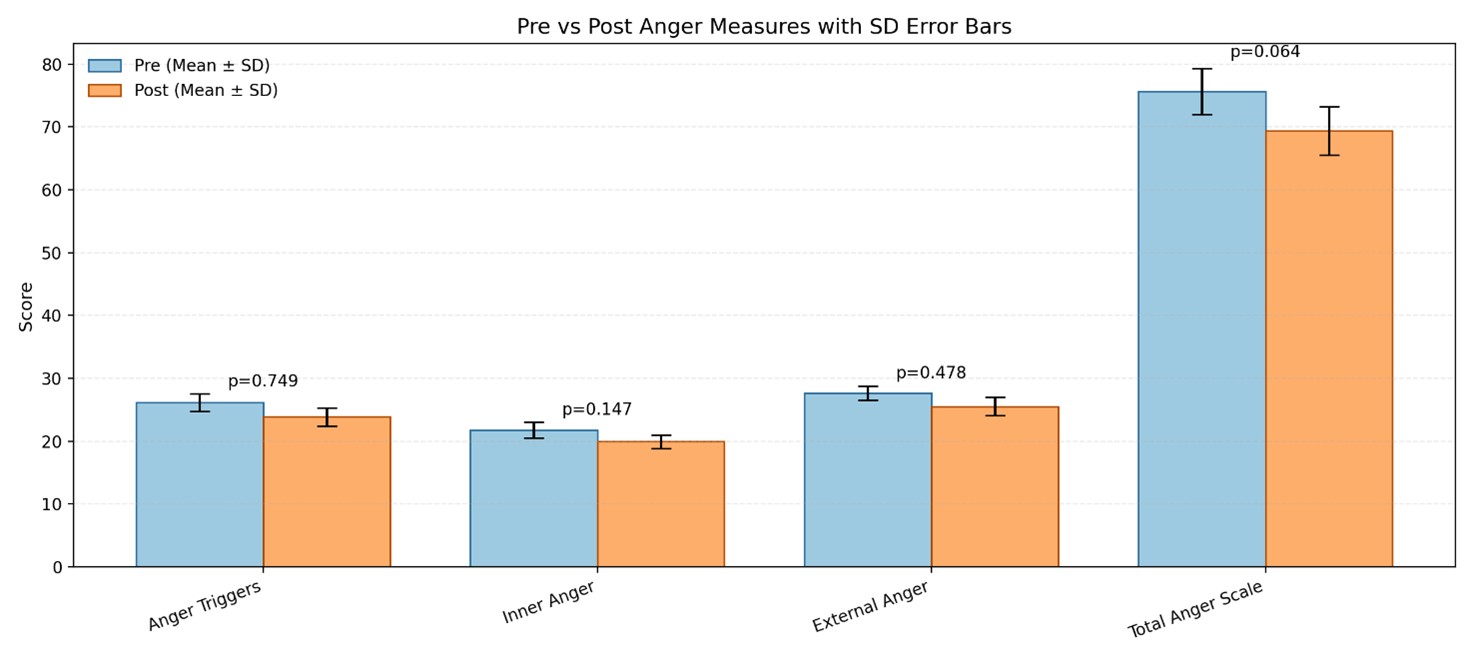
Table 3 presents the results of the Wilcoxon signed-rank tests, which revealed no statistically significant changes in anger scale scores between pre-test and post-test in the control group across any of the subscales (all p > 0,05). Even though the overall anger score showed a slight but nonsignificant decrease (p = 0,064) with a medium effect size (r = 0,41), the differences in anger triggers (r = 0,07), inner anger (r = 0,32), and external anger (r = 0,16) were small and nonsignificant. Such results suggest that the slight variations in anger levels within the control group over time were likely due to natural variation or familiarity with the testing procedure, rather than any systematic intervention. Figure 2 shows the mean anger scale scores of the control group at pre-test and post-test.
Table 3
Wilcoxon signed-rank test results for control group (n = 20)
|
Variable |
Pre |
Post |
Mean rank |
Sum of ranks |
Z |
p-value |
r |
||||||
|
Min |
Max |
Mean ± std. dev. |
Min |
Max |
Mean ± std. dev. |
Positive |
Negative |
Positive |
Negative |
||||
|
Anger triggers |
23 |
29 |
26,15 ± 1,42 |
21 |
27 |
23,90 ± 1,45 |
15,2 |
14,8 |
304 |
296 |
0,32 |
0,749 |
0,07 |
|
Inner anger |
19 |
24 |
21,80 ± 1,24 |
18 |
22 |
19,95 ± 1,10 |
16,0 |
14,0 |
320 |
280 |
1,45 |
0,147 |
0,32 |
|
External anger |
25 |
29 |
27,70 ±1,13 |
23 |
29 |
25,55 ± 1,47 |
15,5 |
14,5 |
310 |
290 |
0,71 |
0,478 |
0,16 |
|
Total anger scale |
67 |
82 |
75,65 ± 3,66 |
62 |
78 |
69,40 ± 3,84 |
16,5 |
13,5 |
330 |
270 |
1,85 |
0,064 |
0,41 |
Note: r = effect size, Std = standard deviation; Sig = statistical significance.
The results of the Wilcoxon signed-rank test (Table 3) indicate that there are no statistically significant differences in the anger scores between the pre-test and post-test in all subscales (p = 0,05) and that the effect sizes are very small (anger triggers: r = 0,07; external anger: r = 0,16; inner anger: r = 0,32). Even though the total anger scale indicated a relatively small numerical decrease (75,65 ± 3,66 to 69,40 ± 3,84) with the moderate effect size (r = 0,41), this was not statistically significant (p = 0,064), which is marginally below the conventional level of significance (a = 0,05). These results suggest that, with no intervention, the level of anger did not change significantly during the eight weeks of study, and the changes observed were probably due to random variation, the effect of familiarity with the tests, or the regression to the mean as opposed to a significant change in the intensity of anger.
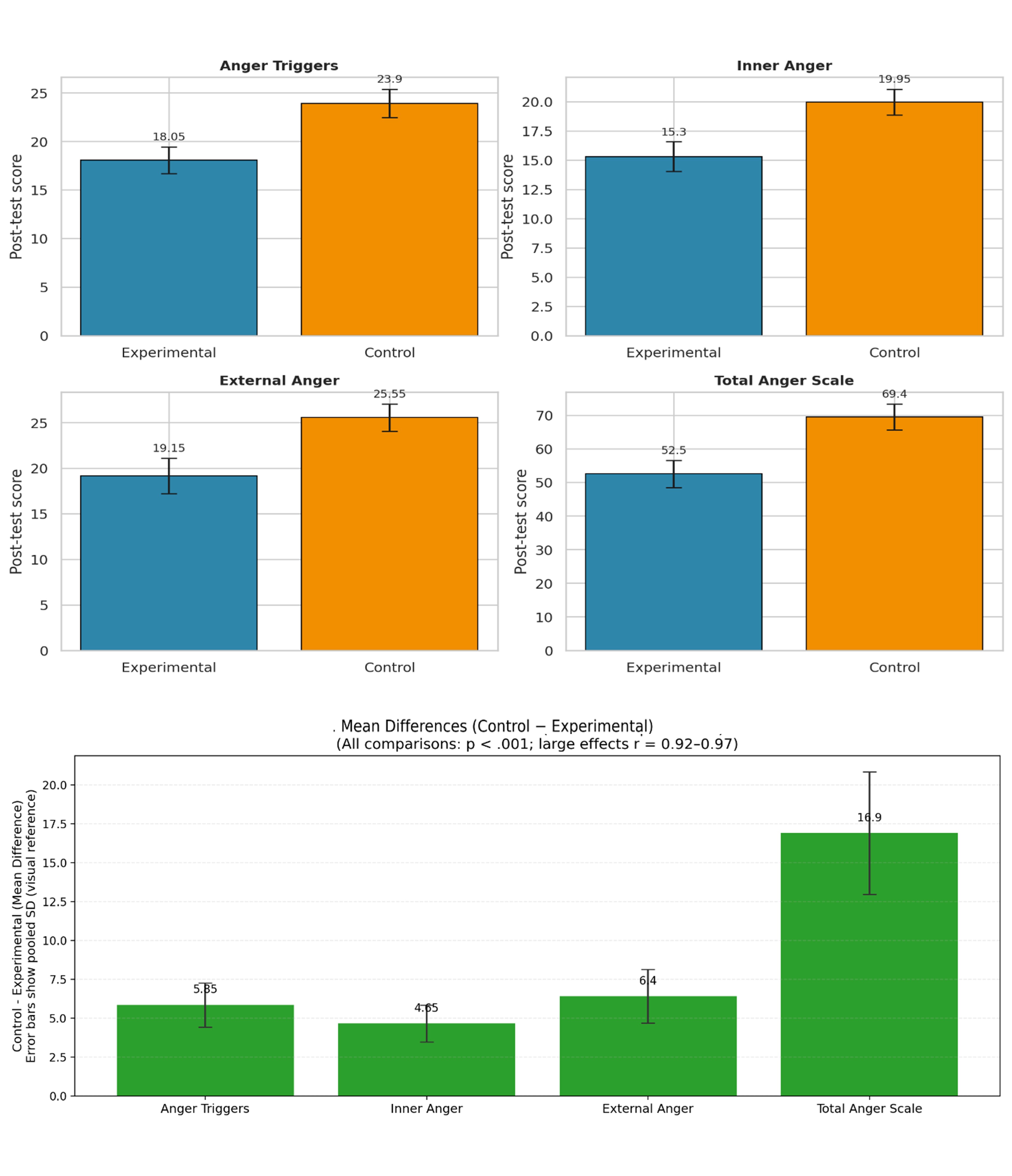
The results of the Mann-Whitney U test, as shown in Table 4 of the post-test scores of the anger scales between the experimental and control groups, showed that there were statistically significant differences in the two groups in terms of all subscales (p = 0,001). The effect sizes of the experimental group were extremely large at post-test (r = 0,92 to 0,97), and the anger scores showed a significant decrease compared to the control group, with strong evidence of the practical applicability of the recreational therapy program. The visual comparison of the mean scores at the end of the intervention is presented in Figure 3, making it clear that the performance of the experimental group is much better than the performance of the control group.
Table 4
Mann-Whitney U Test results comparing post-test scores between experimental and control groups
|
Variable |
Group |
n |
Mean ± std. dev. |
Mean rank |
U |
Z |
p-value |
r |
|
Anger triggers |
Experimental |
20 |
18,05 ± 1,39 |
12,3 |
62,0 |
4,12 |
< 0,001 |
0,92 |
|
Control |
20 |
23,90 ± 1,45 |
28,7 |
|||||
|
Inner anger |
Experimental |
20 |
15,30 ± 1,26 |
11,8 |
58,0 |
4,25 |
< 0,001 |
0,95 |
|
Control |
20 |
19,95 ± 1,10 |
29,2 |
|||||
|
External anger |
Experimental |
20 |
19,15 ± 1,95 |
12,1 |
60,0 |
4,18 |
< 0,001 |
0,93 |
|
Control |
20 |
25,55 ± 1,47 |
28,9 |
|||||
|
Total anger scale |
Experimental |
20 |
52,50 ± 4,03 |
11,5 |
52,0 |
4,36 |
< 0,001 |
0,97 |
|
Control |
20 |
69,40 ± 3,84 |
29,5 |
The Mann-Whitney U test results (Table 4) show that the differences between the groups in post-intervention anger ratings are highly significant, with the experimental group having significantly lower anger levels across all subscales than the control group (p < 0,001). Specifically, the experimental group scored significantly lower on anger triggers (18,05 ± 1,39 vs. 23,90 ± 1,45), inner anger (15,30 ± 1,26 vs. 19,95 ± 1,10), external anger (19,15 ± 1,95 vs. 25,55 ± 1,47), and total anger scale (52,50 ± 4,03 vs. 69,40 ± 3,84). Importantly, these differences were associated with exceptionally large effect sizes (r = 0,92–0,97), which far surpass the conventional threshold for large effects (r ≥ 0,50), suggesting not only statistical significance but also substantial practical meaning. The consistently lower mean scores of the experimental group compared to the control group provide additional evidence of the intervention's effectiveness.
Discussion
This research aimed to evaluate the immediate effect of an 8-week recreational behavioral therapy program on anger reactions among undergraduate students at King Faisal University. The findings demonstrate a robust short-term effect: the experimental group exhibited statistically significant reductions across all anger dimensions (anger triggers, inner anger, external anger, and total anger scale) from pre- to post-intervention (p < 0,001, r = 0,84–0,97). Critically, at post-test, the experimental group scored significantly lower than the control group on all subscales (p < 0,001, r = 0,92–0,97), confirming that these improvements were attributable to the intervention rather than extraneous variables such as maturation or test-retest effects. Conversely, the control group showed no statistically significant changes over time (p > 0,05 across subscales), with negligible to small effect sizes (r = 0,07–0,32), reinforcing the internal validity of the observed intervention effects. The small decrease in overall anger (p = 0,064, r = 0,41) was not significant according to traditional standards and probably indicates natural variation, test-retest familiarity, or regression-to-the-mean effects, as often seen in repeated psychological tests. More importantly, the evidence that the internal validity of the study is strong is the fact that the control group did not produce meaningful change, which would otherwise contribute to the dramatic changes in the experimental group being the result of the simple progression of time and consecutive exposure to the scale. Different studies have helped support the efficacy of recreational behavioral therapy programs in reducing anger reactions in students. On the same note, the study of children with intellectual disabilities demonstrated that a recreational program resulted in significant improvements in anger triggers and overall anger levels, which supported the beneficial effect of structured recreational activities (Elsayed, Hassan, 2023). Moreover, cognitive-behavioral therapy has demonstrated its usefulness in anger management in high school students as well, and the level of anger management has improved considerably after the intervention (Vural, Yayci, 2023). All of the findings highlight the possibilities of recreational and therapy programs to deal with anger problems in various populations (Herrera, Ortiz, 2023).
These findings are in line with the rest of the literature that shows the effects on university students. To take the example, Özdemir and Eryilmaz (2024) and Marcelino et al. (2023) achieved a significant decrease in anger and aggressive levels due to cognitive-behavioral program implementation and the implementation of multimodal strategies (anger management programs) with the inclusion of emotion regulation of the structured anger management program in interventions, respectively. Equally, Tomescu et al. (2024) reported the decrease in violence and aggression by means of supervised sports and recreational activities, which can be associated with the focus of the current program on cooperative games, expressive arts, and behavioral reinforcement. The study by Anjanappa and colleagues found that the level of anger, as well as problem-solving and communication skills, dropped significantly in adolescents undergoing an anger management course (Anjanappa et al., 2023). Likewise, a meta-analysis study by Nauraliefia and Yudiarso noted a significant effect size in the anger and aggression reduction by such programs (Mardani et al., 2024; Nauraliefia, Yudiarso, 2023). Moreover, a socio-emotional education program was also useful in minimizing attitudes towards school violence, showing great shifts in student attitudes and enhancing positive school coexistence (Jesus et al., 2023). The study conducted by Doğan and Çam (2020) revealed that an intervention grounded in the Roy Adaptation Model was much more effective in managing anger in adolescents and found that it was crucial to address emotional regulation.
The large effect sizes in the current research (r > 0,90) can be explained by the fact that the program includes the combination of evidence-based behavioral interventions (e.g., cognitive restructuring, assertive communication, time-out) with stimulating, culturally relevant recreational activities (e.g., team sports, art expression, agility games). The design probably boosted motivation, participation, and skill generalization, which is significant in maintaining emotional control gains (Álvarez-Santos et al., 2024; Elsayed and Hassan, 2023). Overall, the present results are strong quantitative data that a structured recreational behavioral therapy program can create clinically significant anger changes in university students. The sharp difference in the experimental and control groups, not only in statistical significance but also in practical effect, substantiates the point that the intervention was the active agent of change. As research by Herrera and Ortiz (2023) has shown, an academic stress level among students at a university was significantly reduced with the help of a recreation program, which makes it possible to assume that such programs will also be able to alter such emotional experiences as anger. Moreover, the article by Park and Kim (2022) created and tested an anger control group-based intervention with college students, which led to remarkable effects of anger expression and interpersonal problems, which also contributes to the idea that a structured intervention can bring meaningful changes in anger management. Besides, self-control methods applied to group counseling, investigated by Susilo and Lubis (2025), demonstrated a high anger reduction in adolescents, which indicated that the same methods might be useful in university students. Taken together, these works demonstrate robust quantitative data that recreational and therapeutic intervention programs can have a substantial effect on anger management among university students, with evident differences between control and experimental groups providing strong evidence that the interventions under consideration are indeed a force for change.
Conclusions
This research aimed to evaluate the immediate effect of an 8-week recreational behavioral therapy program on anger reactions among undergraduate students at King Faisal University. According to the results, all parameters of anger showed statistically very significant and large effects from pre- to post-test in experimental group with a very large effect size (r = 0,84–0,97). However, on the post-test, experimental group was found to have significantly lower scores than the control group across all subscales (p < 0,001, r = 0,92–0,97), but no statistically significant time effects were observed in control group (p > 0,05 for all subscales). Such an enormous difference is a guarantee that whatever improvement was observed was only as a result of the intervention and not as a result of time, the multiple measurements, or any other confounding variable. The salient feature of the favorable results of the intervention was the combined program, which incorporated evidence-based behavioral methods, i.e., cognitive restructuring, the art of assertive communication training, positive reinforcement, role-playing, and response cost in the context of culturally significant recreation activities (e.g., cooperative sports, expressive arts, and agility games). This guaranteed greater involvement of students and enabled the actual practice and generalization of anger management skills in situations that were emotionally stimulating but not threatening. It is an excellent example of emotion management that is robust, feasible, and relatable to patients in universities by linking clinical endeavors in behavior changes with hobbies that are both entertaining and accessible. Recreational frameworks are an effective way of implementing behavioral skills training, and so redesign traditional anger management into an experiential, participatory social support process. The results have a tremendous implication regarding the practice and changes made by university counselling and student support services to implement the above recreational-behavioral programs as a mental health promotion tool. Further research needs to be directed at the extended sustainability of the effects and versatility of this model for other psychological problems, such as anxiety, stress, and emotional control in different environments and groups of students.
Limitations. Although the results of this study are strong, several limitations must be considered when interpreting the findings. First, only students from King Faisal University were included, which may limit the generalizability of the results to other university populations or cultural contexts. Future studies should include samples from a wider range of universities to enhance external validity. Second, the use of self-reported anger scale measures, although conventional, is vulnerable to biases such as social desirability, wherein participants may tend to underrate their anger levels. Future studies should consider incorporating objective physiological measures (e.g., heart rate variability) or behavioral observations to obtain a more comprehensive assessment. Lastly, the study evaluated the effectiveness of the program immediately after the intervention and at one follow-up point. The long-term sustainability of the anger management skills learned is uncertain. A longitudinal study with follow-up measures over six-month to one-year periods would be important to establish the sustainability of the intervention effects.
A limitation of this study is the use of an anger scale based on the PROMIS measure, which was developed to assess anger in general clinical samples rather than specifically in university students. Although validity and reliability were confirmed for the present sample (Cronbach's α = 0,896–0,921), the generalizability of the findings may be influenced by the specific features of the university educational context. Future research should focus on developing a scale specifically tailored to assess anger in academic settings.