Introduction
Artificial Intelligence (AI) has rapidly reshaped the creative industries, redefining how content is conceived, produced, and valued. Generative platforms such as ChatGPT, MidJourney, and Runway are now commonplace in journalism, filmmaking, advertising, and digital storytelling, providing novel possibilities for ideation, accelerated production, and experimentation with new aesthetic directions (Erickson, 2023; Guzman, Lewis, 2024). These developments raise important questions about how creativity is being reconfigured in an era of machine assistance.
Alongside its industrial applications, AI is also transforming education. In higher education, generative tools are increasingly used by students for brainstorming, drafting, and creative assignments, prompting debates about their impact on learning, authorship, and skill development (Kohnke, Moorhouse, Zou, 2023b). For media and communication education in particular, AI is not only a technological resource but also a cultural force that shapes how students learn to create, critique, and position themselves as future professionals. Understanding how students interpret and negotiate AI’s role is therefore essential for both educational psychology and creative pedagogy. Particularly, a growing body of scholarship has examined AI’s potential to enhance creativity (Beaty, Johnson, 2021; Cropley, Medeiros, Damadzic, 2023; Ivcevic, Grandinetti, 2024; Kaufman, Beghetto, 2009). Yet, many other scholars remain cautious. Cropley et al. (2023) argue that algorithmic processes mimic rather than originate creative imagination, challenging assumptions of originality and depth. Similarly, Beaty and Johnson (2021) emphasize that creativity is inherently subjective, complicating any attempt to evaluate AI’s role in the process.
Despite these insights, research has often prioritized technical capability or ethical debate, leaving less attention to how emerging creators themselves interpret AI. Media and communication students offer a particularly significant lens. As digital natives and future professionals, they simultaneously experiment with AI tools and reflect on their implications for authorship, authenticity, and cultural value (Perez, 2024; Wingström, Johanna, Lundman, 2024). Unlike casual users, these students are in the process of professional formation, learning to become creators, storytellers, and cultural intermediaries. Their perceptions therefore provide early indications of how AI may be adopted, resisted, or critically evaluated in creative fields.
What remains underexplored is how students position AI within their own creative practices: Do they regard it as a collaborator, a constraint, or a competitor to human originality? Where do they draw the boundaries around what can be delegated to machines while retaining personal voice and ownership? Addressing these questions is vital for understanding how human-AI collaboration will shape the next generation of creative professionals.
To explain how users adopt and evaluate new technologies, prior research often employs the Technology Acceptance Model (TAM). TAM proposes that two core beliefs including perceived usefulness and perceived ease of use shape users’ attitudes and intentions toward technology adoption (Davis, Bagozzi, Warshaw, 1989). Applied to generative AI, these constructs help illuminate why some students enthusiastically delegate creative tasks to AI (viewing it as efficient and user-friendly), while others hesitate due to concerns over authenticity, learning, or control. In this sense, TAM offers a useful conceptual lens for examining how students balance functional efficiency with the preservation of human authorship in their creative work.
Building on this theoretical foundation, the present study applies TAM to explore how media and communication students negotiate their willingness to delegate creative tasks to AI within educational contexts. This study examines media and communication students in Vietnam and investigates two research questions:
RQ1: How do media students understand and interpret the role of AI within their creative practices?
RQ2: What factors shape students’ willingness to delegate certain creative tasks to AI tools?
By addressing these questions, the study highlights the complexities of human-AI collaboration in educational contexts. It also emphasizes the psychological and educational dimensions of creativity, showing how students balance optimism about AI’s potential with skepticism about its limitations. The findings contribute not only to debates about AI and creativity but also to curriculum development, ethical tool design, and broader discussions about how future professionals negotiate authorship and agency in the AI era.
Literature review
AI as a supporter for human creativity
Creativity is commonly defined as the capacity to generate ideas, artifacts, or expressions that are both novel and contextually meaningful (Runco, Jaeger, 2012). Recent scholarship increasingly frames creativity as a socio-technical process, highlighting the potential of co-creativity in which humans and AI combine complementary strengths (Daly, Hearn, Papageorgiou, 2025; Wingström et al., 2024). Ivcevic and Grandinetti (2024) argue that AI can scaffold idea generation, problem-solving, and even professional-level creative production, particularly for individuals with lower confidence in their abilities. In this light, AI is best understood as an augmenter, providing efficiency and structural support while humans contribute cultural grounding and emotional depth.
Opportunities and expanding access in media production
Within media industries, AI is increasingly framed not as a substitute but as a collaborator that broadens creative possibilities. Generative models such as ChatGPT, DALL-E, and MidJourney enable creators to experiment with new aesthetic forms and storytelling modes, lowering technical barriers and encouraging broader participation (Anantrasirichai, Bull, 2022; Vinchon et al., 2023). Scholars describe this as a democratizing effect, allowing individuals without formal training to produce professional-quality work (Herrie et al., 2024; Prasad, Makesh, 2024; Schröter, 2019). Such inclusivity not only amplifies underrepresented voices but also fosters hybrid creative forms that merge human intentionality with machine-generated novelty. AI has further enabled interdisciplinary practices such as interactive installations, adaptive journalism, and AI-driven gaming, transforming creativity into a more dynamic, collaborative process (Sonni et al., 2024; Wingström et al., 2024).
Challenges: originality, authorship, and ethics
Despite these opportunities, scholars caution that AI also introduces significant risks into creative practice. AI-generated media is often derivative, recombining existing training data rather than producing truly original, contextually embedded work (Wingström, Hautala, Lundman, 2024). Concerns have been raised about the potential erosion of creative skills, particularly among emerging creators who may grow reliant on machine support at the expense of developing divergent thinking or risk-taking abilities (Ivcevic, Grandinetti, 2024). Authorship and ownership further complicate the picture: when AI contributes substantially to a creative product, questions of attribution and copyright inevitably arise (Mazzi, 2024). Ethical issues including algorithmic bias, cultural misrepresentation, and the spread of misinformation also highlight the broader social consequences of AI-generated media (Hanna et al., 2025; Lundberg, Mozelius, 2024).
Perceptions of AI and delegation boundaries
Studies suggest that people acknowledge AI’s value for idea generation and problem-solving, yet they consistently privilege human-created outputs for their emotional authenticity and narrative depth (Grassini, Koivisto, 2025; Neef et al., 2024). Importantly, these perceptions are shaped by contextual and psychological factors. Trust, transparency, and accountability influence willingness to adopt AI (Gerlich, 2023) while familiarity and clearly defined roles (where AI is seen as augmentative rather than substitutive) generate greater acceptance (Biswas, Khan, Talukder, 2024). Even when users value AI’s efficiency, they often draw firm boundaries around identity-driven or emotionally expressive tasks, reserving these for human authorship. This negotiation of boundaries underscores the need for a more precise conceptual lens to explain when and why individuals delegate creative tasks to AI.
AI in education
Generative tools are now widely used by students for brainstorming, drafting, and creative assignments, raising new questions about authorship, learning, and the development of higher-order thinking skills (Kohnke, Moorhouse, Zou, 2023a; Sergeeva, Zheltukhina, Demir, 2025; Zawacki-Richter et al., 2019). Research highlights both opportunities and challenges: on one hand, AI can serve as a scaffold for learners with low confidence, reduce anxiety about starting tasks, and expand access to professional-quality production (Prasad, Makesh, 2024). On the other hand, concerns persist that excessive reliance may undermine critical thinking, originality, and independent problem-solving (Luckin et al., 2022). Within creative education, these tensions are particularly acute, as students must learn not only how to use AI effectively but also how to safeguard authenticity, cultural awareness, and personal voice. This positions education as a crucial site for examining how future professionals negotiate the benefits and risks of AI-assisted creativity.
Literature gap and study contribution
Although prior research has illuminated AI’s technical capacities and the public’s ambivalent attitudes, little attention has been paid to the perspectives of media students, a group uniquely positioned as both digital natives and future creative professionals. Unlike general users, these students are in the process of forming professional identities as creators and cultural intermediaries, making their perceptions particularly influential in shaping the future integration or resistance of AI in creative industries. Existing studies primarily compare outputs (AI vs. human) or investigate professionals’ attitudes, leaving students’ formative experiences largely underexplored.
To better explain how students decide when and how to use AI, this study draws on insights from the Technology Acceptance Model (TAM) (Davis et al., 1989). TAM posits that individuals’ technology adoption is primarily influenced by their perceived usefulness and perceived ease of use, which jointly shape behavioral intention. In the context of creative education, these constructs help interpret how students weigh AI’s functional benefits (e.g., efficiency, idea generation) against potential costs such as loss of authenticity or emotional ownership. While this study remains exploratory, TAM provides a conceptual lens to interpret the psychological mechanisms underlying students’ delegation decisions.
Methods
Research design
This study employed a qualitative research design using semi-structured interviews. A qualitative approach was chosen because the aim was to explore students’ subjective perceptions, attitudes, and decision-making processes regarding AI use in creativity. Such nuanced, interpretive insights cannot be fully captured through quantitative surveys alone (Creswell, Poth, 2017). Semi-structured interviews offered both consistency across participants and the flexibility to probe emerging issues, ensuring that key themes from the literature were covered (Duffy, Hund, 2019; Sundar, 2020). While qualitative interviews provided rich insights into students’ perceptions and decision-making processes, the study does not claim statistical generalizability. A quantitative component such as a survey measuring the prevalence or strength of identified factors could provide more objective evidence of scope and distribution. However, the exploratory focus of this research required prioritizing depth of understanding over breadth. Future studies may adopt a mixed-methods design, combining interviews with large-scale surveys, to strengthen generalizability.
Interview guide
The interview script was developed based on the literature review and structured around two broad areas aligned with the research questions:
- Understanding AI’s role in creativity (e.g., “How would you describe AI’s role in your creative process?”).
- Delegation and boundaries of AI use (e.g., “Which creative tasks would you allow AI to handle, and which would you keep for yourself?”).
Participants and sampling
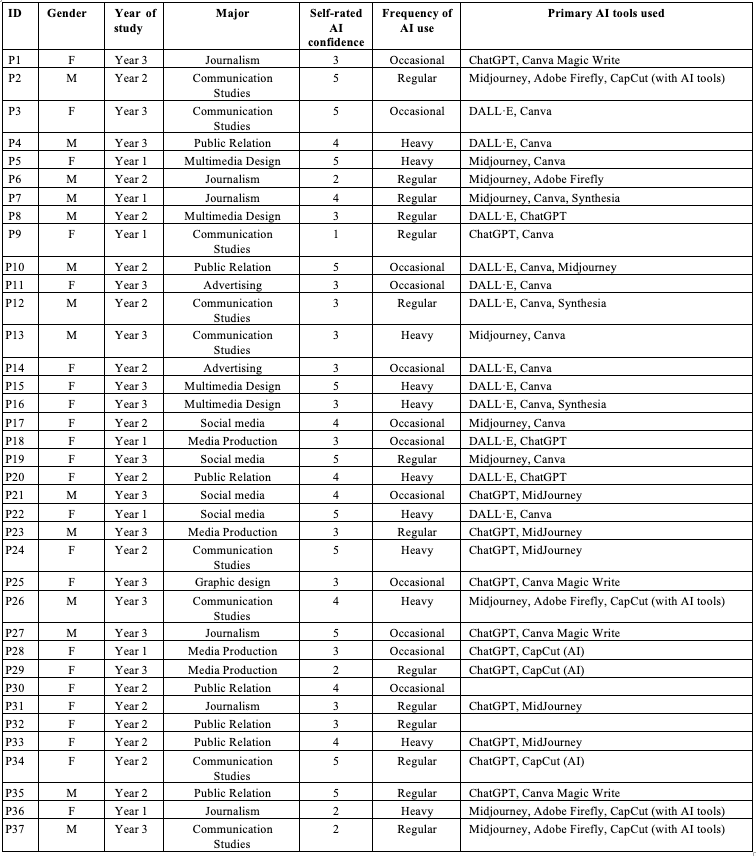
The study included 37 undergraduate students enrolled in media and communication programs (Table 1). Participants ranged in age from 19 to 26 and represented diverse majors, including Media Production, Journalism, Digital Design, and Communication Studies. Both male and female students were included. All participants reported prior experience with generative AI tools in academic or creative contexts. The most frequently used tools included ChatGPT for writing, MidJourney for image generation, Grammarly for editing, and AI-based applications for video editing. Levels of familiarity varied: while some students engaged with AI occasionally for brainstorming or drafting, others integrated it extensively into their creative workflows.
Purposive sampling was used to ensure participants met criteria relevant to the research objectives: (1) prior exposure to AI tools, and (2) active engagement in creative production, either through coursework or personal projects (Hennink, Hutter, Bailey, 2020). Recruitment was conducted via email invitations, and social media posts distributed to media and communication cohorts. This approach maximized the likelihood of obtaining information-rich cases that could meaningfully address the research questions.
Table 1
Profile of participants
Procedure
Data were collected through semi-structured interviews conducted either face-to-face or via Google Meet. Each session lasted approximately 45–60 minutes. The interview guide was organized around two core areas of inquiry aligned with the research questions: (1) how media students understand and interpret the role of AI in their creative practices, and (2) the factors influencing their willingness to delegate specific creative tasks to AI tools. Questions were open-ended to encourage reflection and elaboration, while follow-up probes were used to explore emerging themes. All interviews were audio-recorded with participants’ informed consent and transcribed verbatim for subsequent analysis.
Data analysis
Interview data were analyzed using Braun and Clarke’s (2006) six-phase thematic analysis: familiarization, coding, theme development, review, definition, and reporting. This approach was chosen to capture both the predefined research questions and emergent insights into students’ perceptions of AI and their delegation decisions.
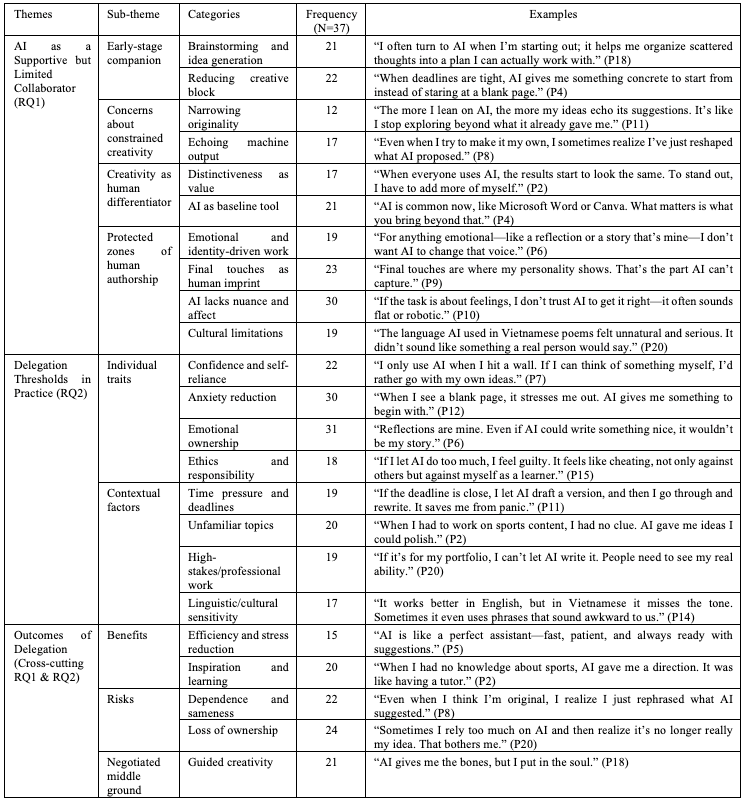
All interviews were transcribed verbatim and reviewed repeatedly for immersion. Coding combined deductive strategies (guided by the research questions) and inductive strategies (open to new insights). Codes included references to efficiency, authenticity, authorship, and boundaries of delegation. Through iterative team discussions, these codes were refined into themes (Table 2).
Three core themes emerged: (1) AI as a supportive but limited collaborator; (2) Delegation Thresholds in Practice; (3) Outcomes of delegation. Rigor was ensured through researcher triangulation, reflexive memo-writing, and the use of illustrative participant quotes to substantiate findings.
Table 2
Themes, sub-themes, categories and examples
Results
Research question 1. How do media students understand and interpret the role of AI in their creative practices?
AI as an early-stage companion
Interviews revealed that students perceived AI as particularly valuable in the early phases of the creative process. AI was described as a tool that eased the burden of beginning a task by generating concepts, providing structural outlines, and suggesting new directions. As one participant explained, “I often turn to AI when I’m starting out; it helps me organize scattered thoughts into a plan I can actually work with” (P18). Another emphasized its usefulness under time pressure, noting, “When deadlines are tight, AI gives me something concrete to start from instead of staring at a blank page” (P4). Similarly, P9 remarked, “If I run out of ideas, I let AI suggest some options and then I adapt them in my own way”. In this sense, AI was framed as a supportive partner that reduced barriers to idea generation without replacing human agency.
Concerns about constrained creativity
While students acknowledged AI’s benefits, they also expressed concern that reliance on its suggestions could narrow their creative scope. Several noted that overuse risked diminishing originality, as ideas began to mirror machine outputs. As P11 admitted, “The more I lean on AI, the more my ideas echo its suggestions. It’s like I stop exploring beyond what it already gave me.” Similarly, P8 reflected, “Even when I try to make it my own, I sometimes realize I’ve just reshaped what AI proposed.” These accounts highlight a tension in students’ experiences: AI enhanced productivity but simultaneously risked eroding independent imagination.
Creativity as a human differentiator
Participants often reflected on how the widespread availability of AI tools was reshaping the meaning of creativity itself. Because “good enough” outputs could be produced by almost anyone, students felt new pressure to assert what was uniquely human in their work. As P2 explained, “When everyone uses AI, the results start to look the same. To stand out, I have to add more of myself”. Rather than viewing AI as a threat, others described it as a baseline tool, useful but ultimately insufficient for originality. P4 drew a comparison: “AI is common now, like Microsoft Word or Canva. What matters is what you bring beyond that”. These perspectives highlight how creativity, in students’ eyes, was less about producing content and more about infusing personal distinctiveness, qualities they believed AI could not replicate.
Protected zones of human authorship
Equally striking was the way students drew firm boundaries around tasks they considered inseparable from their identity. Work involving emotions, aesthetics, or storytelling was consistently described as off-limits for AI. P6 captured this sentiment: “For anything emotional, like a reflection or a story that’s mine, I don’t want AI to change that voice”. Echoing this, P9 stressed the irreplaceable role of human presence in finishing creative work: “Final touches are where my personality shows. That’s the part AI can’t capture”.
Beyond authorship, students voiced doubts about AI’s ability to convey subtlety. P10 observed that “If the task is about feelings, I don’t trust AI to get it right, it often sounds flat or robotic”. Cultural nuances were also seen as difficult for AI to handle. For instance, P20 remarked that “The Vietnamese in the AI-generated poems sounded unnatural and overly formal, not like how real people actually speak”.
Protecting emotionally expressive tasks was not only about practical quality, but also about identity and ownership. For some, drawing these boundaries carried symbolic weight. P18 explained, “When I write something personal, I need people to know it’s really mine, not just a prompt result”. P20 went further, admitting discomfort with over-reliance: “I don’t like the feeling that my own voice disappears when I rely too much on AI”. These accounts reveal that while students embraced AI’s supportive role, they simultaneously resisted its intrusion into the expressive core of creativity.
Research question 2. What factors shape students’ willingness to delegate creative tasks to AI?
Individual traits: Confidence, ownership, and ethics
Students emphasized that their personal traits strongly influenced how much they were willing to delegate. Some participants with higher creative confidence described relying less on AI tools, expressing concern that doing so might constrain their originality or personal style. P7 explained, “I only use AI when I hit a wall. If I can think of something myself, I’d rather go with my own ideas”. P3 added, “AI gives quick results, but I don’t trust it to make something original. I feel better when I rely on my own thinking”. These observations point to a possible link between creative confidence and limited AI reliance – a relationship that warrants further quantitative examination.
By contrast, several students with lower confidence described AI as reducing anxiety about starting projects. P12 shared, “When I see a blank page, it stresses me out. AI gives me something to begin with, so I don’t waste hours thinking where to start”. Similarly, P18 remarked, “Sometimes I ask AI to give me headlines or options. It’s not that I’ll use them directly, but they make me feel less stuck”.
Emotional ownership was also a defining boundary. P6 asserted, “Reflections are mine. Even if AI could write something nice, it wouldn’t be my story”. Ethical concerns further shaped delegation decisions. P15 explained, “If I let AI do too much, I feel guilty. It feels like cheating, not only against others but against myself as a learner”. Others worried about risks of misinformation or unintentional plagiarism. As P8 cautioned, “Sometimes AI gives you content that looks good but is copied or wrong. If I submit that, it’s on me, not the AI”.
Contextual factors: task type, purpose, and cultural sensitivity
Students’ willingness to delegate also varied depending on the type and purpose of the task. Routine or technical tasks were more likely to be delegated, while expressive or identity-based work was guarded. P11 explained, “If the deadline is close, I let AI draft a version, and then I go through and rewrite. It saves me from panic”. P2 recalled, “When I had to work on sports content, I had no clue. AI gave me ideas I could polish. Without it, I would have been stuck”.
By contrast, professional or high-stakes assignments were closely protected. P20 emphasized, “If it’s for my portfolio, I can’t let AI write it. People need to see my real ability.” P9 added, “For the final touches, it has to be me. That’s the part people will recognize as my style”.
Cultural and linguistic sensitivity further shaped delegation choices. P20 described her frustration with Vietnamese poetry: “The words AI gave me sounded stiff and unnatural, like a machine pretending to be human”. P14 noted, “It works better in English, but in Vietnamese it misses the tone. Sometimes it even uses phrases that sound awkward to us”. P10 reflected on tone: “In English it sounds okay, but in Vietnamese the style is too formal, like a textbook, not a person talking”.
Negotiating the delegation threshold
Across interviews, students described a flexible “delegation threshold” that determined what tasks AI could handle and what they retained for themselves. Brainstorming, outlining, and early drafts were generally viewed as acceptable for delegation. As P18 explained, “For outlines, it’s perfect. I give it a topic, it gives me a structure, and then I personalize”. P2 added, “If I’m too tired, I ask AI for ideas. I don’t copy them, but they spark my thinking”.
However, emotionally expressive or identity-driven work was consistently reserved for human authorship. P6 explained, “AI can suggest, but it can’t decide emotions for me. That’s the part I want to keep”. P20 described moments of discomfort when boundaries were crossed: “Sometimes I rely too much on AI, and then I look at my draft and think, this doesn’t sound like me anymore. That’s when I rewrite it”.
For some, this negotiation was iterative. P10 explained, “Sometimes I let AI write the draft, then I delete half of it and rewrite in my own words. That way it feels like mine”. P4 summarized, “AI is good for giving me structure, but I’m the one who fills it with meaning”.
Outcomes of delegation
Students reported both benefits and risks from crossing the delegation threshold. On the positive side, AI enhanced efficiency, reduced stress, and offered new ideas. P5 praised, “AI is like a perfect assistant: fast, patient, and always ready with suggestion”. P12 emphasized time savings: “It helps me move faster, especially when I’m juggling multiple deadlines”.
At the same time, risks were widely acknowledged. P17 remarked, “With AI becoming widely available, originality and critical thinking matter more than ever”. P8 worried about hidden dependence: “Even when I think I’m original, I realize I just rephrased what AI suggested. It’s like being trapped in its bubble”.
For many, the preferred outcome was a middle ground described as “guided creativity”. AI provided scaffolding, but ownership remained with the student. As P9 concluded, “AI helps me save time, but the best parts, the ones people recognize as me, still come from my own effort”.
Discussion
AI as a supportive but limited collaborator
The findings indicate that students framed AI primarily as a practical assistant rather than an autonomous creator. This aligns with prior research highlighting AI’s potential to reduce creative blocks and stimulate divergent thinking (Ivcevic, Grandinetti, 2024; Perez, 2024). At the same time, participants voiced concerns about over-reliance, cautioning that excessive dependence on AI risked narrowing originality and producing what several described as a “bubble” effect. This “bubble” effect can be understood through the lens of cognitive psychology and creative cognition. When students repeatedly rely on AI suggestions, they may experience cognitive fixation – a tendency to stay within the bounds of existing examples rather than explore novel directions (Smith, 2003). Generative AI models, by design, synthesize outputs from vast datasets of prior human creations; as a result, they tend to reinforce statistically frequent patterns instead of generating truly unconventional associations. From a divergent thinking perspective (Guilford, 1967; Runco, Acar, 2012), such pattern reinforcement narrows the cognitive search space and reduces the fluency, flexibility, and originality of ideas. Students’ descriptions of “getting trapped” in AI’s logic reflect this subtle psychological mechanism: the technology provides efficient but convergent prompts that streamline creativity while simultaneously constraining exploration. Thus, while AI supports productivity, it may also discourage the deliberate risk-taking and conceptual expansion that characterize genuine creative thinking.
Negotiating delegation thresholds
A central contribution of this study is the identification of delegation thresholds (Figure 1), flexible boundaries where students decide whether to assign a task to AI or retain it for themselves. These thresholds were not fixed but shifted depending on personal and situational factors. Individual traits such as creative confidence, emotional ownership, and ethical stance strongly shaped these decisions. Students with higher confidence tended to restrict AI use to supportive roles, while others relied more heavily on AI to reduce anxiety. Ethical concerns also constrained delegation, with several participants equating extensive AI use with “cheating” or undermining their own learning. These findings echo broader debates in human–AI interaction about accountability and transparency (Filipova, Abrosimova, Abdiraiymova, 2025; Gerlich, 2023).
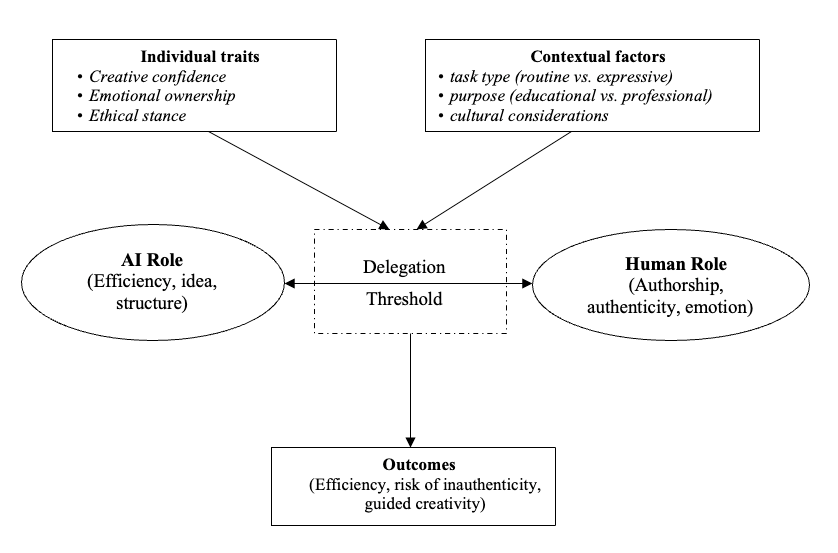
Contextual factors further influenced delegation. Routine or deadline-driven assignments were often entrusted to AI, whereas expressive or portfolio-related tasks were firmly protected. Students also highlighted cultural and linguistic limitations, particularly when working in Vietnamese, noting that AI often struggled to capture nuance and tone. These insights extend existing research on trust and context in AI adoption (Biswas et al., 2024) by showing how creative practitioners actively calibrate delegation in response to situational demands.
The findings can be interpreted through the lens of the Technology Acceptance Model (TAM), which emphasizes perceived usefulness and perceived ease of use as key predictors of technology adoption. In this study, students’ contextual decisions to delegate AI tasks align closely with these dimensions. AI was viewed as useful for overcoming creative blocks, meeting deadlines, and organizing ideas — reflecting high perceived usefulness. However, delegation was restricted when students questioned AI’s cultural sensitivity, emotional expressiveness, or authenticity, indicating low perceived usefulness for identity-driven tasks. Ease of use also shaped behavior: familiar tools like ChatGPT and Grammarly encouraged experimentation, whereas image or video generators with complex prompts deterred use.
Confidence further acted as a moderator within this framework: students with greater creative self-assurance perceived lower relative usefulness of AI and thus preferred manual control, while those with less confidence regarded AI as a helpful cognitive scaffold. These interpretations extend TAM beyond instrumental efficiency, highlighting its relevance for understanding creative and ethical judgments in human–AI collaboration.
Another contextual dimension shaping delegation is the institutional environment of academic integrity. Several students described feelings of guilt or deception when using AI, reflecting the moral uncertainty that arises from ambiguous or evolving university policies. In higher education, rules regarding AI use often remain implicit or inconsistently enforced, leaving students to rely on personal ethics to decide what constitutes legitimate assistance versus academic dishonesty. This moral negotiation mirrors findings in educational research that link unclear integrity guidelines to student anxiety and self-censorship (Luckin et al., 2022; Zawacki-Richter et al., 2019). In the Vietnamese context, where academic achievement and respect for teacher authority are culturally salient (Thi, Pereira, 2022; Nguyen, Habók, 2021), the perception of “cheating” may carry heightened emotional weight. Consequently, students’ delegation practices are shaped not only by cognitive and creative factors but also by their interpretations of institutional expectations (Aleshkovski, Gasparishvili et al., Savina, 2024). Future studies could examine how clearly defined AI-use policies affect students’ sense of responsibility, authorship, and ethical comfort in creative work.
Implications
The study contributes to debates on human–AI collaboration in creativity, advancing three key insights. First, delegation is a negotiated and ongoing process in which students continuously balance utility and authenticity rather than making one-time decisions. Second, individual traits and contextual factors intersect to mediate delegation, underscoring the need to account for both personal dispositions and situational conditions in HAI research. Third, outcomes such as efficiency, authenticity, and guided creativity function simultaneously as results and evaluative criteria, shaping how students reflect on and recalibrate their delegation thresholds. This framework extends existing co-creativity models (Demsar et al., 2022; O'Toole, Horvát, 2024) by emphasizing why and how delegation occurs in practice.
For creative education, there is a need to integrate critical reflection on AI into curricula, enabling students to recognize when AI enhances creativity and when it risks undermining authenticity. For AI design, the results highlight the demand for features that allow users to calibrate human–machine balance, enhance cultural sensitivity in non-English contexts, and provide greater transparency in authorship. For creative industries, the study underscores the enduring value of authenticity and distinctiveness, reminding practitioners that in an AI-saturated environment, human voice and originality remain vital markers of professional credibility.
Conclusion and limitations
The study reveals that students welcomed AI as a supportive assistant for efficiency, idea generation, and structural scaffolding, yet consistently drew boundaries around tasks tied to authenticity, emotional ownership, and personal identity. Delegation thresholds were shaped by individual traits such as confidence and ethics, as well as contextual factors including task type, purpose, and cultural sensitivity.
A key contribution of this research is the development of the Delegation Threshold Model which conceptualizes delegation not as a binary act but as a dynamic decision-making process influenced by psychological and situational factors. The model demonstrates that students continuously evaluate when, how, and to what extent AI should participate in creative tasks, balancing perceived usefulness against the preservation of human authorship. By mapping these thresholds, the study extends the Technology Acceptance Model into the creative and educational domain, revealing how personal values such as authenticity, integrity, and self-expression mediate technology adoption.
The findings also highlight the ethical and pedagogical implications of AI integration in higher education. Feelings of “guilt” and “deception” expressed by participants suggest that ambiguous institutional policies on AI use create uncertainty about acceptable boundaries of authorship. Universities and educators therefore need to develop clearer academic integrity frameworks and critical AI literacy programs that guide students in using AI responsibly while maintaining creative autonomy.
This study is exploratory in nature and draws on a culturally specific sample of Vietnamese media students, whose experiences reflect the emerging realities of AI adoption in a distinct educational and cultural context. While the findings provide valuable qualitative insights, they should not be considered generalizable to broader or cross-national populations. Additionally, the Delegation Threshold Model, developed from this pilot study, offers a conceptual foundation for future cross-cultural and mixed-method investigations into AI-assisted creativity. Further research could test and refine the model to better understand how delegation decisions evolve across disciplines, experience levels, and educational systems. Moreover, the data capture a moment in time; delegation thresholds may evolve as AI technologies advance and become more deeply embedded in creative workflows. Moreover, the association between creative confidence and AI use observed in this study should be interpreted with caution, as it is based on a small number of qualitative cases. Future research employing surveys or mixed-method approaches could help verify whether these patterns hold across larger and more diverse student populations. Future research could expand cross-culturally, investigate longitudinal changes in delegation practices, and test the Delegation Threshold Model using larger-scale or mixed-method approaches. Further, examining how educators and industry professionals negotiate delegation could provide comparative insights into how boundaries shift across experience levels and contexts.