Introduction
In the Chinese educational context, learning is driven by both internal motivation and external pressures, such as family expectations and cultural norms.
Learning engagement is a positive, fulfilling state related to learning (Ni, Wu, 2011), influencing students’ academic processes, motivation, emotions, and outcomes. It predicts performance and achievement (Estévez et al., 2021; Lei et al., 2018), stimulates learning motivation (Yang et al., 2021), enhances satisfaction (Wang, Wang, 2021), and improves well-being (Zhu et al., 2019).
It is shaped by both internal and external factors. External influences include family income, parenting style, school climate, social support, and interpersonal relationships (Liu et al., 2023; Zhou et al., 2021; Jiang et al., 2023; Yan et al., 2018). However, the internal mechanism, especially self-esteem, remains underexplored. Self-esteem can motivate engagement (Lim, Lee, 2017; Shi, Tan, 2008), yet most studies focus on direct effects, neglecting mediating or moderating processes.
Junior high school students experience rapid self-awareness growth and mounting academic pressure (Kim et al., 2021), making self-esteem and self-efficacy critical for learning (Zhou, Wang, 2005; Peng et al., 2019; Wang et al., 2024).
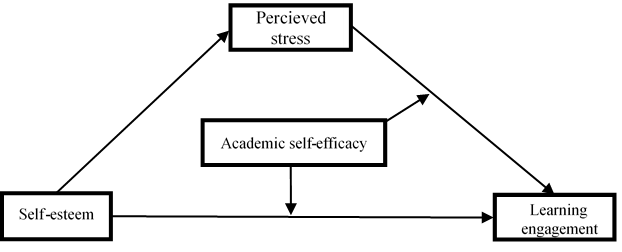
This study explores how self-esteem influences learning engagement, examining perceived stress as a mediator and academic self-efficacy as a moderator, to clarify both “how” and “when” self-esteem affects engagement and inform educational strategies.
Relationship between self-esteem and learning engagement
Self-esteem refers to an individual’s positive or negative self-evaluation (Rosenberg, 1965). Expectancy-value theory posits that positive self-evaluation predicts outcomes such as learning engagement (Fang, 2016). As a dynamic trait, self-esteem can fluctuate and affect one’s mood and motivation (Liu et al., 2024). For example, low self-esteem may lead to depression (Xin et al., 2023), which impairs attention and academic performance (Zhang et al., 2024). Cross-cultural research shows self-esteem is a key factor in student engagement and academic success (Zhang, 2022), positively associated with learning engagement in both middle and high school students (Yan et al., 2018; Gupta et al., 2023; Zhao et al., 2021). Higher self-esteem promotes positive self-evaluation, thereby enhancing engagement (Kim, Kim, 2021). It also supports adaptive coping strategies (Arndt, Goldenberg, 2002), enabling students to persist and respond effectively to challenges, improving learning outcomes (Zheng et al., 2020). Conversely, threatened self-esteem may cause avoidance of academic tasks (Fredricks et al., 2019). H1: Self-esteem positively predicts learning engagement in junior high school students.
The mediating role of perceived stress
Perceived stress is the emotional response to challenge or threat based on cognitive appraisal (Lazarus, Folkmann, 1986). According to resource conservation theory, individuals strive to protect valued resources (Hobfoll, 1989). Self-esteem, as a psychological resource, helps individuals adopt healthier coping strategies (DeLongis et al., 1988), thereby lowering the negative impact of stress on learning. Students with high self-esteem often feel more confident in coping with academic stress (Mulyadi et al., 2016). Conversely, high perceived stress may reduce learning motivation and performance (Pascoe et al., 2020), and is negatively correlated with learning engagement (Lei et al., 2018; Li & Zhang, 2018; Serrano, Yolanda, 2016). Stress can threaten both self-efficacy and engagement (Zhao et al., 2021), leading students to adjust engagement levels to protect self-esteem. H2: Perceived stress mediates the relationship between self-esteem and learning engagement.
The moderating role of academic self-efficacy
The mediating effect of perceived stress may vary by levels of academic self-efficacy. Academic self-efficacy refers to a student’s belief in their academic ability (Bian, 2004), reflecting confidence and control (Pintrich, 1990). It may moderate the link between self-esteem and engagement—enhancing or weakening its effect. Students with higher academic self-efficacy tend to show stronger motivation and goal-setting behaviors, which promotes learning engagement (Bao et al., 2016). In contrast, low self-efficacy leads to pessimistic views and diminished engagement (Zimmerman, 2000). H3: Academic self-efficacy moderates the effect of self-esteem on learning engagement.
Based on social cognitive theory, self-efficacy influences how individuals perceive and respond to stress (Bandura, 1997). Students with high academic self-efficacy may perceive greater pressure in challenging tasks, increasing their risk of burnout and reducing engagement (Zhao, 2024; Wang, Zhang, 2024). Though often beneficial, academic self-efficacy may exacerbate the adverse impact of stress in high-pressure contexts (Usher, Pajares, 2008; Honicke, Broadbent, 2016). In such cases, academic motivation may be more easily disrupted (Lent et al., 2000; Linnenbrink-Garcia et al., 2018), a pattern consistent across disciplines (Huang et al., 2024; Schmitt-Cerna et al., 2024). H4: Academic self-efficacy moderates the relationship between perceived stress and learning engagement.
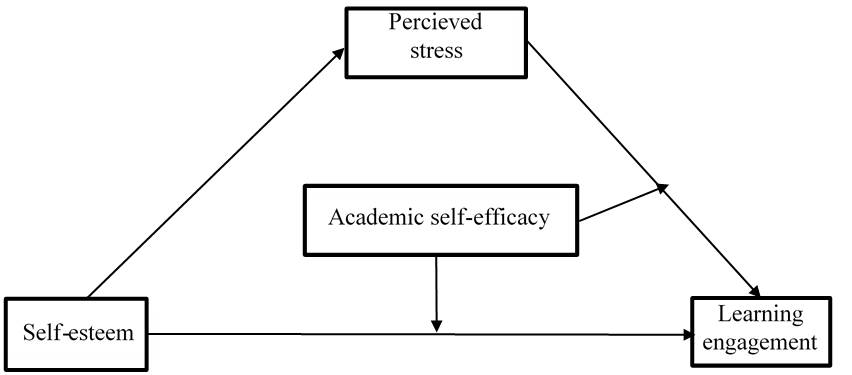
In summary, this study investigates junior high school students and constructs a moderated mediation model (Fig. 1) to explore how self-esteem, perceived stress, and academic self-efficacy influence learning engagement.
Materials and methods
Participants
This study used cluster convenience sampling in five public middle schools across Anhui Province (Bengbu, Huaibei, Huainan, Wuhu) and Hangzhou, Zhejiang. A total of 1855 questionnaires were distributed; after removing those with highly regular patterns or extensive missing data, 1684 valid responses remained (90,78% retention). The final sample included 836 males (49,64%) and 848 females (50,36%), with 615 seventh-graders (36,52%), 474 eighth-graders (28,15%), and 595 ninth-graders (35,33%).
Measures
All instruments are widely used in Chinese adolescent populations and exhibited good reliability in this sample.
Self-esteem scale (RSES)
Self-esteem was measured using the Chinese version of the Rosenberg Self-Esteem Scale (Ji et al., 1999). This 10-item scale (e.g., “I consider myself a valuable person”) uses a 4-point Likert scale (1 = strongly disagree to 4 = strongly agree). Items 3, 5, 8, 9, and 10 were reverse-scored. A higher total score indicates higher self‑esteem. Cronbach’s α = 0,87.
Chinese version of Learning Engagement Scale
The 17-item Chinese adaptation by Fang Laitan et al. (2008) assesses three dimensions—vitality, dedication, and concentration (e.g., “I feel eager to learn as soon as I wake up”). Responses are rated on a 7-point Likert scale (1 = never to 7 = always), with higher scores indicating stronger engagement. Cronbach’s α = 0,95.
Academic Self-Efficacy Scale
Adapted by Liang (2000), this 22-item scale includes learning-level and learning-behavior subscales (e.g., “I believe that I have the ability to achieve good results in my studies”). Items are rated on a 5-point Likert scale (1 = very poorly to 5 = very well), with items 14, 16, 17, and 20 reverse-coded. Cronbach’s α = 0,90.
Chinese version of the Perceived Stress Scale (PSS)
The 14-item Chinese PSS (Yang, Huang, 2003) includes “loss of control” and “tension” dimensions (e.g., “Feeling upset when something unanticipated happens”). Items are rated on a 5-point Likert scale (1 = never to 5 = always), with “loss of control” items reverse-scored. Higher scores reflect greater perceived stress. Cronbach’s α = 0,79.
Data processing
The data were analyzed for common method bias, descriptive statistics, and correlation analysis using SPSS 26.0. Additionally, the PROCESS 4.2 macro program developed by Hayes was employed to examine the mediating effect and moderated mediating effect of the data.
Results
Common method bias test
Given that all variables were assessed through self-reporting and common method bias may exist between variables, the Harman’s single-factor test was used to test for common method bias. The results showed that there were 10 factors with eigenvalues exceeding 1, and the first factor explained 28,72% of the variance, which was less than the critical value of 40%, indicating that there was no serious common method bias in this study (Zhou, Long, 2004).
Descriptive statistics and correlation analysis
The results of descriptive statistics and correlations of the variables are shown in Table 1. The results of the correlation analysis indicate that self-esteem was significantly negatively correlated with perceived stress and significantly positively correlated with academic self-efficacy and learning engagement; perceived stress was significantly negatively correlated with academic self-efficacy and learning engagement; and academic self-efficacy was significantly positively correlated with learning engagement.
Table 1
Descriptive statistics and correlation of the variables
|
Variant |
M |
SD |
1 |
2 |
3 |
|
1. Self-esteem |
2,90 |
0,58 |
— |
|
|
|
2. Perceived stress |
3,03 |
0,62 |
–0,59*** |
— |
|
|
3. Academic self-efficacy |
3,27 |
0,64 |
0,55*** |
–0,51*** |
— |
|
4. Learning engagement |
4,35 |
1,33 |
0,37*** |
–0,37*** |
0,67*** |
Note: * p < 0,05, ** p < 0,01, *** p < 0,001, below.
Tests of the mediating effect of perceived stress
The standardized variables were analyzed using Model 4 in the SPSS macro PROCESS developed by Hayes, and the mediation model was tested while controlling for gender and grade level (M = 1,99, SD = 0,85). The results, as shown in Table 2, showed that self-esteem significantly positively predicted learning engagement (β = 0,37, p < 0,001, 95%CI = [0,33, 0,42]). After incorporating the mediating variable, self-esteem significantly negatively predicted perceived stress (β = –0,57, p < 0,001, 95%CI = [–0,61, –0,54]), and perceived stress significantly negatively predicted learning engagement (β = –0,25, p < 0,001, 95%CI = [–0,31, –0,20]). Moreover, self-esteem remained a significant positive predictor of learning engagement (β = 0,23, p < 0,001, 95%CI = [0,17, 0,28]). As indicated in Tables 2 and 3, perceived stress serves as a mediator in the relationship between self-esteem and learning engagement.
Table 2
Regression analysis (standardized) of the mediating model of perceived stress between self-esteem and learning engagement among junior high school students
|
Outcome variable |
Predictor variable |
β |
t |
95% CI |
R2 |
F |
|
Learning engagement |
self-esteem |
0,37 |
16,31*** |
[0,33, 0,42] |
0,16 |
39,91*** |
|
Perceived stress |
self-esteem |
–0,57 |
–28,76*** |
[–0,61, –0,53] |
0,37 |
122,09*** |
|
Learning engagement |
self-esteem |
0,23 |
8,40*** |
[0,17, 0,28] |
0,20 |
46,60*** |
|
perceived stress |
–0,25 |
–9,18*** |
[–0,31, –0,20] |
Table 3
Analysis of the mediating effect of perceived stress on the relationship between self-esteem and learning engagement among junior high school students
|
Type of effect |
Efficiency value |
BootSE |
Bootstrap 95% CI |
Percentage of relative effects |
|
Total effect |
0,37 |
0,02 |
[0,33, 0,42] |
100,00 |
|
Direct effect |
0,23 |
0,03 |
[0,17, 0,28] |
62,16 |
|
Indirect effect |
0,14 |
0,02 |
[0,11, 0,18] |
37,84 |
Testing the Moderating Effects of Academic Self-Efficacy
The standardized variables were analyzed using Model 15 in the SPSS macro PROCESS developed by Hayes, while controlling for gender, grade, and location. The moderated mediation model was tested accordingly. As shown in Table 4, self-esteem significantly negatively predicted perceived stress (β = –0,58, p < 0,001), and the interaction between self-esteem and academic self-efficacy significantly negatively predicted learning engagement (β = –0,06, p < 0,01). Perceived stress significantly negatively predicted learning engagement (β = –0,06, p < 0,01), and the interaction term of perceived stress and academic self-efficacy significantly negatively predicted learning engagement (β = –0,06, p < 0,01). These findings suggest that the direct effect of self-esteem on learning engagement is moderated by academic self-efficacy, and the latter half of the mediation pathway through perceived stress is moderated by academic self-efficacy.
Table 4
Mediation effects test with moderation/moderated mediation effect test
|
Predictor variable |
Equation 1: Pressure perception |
Equation 2: Learning engagement |
||||
|
β |
t |
95% CI |
β |
t |
95% CI |
|
|
Gender a |
–0,18 |
–4,68*** |
[–0,26; –0,11] |
–0,10 |
–2,83** |
[–0,17; –0,03] |
|
Grade b |
0,07 |
1,20 |
[–0,04; 0,18] |
–0,08 |
–1,58 |
[–0,19; 0,02] |
|
Grade c |
0,12 |
2,21* |
[0,01; 0,22] |
–0,09 |
–1,82 |
[–0,18; 0,01] |
|
Self-esteem (X) |
–0,57 |
−28,76*** |
[–0,61; –0,53] |
–0,01 |
–0,61 |
[–0,06; 0,03] |
|
Academic self-efficacy (U) |
|
|
|
0,65 |
28,78*** |
[0,60; 0,69] |
|
X × U |
|
|
|
–0,06 |
–2,65** |
[–0,10; –0,01] |
|
Perceived stress(M) |
|
|
|
–0,06 |
−2,59** |
[–0,11; –0,01] |
|
M × U |
|
|
|
–0,06 |
–2,82** |
[–0,10; –0,02] |
|
R2 |
0,37 |
0,47 |
||||
|
F |
122,09*** |
122,75*** |
||||
Note: Gender a is a dummy variable, where boys = 1, girls = 0. The mean value represents the proportion of boys. Grade is also coded as a set of dummy variables, grade b: first year = 0, second year = 1, third year = 0, with its mean value is the proportion of second years; grade c: first year = 0, second year = 0, third year = 1, with its mean value is the proportion of third years.
To further examine how academic self-efficacy moderates the relationship between self-esteem and learning engagement, and perceived stress and learning engagement, the Johnson-Neyman method was employed to conduct a simple slope analysis, and the results are shown in Figures 2 and 3. When academic self-efficacy scores were less than 2,00, the interaction between self-esteem and academic self-efficacy significantly enhanced learning engagement (simple slope = 0,10, t = 1,96, p < 0,05); when academic self-efficacy scores were greater than 3,72, the interaction of self-esteem and academic self-efficacy significantly weakened learning engagement (simple slope = –0,05, t = –1,96, p < 0,05); and the interaction of self-esteem and academic self-efficacy played a non-significant role in learning engagement when academic self-efficacy scores ranged from 2,00 to 3,72 (see Figure 2). Furthermore, when academic self-efficacy scores were greater than 3,13, the negative predictive effect of perceived stress on learning engagement was significant (simple slope = –0,05, t = –1,96, p < 0,05, see Figure 3). The effect size model illustrating the relationships among the variables is depicted in Figure 4.
Discussion
4.1 The direct effect of self-esteem on learning engagement among junior high school students
This study revealed a significant positive correlation between self-esteem and learning engagement. Regression analyses controlling for gender and grade confirmed that self-esteem significantly predicted learning engagement, aligning with prior research (Yan et al., 2018; Gupta et al., 2023). These findings validate Hypothesis 1 and support expectancy-value theory, suggesting that students with high self-esteem adopt more rigorous personal standards and are more likely to evaluate themselves positively (Zhao, Zheng et al., 2021), thus exhibiting increased learning engagement (Fang, 2016). They demonstrate greater motivation and effort in academic tasks — a form of “learning for dignity”.
In contrast, students with low self-esteem tend to lack confidence, fearing failure and exhibiting avoidance motivation. This mindset, described as “not learning out of fear of failure”, leads them to become overly cautious, disengaged, and discouraged by setbacks, which in turn undermines their learning engagement.
4.2 Mediating of perceived stress
The results also confirmed Hypothesis 2: self-esteem negatively predicted perceived stress, which in turn mediated the relationship between self-esteem and learning engagement. This finding aligns with previous studies (Li et al., 2018). Perceived stress was found to negatively predict learning engagement. When students face stressful academic challenges, they must allocate extra energy to cope with emotional and cognitive demands, impairing motivation and concentration and reducing engagement. Prolonged exposure to pressure may lead to feelings of helplessness and self-doubt, further hindering academic focus (Beauchamp et al., 2022).
These findings are consistent with the Conservation of Resources (COR) Theory, which posits that people strive to retain, protect, and build resources, and stress occurs when resources are threatened or lost (Hobfoll, 1989). Self-esteem acts as a positive psychological resource that buffers the impact of stress and fosters adaptive coping strategies (Lee et al., 2013). Students with high self-esteem interpret challenges as opportunities for growth, which lowers perceived stress and enhances confidence, thereby promoting engagement (Masoom, 2021). Conversely, those with low self-esteem interpret the same situations as threats, leading to heightened stress, self-doubt, and reduced learning engagement (Bai et al., 2021).
4.3 The moderating role of academic self-efficacy
This study further explored the moderating role of academic self-efficacy and found that it moderated both the indirect path (stress to engagement) and the direct path (self-esteem to engagement). Consistent with prior research (Linnenbrink-Garcia et al., 2018), students with high academic self-efficacy experienced a stronger negative impact of perceived stress on learning engagement. These students tend to hold higher expectations for themselves, and in high-pressure environments, such expectations may increase psychological burden, reduce motivation, and impair focus (Wang, Zhang, 2024). Research shows that high academic self-efficacy may lead to greater burnout under pressure (Zhao et al., 2023), particularly when students use performance-driven strategies that are effort-intensive and stress-sensitive (Zhao et al., 2021). In contrast, students with low academic self-efficacy may rely more on external support or simplify task demands, dampening the stress-engagement link (Chen, Lyu, 2024).
Interestingly, academic self-efficacy also moderated the direct relationship between self-esteem and engagement. At low levels of self-efficacy (scores < 2,00), self-esteem positively predicted engagement, consistent with Giunta et al. (2013). However, at high levels of self-efficacy (scores > 3,72), this effect reversed—students with high self-esteem exhibited lower learning engagement. This paradox can be explained by Bandura’s social learning theory, where individual, behavioral, and environmental factors interact (de la Fuente et al., 2023). Students with both high self-esteem and high self-efficacy may become overconfident, adopt defensive behaviors to maintain self-image (Robins, Beer, 2001), or even show disengagement due to maladaptive coping (Loscalzo, Giannini, 2022). Moreover, excessive confidence may turn into arrogance, resulting in reduced effort or avoidance of challenges. These students may struggle more with failure and academic difficulty, ultimately leading to lower engagement (Yuan et al., 2024; Gębka, 2014; Schlegel et al., 2009; Ouweneel et al., 2011).
4.4 Research Implications
This study’s moderated mediation model clarifies how and when self-esteem influences learning engagement via perceived stress and academic self-efficacy. The findings contribute to the theoretical understanding of internal mechanisms underlying learning engagement. Practically, the results underscore the importance of supporting students' psychological resources. Educators and parents should foster students’ self-esteem through affirmation and encouragement, cultivate academic self-efficacy through goal-setting and skill-building, and teach stress management strategies. Such efforts may buffer stress responses and enhance students’ academic motivation and engagement.
Conclusions
Self-esteem positively predicted junior high school students' learning engagement, with perceived stress mediating the relationship between self-esteem and learning engagement. Academic self-efficacy moderated both the direct pathway from self-esteem to learning engagement and the latter stage of the mediation pathway involving perceived stress. The findings reveal that self-esteem negatively influences middle school students' level of learning engagement through heightened perceived stress. Notably, individuals with higher academic self-efficacy exhibited stronger positive effects of self-esteem on learning engagement while demonstrating greater resilience against the adverse impacts of perceived stress.
Limitations. This study has limitations. First, its cross-sectional design prevents causal inference. Future research should use longitudinal or experimental methods. Second, only middle school students were examined; high school students under promotion pressure also warrant attention. Finally, this study focused on perceived stress and academic self-efficacy; future models could include other cognitive or personality factors.